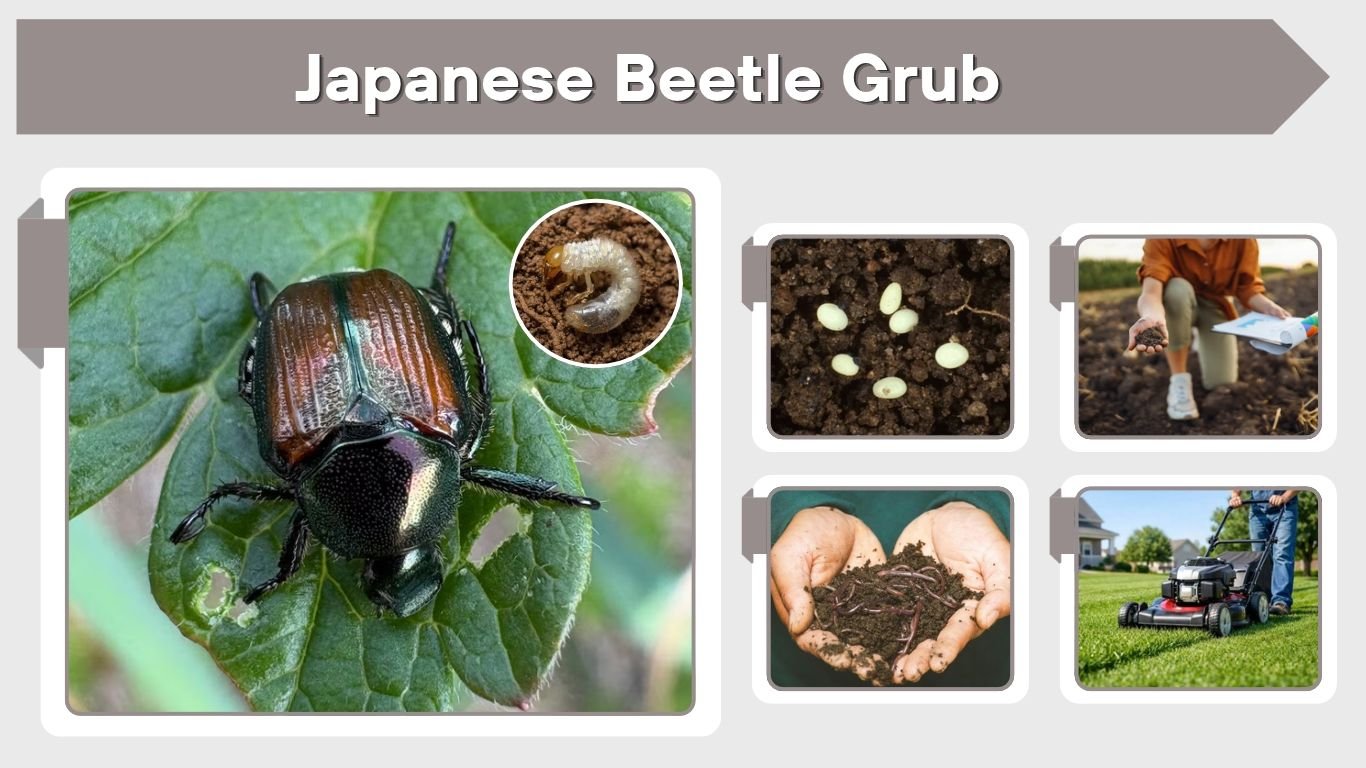
Japanese beetle grubs are common lawn pests that live underground and feed on grass roots, often causing brown patches and weakened turf. These white, C-shaped larvae eventually develop into adult Japanese beetles, which damage leaves, flowers, and garden plants. Identifying grubs early is important because severe infestations can destroy large sections of healthy grass. Fortunately, several natural and chemical control methods can help manage these pests. This guide explains Japanese beetle grub identification, life cycle, lawn damage, beneficial nematodes, milky spore treatments, and the best time for effective grub control.
What Is a Japanese Beetle Grub?
A Japanese beetle grub is the immature larval stage of the Japanese beetle (Popillia japonica). It belongs to the scarab beetle family, Scarabaeidae, and develops underground before becoming an adult beetle.
Japanese beetle grubs primarily feed on grass roots. They are particularly troublesome in lawns, golf courses, parks, and other grassy landscapes.
Do Grubs Turn Into Japanese Beetles?
Yes, Japanese beetle grubs eventually develop into adult Japanese beetles through complete metamorphosis.
However, not every white grub becomes a Japanese beetle. June beetles, masked chafers, and European chafers also produce similar larvae.
Correctly identifying the grub species is important before selecting a treatment.
What Do Japanese Beetle Grubs Look Like?
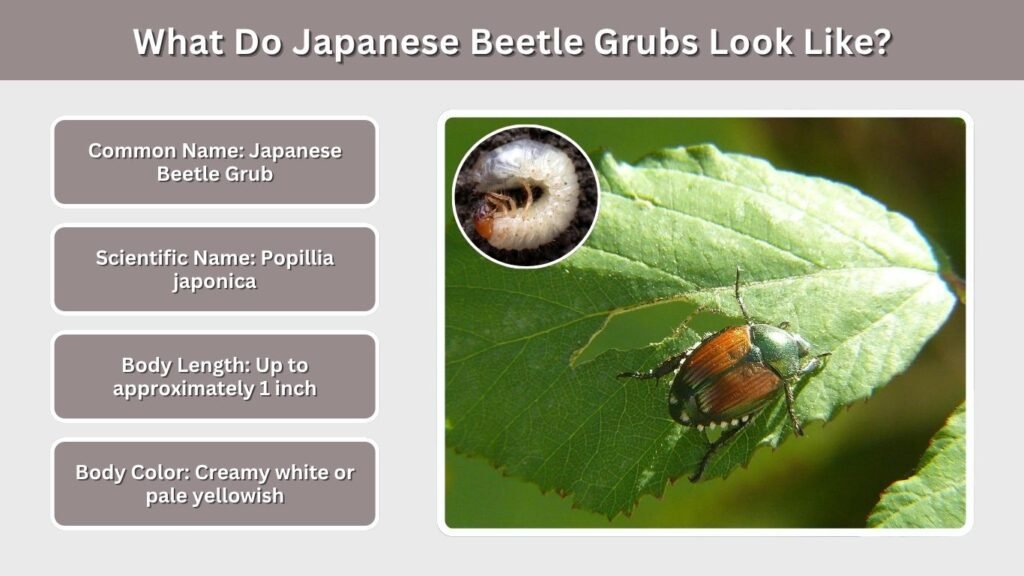
Japanese beetle grubs have soft, creamy-white bodies, brown heads, and six short legs near the front. When disturbed, they curl into a characteristic C shape.
Their appearance is similar to other scarab beetle larvae, but specific identifying features help distinguish them.
Japanese Beetle Grub Identification
- Common Name: Japanese Beetle Grub
- Scientific Name: Popillia japonica
- Family: Scarabaeidae
- Body Length: Up to approximately 1 inch
- Body Color: Creamy white or pale yellowish
- Head Color: Reddish-brown
- Body Shape: Thick, segmented, and C-shaped
- Legs: Six short legs behind the head
- Habitat: Soil beneath lawns and grassy areas
- Raster Pattern: Two short rows of spines forming a V shape
Japanese Beetle Grub Size
Newly hatched Japanese beetle grubs are small and difficult to notice without examining the soil carefully.
As they mature, their bodies become thicker and longer. Fully developed grubs generally measure approximately one inch.
The characteristic V-shaped raster pattern on the underside of the final abdominal segment provides a more reliable identification feature than size alone.
Japanese Beetle Grub vs. June Bug Grub
Japanese beetle grubs and June bug grubs look remarkably similar. Both have white, curved bodies, brown heads, and three pairs of legs.
However, their development and identification patterns differ.
How Can You Tell Them Apart?
Japanese beetle grubs have two short rows of spines forming a V-shaped raster pattern.
Many May and June beetle grubs have longer, nearly parallel rows of spines instead.
Japanese beetles generally complete one generation annually, while some June beetle species require two or three years to finish development.
Japanese Beetle Grub Life Cycle

Japanese beetles undergo four developmental stages: egg, larva, pupa, and adult. Their life cycle generally takes one year in temperate North American climates.
Adult females deposit eggs in soil during summer, especially in grassy areas with sufficient moisture.
When Do Japanese Beetle Grubs Hatch?
Eggs typically hatch within one to two weeks, depending on soil temperature and moisture.
Young grubs begin feeding on grass roots shortly after emerging. They grow through three larval stages before moving deeper underground as temperatures decrease.
During spring, mature grubs return closer to the soil surface, finish development, and pupate.
Do Japanese Beetle Grubs Survive Winter?
Yes, Japanese beetle grubs usually survive winter by moving deeper into the soil.
This behavior protects them from freezing temperatures near the surface.
During warmer spring weather, they move upward again and resume limited feeding before becoming pupae.
Japanese Beetle Grub Damage to Lawns
Japanese beetle grubs damage lawns by feeding on turfgrass roots. Their feeding weakens the grass and reduces its ability to absorb water and nutrients.
Severe infestations can cause extensive lawn deterioration, especially during hot or dry conditions.
Signs of Japanese Beetle Grub Damage
- Brown Patches: Irregular sections of grass become yellow or brown.
- Loose Turf: Damaged grass lifts easily because its roots have been consumed.
- Wilting Grass: Affected areas struggle to recover after watering.
- Visible White Grubs: Cream-colored larvae appear beneath damaged turf.
- Animal Digging: Skunks, raccoons, and birds disturb lawns while searching for grubs.
- Weak Root Growth: Grass becomes thin and develops poorly.
How Do You Check Your Lawn for Grubs?
Use a garden spade to lift approximately one square foot of turf from a suspicious area.
Inspect the soil and grass roots to a depth of several inches. Count the grubs and examine their physical characteristics.
Finding a few grubs does not automatically mean treatment is necessary. Lawn health, grub density, and existing damage should determine whether control measures are justified.
How to Get Rid of Japanese Beetle Grubs Naturally

Natural Japanese beetle grub control methods can reduce infestations without relying entirely on conventional insecticides.
However, effectiveness depends on soil conditions, pest development, and application timing.
Natural Japanese Beetle Grub Control Methods
- Beneficial Nematodes: Apply insect-parasitic nematodes to target young grubs beneath the soil.
- Healthy Lawn Maintenance: Maintain appropriate mowing, fertilization, and irrigation to improve turf resilience.
- Biological Treatments: Consider registered microbial products designed for scarab beetle larvae.
- Summer Water Management: Avoid unnecessary irrigation during egg-laying periods without placing grass under excessive drought stress.
- Regular Soil Inspection: Monitor grub populations before visible lawn damage becomes severe.
Beneficial Nematodes for Japanese Beetle Grubs
Beneficial nematodes are microscopic organisms that infect certain soil-dwelling insects.
Heterorhabditis bacteriophora is commonly used against Japanese beetle grubs.
Apply nematodes when young grubs are present, preferably during cool or cloudy conditions. Moist soil is essential for their survival and movement.
Results can vary significantly depending on application conditions.
Does Milky Spore Kill Japanese Beetle Grubs?
Milky spore is a bacterial disease caused by Paenibacillus popilliae that specifically infects Japanese beetle larvae.
Although commercial milky spore products are marketed for long-term control, modern university research has not consistently demonstrated benefits from their application.
Therefore, milky spore should not be considered a guaranteed solution for lawn infestations.
Best Japanese Beetle Grub Killer and Treatment
Chemical grub control may be appropriate when Japanese beetle populations are high and lawn damage is significant.
Different insecticides work at different developmental stages, making treatment timing especially important.
What Insecticides Kill Japanese Beetle Grubs?
Chlorantraniliprole is commonly used as a preventive treatment against developing grubs.
Trichlorfon can provide curative control when actively feeding grubs are present.
Other registered products may contain imidacloprid or clothianidin, although these chemicals can pose risks to pollinators.
Always check local regulations and follow product labels carefully.
When to Apply Japanese Beetle Grub Control
The best treatment period depends on whether you are preventing an infestation or controlling grubs already feeding beneath the lawn.
Small grubs are generally easier to manage than mature larvae.
Preventive vs. Curative Grub Treatment
Preventive treatments are commonly applied during late spring or early summer, before or around the beginning of egg-laying activity.
Curative treatments are generally most effective in late summer or early autumn, when newly hatched grubs remain near the soil surface.
Spring treatment is usually less effective because mature grubs are harder to control and will soon pupate.
How to Prevent Japanese Beetle Grubs in Lawns

Long-term grub prevention requires healthy turfgrass, regular monitoring, and appropriate pest management decisions.
Maintaining suitable soil conditions allows grass to tolerate limited feeding without serious damage.
Lawn Prevention Tips
Keep grass at the recommended mowing height for your turf species and avoid excessive fertilization.
Inspect areas with a history of grub damage during late summer.
Use preventive insecticides only when previous infestations or monitoring indicate a meaningful risk.
Remember that controlling lawn grubs does not necessarily prevent adult Japanese beetles from flying into your garden from surrounding areas.
FAQs
1. Do All Grubs Turn Into Japanese Beetles?
No, not all white grubs become Japanese beetles. June beetles, masked chafers, and several other scarab beetles also produce similar larvae. Identifying the raster pattern and other physical features helps distinguish Japanese beetle grubs from related species.
2. What Is the Best Time to Kill Japanese Beetle Grubs?
Late summer is generally the most effective period for curative treatment because young grubs are actively feeding near the surface. Preventive treatments are usually applied earlier. Exact timing depends on climate, insect development, and the product selected.
3. Do Beneficial Nematodes Kill Japanese Beetle Grubs?
Yes, beneficial nematodes such as Heterorhabditis bacteriophora can infect and kill Japanese beetle grubs. They perform best in moist soil when larvae are actively feeding. However, field results vary, so they do not guarantee complete infestation control.
4. Does Neem Oil Kill Japanese Beetle Grubs?
Neem-based products may affect some insects, but ordinary neem oil sprays are not a well-established, reliable treatment for Japanese beetle grubs underground. Products intended for adult beetles should not be assumed effective against soil-dwelling larvae.
5. How Many Japanese Beetle Grubs Are Too Many?
Treatment thresholds vary with grass species, growing conditions, and grub size. Approximately five to ten grubs per square foot may justify treatment in some lawns, especially when damage is visible. Healthy turf can sometimes tolerate higher populations.