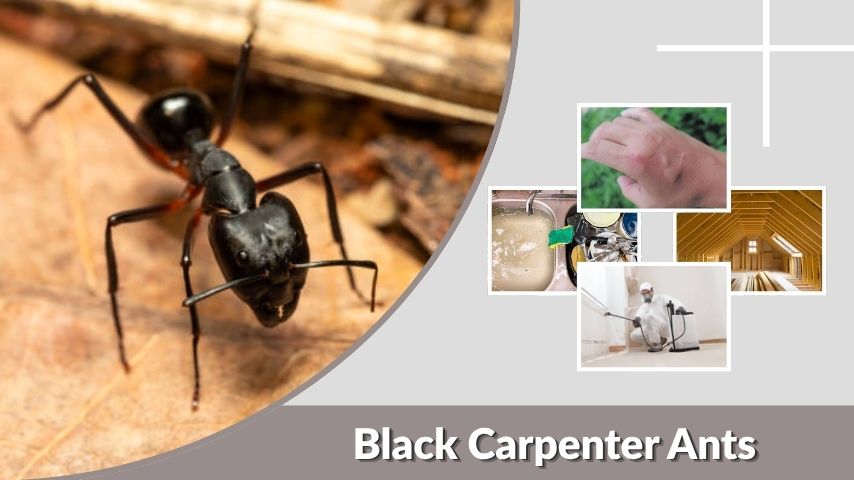
Black carpenter ants are large dark ants that often worry homeowners because they can tunnel through wood to build nests. They do not eat wood like termites, but their nesting activity can still damage damp or weakened wooden areas over time. These ants may appear in kitchens, bathrooms, basements, wall voids, window frames, or around outdoor wood. Learning how to identify black carpenter ants, where they nest, and how to control them can help protect your home from hidden damage.
What Is a Black Carpenter Ant?
Black carpenter ants are carpenter ants in the genus Camponotus. The best-known black carpenter ant in many parts of North America is Camponotus pennsylvanicus. It is usually large, dark, and often connected with wood, moisture, and hidden nesting areas. Ohio State University lists the black carpenter ant as Camponotus pennsylvanicus and notes that carpenter ants are among the largest ants found in the United States.
Identification
- Usually black or very dark brown
- Large compared with many common house ants
- Has elbowed antennae
- Has a narrow, pinched waist
- Has one node between the thorax and abdomen
- Thorax looks evenly rounded from the side
- Workers in the same colony may be different sizes
- Winged ants may appear when a colony is mature
- Often associated with damp, decayed, or damaged wood
Black Carpenter Ant Size
Black carpenter ants are usually bigger than little black ants, pavement ants, and many other household ants. Rutgers states that black carpenter ant workers commonly range from 6 to 13 mm, or about 1/4 to 5/8 inch, and that colonies can include major, media, and minor workers.
| Ant Type | Common Size | Main Clue |
| Little black ant | About 1/16 inch | Tiny, shiny, often trails to food |
| Regular house ant | Small to medium | Usually a nuisance pest |
| Black carpenter ant worker | About 1/4–5/8 inch | Large, may vary in size |
| Black carpenter ant queen | Larger than workers | May shed wings after mating |
Scientific Name and Color
The common black carpenter ant is Camponotus pennsylvanicus. It is mostly black, but carpenter ants as a group are not always black. Depending on the species, they may be black, red, brown, tan, yellow, or mixed-color. Ohio State University notes that the black carpenter ant has very fine whitish or yellowish hairs on the abdomen.
Black Carpenter Ants vs Regular Black Ants
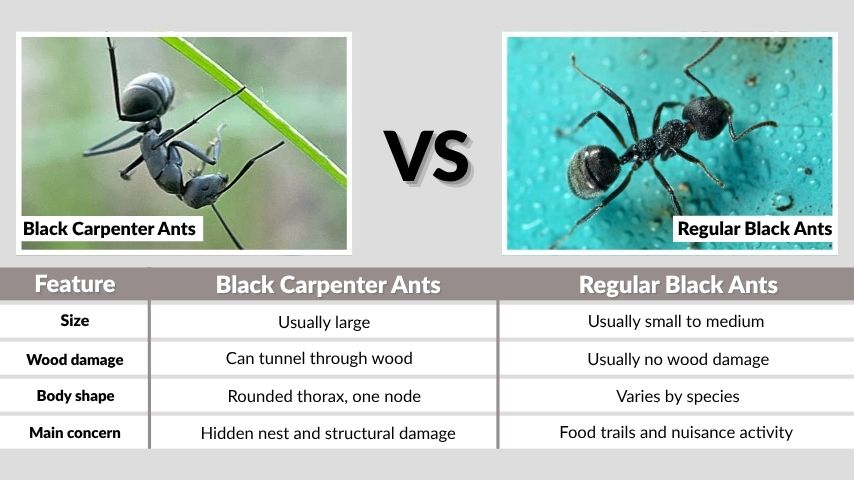
Many people call any dark ant a “black ant,” but that can be misleading. Some black ants are small nuisance ants that enter homes for crumbs, sweets, grease, or water. Black carpenter ants are more concerning because they may nest in wood and signal moisture problems.
Quick Comparison
| Feature | Black Carpenter Ants | Regular Black Ants |
| Size | Usually large | Usually small to medium |
| Wood damage | Can tunnel through wood | Usually no wood damage |
| Body shape | Rounded thorax, one node | Varies by species |
| Main concern | Hidden nest and structural damage | Food trails and nuisance activity |
| Common signs | Frass, hollow wood, winged ants | Kitchen trails, small ants near food |
| Treatment | Find nest and fix moisture | Sanitation and baiting |
Are All Big Black Ants Carpenter Ants?
No, all big black ants are not carpenter ants. Some field ants and other large ants may also be dark-colored. Ohio State University warns that large black field ants can be mistaken for carpenter ants, but their body structure and management are different.
Are Tiny Black Ants Carpenter Ants?
Tiny black ants are usually not carpenter ants. If the ants are very small and mostly found around sugar, grease, crumbs, or pet food, they may be little black ants or another nuisance ant species. Carpenter ants are usually larger and more closely linked with damp wood, frass, or repeated indoor sightings.
Where Do Black Carpenter Ants Live?
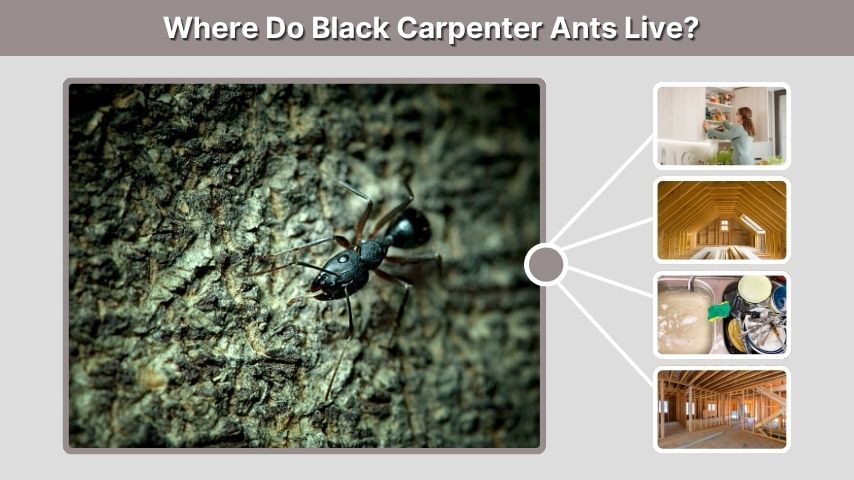
Black carpenter ants can nest outdoors or indoors. Outdoor nests are often in decaying trees, stumps, logs, roots, fence posts, landscape timbers, or other wood. Indoors, they may nest in damp or decayed wood near leaks, condensation, poor ventilation, or structural gaps.
Common Indoor Nesting Spots
- Window frames
- Door frames
- Wall voids
- Bathroom walls
- Kitchen cabinets
- Around sinks and dishwashers
- Attic beams
- Basement wood
- Crawl spaces
- Hollow doors
- Foam insulation
- Areas near plumbing or roof leaks
The University of Minnesota Extension says carpenter ants may nest in moist or decayed wood caused by leaks, condensation, or poor air circulation, and common sites include bathroom areas, dishwashers, attic beams, subfloor spaces, hollow doors, and wall voids.
Parent Nests and Satellite Nests
Carpenter ants may have a parent nest and one or more satellite nests. The parent nest usually needs more moisture because it contains the queen, eggs, and young larvae. Satellite nests may be found in drier places such as wall voids, insulation, hollow doors, or sound wood. This is one reason carpenter ant problems can be hard to solve without finding the actual nesting sites.
Why Moisture Matters
Damp or rotting wood is especially attractive because it is easier for carpenter ants to tunnel through. University of Maryland Extension explains that damp or rotting wood attracts carpenter ants because softer fibers make tunneling easier, and carpenter ant galleries are clean and smooth compared with termite galleries.
Signs of Black Carpenter Ants in the House
Seeing one large black ant does not always mean you have an infestation. However, repeated sightings, especially indoors, should be checked carefully. Carpenter ants may forage at night, so the problem is sometimes missed during the day.
Common Warning Signs
- Large black ants indoors
- Ant trails at night
- Sawdust-like frass near wood
- Winged black ants inside
- Shed wings near windows
- Rustling sounds inside walls
- Hollow-sounding wood
- Small openings in wood
- Moist or rotting wood nearby
- Repeated ants near sinks, bathrooms, or windows
The University of Minnesota Extension lists coarse sawdust, repeated sightings of many workers, and large numbers of winged ants indoors as signs that a carpenter ant nest may be present. It also notes that an active colony may make a dry rustling sound.
What Does Carpenter Ant Frass Look Like?
Frass looks like coarse sawdust or wood shavings. It may appear near baseboards, window frames, door frames, beams, or wall openings. Carpenter ants push this material out as they clean and expand their galleries. Rutgers notes that carpenter ant damage often includes clean tunnels and piles of dust near the nest site.
Are Winged Black Carpenter Ants a Bad Sign?
Winged black carpenter ants are reproductive ants, also called swarmers. Finding many winged carpenter ants indoors can suggest a nest in the structure. Texas A&M AgriLife Extension says the presence of winged ants indoors generally means a nest is located in the structure.
Do Black Carpenter Ants Bite or Sting?
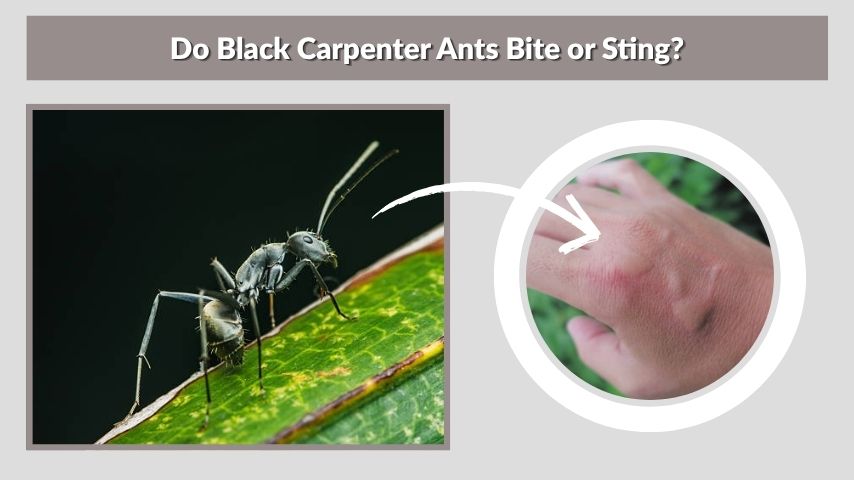
Black carpenter ants can bite, but they do not sting. Their jaws can pinch the skin if they are handled or disturbed. Ohio State University notes that carpenter ant workers can bite readily if handled and may inject formic acid into the wound, but they do not sting.
A bite may cause temporary pain, redness, or a burning feeling. For most people, it is not medically serious. Wash the area with soap and water and avoid scratching. Medical advice may be needed if swelling, infection, or allergic symptoms develop.
Do Black Carpenter Ants Damage Wood?
Black carpenter ants can damage wood by excavating tunnels and galleries for nesting. They do not eat the wood. Instead, they remove wood particles and push debris out of the nest. Over time, a large or long-lasting colony can weaken wooden areas.
Carpenter Ant Damage vs Termite Damage
| Feature | Black Carpenter Ants | Termites |
| Wood behavior | Tunnel through wood | Eat wood |
| Galleries | Clean and smooth | Often muddy or rough |
| Debris | May leave frass | May leave mud tubes or pellets |
| Body shape | Narrow waist, elbowed antennae | Broad waist, straight antennae |
| Wing shape | Front wings longer than hind wings | Wings usually equal length |
North Carolina State Extension explains that carpenter ants are generally less damaging than termites, but ignored carpenter ant problems can still lead to significant wood damage.
What Do Black Carpenter Ants Eat?
Black carpenter ants eat protein and sugar-based foods. Outdoors, they feed on insects and honeydew from aphids and scale insects. Indoors, they may feed on meat, pet food, syrup, honey, sugar, jelly, and other sweets. The University of Minnesota Extension also notes that carpenter ants search for food between sunset and midnight during spring and summer.
This diet is why carpenter ants may appear in kitchens even when the nest is somewhere else. Seeing them near food does not prove the nest is in the kitchen, but it can help you track their trail back toward a wall gap, window frame, crawl space, or outdoor source.
How to Get Rid of Black Carpenter Ants
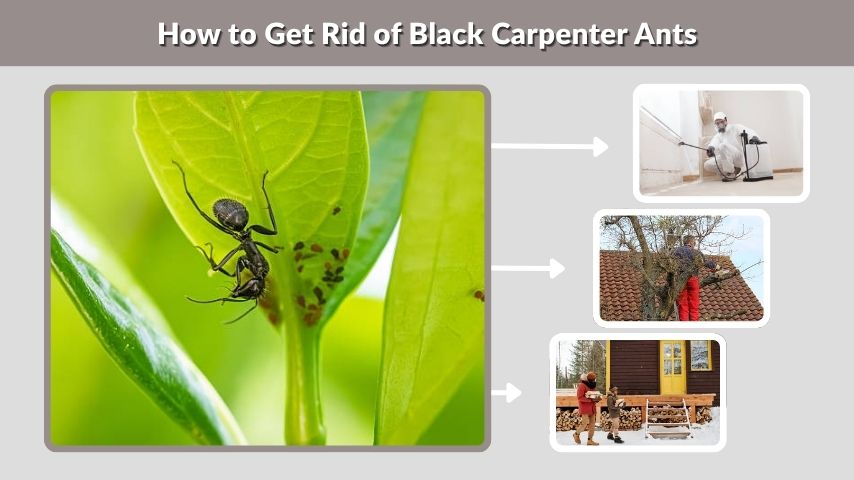
Getting rid of black carpenter ants requires targeting the colony, not just the visible ants. Spraying workers on a counter or wall may kill a few ants, but the hidden nest can continue producing more workers.
Step-by-Step Control
- Identify the ants correctly.
- Watch ant trails at night with a flashlight.
- Look for frass near wood, windows, trim, and baseboards.
- Check damp areas near sinks, tubs, dishwashers, basements, and crawl spaces.
- Repair roof leaks, plumbing leaks, condensation, and drainage problems.
- Replace rotting or badly damaged wood.
- Seal cracks around doors, windows, foundations, pipes, and vents.
- Trim branches and shrubs away from the house.
- Move firewood and rotting logs away from the foundation.
- Use carpenter ant bait where ants are actively foraging.
- Call pest control if the nest is hidden or activity continues.
The University of Minnesota Extension says the best control method is to locate and destroy the nest, replace damaged or decayed wood, and eliminate moisture problems. It also notes that spraying foraging workers is not effective because it does not eliminate the hidden nest.
What Kills Black Carpenter Ants?
Carpenter ant baits, dusts, liquid treatments, and professional nest treatments can kill black carpenter ants, but the treatment must reach the colony. Baits can work because ants carry food back to the nest, but carpenter ants may be selective, so bait placement and timing matter.
When to Call a Professional
Call a pest professional if you see winged ants indoors, repeated large black ants, frass, hollow wood, or rustling sounds in walls. Carpenter ant nests are often hidden in wall voids, ceilings, subfloors, attics, hollow doors, or outdoor parent colonies. Professional inspection is also helpful when moisture damage is involved.
FAQs
Are black carpenter ants dangerous?
Black carpenter ants are not usually dangerous to people, but they can be dangerous to a house if they nest in wood. Their bites may hurt, but the bigger concern is hidden wood damage and moisture problems.
Are all black ants carpenter ants?
No. Many ants are black, including little black ants, pavement ants, field ants, and odorous house ants. Carpenter ants are usually larger and may be linked with frass, damp wood, hollow sounds, or winged ants indoors.
Do black carpenter ants have wings?
Only reproductive black carpenter ants have wings. Worker ants do not. Large numbers of winged carpenter ants indoors can suggest a mature nest inside the structure or very close to the home.
Do black carpenter ants eat wood?
No. Black carpenter ants do not eat wood like termites. They chew and remove wood to create nesting galleries. Their food includes insects, honeydew, sweets, meats, pet food, and other protein or sugar sources.
How do you get rid of black carpenter ants permanently?
The best long-term control is to find the nest, fix moisture problems, replace damaged wood, seal entry points, remove outdoor wood sources, and use targeted bait or professional treatment. Killing only visible ants usually does not solve the colony.