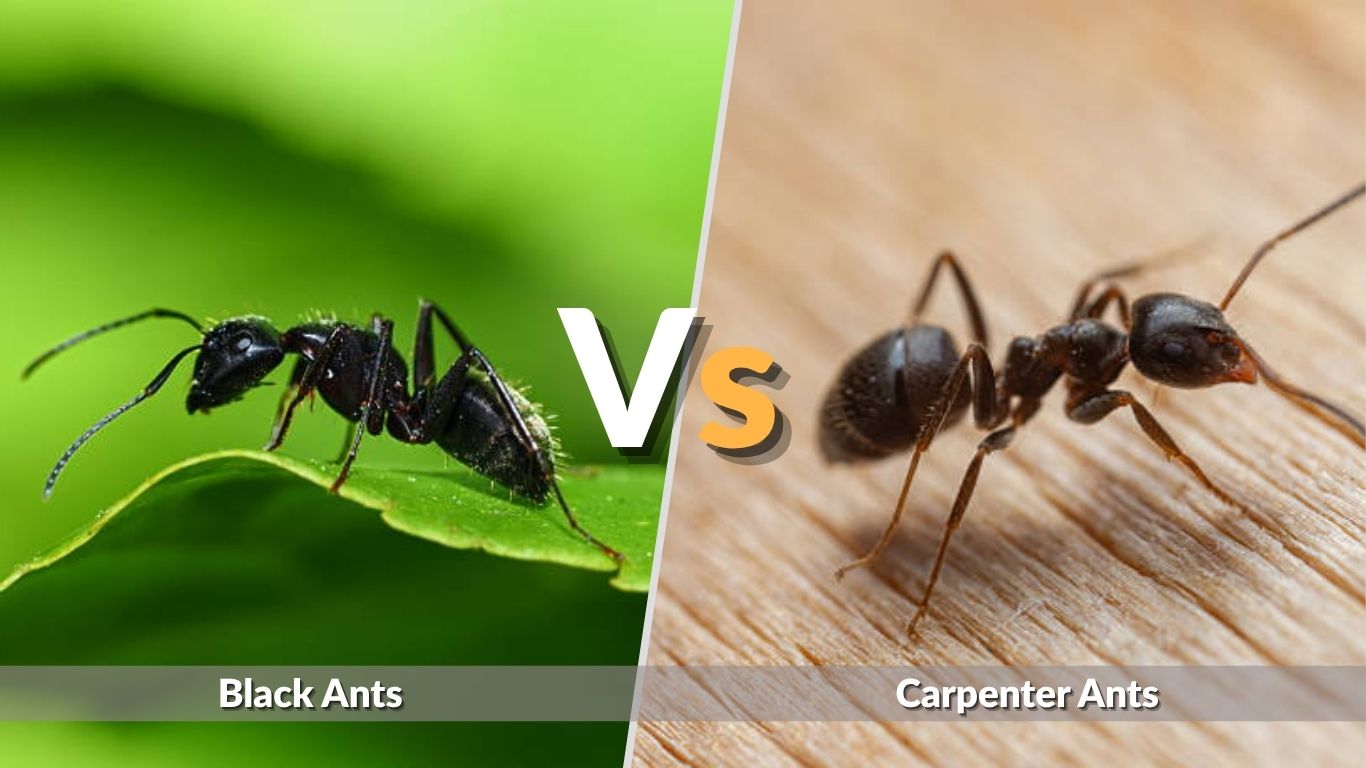
Black ants and carpenter ants can look similar at first, especially when both are dark-colored and found inside a home. However, they are not always the same problem. “Black ant” is a broad description that may include little black ants, odorous house ants, pavement ants, or even black carpenter ants. Carpenter ants are more concerning because they tunnel through wood to build nests. Knowing the difference helps you choose the right treatment and avoid hidden home damage.
Black Ants vs Carpenter Ants: Quick Comparison
Black ants are usually smaller nuisance ants, while carpenter ants are larger ants that may nest in wood. Color alone is not enough for identification because many ant species can be black or dark brown. The University of Minnesota Extension notes that ant color can help, but it is not definitive, and worker ants can range widely in size.
Main Difference at a Glance
| Feature | Black Ants | Carpenter Ants |
| Meaning | General name for small dark ants | Specific group of wood-nesting ants |
| Size | Often tiny to medium | Usually large, but sizes vary |
| Color | Black or dark brown | Black, reddish-black, brown, or red-black |
| Wood damage | Usually no wood tunneling | Can tunnel through wood |
| Main problem | Food trails and nuisance activity | Possible hidden nest and structural concern |
| Common signs | Trails, crumbs, kitchen activity | Frass, hollow wood, winged ants, wall sounds |
| Treatment focus | Sanitation and baiting | Locate nest, fix moisture, treat colony |
Are Carpenter Ants Just Big Black Ants?
Some carpenter ants are big black ants, but not every big black ant is a carpenter ant. The common black carpenter ant can be dull black and have workers of different sizes, but other dark ants may also appear large to homeowners. The Illinois Department of Public Health notes that black carpenter ant workers vary in size and can be up to ¾ inch long.
Why the Confusion Happens
The confusion happens because people often identify ants by color only. If an ant is black and large, many homeowners assume it is a carpenter ant. If it is tiny and black, they may call it a black ant. In reality, identification depends on size, body shape, nesting habits, trails, winged swarmers, frass, and where the ants are appearing.
Carpenter Ant vs Black Ant Size
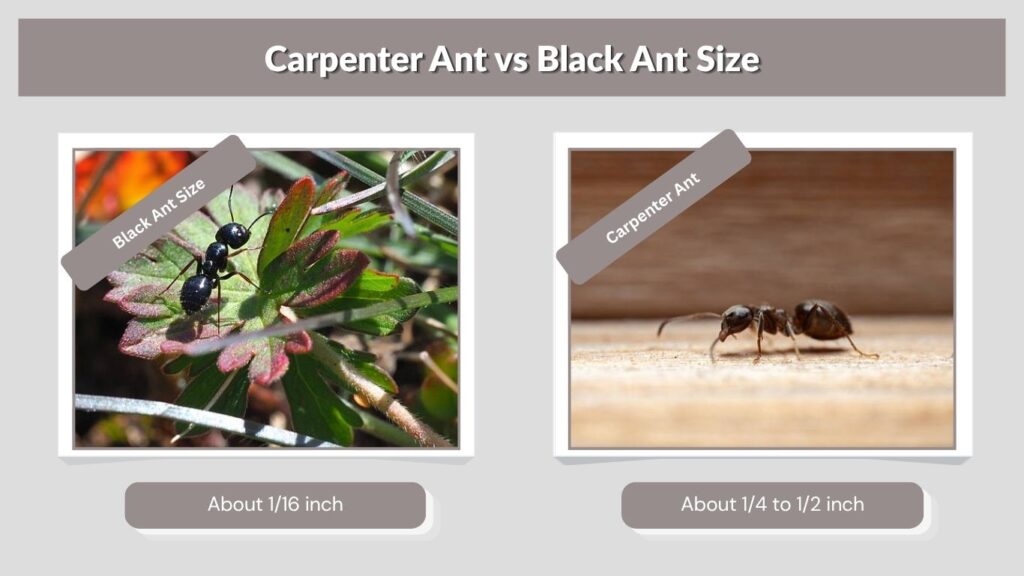
Size is one of the easiest clues, but it should not be the only clue. Carpenter ants are usually larger than common household black ants, yet carpenter ant workers from the same colony can vary in size.
Size Comparison Table
| Ant Type | Common Worker Size | What It Means |
| Little black ant | About 1/16 inch | Very small, shiny black nuisance ant |
| Odorous house ant | About 1/16 to 1/8 inch | Small dark ant; smells when crushed |
| Pavement ant | Small to medium | Often nests near pavement, slabs, and foundations |
| Carpenter ant | About 1/4 to 1/2 inch, sometimes larger | Larger ant that may nest in wood |
Texas A&M says little black ant workers are about 1/16 inch long and shiny black. Harvard Extension material says carpenter ant workers from one colony may range from about 1/4 inch to 1/2 inch, while queens may be larger.
Why Size Alone Can Mislead You
Size alone can mislead you because carpenter ants are polymorphic, meaning workers in one colony can be different sizes. The University of Georgia Extension notes that ants from a single carpenter ant colony vary considerably, so size alone should not be used for identification.
Little Black Ant vs Carpenter Ant
A little black ant is much smaller than a carpenter ant. Little black ants often trail to sweets, grease, crumbs, pet food, and outdoor honeydew. Carpenter ants can also forage for food, but the bigger concern is whether they are nesting in damp or damaged wood. If the ants are tiny and forming kitchen trails, they may be nuisance black ants. If they are large and connected with frass or wood damage, carpenter ants are more likely.
How to Identify Carpenter Ants vs Black Ants
Identification should include body size, body shape, behavior, nesting place, and damage signs. A phone close-up or magnifying glass can help, but you may need an extension office or pest professional if the problem is serious.
Identification Clues
- Carpenter ants are usually larger than common small black ants.
- Carpenter ants may be black, reddish-black, brown, or red-black, not only black.
- Little black ants are tiny and shiny black, often around 1/16 inch.
- Odorous house ants are dark brown to black and smell bad when crushed.
- Carpenter ants may appear near wood, moisture, windows, walls, or crawl spaces.
- Small black ants often appear in kitchens, near sweets, crumbs, grease, or water.
- Carpenter ant workers can vary in size, while some small black ant species are more uniform in size.
- Frass near wood is a stronger carpenter ant clue than color alone.
Wisconsin Extension describes odorous house ants as dark brown to black and about 1/8 inch long, with a smell like rotten coconut or blue cheese when crushed. Texas A&M also explains that worker size and whether ants are uniform or variable in size are useful features for household ant identification.
Body Shape and Color
Carpenter ants often have a larger, more robust body with a smooth, rounded thorax when viewed from the side. Many small black ants look more compact and delicate. But color is not reliable by itself. A carpenter ant can be black, reddish, or dark brown, while nuisance ants can also be black.
Winged Black Ants vs Carpenter Ants
Winged black ants can be reproductive ants from several species, including carpenter ants. Winged carpenter ants are especially concerned indoors because they may indicate a mature colony nearby. Ohio State University Extension notes that winged ants can be confused with winged termites, but ants have elbowed antennae, a constricted waist, and front wings larger than hind wings.
Damage: Do Black Ants or Carpenter Ants Harm Wood?
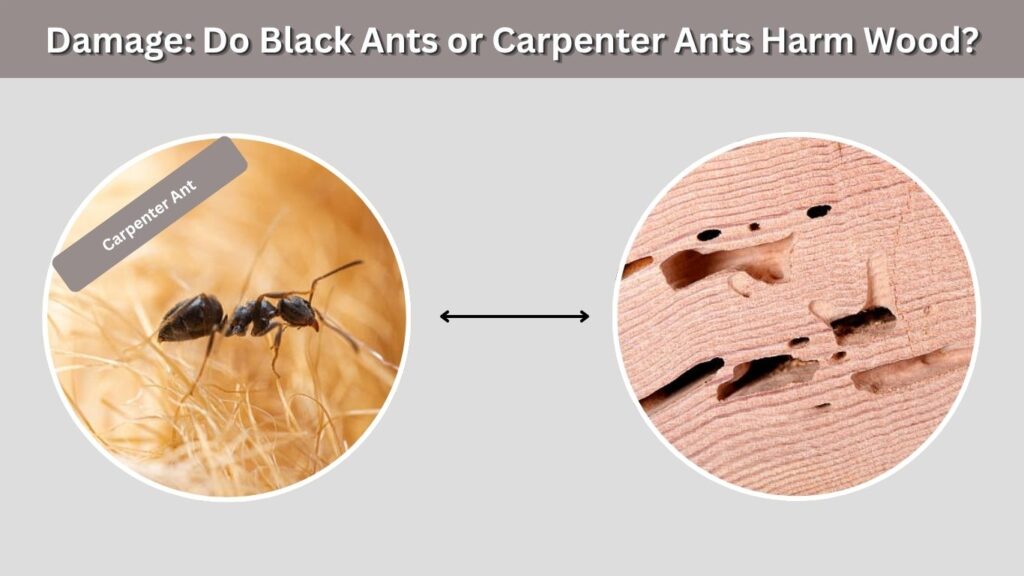
This is the most important difference for homeowners. Most small black ants are nuisance pests. Carpenter ants can damage wood because they excavate galleries for nesting.
Damage Comparison
| Sign | Black Ants | Carpenter Ants |
| Sawdust-like frass | Usually no | Common warning sign |
| Smooth tunnels in wood | No | Yes |
| Hollow-sounding wood | No | Possible |
| Winged ants indoors | Possible, but depends on species | Strong warning sign if repeated |
| Moisture-damaged wood nearby | May attract many ants | Very important carpenter ant clue |
| Structural concern | Usually low | Can increase over time |
The University of Minnesota Extension explains that carpenter ants damage wood by excavating galleries and tunnels for their nests; the damage is variable, but severe damage can weaken structural wood over time. North Carolina State Extension says carpenter ant-damaged wood may have slit-like openings where ants expel sawdust and frass, and their galleries often have smooth walls.
Do Carpenter Ants Eat Wood?
No, carpenter ants do not eat wood. They chew through wood and remove it to create nest space. This is why frass may appear below openings in wood. Ordinary small black ants usually do not create this type of wood debris.
Are Small Black Ants Dangerous to the House?
Most small black ants are more of a food and sanitation nuisance than a structural threat. They may enter for sweets, grease, crumbs, water, or shelter. They can be annoying in kitchens and bathrooms, but they usually do not tunnel through wood like carpenter ants.
Why Ants Are in Your House
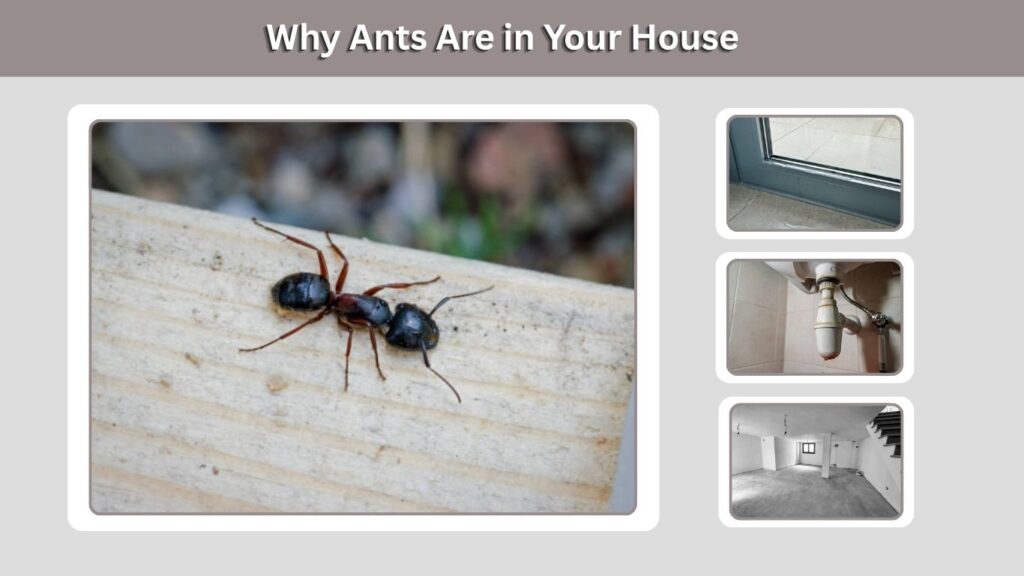
Both black ants and carpenter ants may enter homes for food and water. The difference is that carpenter ants may also be connected to a hidden moisture or wood problem.
What Attracts Black Ants Indoors?
Small black ants often come inside for easy food and water. Common attractants include sugar, syrup, fruit juice, crumbs, grease, pet food, trash, and leaking water. Odorous house ants and little black ants may form long trails along counters, baseboards, sinks, and windows.
What Attracts Carpenter Ants Indoors?
Carpenter ants are strongly associated with damp, decaying, or moisture-damaged wood. They may nest near leaking windows, roof leaks, plumbing leaks, crawl spaces, basements, decks, porches, or wall voids. Illinois public health guidance notes that carpenter ant satellite nests are often established in wood where moisture problems exist, such as near leaking pipes, poorly sealed window frames, and roof leaks.
Indoor Ant Clues by Location
| Where You See Ants | More Likely Meaning |
| Kitchen counter | Food-foraging black ants or carpenter ants |
| Bathroom sink | Moisture attraction |
| Window frame | Possible entry point or damaged wood |
| Basement beam | Possible carpenter ant nesting area |
| Near pet food | Food-foraging ants |
| Around rotting trim | Carpenter ants more likely |
| Near sawdust-like debris | Carpenter ants more likely |
How to Get Rid of Black Ants vs Carpenter Ants
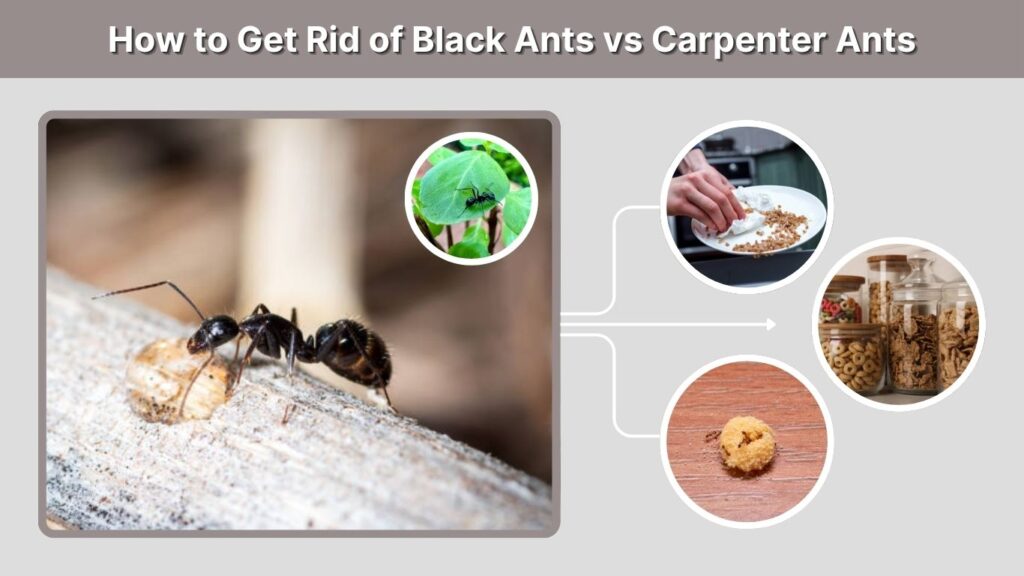
Treatment depends on the ant type. If you treat carpenter ants like ordinary sugar ants, you may miss the hidden nest. If you treat small black ants like carpenter ants, you may overreact to a nuisance problem.
For Small Black Ants
- Clean crumbs, grease, and spills quickly.
- Store sugar, cereal, pet food, and snacks in sealed containers.
- Empty trash regularly.
- Wipe ant trails to remove scent paths.
- Seal cracks around windows, doors, and pipes.
- Use ant bait near active trails.
- Avoid spraying directly on bait trails because ants may stop feeding on bait.
For Carpenter Ants
- Look for frass, hollow wood, moisture damage, and ant trails at night.
- Inspect windows, doors, bathrooms, kitchens, crawl spaces, and basements.
- Fix roof leaks, plumbing leaks, condensation, and drainage problems.
- Replace soft, rotting, or badly damaged wood.
- Use bait only where carpenter ants are actively foraging.
- Consider dust or direct nest treatment if the nest is located.
- Call pest control if winged ants, frass, or repeated large ants appear indoors.
The University of Minnesota Extension recommends locating and destroying the carpenter ant nest, replacing damaged or decayed wood, and eliminating moisture problems.
When Should You Worry?
You should worry more when the ants are large, repeated, and connected with wood or moisture. A few tiny black ants in the kitchen may be a nuisance. Large ants appearing from a wall, window frame, or damp wooden area may be a bigger warning sign.
Red Flags for Carpenter Ants
- Large black or reddish-black ants indoors repeatedly
- Sawdust-like frass under trim, beams, or window frames
- Winged ants inside the house
- Hollow-sounding wood
- Rustling sounds in walls
- Moist or rotting wood nearby
- Ants appearing in winter from inside the structure
- Small holes or slit-like openings in wood
When to Call a Professional
Call a professional if you find frass, winged ants indoors, repeated large ants, or suspected activity inside walls. Carpenter ant colonies can be hard to locate, and killing only visible ants may not remove the nest. A professional can identify the species, find moisture sources, and target the colony more accurately.
FAQs
Are black ants and carpenter ants the same?
Not always. “Black ants” is a general name for many dark ants, including little black ants, odorous house ants, pavement ants, and sometimes black carpenter ants. Carpenter ants are a specific type of ant that can tunnel through wood to build nests.
How can I tell a carpenter ant from a black ant?
Carpenter ants are usually larger and may appear near wood, moisture, frass, or hollow-sounding areas. Small black ants are usually much smaller and often trail to food or water. Color alone is not enough to identify them.
Are big black ants always carpenter ants?
No. Many carpenter ants are big and black, but not every big black ant is a carpenter ant. Look for other clues such as sawdust-like frass, damaged wood, winged ants indoors, and repeated activity near damp wooden areas.
Do black ants damage wood like carpenter ants?
Most small black ants do not damage wood. Carpenter ants can damage wood by excavating galleries for nesting. They do not eat wood, but their tunneling can weaken wood over time if the colony remains active.
Which is worse, black ants or carpenter ants?
Carpenter ants are usually worse for a house because they may indicate moisture damage and can tunnel through wood. Small black ants are usually more of a nuisance around food, water, and kitchen areas.