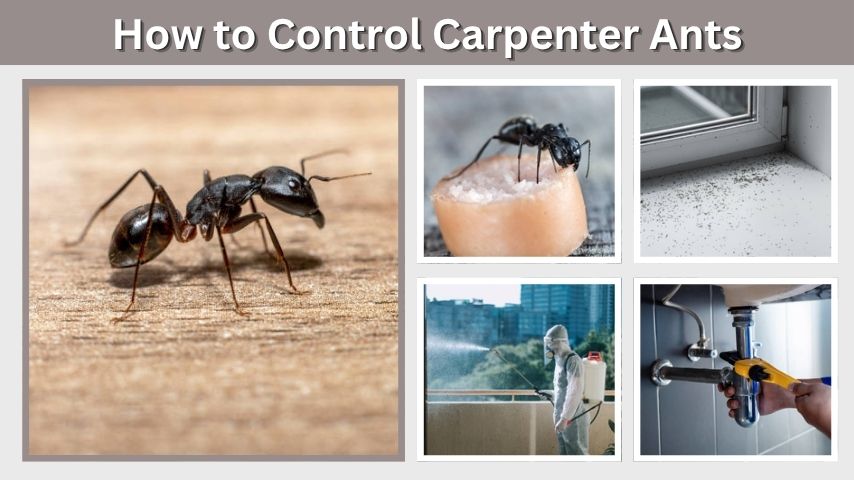
Carpenter ants can be hard to control because the real problem is often hidden. The ants you see on counters, walls, trees, or firewood may only be workers, while the main nest may be inside damp wood, wall voids, insulation, logs, stumps, or outdoor structures. Unlike termites, carpenter ants do not eat wood, but they excavate it to build nesting galleries. The best control plan is to identify the ants, find the nest, fix moisture problems, treat the colony, and prevent new ants from moving in.
Step 1: Confirm That You Have Carpenter Ants
Before using any treatment, make sure the ants are actually carpenter ants. Many black ants look similar, but not all of them damage wood. Misidentifying the pest can lead to the wrong control method and wasted time.
Identification
- Carpenter ants are usually larger than many common household ants.
- They may be black, reddish-black, brown, red, or mixed-color.
- They have elbowed antennae and a narrow waist.
- Workers in the same colony may be different sizes.
- Winged carpenter ants have front wings longer than the back wings.
- They may appear near wood, moisture, walls, windows, or crawl spaces.
- They may leave sawdust-like frass near nesting areas.
- They do not make mud tubes like subterranean termites.
Carpenter ants excavate wood to make nests, while termites eat wood. The University of Minnesota Extension says the best way to control carpenter ants is to locate and destroy the nest, replace damaged or decayed wood, and eliminate moisture problems.
Carpenter Ants vs Termites
| Feature | Carpenter Ants | Termites |
| Wood behavior | Tunnel through wood | Eat wood |
| Body shape | Narrow waist | Broad waist |
| Antennae | Elbowed | Straight |
| Wings | Front wings longer than rear wings | Wings usually equal length |
| Debris | Sawdust-like frass | Mud tubes or pellets, depending on species |
| Galleries | Smooth and clean | Often muddy or rough |
Step 2: Inspect the House for Activity
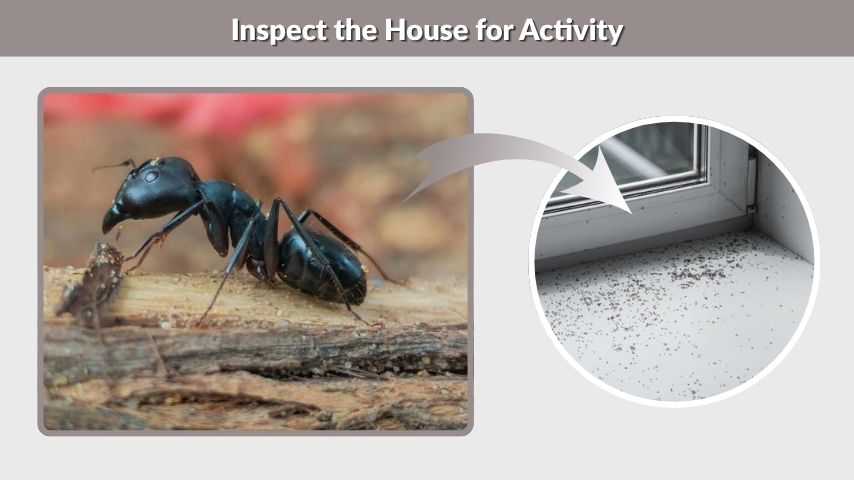
After identification, inspect the home carefully. Carpenter ants are often most active at night, so a daytime inspection may miss them. Use a flashlight after dark and watch where the ants travel.
Common Indoor Signs
- Large ants indoors, especially at night
- Ant trails along baseboards, counters, pipes, or walls
- Sawdust-like frass under trim, beams, or window frames
- Winged ants inside the house
- Shed wings near windows or lights
- Rustling sounds inside walls or wood
- Hollow-sounding wood
- Moist, soft, or rotting wooden areas
- Ants coming from cracks, outlets, cabinets, or wall gaps
An active carpenter ant colony may make a dry rustling sound, and tapping a suspected area can sometimes make the sound easier to hear. Pest professionals may even use listening tools to locate hidden nests.
Where to Check First
Focus on wet or damaged areas first. Check under sinks, around dishwashers, behind toilets, near tubs, around window frames, in basements, crawl spaces, attics, decks, porches, and near roof leaks. Carpenter ant problems are often associated with moisture, and damp wood is easier for them to tunnel through.
Step 3: Find the Nest
Finding the nest is the most important step in carpenter ant control. Killing visible ants may reduce activity for a short time, but it usually does not remove the colony.
Track Ant Trails at Night
Carpenter ants often forage after dark. Place a small amount of honey or sugar water near active areas and wait. When ants feed, follow them as they travel away from the food. North Carolina State Extension recommends using honey mixed with water outdoors to help track carpenter ants back toward the nest, and notes that nests may be nearby or as far as 300 feet away from foraging ants.
Do not disturb the trail too early. Watch where the ants disappear. They may enter a crack near a window, a gap near a pipe, a baseboard opening, a deck board, a tree cavity, or a foundation gap.
Indoor vs Outdoor Nest Clues
| Clue | What It May Mean |
| Ants seen near food only | Outdoor nest may be foraging indoors |
| Frass near wood | Nest may be nearby |
| Winged ants indoors | Mature indoor or nearby nest possible |
| Ants in winter | Indoor nest more likely |
| Trails from shrubs or tree branches | Outdoor colony may be entering home |
| Ants near damp wood | Moisture-related nesting area likely |
Step 4: Fix Moisture Problems
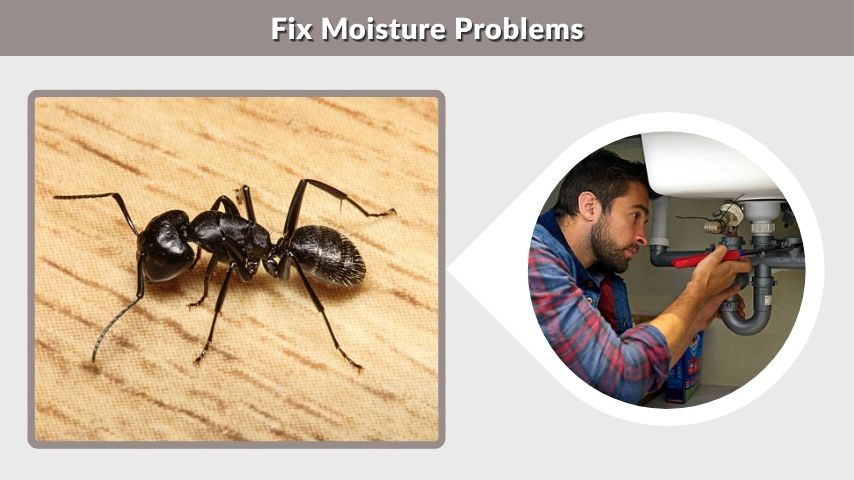
Moisture repair is one of the most important parts of carpenter ant control. If you kill the ants but leave damp wood, leaks, and rot in place, new ants may return later.
Moisture Problems to Fix
- Leaky plumbing under sinks
- Roof leaks
- Clogged gutters
- Wet crawl spaces
- Poor attic ventilation
- Condensation around windows
- Damaged caulking
- Leaking dishwashers
- Rotting deck boards
- Soil-to-wood contact
- Mulch piled against siding
Carpenter ants prefer damp or rotting wood because softer fibers make tunneling easier, and their excavated galleries are usually clean and smooth compared with termite damage.
Replace Damaged Wood
Soft, rotten, or hollow wood should be repaired or replaced after the colony is controlled. Do not just paint over damaged wood. Painting may hide the problem, but it will not remove the nest, moisture source, or structural weakness.
Step 5: Control Carpenter Ants Inside the House
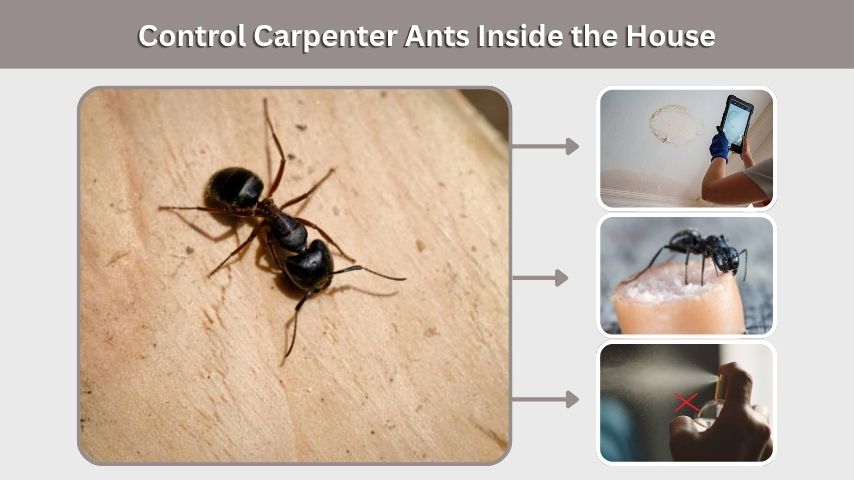
Indoor control should focus on the nest, not just the visible ants. Carpenter ants may hide in wall voids, hollow doors, insulation, window frames, subfloors, ceiling spaces, and damp wooden structures.
Indoor Control Steps
- Follow ant trails to find entry and exit points.
- Look for frass near wooden areas.
- Inspect wet areas around plumbing, windows, and roof leaks.
- Use carpenter ant bait where ants are actively foraging.
- Avoid spraying directly on bait trails.
- Treat the nest directly only if you know where it is.
- Repair moisture and replace damaged wood.
- Call a professional if ants are inside walls or ceilings.
Over-the-counter sprays may kill some workers, but they are usually limited because the colony remains hidden. Nebraska Extension notes that spraying foraging workers has limited value because the colony is largely unaffected.
Why Spraying Visible Ants Is Not Enough
The ants walking across a floor or counter are usually workers. The queen, brood, and colony may be deep inside a wall, tree, stump, deck, or outdoor nest. If the queen survives, the colony can keep producing more ants. This is why baiting, direct nest treatment, and moisture repair are more important than killing a few visible ants.
Step 6: Control Carpenter Ants Outside
Outdoor control is important because many indoor carpenter ant problems begin outside. A colony may live in a stump, log, tree, fence post, woodpile, deck, or landscape timber and send workers indoors to forage.
Outdoor Control Steps
- Remove rotting logs, old stumps, and scrap wood near the house.
- Store firewood off the ground and away from the foundation.
- Trim tree branches and shrubs away from the roof and siding.
- Keep mulch several inches away from siding.
- Repair rotten deck, porch, fence, or shed wood.
- Seal cracks around foundations, windows, doors, vents, and utility lines.
- Place bait near outdoor trails if ants are actively foraging.
- Treat confirmed outdoor nests when needed.
Carpenter ants can enter through cracks, doors, windows, vents, foundations, and even tree limbs or shrubs touching the structure.
Firewood and Carpenter Ant Control
Firewood can contain carpenter ants if it is damp, old, or stored directly on the ground. Keep firewood stacked away from the house, elevated if possible, and covered from rain while allowing airflow. Bring in only the amount you plan to burn soon. Do not store large cords of firewood in the basement, garage, or against exterior walls.
Step 7: Control Carpenter Ants in Trees
Carpenter ants in trees do not always mean the tree must be removed. They often nest in dead, decaying, or hollow portions of a tree rather than healthy wood. The real concern is whether the tree is structurally weak, close to the house, or giving ants access to the roof or siding.
What to Do About Tree Nests
If you see carpenter ants entering a tree cavity, inspect the tree for decay, cracks, hollow areas, or falling limb risk. Michigan State University Extension notes that treating an outdoor nest with insecticidal dust may be possible, but controlling the nest itself is often unnecessary for tree health.
If a tree is close to your home, trim branches away from the structure. If the tree looks weak or hollow, contact an arborist. Treating the ants without addressing tree decay or house access may not solve the long-term issue.
Step 8: Use Baits and Treatments Correctly
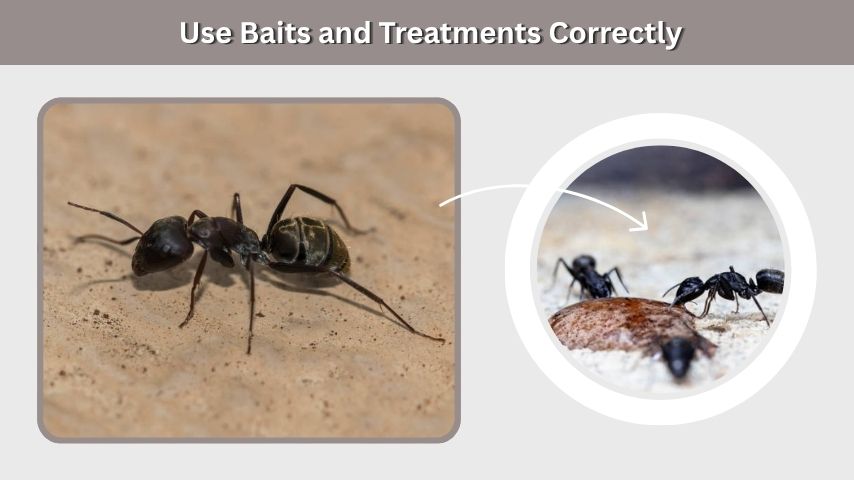
Baits can help when ants are actively foraging, but carpenter ants can be picky. Their food preference may change during the season. Some colonies accept sweet bait, while others prefer protein or grease-based bait.
Baiting Tips
- Place bait near active trails, not randomly.
- Try both sweet and protein-based carpenter ant baits.
- Keep bait away from children and pets.
- Do not spray repellents near bait.
- Replace old or dried bait as needed.
- Be patient, because baiting may take time.
Nebraska Extension notes that carpenter ants have a varied diet, which can make baits less consistently successful than with some other ant species.
Direct Nest Treatment
If the nest is found, direct treatment is often more effective. Nests and trails may be treated with labeled dusts, sprays, or other products, depending on the location. Colorado State Extension notes that nests and ant trails can be treated with insecticides, including dusts, sprays, and baits.
Always follow the label. Do not apply dusts or sprays into electrical areas, HVAC systems, or wall voids unless the product is labeled for that use.
Step 9: Use Natural Control Methods Carefully
Natural control works best when it focuses on prevention. Moisture repair, food cleanup, exclusion, and wood removal are the most reliable non-chemical methods.
Natural Control Options
- Fix leaks and reduce humidity.
- Remove rotting wood and old stumps.
- Keep firewood away from the house.
- Clean crumbs, grease, sweets, and pet food.
- Seal cracks and entry points.
- Trim branches away from the structure.
- Vacuum visible ants and frass.
- Use sticky monitoring traps near suspected areas.
Diatomaceous earth may kill ants that directly crawl through dry dust, but it is not a complete solution for hidden carpenter ant colonies. It works only when dry and when insects contact it. Do not breathe the dust, and do not apply it carelessly around children, pets, food-prep areas, or air vents. For carpenter ants, diatomaceous earth may help on dry trails or entry points, but it usually will not reach a nest hidden inside walls, wood, or trees.
Step 10: Monitor and Prevent Future Infestations
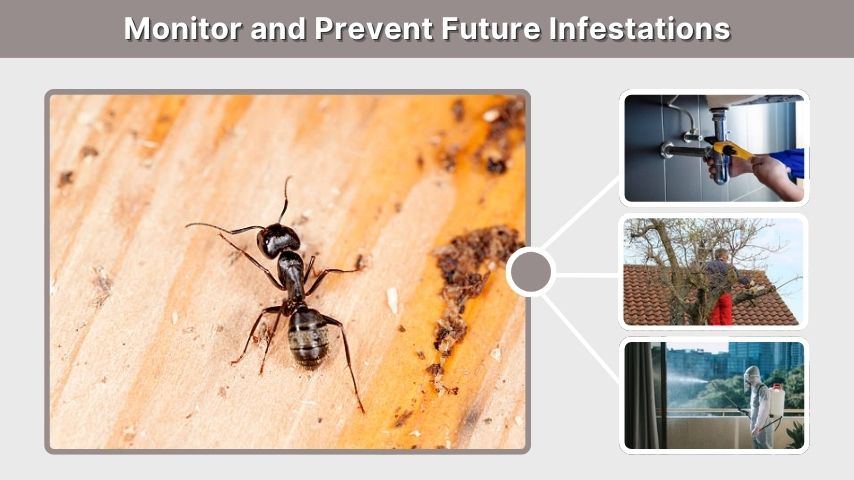
Carpenter ant control does not end after treatment. Continue watching for activity for several weeks, especially at night. If you still see ants, the main nest may not have been reached, or there may be more than one colony.
Prevention Checklist
- Keep wood dry and well ventilated.
- Repair leaks quickly.
- Replace rotting wood.
- Keep gutters clean.
- Store firewood away from the house.
- Trim vegetation away from siding and rooflines.
- Seal cracks and utility openings.
- Keep food sealed and counters clean.
- Inspect basements, crawl spaces, attics, and window frames regularly.
- Call a professional if signs keep returning.
Professional help is wise when you see winged ants indoors, repeated frass, hollow wood, rustling sounds, or ants coming from walls. Rutgers notes that sprays usually do not kill the whole colony unless applied directly to the nest, while professional treatments may be needed for effective control.
FAQs
What is the best way to control carpenter ants?
The best way to control carpenter ants is to find the nest, treat the colony, fix moisture problems, remove damaged wood, and seal entry points. Killing only the ants you see usually does not eliminate the hidden nest.
How do you control carpenter ants in the house?
Inspect damp areas, follow ant trails at night, look for frass, use carpenter ant bait near active trails, and treat the nest directly if you find it. Repair leaks and damaged wood so the ants do not return.
How do you control carpenter ants outside?
Remove rotting logs, stumps, old boards, and firewood near the house. Trim branches away from the structure, seal entry points, and use bait or targeted treatment near active trails or confirmed nests.
How do you control carpenter ants naturally?
Natural control includes fixing leaks, reducing moisture, removing rotting wood, sealing cracks, cleaning food sources, trimming vegetation, and storing firewood properly. Diatomaceous earth may help on dry trails, but it usually will not eliminate hidden nests.
Should I call pest control for carpenter ants?
Yes, call pest control if you see winged ants indoors, repeated frass, hollow wood, rustling in walls, or ants coming from hidden gaps. These signs may mean the colony is inside the structure and needs targeted treatment.