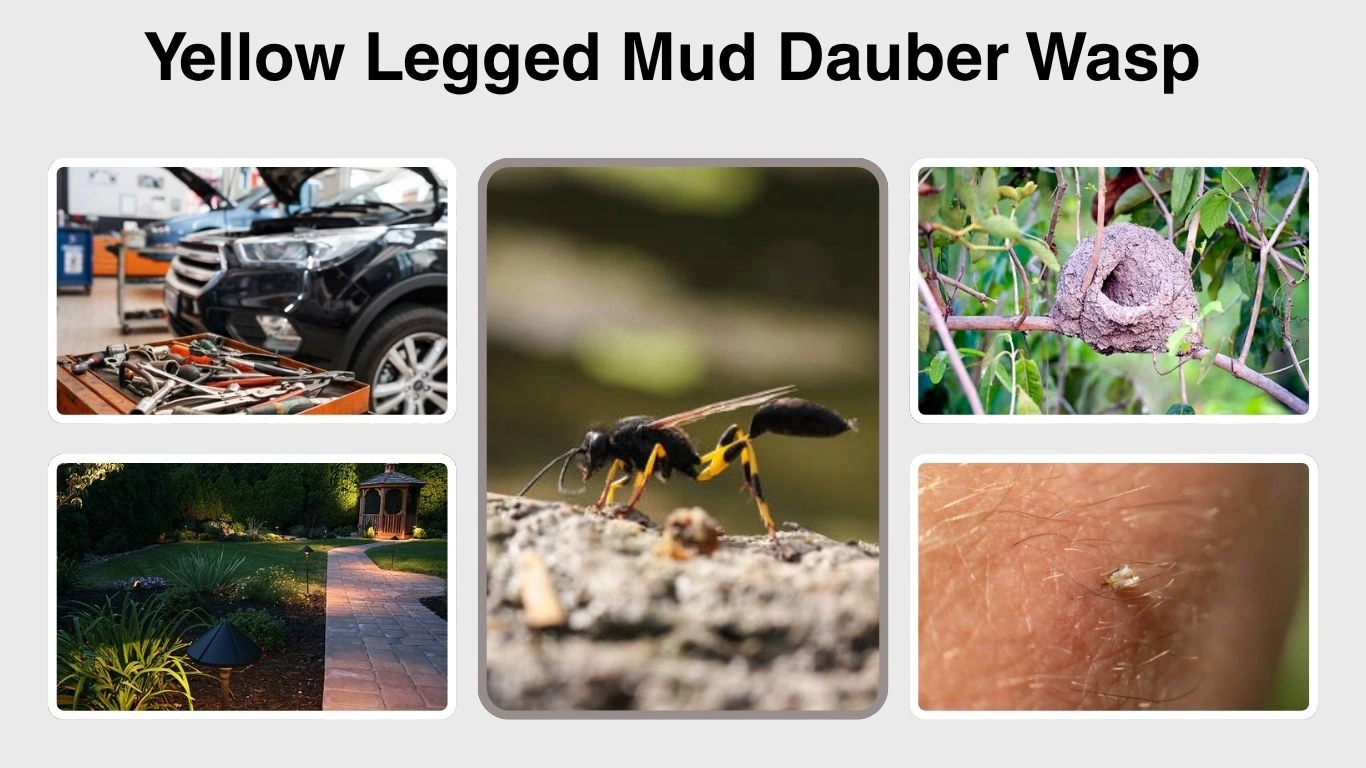
The yellow legged mud dauber wasp is one of the most recognizable solitary wasps found around homes, barns, garages, and gardens. Its slender black body, bright yellow legs, and unusual mud nests often attract attention and sometimes fear. Many people mistake these insects for aggressive hornets or dangerous wasps, especially when they see one flying around porches or inside the house.
Fortunately, yellow-legged mud dauber wasps are usually calm and non-aggressive. Unlike social wasps that defend colonies, mud daubers live alone and rarely sting humans. They are also beneficial insects because they hunt spiders, including black widow spiders in some areas.
This guide explains how to identify yellow legged mud dauber wasps, what their nests look like, whether their sting is dangerous, and what to do if you find one in your home.
What Is a Yellow Legged Mud Dauber Wasp?
The yellow-legged mud dauber wasp is a solitary wasp species known for building nests out of mud. These wasps belong to the thread-waisted wasp family, a group recognized for their extremely narrow waist and long body shape.
Unlike yellow jackets or hornets, mud daubers do not live in colonies. Each female builds and maintains her own nest, hunts her own prey, and raises her own offspring independently.
Mud daubers are best known for:
- Their long yellow legs
- Thin thread-like waist
- Tube-shaped mud nests
- Spider-hunting behavior
Because of their unusual appearance, many homeowners assume they are dangerous, but they are actually among the least aggressive wasps commonly found around buildings.
Why Are They Called Mud Daubers?
Mud daubers get their name from the way they construct nests. Female wasps collect wet mud and shape it into small tubular chambers attached to walls, ceilings, or sheltered surfaces.
Each chamber contains:
- One egg
- Several paralyzed spiders
- A sealed mud covering
Once the larva hatches, it feeds on the stored spiders until it matures into an adult wasp.
The nests are often found in:
- Garages
- Barns
- Attics
- Porches
- Sheds
- Roof overhangs
Their mud-building behavior is one of the easiest ways to identify them.
How to Identify a Yellow-Legged Mud Dauber Wasp

The yellow legged mud dauber wasp has several physical features that make it stand out from other wasps.
Physical Characteristics
Most yellow-legged mud daubers have:
- Long narrow bodies
- Extremely thin waists
- Long dangling legs during flight
- Smooth shiny appearance
- Slow hovering flight patterns
Unlike bees, they have very little body hair.
Color and Appearance
The body is usually black or dark metallic blue, while the legs are bright yellow or yellow-orange. Their wings often appear smoky or dark brown in sunlight.
The strong contrast between the black body and yellow legs makes this species easy to recognize.
Size Range
Adult yellow-legged mud daubers typically grow between 1 and 1.5 inches long. Females are often slightly larger than males because they build nests and hunt spiders.
Yellow Legged Mud Dauber Wasp Nest

The nest is one of the most important identifying features of a mud dauber wasp.
What Does the Nest Look Like?
A yellow legged mud dauber wasp nest usually appears as:
- Small mud tubes
- Hardened clay-like structures
- Cylindrical chambers attached together
- Brown or gray mud patches
The nests may resemble dried mud pipes stuck against walls or ceilings.
Common Nest Locations
These wasps prefer quiet protected spaces where the nests remain dry and sheltered from rain.
Common nesting locations include:
- Garage ceilings
- Porch roofs
- Barn walls
- Attic corners
- Storage sheds
- Under eaves
Some nests contain only a few chambers, while others may grow into larger clustered groups over time.
Active vs Old Nests
Active nests usually have adult wasps flying nearby. Older nests may contain small round exit holes where adult wasps already emerged.
Abandoned nests are sometimes reused by other insects or mud dauber species.
Yellow Legged Mud Dauber Wasp Sting

Many homeowners worry about being stung after spotting these insects near their homes.
Do Yellow Legged Mud Dauber Wasps Sting?
Yes, yellow-legged mud dauber wasps can sting, but they rarely sting humans unless directly threatened or trapped.
Because they are solitary wasps, they do not aggressively defend nests the way hornets or yellow jackets do.
Female mud daubers mainly use their sting for hunting spiders rather than attacking people.
What Does the Sting Feel Like?
A yellow legged mud dauber wasp sting is usually mild compared to other wasp stings.
Common symptoms include:
- Temporary burning pain
- Mild redness
- Small swelling
- Minor itching
Most reactions disappear within a short time without medical treatment.
Allergic Reactions
Although rare, some individuals may experience allergic reactions to wasp stings.
Seek medical help immediately if symptoms include:
- Trouble breathing
- Severe swelling
- Dizziness
- Facial swelling
- Rapid heartbeat
For most people, however, mud daubers are considered low-risk insects.
Are Yellow Legged Mud Dauber Wasps Dangerous?
Despite their intimidating appearance, yellow-legged mud dauber wasps are generally considered harmless to humans.
Aggression Level
Mud daubers are far less aggressive than social wasps such as:
- Hornets
- Yellow jackets
- Paper wasps
They usually avoid people and prefer flying away instead of attacking. Even when nesting near homes, they rarely defend their nests aggressively.
This calm behavior is one reason many experts consider mud daubers beneficial insects rather than dangerous pests.
Why They Are Beneficial
Yellow-legged mud dauber wasps play an important role in controlling spider populations. Female mud daubers hunt spiders, sting them to cause paralysis, and place them inside mud nest chambers as food for their larvae.
Some species even capture black widow spiders, which makes them useful around homes, garages, and sheds.
Because they naturally reduce spider numbers, many homeowners tolerate mud daubers unless nests become excessive.
Risk Around Children and Pets
The risk to children and pets is generally low because mud daubers are not naturally aggressive.
Problems usually occur only when:
- Someone handles a wasp directly
- A nest is disturbed
- The insect becomes trapped inside clothing
Teaching children not to touch nests or swat at wasps is usually enough to avoid stings.
Yellow Legged Mud Dauber Wasp in House
Finding a yellow legged mud dauber wasp in house can be alarming, especially because many people mistake them for aggressive stinging insects.
Fortunately, a single mud dauber indoors is rarely a serious problem.
Why They Enter Homes
Mud daubers may enter homes for several reasons:
- Searching for sheltered nesting spots
- Following spiders indoors
- Entering through open windows or doors
- Looking for quiet protected corners
Garages, attics, basements, and storage areas are especially attractive because they provide safe nesting locations.
What to Do If You Find One Indoors
If you spot a mud dauber inside:
- Stay calm
- Avoid swatting at it
- Open a nearby window or door
- Allow the wasp to fly outside naturally
Because mud daubers are not highly defensive, they usually leave on their own if given an escape route.
How to Prevent Indoor Entry
To reduce the chances of mud daubers entering your house:
- Seal cracks around windows and doors
- Install tight-fitting screens
- Remove old mud nests quickly
- Keep garages and sheds clean
- Limit access to sheltered wall corners
Prevention is usually more effective than extermination.
Lifecycle of Yellow-Legged Mud Dauber Wasps
Understanding the lifecycle of yellow-legged mud dauber wasps helps explain why they appear seasonally around homes.
Egg Stage
The female lays one egg inside each mud chamber after stocking it with paralyzed spiders.
She then seals the chamber with mud before moving on to create another section.
Larval Development
Once the egg hatches, the larva feeds on the stored spiders. The spiders remain alive but paralyzed, which keeps the food fresh for the developing wasp.
Adult Emergence
After completing development, the adult wasp chews its way out of the mud chamber and begins searching for food and nesting areas.
Adult activity is usually highest during warmer months.
Yellow-Legged Mud Dauber vs Other Wasps

Many people confuse yellow-legged mud daubers with more aggressive wasp species.
Mud Dauber vs Hornet
Hornets are:
- Larger and thicker-bodied
- Highly defensive
- Colony-forming insects
Mud daubers are:
- Slimmer
- Solitary
- Much less aggressive
The narrow waist and dangling legs help distinguish mud daubers from hornets.
Mud Dauber vs Yellow Jacket
Yellow jackets are social wasps that aggressively defend nests and frequently sting humans.
Mud daubers rarely attack and do not swarm around food or sugary drinks like yellow jackets often do.
Mud Dauber vs Great Black Wasp
Great black wasps are also solitary but usually nest underground instead of building mud tubes.
Mud daubers are more slender and easier to identify because of their distinctive mud nests.
How to Remove a Yellow-Legged Mud Dauber Wasp Nest

Although mud daubers are beneficial insects, some homeowners choose to remove nests for cosmetic or safety reasons.
Best Time for Removal
The safest time to remove a nest is:
- Early morning
- Nighttime
- During cooler temperatures
Wasps are less active during these periods.
Safe Removal Steps
For small nests:
- Wear gloves and protective clothing
- Use a scraper or putty knife
- Place the nest in a sealed bag
- Clean the area thoroughly afterward
Because mud daubers are solitary, removing a nest is usually much easier than dealing with social wasp colonies.
Preventing Future Nests
To discourage future nesting:
- Remove abandoned nests quickly
- Seal cracks and gaps
- Reduce mud sources near buildings
- Keep storage areas clean and uncluttered
FAQs
Are yellow legged mud dauber wasps dangerous?
Yellow legged mud dauber wasps are generally not dangerous to humans. They are solitary, non-aggressive insects that rarely sting unless directly threatened or handled.
Do yellow-legged mud dauber wasps sting humans?
Yes, they can sting, but stings are uncommon because these wasps usually avoid people. Their sting is typically mild and causes only temporary pain, redness, or swelling.
What does a yellow legged mud dauber wasp nest look like?
Their nests look like small tube-shaped mud structures attached to walls, ceilings, garages, porches, or barns. The nests are made from hardened mud and often appear gray or brown.
Why is a yellow legged mud dauber wasp in my house?
Mud daubers may enter homes while searching for nesting areas, spiders, or sheltered spaces. Open windows, vents, garages, and attic gaps often allow them indoors.
Should I remove a yellow-legged mud dauber wasp nest?
If the nest is located in a low-traffic area, it is usually safe to leave it alone because mud daubers are beneficial spider hunters. However, nests near entrances or living spaces can be removed carefully if needed.