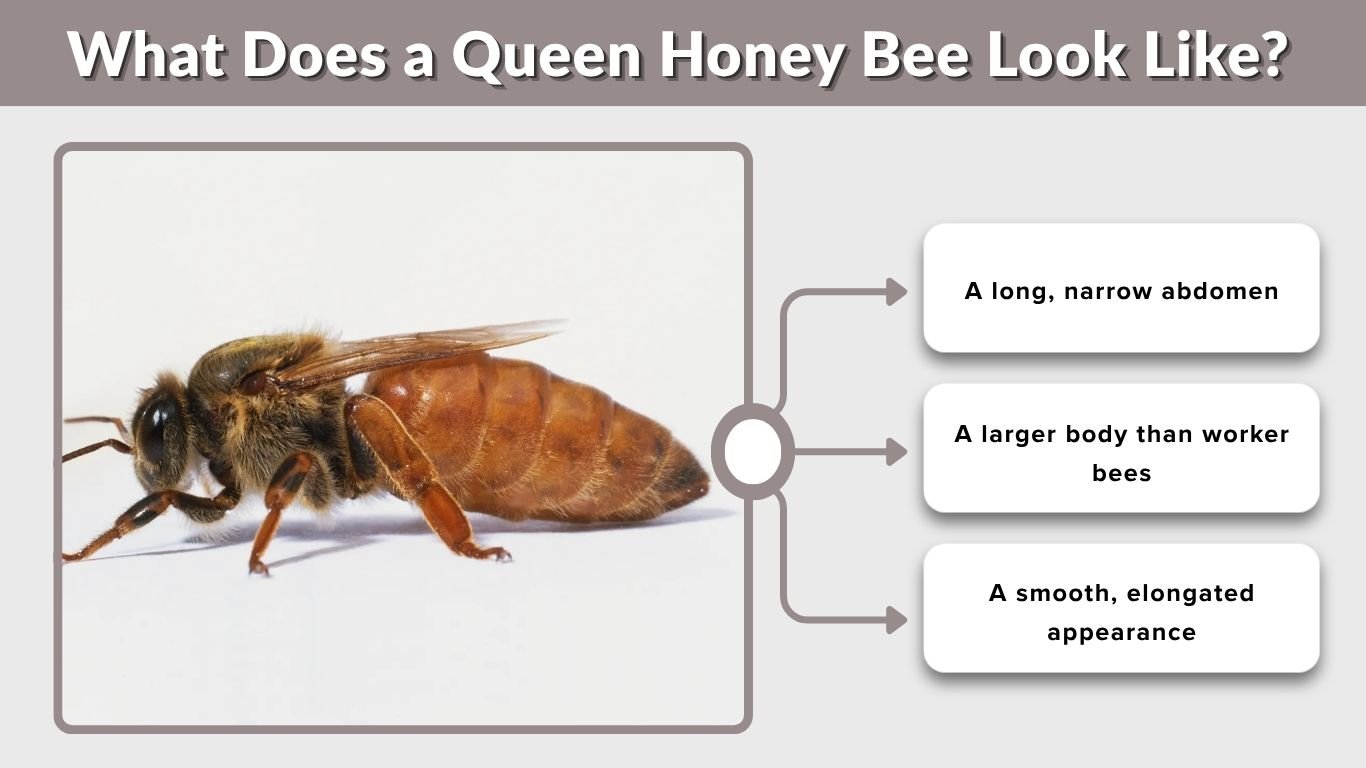
A queen honey bee looks noticeably different from worker bees once you know which features to check. She has a longer abdomen, a larger overall body, and a more elongated shape than the thousands of workers surrounding her. However, finding the queen inside a crowded hive can still be difficult because her coloration may be similar to other bees. Understanding her size, abdomen, legs, behavior, and movement can make identification much easier. This guide explains exactly what a queen honey bee looks like and how to distinguish her from workers and drones.
What Does a Queen Honey Bee Look Like?
A queen honey bee is usually the largest female bee in the colony. Her most distinctive feature is her long, tapered abdomen, which extends well beyond the tips of her folded wings.
A typical queen has:
- A long, narrow abdomen
- A larger body than worker bees
- Relatively short-looking wings compared with her abdomen
- Long legs
- A smooth, elongated appearance
- Color ranging from golden brown to very dark brown or nearly black
Color alone is not reliable for identifying a queen. Queens can look light, dark, striped, or nearly uniform depending on genetics.
Body shape is generally a much better clue.
How Big Is a Queen Honey Bee?
A queen is typically longer than a worker bee, although she is not necessarily dramatically wider.
Her extended abdomen creates most of the difference in size.
A mature laying queen may measure approximately 18–22 mm long, whereas worker honey bees are commonly around 12–15 mm.
Queens can temporarily appear smaller before mating or after they stop laying eggs. Once a queen begins producing large numbers of eggs, her abdomen becomes noticeably enlarged.
This is one reason experienced beekeepers often look for body length rather than overall bulk.
Queen Honey Bee Abdomen
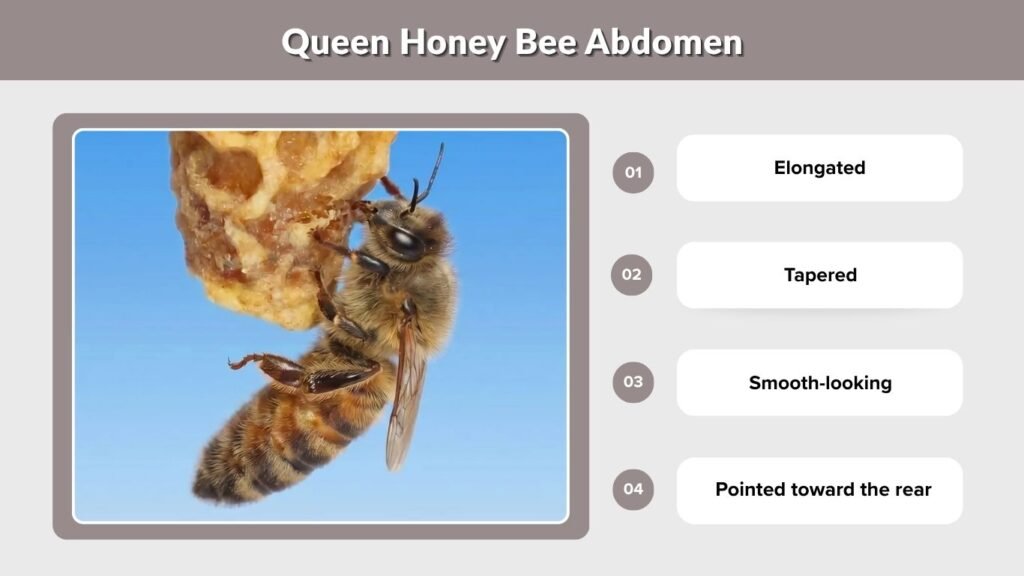
The abdomen is one of the easiest features to use when identifying a queen.
A worker’s abdomen usually ends close to the tips of her folded wings. A queen’s abdomen extends noticeably farther.
The queen’s abdomen is also more:
- Elongated
- Tapered
- Smooth-looking
- Pointed toward the rear
Her large abdomen contains highly developed reproductive organs that allow her to lay enormous numbers of eggs during periods of strong colony growth.
A productive queen may lay well over a thousand eggs in a single day under favorable conditions.
What Color Is a Queen Honey Bee?
There is no single queen honey bee color.
Depending on the strain and genetics of the colony, a queen may be:
- Golden
- Light brown
- Reddish brown
- Dark brown
- Nearly black
- Banded or striped
Some queens look almost identical in color to their workers.
This can make finding them difficult even when their body size differs.
Commercially managed queens are sometimes marked with a small colored dot on the thorax. This makes them easier to locate and can indicate the year in which the queen was introduced or produced.
What Do Queen Honey Bee Wings Look Like?
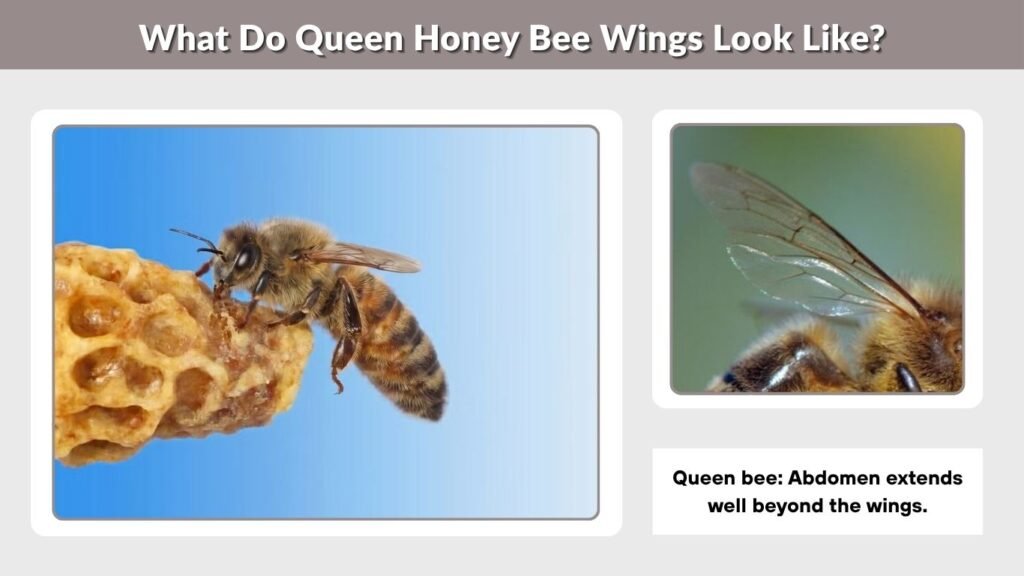
A queen has two pairs of wings just like worker bees.
However, her wings appear proportionally shorter because her abdomen is much longer.
When her wings are folded across her back, they usually do not reach the end of the abdomen.
This creates an important visual difference:
Worker bee: Wings nearly reach the end of the abdomen.
Queen bee: Abdomen extends well beyond the wings.
The wings themselves are not necessarily unusually small; they simply look short relative to the queen’s elongated body.
What Do a Queen Honey Bee’s Legs Look Like?
Queen honey bees have relatively long legs.
Her legs may make her body appear elevated above the comb as she walks.
Unlike worker bees, queens are not responsible for collecting pollen, so their hind legs do not have the same functional role in transporting pollen.
A queen often moves across the comb with workers surrounding or following her.
Looking for a long-bodied bee that appears to stand slightly taller than nearby workers can help you locate her.
Queen Honey Bee vs Worker Bee
Queens and workers are both female honey bees, but their bodies and roles differ substantially.
Queen Honey Bee
The queen generally has:
- A much longer abdomen
- A larger overall body
- Wings that appear shorter
- Longer-looking legs
- Fully developed reproductive organs
- No normal role in gathering nectar or pollen
Her primary responsibility is reproduction.
Worker Honey Bee
Workers are smaller females responsible for most colony activities.
They:
- Collect nectar
- Gather pollen
- Feed larvae
- Produce wax
- Clean the hive
- Guard the entrance
- Regulate hive temperature
Workers have shorter abdomens and more compact bodies than the queen.
Queen Honey Bee vs Drone
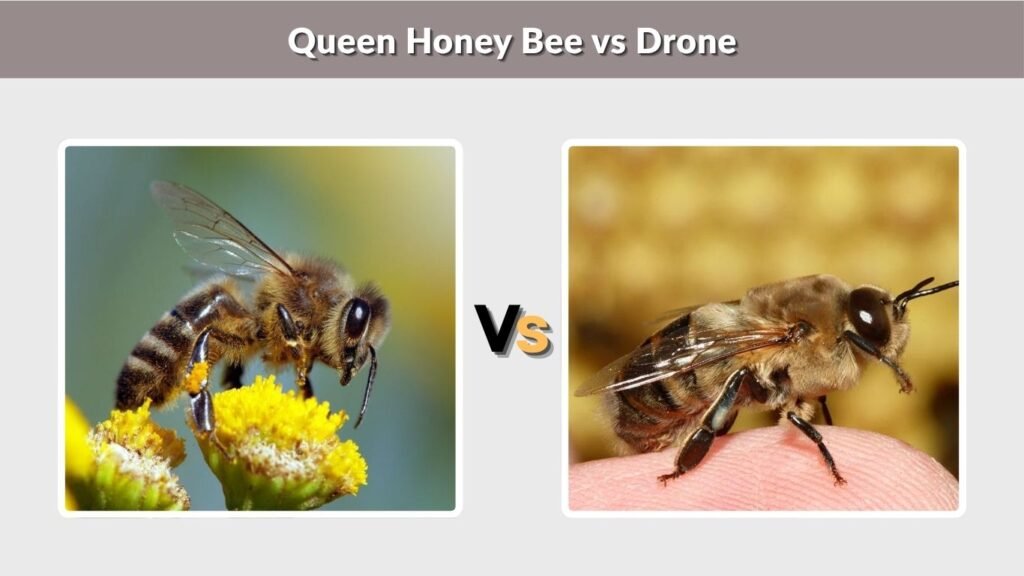
Drones are male honey bees and can also be relatively large, which sometimes causes beginners to confuse them with queens.
However, drones have a very different body shape.
Drones typically have:
- Thick, rounded bodies
- Very large eyes
- Broad heads
- Blunt abdomens
- No stinger
A queen has a noticeably longer, more tapered abdomen.
The drone’s huge eyes are particularly useful for identification because they nearly meet at the top of the head.
Where Is the Queen Usually Found in a Hive?
The queen is commonly found on frames containing brood.
She spends much of her time moving across comb cells and laying eggs.
When searching for her, inspect frames containing:
- Eggs
- Young larvae
- Open brood
- Recently laid brood patterns
Rather than immediately searching for one individual bee, experienced beekeepers often look for the unusual pattern created by workers around the queen.
Workers may form a loose circle around her, with their heads directed toward her body.
This group is sometimes referred to as the queen’s retinue.
How Does a Queen Honey Bee Move?
A laying queen usually walks deliberately across the comb, stopping frequently to inspect cells.
She may insert her head into a cell before turning around and placing her abdomen inside to lay an egg.
Workers often move aside as she passes.
Her long abdomen may also create a distinctive movement compared with smaller workers.
A queen can move surprisingly quickly when disturbed, however, and may disappear beneath clusters of bees.
Can a Queen Honey Bee Fly?
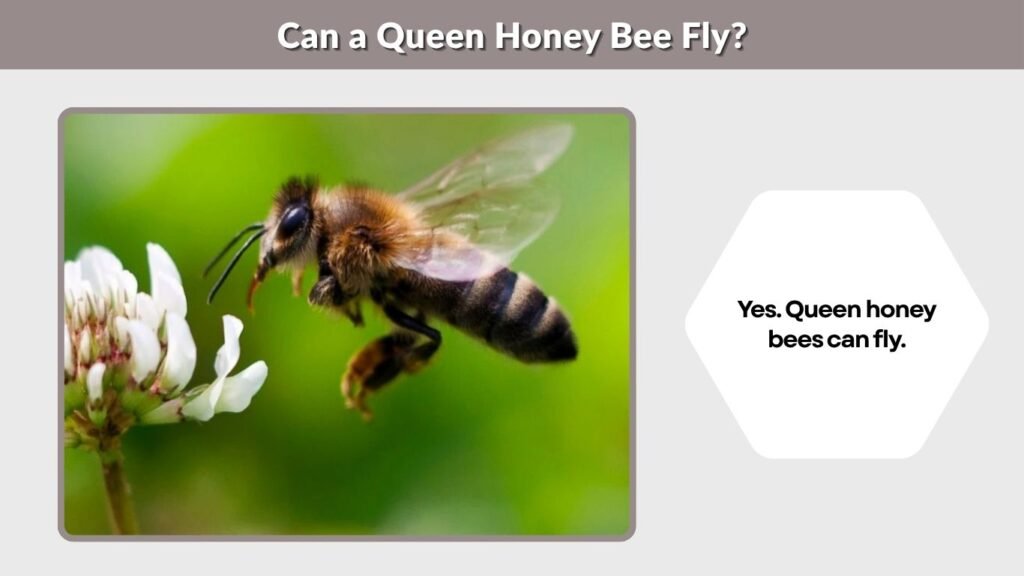
Yes. Queen honey bees can fly.
Young virgin queens leave the hive for mating flights, during which they mate with drones away from the colony.
A mature laying queen usually spends most of her life inside the hive and rarely flies under normal conditions.
Before swarming, workers may reduce the queen’s food intake so she becomes lighter and capable of flying with the departing swarm.
What Does a Virgin Queen Honey Bee Look Like?
A virgin queen has not yet mated and begun regular egg laying.
She may look noticeably different from a mature laying queen.
Virgin queens are often:
- Slimmer
- Faster-moving
- Less swollen through the abdomen
- More difficult to distinguish from large workers
After successful mating and the beginning of egg production, the abdomen becomes longer and fuller.
This makes a mature laying queen much easier to recognize.
What Does a Honey Bee Queen Cell Look Like?
A queen cell is much larger and differently shaped than ordinary worker brood cells.
It often resembles a:
- Peanut shell
- Small hanging capsule
- Rough elongated pod
Queen cells are usually built vertically rather than horizontally like normal worker cells.
Their location can sometimes provide clues about why the colony is producing a queen.
Swarm Queen Cells
These are often built along the lower edges of brood frames when a colony is preparing to swarm.
Supersedure Queen Cells
These may appear on the face of the comb when workers are replacing an aging or failing queen.
Emergency Queen Cells
Workers can enlarge existing worker cells containing very young larvae if the colony suddenly loses its queen.
Regardless of type, a mature capped queen cell is usually much larger and more textured than the surrounding worker brood.
What Does a Queen Bee Egg Look Like?
A queen does not produce a special-looking “queen egg.”
A fertilized egg destined to become a queen initially looks like the egg that would produce a worker.
The difference comes from how the larva is raised.
Worker bees place the developing queen larva in a large queen cell and feed it abundant royal jelly.
This specialized diet and cell environment cause the larva to develop into a reproductive queen rather than an ordinary worker.
How to Find a Queen Honey Bee
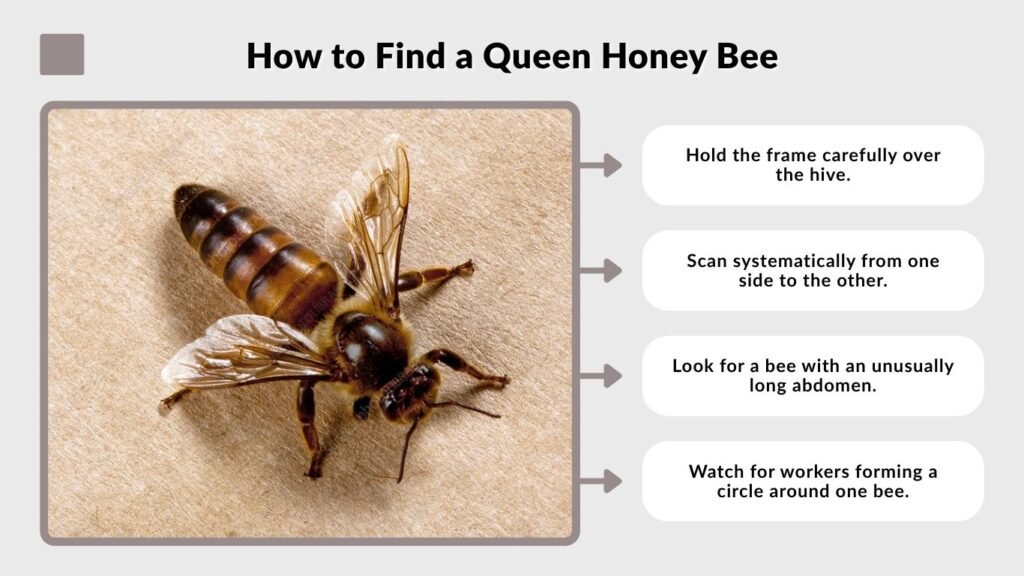
Finding a queen becomes easier with practice.
Start by locating frames containing fresh eggs and young larvae because a laying queen was probably there recently.
Then:
- Hold the frame carefully over the hive.
- Scan systematically from one side to the other.
- Look for a bee with an unusually long abdomen.
- Watch for workers forming a circle around one bee.
- Check both sides of the frame.
- Pay attention to bees moving quickly away from your line of sight.
Do not shake or handle brood frames roughly while searching.
FAQs
What is the easiest way to identify a queen honey bee?
Look for a bee with a long abdomen extending beyond her wings. Her elongated body and the workers gathering around her are often the easiest clues.
Is a queen honey bee bigger than a worker?
Yes. A queen is normally longer and larger than worker bees, mainly because of her enlarged reproductive abdomen.
What color is a queen honey bee?
Queens can be golden, brown, reddish, dark brown, or almost black. Color varies with genetics and is not a reliable identification feature by itself.
Does a queen honey bee have wings?
Yes. Queens have wings and can fly. Virgin queens use them during mating flights, while mature queens rarely leave the colony except during swarming.
What does a queen honey bee cell look like?
A queen cell is large, elongated, and textured, often resembling a peanut shell hanging from the comb. It is much larger than a normal worker brood cell.