A queen honey bee can live much longer than worker bees or drones. While most workers survive only weeks to months depending on the season, a healthy queen may live for 2 to 5 years, and occasionally longer. However, many managed colonies replace their queens before they reach their maximum lifespan because egg-laying performance often declines with age. A queen’s longevity depends on genetics, nutrition, mating success, disease, colony conditions, and beekeeper management. Here is a closer look at how long queen honey bees live and what affects their lifespan.
How Long Does a Queen Honey Bee Live?
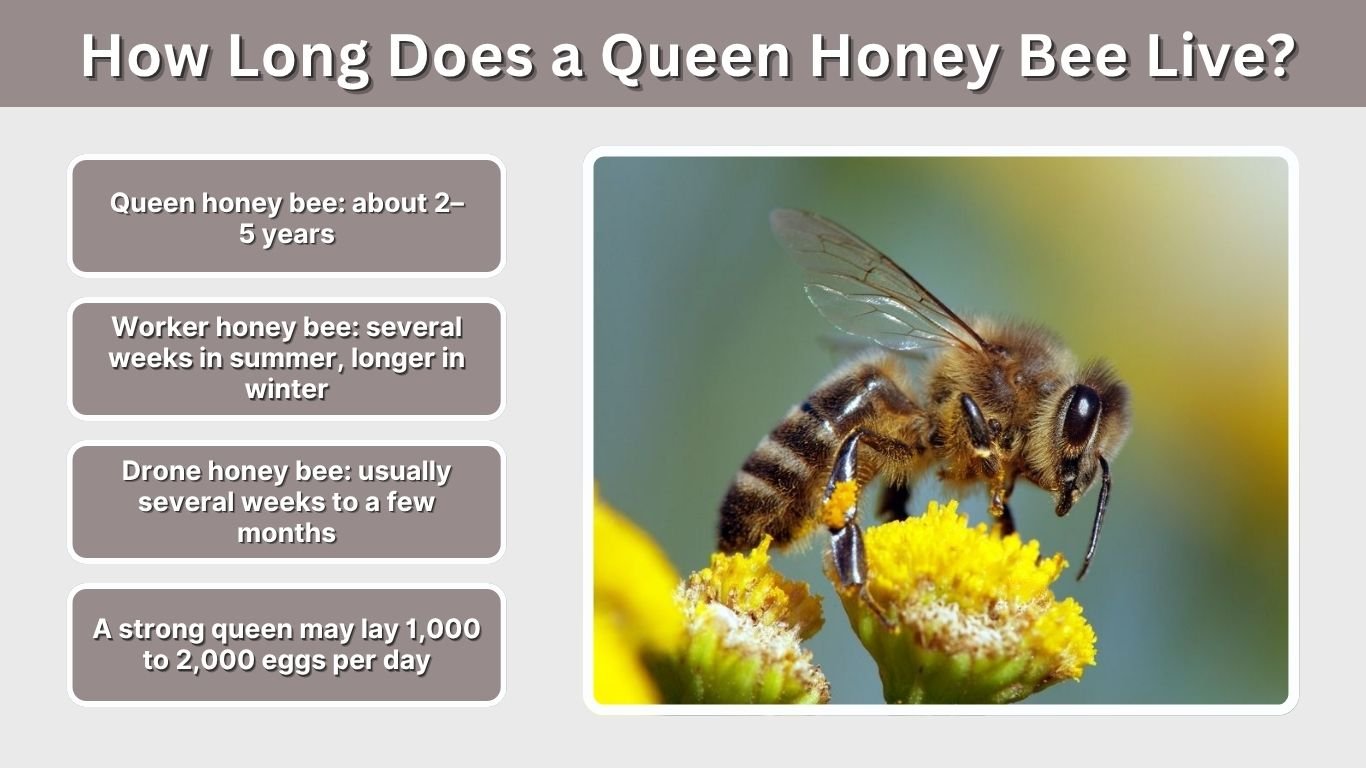
A queen honey bee generally lives about 2 to 5 years.
Some queens may survive longer under favorable conditions, but it is common for colonies to replace queens before they reach old age.
In managed beekeeping, a queen may remain productive for only 1 to 3 years before her egg-laying ability begins to decline.
A simple comparison is:
- Queen honey bee: about 2–5 years
- Worker honey bee: several weeks in summer, longer in winter
- Drone honey bee: usually several weeks to a few months
The queen’s exceptional lifespan is closely connected to her specialized diet, reproductive role, and protection inside the colony.
Why Do Queen Honey Bees Live So Long?
Queen bees and worker bees develop from fertilized eggs, but their development is dramatically different.
Queen larvae are fed abundant royal jelly, a nutrient-rich food produced by worker bees. This specialized diet triggers the development of a reproductive queen rather than a worker.
A queen also spends most of her adult life protected inside the hive.
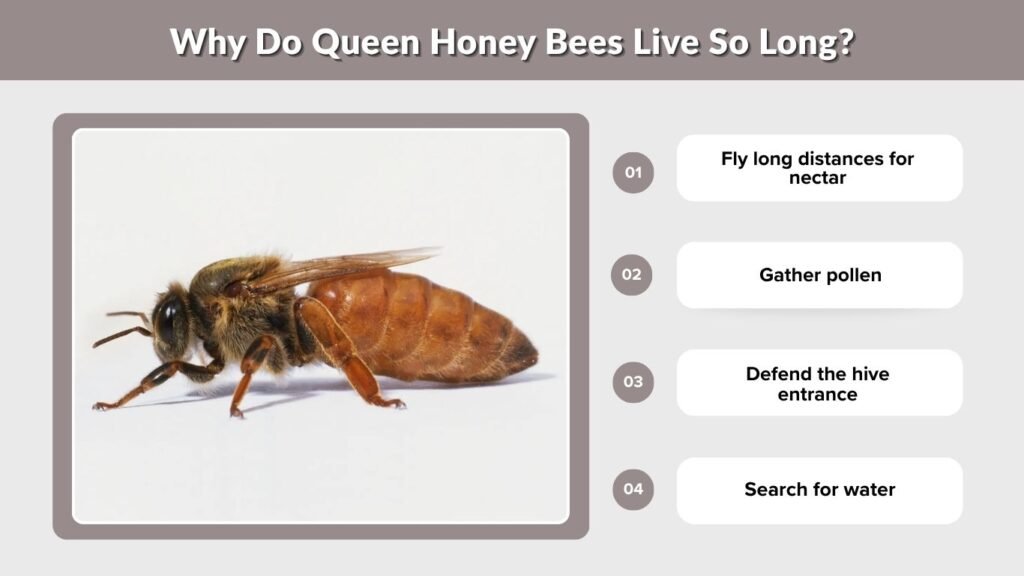
Unlike workers, she does not regularly:
- Fly long distances for nectar
- Gather pollen
- Defend the hive entrance
- Search for water
- Face outdoor predators
- Experience the physical stress of foraging
Worker bees perform demanding tasks that gradually wear down their bodies, while the queen remains surrounded and cared for by attendant workers.
How Long Does a Queen Bee Live After Mating?
After emerging as an adult, a virgin queen typically spends several days developing before leaving the colony on mating flights.
She mates with multiple drones and stores sperm inside a specialized organ called the spermatheca.
This stored sperm can be used to fertilize eggs for years.
Once mating is complete, a queen usually begins laying eggs and spends nearly all of her remaining life inside the hive.
If she remains healthy and retains sufficient stored sperm, she can continue producing fertilized eggs for several years.
As sperm reserves decline or reproductive performance decreases, the colony may begin replacing her.
How Many Eggs Does a Queen Honey Bee Lay?
A healthy queen can lay an extraordinary number of eggs.
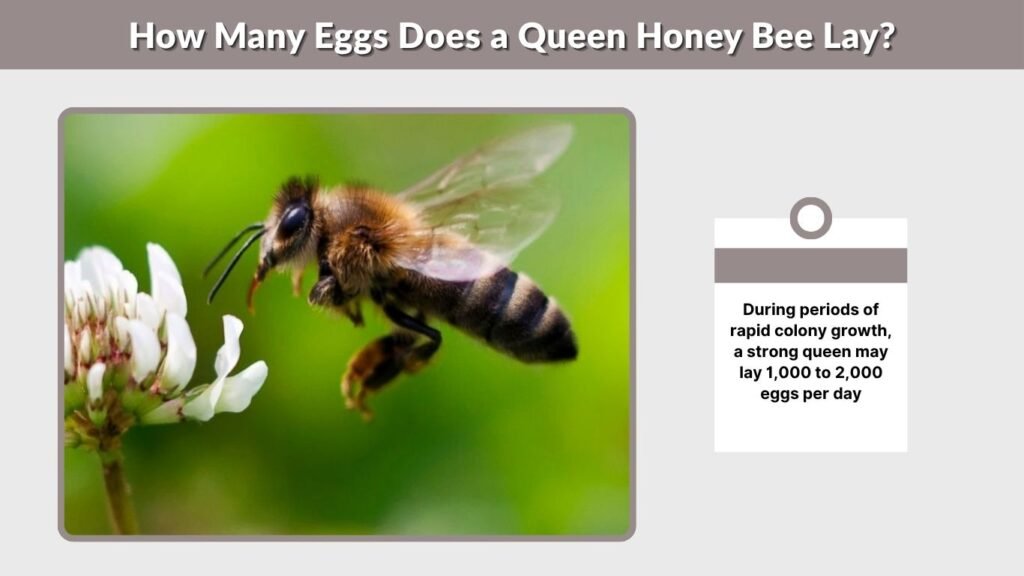
During periods of rapid colony growth, a strong queen may lay 1,000 to 2,000 eggs per day, sometimes approaching her own body weight in eggs.
Her production changes according to:
- Season
- Colony population
- Available food
- Weather
- Queen age
- Available comb space
Egg laying generally increases during spring when flowers and food resources become abundant.
During winter or food shortages, production may slow dramatically or stop temporarily.
Does a Queen Bee Lay Eggs Her Whole Life?
A queen can lay eggs for most of her adult life, but her productivity does not remain constant.
Young, well-mated queens usually produce strong, consistent brood patterns.
As a queen ages, several changes may occur:
- Reduced egg production
- Irregular brood patterns
- Increasing production of unfertilized eggs
- Lower colony population growth
A colony can detect declining queen performance through changes in pheromones and brood production.
Workers may then begin raising a replacement queen.
What Happens When a Queen Honey Bee Gets Old?
Older queens often produce fewer eggs and weaker brood patterns.
The workers may respond through a process known as supersedure.
They select one or more young larvae and raise them inside special queen cells.
These larvae receive royal jelly and develop into new queens.
Once the replacement queen emerges and becomes established, the old queen may disappear or be removed by the colony.
Supersedure allows a colony to replace a declining queen without completely interrupting reproduction.
How Does a Queen Bee Die?
Queen honey bees can die for several reasons.
Natural aging is only one possibility.
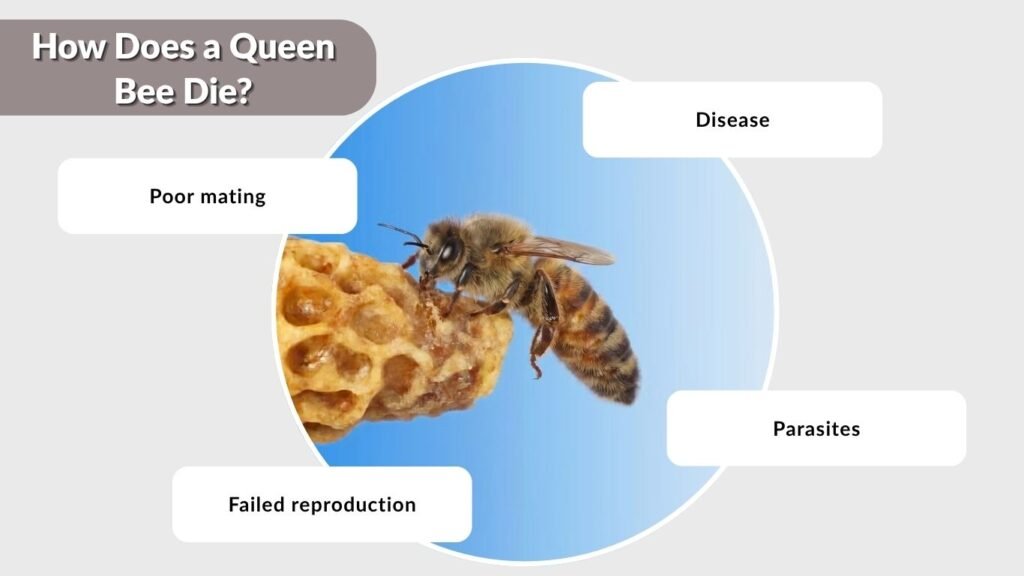
Other causes include:
- Disease
- Parasites
- Injury
- Poor mating
- Failed reproduction
- Colony disturbance
- Worker replacement
- Accidental beekeeper injury
Virgin queens also face risks when leaving the hive for mating flights.
Birds, bad weather, or navigation problems can prevent a young queen from returning.
Can a Honey Bee Colony Survive Without a Queen?
A colony can survive temporarily without a queen, but it cannot remain healthy indefinitely without replacing her.
When a queen disappears, workers detect the loss of her pheromones.
If young fertilized larvae or eggs are available, workers can begin constructing emergency queen cells.
They select very young female larvae and feed them large quantities of royal jelly.
A new queen may then emerge, mate, and begin laying eggs.
If no suitable young brood is available, the colony may eventually become unable to produce a replacement.
How Long Can a Hive Stay Without a Queen?
A colony may remain queenless for several weeks while attempting to raise and mate a replacement.
Producing a new queen requires time for:
- Queen cell development
- Adult queen emergence
- Maturation
- Mating flights
- Beginning egg production
During this period, no new worker eggs may be laid.
If queenlessness continues too long, some worker bees may begin laying unfertilized eggs.
These eggs develop into drones rather than workers, which can eventually cause the colony to collapse if the situation is not corrected.
How Long Do Queen Bees Live Compared With Worker Bees?
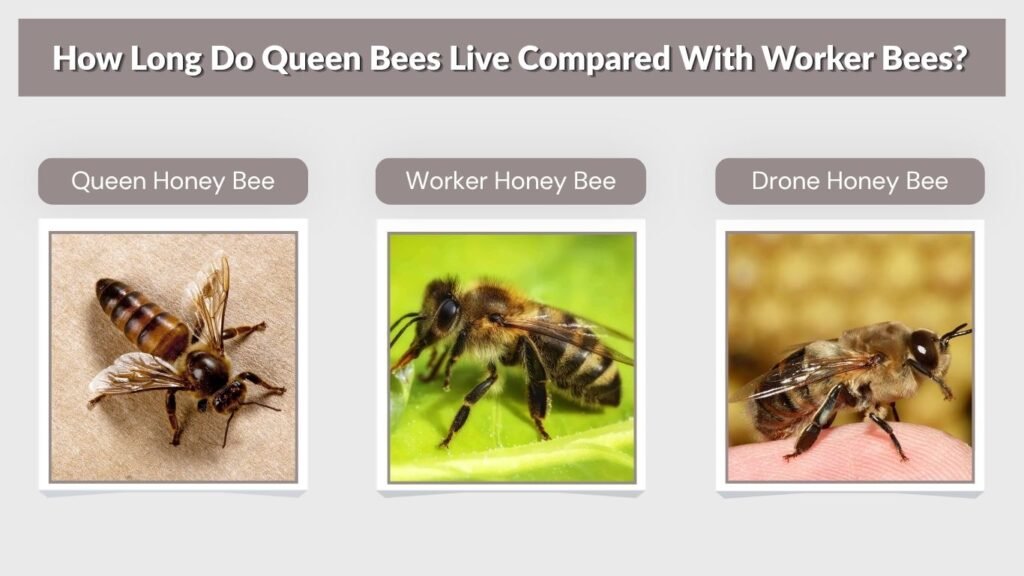
The difference is dramatic.
Queen Honey Bee
A queen commonly lives several years.
She spends most of her life inside the hive, receives constant care, and is fed by worker attendants.
Worker Honey Bee
Summer workers often live only around 5 to 7 weeks because intensive foraging gradually wears down their bodies.
Winter workers may survive for several months because they forage less and must keep the colony alive through cold periods.
Drone Honey Bee
Drones generally live for a few weeks or months.
A drone that successfully mates with a queen dies immediately after mating.
Other drones may be expelled from the colony when food becomes scarce.
Do Beekeepers Replace Queen Bees?
Yes. Many beekeepers replace queens before they reach their maximum possible lifespan.
A young queen usually has better reproductive performance than an aging queen.
Beekeepers may replace a queen because of:
- Poor egg production
- Irregular brood patterns
- Weak colony growth
- Aggressive colony behavior
- Unwanted genetics
- Frequent swarming
- Advanced queen age
Some beekeepers replace queens every year or two, while others allow colonies to replace them naturally.
What Factors Affect Queen Honey Bee Lifespan?
Several factors determine how long a queen survives.
Genetics
Some queen lines naturally show greater longevity and reproductive strength.
Mating Success
A queen that successfully mates with enough healthy drones can store sufficient sperm for long-term egg production.
Poorly mated queens may fail much sooner.
Nutrition
Queens depend on worker bees for food throughout their lives. Strong colonies with good nutritional resources can support healthier queens.
Disease and Parasites
Pathogens, parasites, and viruses can weaken queens and reduce reproductive performance.
Colony Conditions
A healthy colony protects, feeds, and regulates the queen’s environment.
Stress, food shortages, extreme temperatures, or pesticide exposure can indirectly affect queen health.
Can a Queen Honey Bee Live 5 Years?
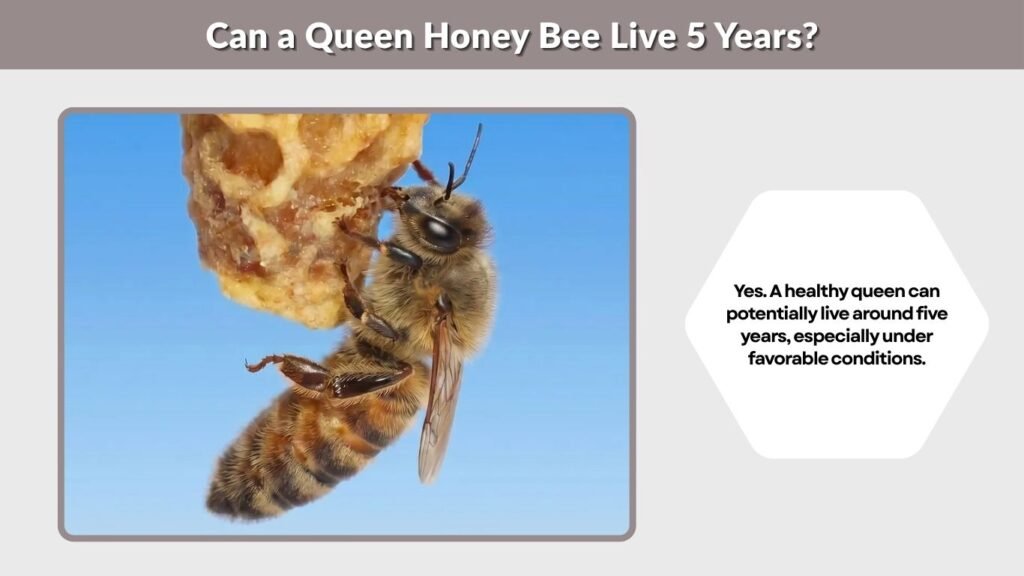
Yes. A healthy queen can potentially live around five years, especially under favorable conditions.
However, reaching that age does not necessarily mean she will remain highly productive.
Many colonies naturally replace queens earlier because reproductive output declines.
For managed honey bee colonies, productivity is often more important than maximum biological lifespan.
FAQs
How long does a queen honey bee normally live?
A queen honey bee commonly lives about 2 to 5 years, although many are naturally or intentionally replaced earlier.
Can a queen bee live longer than 5 years?
Yes, exceptional queens may live longer than five years, but this is less common.
Why does a queen bee live longer than worker bees?
Queens experience less physical stress, remain protected inside the hive, receive specialized nutrition, and do not perform demanding foraging duties.
What happens when the queen bee dies?
If suitable eggs or young larvae are available, worker bees can raise a replacement queen inside specially constructed queen cells.
How often should a queen bee be replaced?
There is no universal schedule. Many beekeepers replace queens every one to three years depending on brood quality, colony performance, genetics, and management goals.