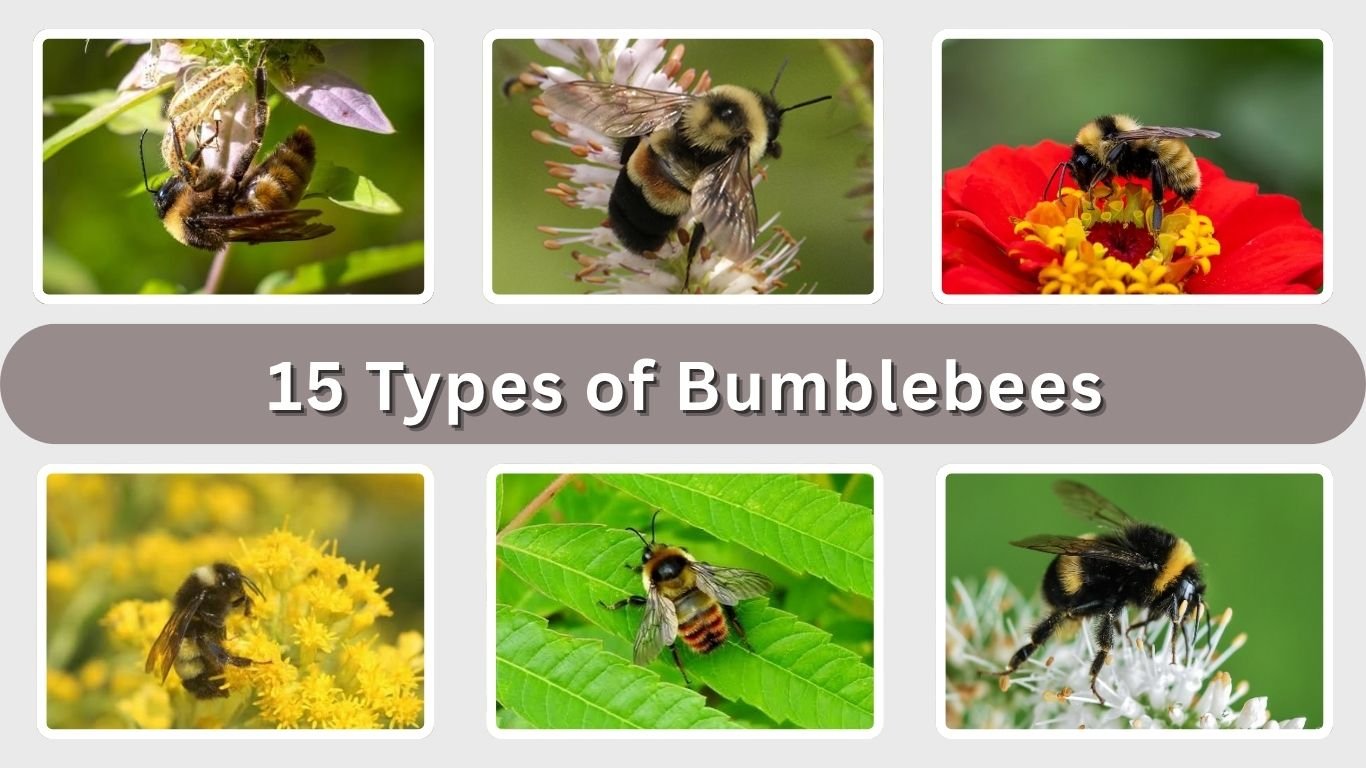
Bumblebees are fuzzy, heavy-bodied pollinators found in gardens, forests, grasslands, farms, and mountain habitats. Although many species share similar black-and-yellow coloring, they differ in body size, markings, geographic distribution, nesting behavior, and flower preferences. Some have red, white, buff, or black tails, while others display distinctive abdominal bands. This guide explores 15 types of bumblebees, including their identification features, average size, natural habitat, diet, pollination behavior, and potential sting risk.
1. Common Eastern Bumblebee
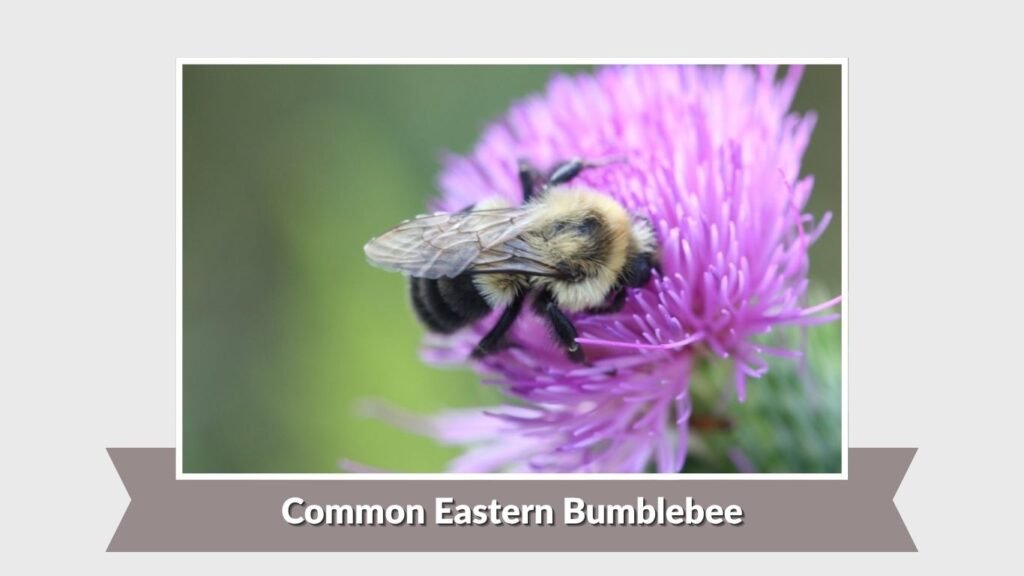
The common eastern bumblebee (Bombus impatiens) is one of the most widespread bumblebees in eastern North America. It is an important pollinator of wildflowers, garden plants, and agricultural crops. This adaptable species can survive in forests, farmland, parks, and urban gardens.
Identification
- Queens measure approximately 17–21 mm long.
- Workers are generally 8–16 mm long.
- The head, legs, and lower abdomen are mostly black.
- Yellow hairs cover the thorax and first abdominal segment.
- Males may have additional yellow coloring on the face.
- The body is rounded, hairy, and robust.
Habitat and Distribution
Common eastern bumblebees occur throughout much of eastern and central North America. They are commonly found in meadows, woodland edges, farms, suburban yards, and flower gardens. Colonies usually develop underground in abandoned rodent burrows, although nests may occasionally appear beneath buildings or inside wall cavities.
Diet and Pollination
Adults feed on flower nectar for energy, while pollen provides protein for developing larvae. These bees visit clover, asters, goldenrod, sunflowers, blueberries, tomatoes, and numerous other flowering plants. They can perform buzz pollination, making them especially useful for pollinating tomatoes, peppers, and related crops.
Behavior and Sting
This species is generally peaceful while gathering food. However, workers may sting repeatedly when their colony is disturbed. The sting usually causes temporary pain, redness, and swelling. Leaving underground nests undisturbed is normally the safest option.
2. American Bumblebee
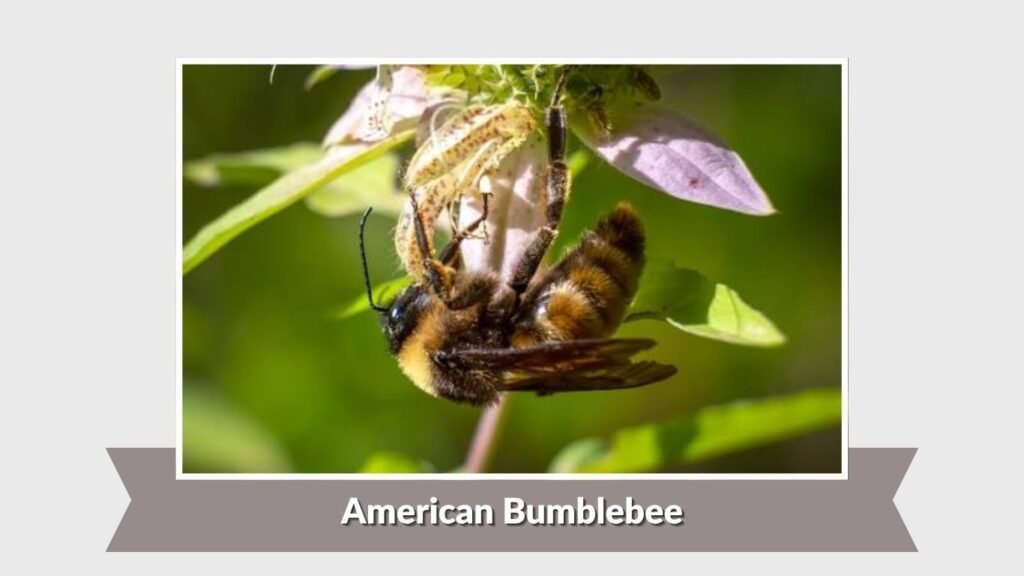
The American bumblebee (Bombus pensylvanicus) is a large, long-tongued species native to North America. Once widespread across open grasslands, its population has declined in several regions because of habitat loss, pesticides, disease, and reduced availability of native flowers.
Identification
- Queens can reach approximately 21–25 mm in length.
- Workers usually measure 13–19 mm.
- The thorax is predominantly yellow with a dark central patch.
- The first abdominal segment is usually yellow.
- Much of the remaining abdomen is black.
- Its face is relatively long and narrow.
- The wings may appear slightly smoky.
Habitat and Distribution
American bumblebees primarily inhabit prairies, grasslands, open farmland, gardens, and woodland edges. Their range covers much of the eastern and central United States and extends into parts of Mexico. Nests are usually established underground in abandoned burrows, but they may also be placed beneath dense vegetation.
Diet and Pollination
Their long tongues allow them to reach nectar inside deep, tubular flowers. American bumblebees frequently visit clover, bee balm, milkweed, blazing star, thistles, sunflowers, and legumes. While collecting pollen and nectar, they support both wild plant reproduction and crop production.
Behavior and Sting
American bumblebees are not normally aggressive away from their nests. Workers and queens can sting repeatedly because their stingers are smooth rather than barbed. Most reactions remain localized, but people with bee-venom allergies may require urgent medical care.
3. Rusty Patched Bumblebee
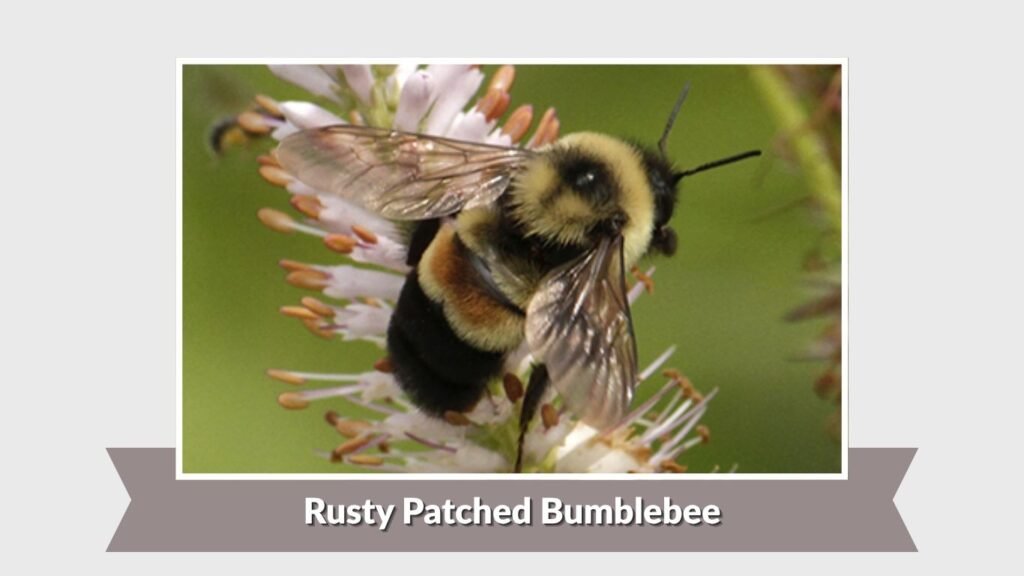
The rusty patched bumblebee (Bombus affinis) is a rare North American species named for the rusty-colored patch on the abdomen of workers and males. It was formerly common across the northeastern and central United States but has experienced a severe population decline.
Identification
- Queens measure approximately 19–23 mm long.
- Workers are generally 9–16 mm long.
- The thorax is yellow with a black area between the wings.
- Workers and males have a rusty patch on the second abdominal segment.
- Queens usually lack the clearly defined rusty patch.
- The remaining abdominal segments are mostly black.
Habitat and Distribution
This bumblebee lives in prairies, grasslands, woodland edges, wetlands, parks, and gardens with abundant flowers. Its historic range covered a large portion of eastern and central North America. Today, surviving populations are much more limited. Colonies generally nest underground in abandoned rodent burrows.
Diet and Pollination
Rusty patched bumblebees visit many flowers throughout their long active season. Common food plants include asters, goldenrod, milkweed, clover, sunflowers, and wild berries. Queens need early-blooming flowers in spring, while colonies depend on continuous nectar and pollen supplies through summer and fall.
Behavior and Sting
Foraging rusty patched bumblebees are usually calm and focused on flowers. Females can sting if trapped, stepped on, or threatened near their nest. Because this is a protected and declining species, nests should never be disturbed or removed without guidance from wildlife authorities.
4. Two-Spotted Bumblebee
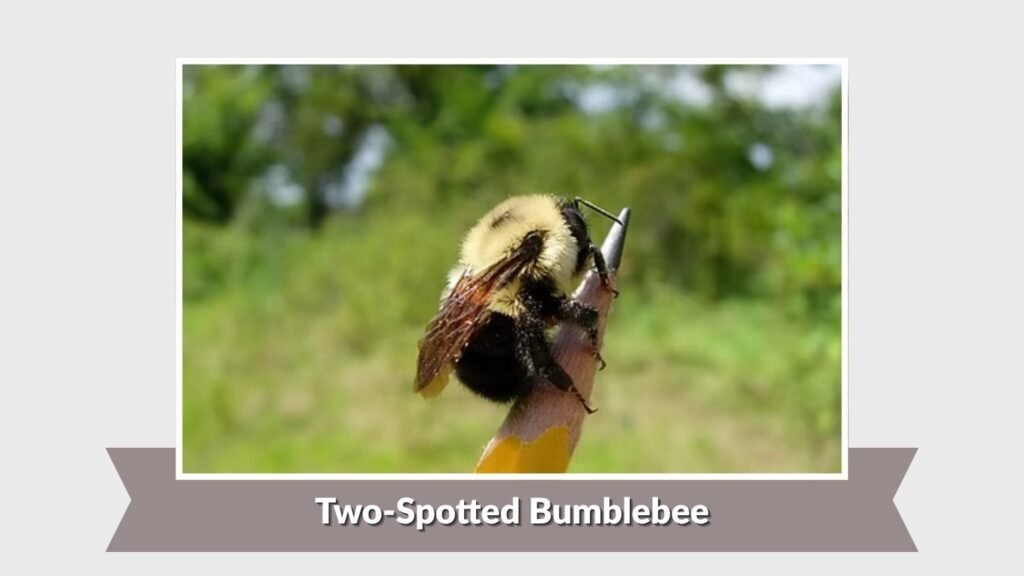
The two-spotted bumblebee (Bombus bimaculatus) is an early-season species found mainly in eastern North America. Its name refers to the two yellow patches that often appear on the second abdominal segment. It is an effective pollinator of spring flowers, fruit trees, and garden plants.
Identification
- Queens are approximately 17–22 mm long.
- Workers generally measure 11–16 mm.
- The thorax is yellow with a dark patch between the wings.
- The first abdominal segment is yellow.
- Two yellow side patches may appear on the second abdominal segment.
- The rest of the abdomen is predominantly black.
- Males may display more extensive yellow hairs.
Habitat and Distribution
Two-spotted bumblebees occupy deciduous forests, woodland edges, meadows, parks, farms, and suburban gardens. They occur across much of the eastern United States and southeastern Canada. Queens commonly select abandoned underground rodent nests when establishing new colonies in spring.
Diet and Pollination
This species visits redbud, clover, blackberry, raspberry, penstemon, milkweed, and many other seasonal flowers. Its early emergence makes it especially valuable for pollinating spring-blooming plants. Workers collect pollen with specialized structures called pollen baskets on their hind legs.
Behavior and Sting
Two-spotted bumblebees are generally nonaggressive while foraging. They may fly defensively around their nest if the entrance is disturbed. Only females possess stingers, and they can sting more than once. Mild pain, itching, and localized swelling are the most common reactions.
5. Brown-Belted Bumblebee
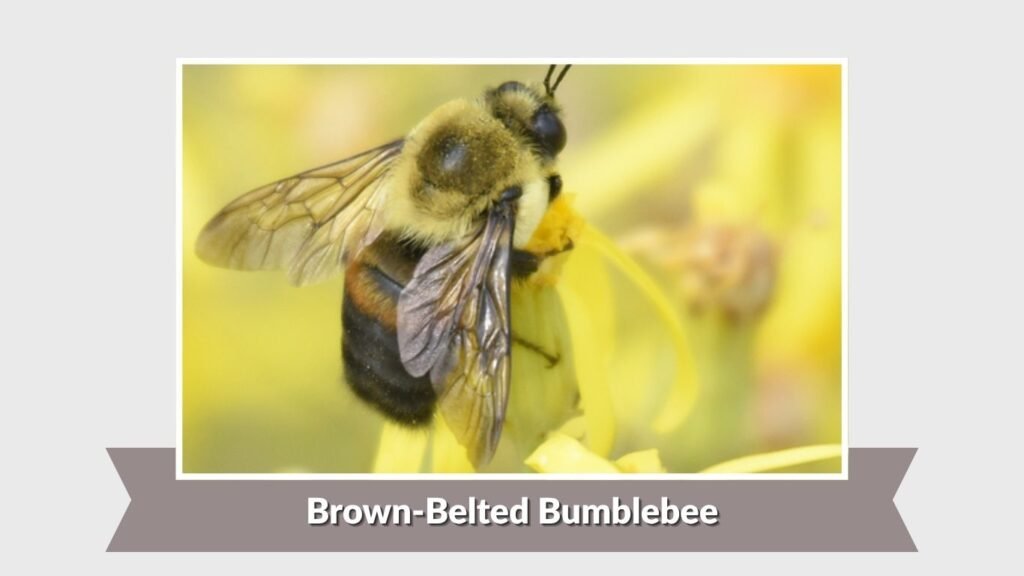
The brown-belted bumblebee (Bombus griseocollis) is a widespread North American species recognized by the brownish band across its abdomen. It tolerates developed landscapes well and frequently appears in farms, roadsides, city parks, and residential gardens.
Identification
- Queens measure approximately 21–23 mm long.
- Workers are usually 10–18 mm long.
- The thorax is covered with golden-yellow hair.
- A dark patch is visible between the wings.
- A reddish-brown or brown belt crosses the second abdominal segment.
- The remaining abdomen is primarily black.
- Males often have yellow facial hairs and large eyes.
Habitat and Distribution
Brown-belted bumblebees occur across southern Canada and much of the United States. They prefer open habitats, including grasslands, fields, farms, gardens, and woodland borders. Unlike many species, they may build nests on or slightly above the ground beneath grass, leaf litter, boards, or other protective materials.
Diet and Pollination
These generalist pollinators feed from numerous flowers, including clover, milkweed, goldenrod, sunflowers, asters, and mountain mint. They collect nectar for energy and carry pollen back to the colony to feed developing larvae. Their ability to use many flower species helps them survive in human-modified environments.
Behavior and Sting
Brown-belted bumblebees are typically calm when visiting flowers. Because nests can occur near the ground surface, accidental disturbance is possible during mowing or gardening. Workers may sting defensively, but they do not normally attack people without provocation.
6. Golden Northern Bumblebee
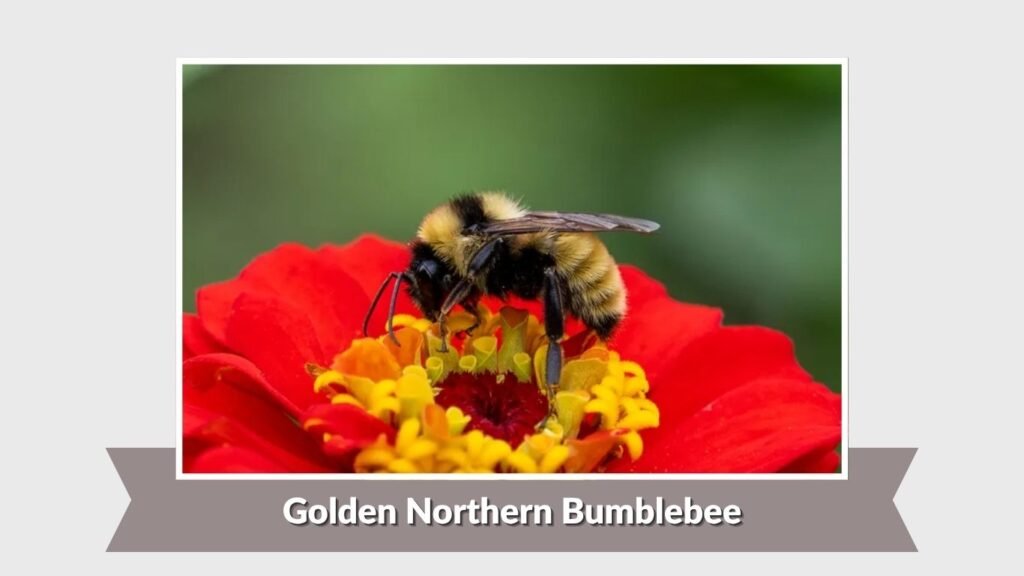
The golden northern bumblebee (Bombus fervidus) is a large, brightly colored species native to North America. Its golden-yellow body makes it one of the most recognizable bumblebees. It is an important pollinator of wildflowers, garden plants, and agricultural crops.
Identification
- Queens measure approximately 19–21 mm long.
- Workers are generally around 10–16 mm long.
- The head and face are primarily black.
- A narrow black band runs between the wings.
- The first four abdominal segments are golden yellow.
- The tip of the abdomen is black.
- The wings have a dark or smoky appearance.
Habitat and Distribution
Golden northern bumblebees are widely distributed across the continental United States and southern Canada. They prefer open environments such as grasslands, prairies, farms, roadsides, and large meadows. Colonies may be established underground or near the ground beneath dense vegetation.
Diet and Pollination
This long-tongued species can obtain nectar from deep, tubular flowers. It commonly visits clover, milkweed, thistles, vetches, bee balm, sunflowers, and other wildflowers. Its pollination activity supports natural plant communities and crop production throughout its range.
Behavior and Sting
Golden northern bumblebees are usually peaceful while feeding. However, their colonies can be strongly defended when nests are disturbed. Female bees can sting multiple times, causing pain, redness, and localized swelling.
7. Yellow-Banded Bumblebee
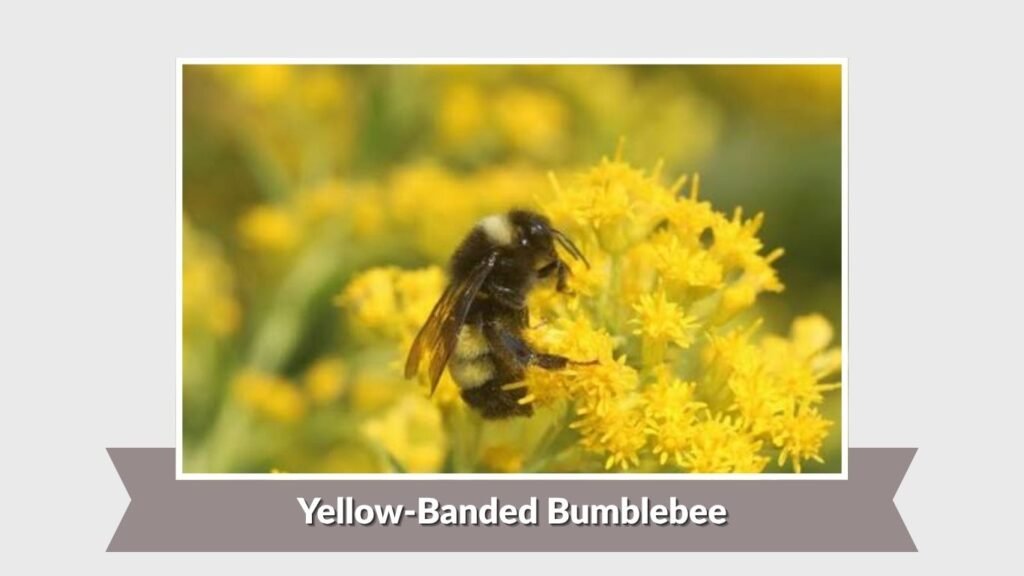
The yellow-banded bumblebee (Bombus terricola) is a medium-sized North American species recognized by the bright yellow bands across its abdomen. Once widespread and common, it has declined considerably in several parts of its historical range.
Identification
- Queens are approximately 17–21 mm long.
- Workers generally measure 10–15 mm.
- The head is mostly covered with black hair.
- The front portion of the thorax is yellow.
- The rear part of the thorax is predominantly black.
- The second and third abdominal segments are yellow.
- The remaining abdominal segments are mostly black.
Habitat and Distribution
Yellow-banded bumblebees inhabit woodlands, wetlands, meadows, prairies, and forest edges across Canada and the northern United States. They usually construct nests underground in abandoned rodent burrows. Queens emerge early and often forage near forests where spring flowers are available.
Diet and Pollination
This short-tongued bumblebee feeds most easily from shallow flowers. Important food plants include willow, maple, cherry, goldenrod, asters, clover, and other native plants. It can also perform buzz pollination to release firmly held pollen.
Behavior and Sting
Yellow-banded bumblebees rarely show aggression while foraging. Workers may defend the underground colony if people or animals disturb its entrance. Their sting is painful but usually produces only a temporary localized reaction.
8. Red-Belted Bumblebee
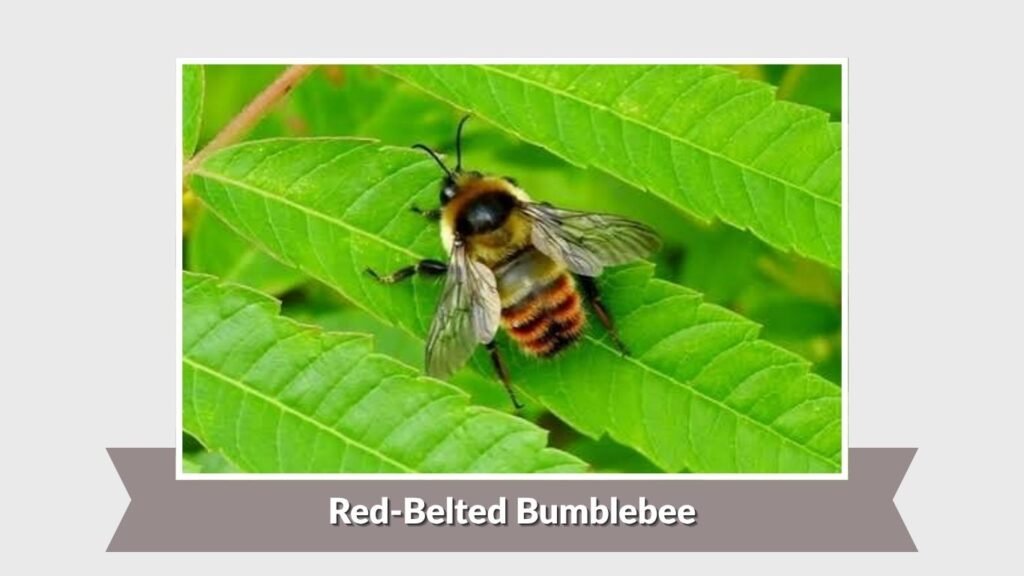
The red-belted bumblebee (Bombus rufocinctus) is a highly variable species native to North America. Some individuals have a clearly visible red or orange abdominal belt, while others display mostly yellow and black patterns.
Identification
- Queens usually measure approximately 16–18 mm long.
- Workers are generally around 11–12 mm long.
- The face is relatively short and covered primarily with black hair.
- A dark, often oval-shaped patch appears between the wings.
- Red or orange hairs may occur on the middle abdominal segments.
- Some individuals have little or no visible red coloring.
- The body hair is relatively short and even.
Habitat and Distribution
Red-belted bumblebees occur across much of Canada and parts of the western, midwestern, and northeastern United States. They inhabit prairies, mountain meadows, woodland openings, parks, and gardens. Nests may be located underground or at the soil surface.
Diet and Pollination
This short-tongued species commonly visits asters, thistles, strawberries, sunflowers, goldenrod, clover, and vetch. It gathers nectar for energy and pollen for developing larvae. Its broad flower preferences make it a useful pollinator in both natural and cultivated landscapes.
Behavior and Sting
Red-belted bumblebees are usually calm and avoid unnecessary contact with humans. Females can sting repeatedly when handled or when their colony is threatened. Because their coloring is highly variable, photographs alone may not always provide a certain identification.
9. Hunt’s Bumblebee
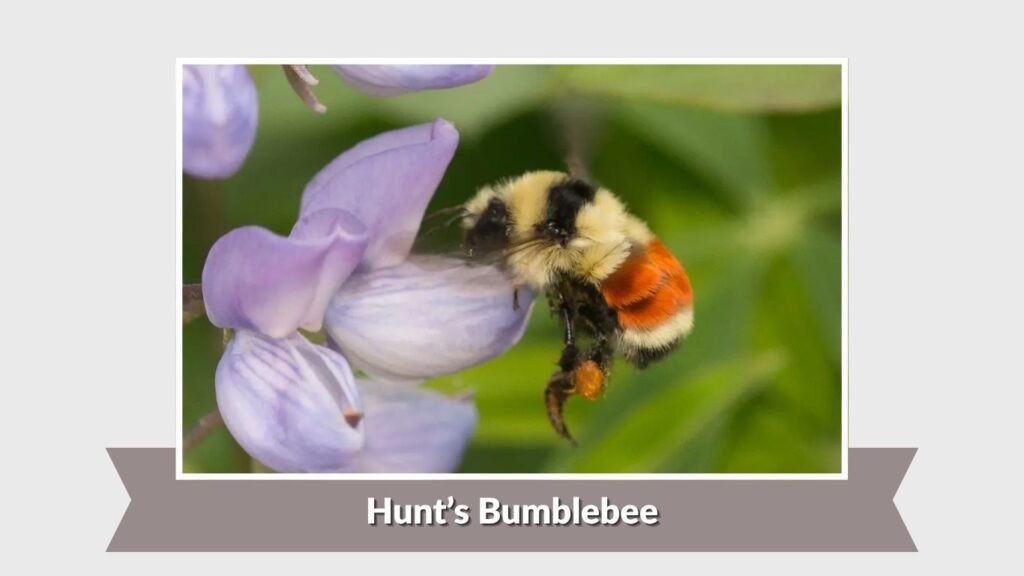
Hunt’s bumblebee (Bombus huntii) is a colorful western North American species. Its yellow, black, and orange pattern makes it relatively easy to recognize. It is a valuable pollinator in dry grasslands, mountain meadows, farms, and gardens.
Identification
- Queens measure approximately 19–20 mm long.
- Workers usually measure 11–14 mm.
- Males are generally around 9–13 mm long.
- The face and top of the head have yellow hairs.
- A black band runs between the wing bases.
- The first abdominal segment is yellow.
- The second and third segments are orange.
- The fourth segment is yellow, followed by a black tip.
Habitat and Distribution
Hunt’s bumblebees are found throughout western North America, extending east into the Great Plains and south into mountainous areas of Mexico. They inhabit deserts, shrublands, prairies, open forests, farms, and mountain meadows. Colonies are normally established underground.
Diet and Pollination
This medium-tongued species visits lupines, milkvetch, fleabane, penstemon, phacelia, rabbitbrush, and many garden flowers. It can perform buzz pollination, making it valuable for tomatoes and other crops whose flowers hold pollen tightly.
Behavior and Sting
Hunt’s bumblebees are active, fast-moving foragers but are not normally aggressive toward people. Females may sting if squeezed, stepped on, or disturbed near the nest. Their colonies are annual, with only newly mated queens surviving the winter.
10. Nevada Bumblebee
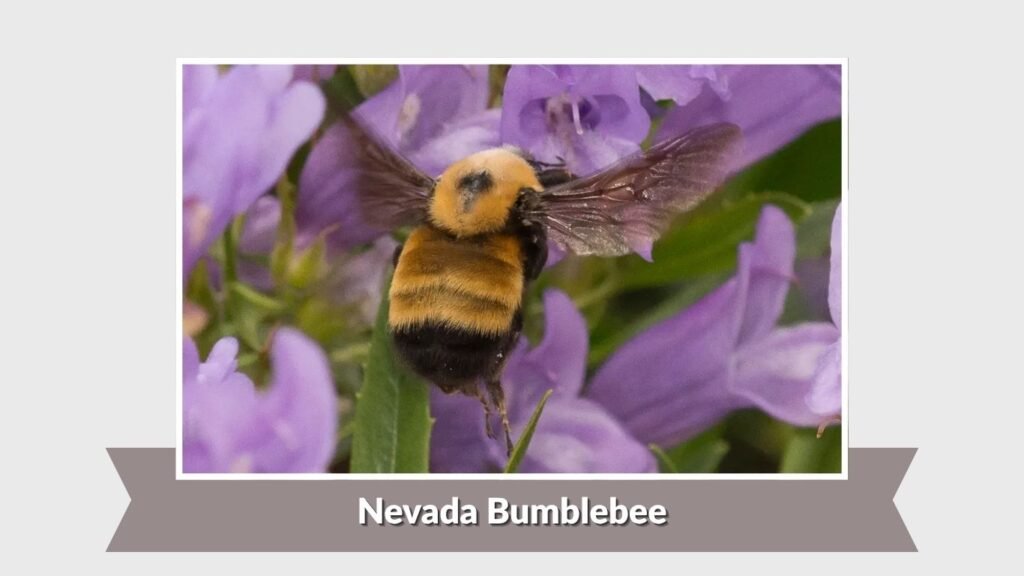
The Nevada bumblebee (Bombus nevadensis) is one of the larger bumblebee species in western North America. Despite its name, it is not limited to Nevada. Its range extends across many western and central regions.
Identification
- Queens average approximately 20 mm long.
- Workers may measure around 17 mm.
- Males are generally approximately 14 mm long.
- Female heads are primarily black.
- The thorax is golden yellow with a central black spot.
- The first three abdominal segments are golden yellow.
- The rear abdominal segments are black.
- Males may have yellow facial hairs.
Habitat and Distribution
Nevada bumblebees occur from Alaska and western Canada south through the western United States. Their distribution extends eastward into parts of the Great Plains and Midwest. They prefer open landscapes such as prairies, sagebrush areas, meadows, farms, and mountain valleys.
Diet and Pollination
These bees visit milkvetch, thistles, clover, penstemon, phacelia, salvia, and bergamot. Their relatively long tongues allow them to reach nectar from deeper flowers. They also transport large quantities of pollen between plants.
Behavior and Sting
Nevada bumblebees are generally docile while feeding and usually ignore nearby people. However, females can sting repeatedly in defense. Underground nests should be left undisturbed whenever they do not present an immediate safety problem.
11. Black-Tailed Bumblebee
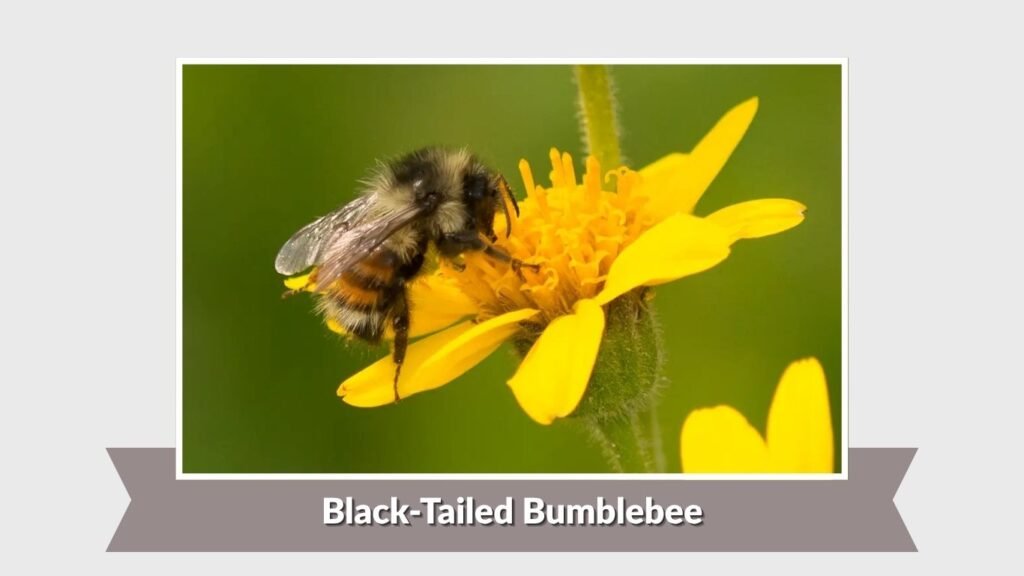
The black-tailed bumblebee (Bombus melanopygus) is a colorful species native to western North America. Despite its common name, not every individual has an entirely black middle abdomen. Some populations display red or orange abdominal hairs, making identification more challenging.
Identification
- Queens usually measure approximately 15–19 mm long.
- Workers are generally around 9–15 mm long.
- The face may be covered with yellow hairs.
- A black band extends between the wing bases.
- The first abdominal segment is yellow.
- The second and third segments may be black or reddish-orange.
- Yellow hairs are usually present on the fourth abdominal segment.
- The end of the abdomen is black.
Habitat and Distribution
Black-tailed bumblebees occur across western North America, from Alaska and western Canada south through the western United States. They inhabit mountains, forests, meadows, coastal areas, farms, and urban gardens. Colonies are commonly established underground in abandoned rodent burrows.
Diet and Pollination
These bumblebees visit lupines, clover, currants, blueberries, penstemons, thistles, and numerous other flowers. They can perform buzz pollination, which helps release pollen from flowers such as tomatoes and blueberries.
Behavior and Sting
Black-tailed bumblebees are usually calm while foraging. Workers may become defensive near their underground colony, particularly if vibrations or digging disturb the nest. Females can sting repeatedly, but attacks are uncommon without provocation.
12. White-Tailed Bumblebee
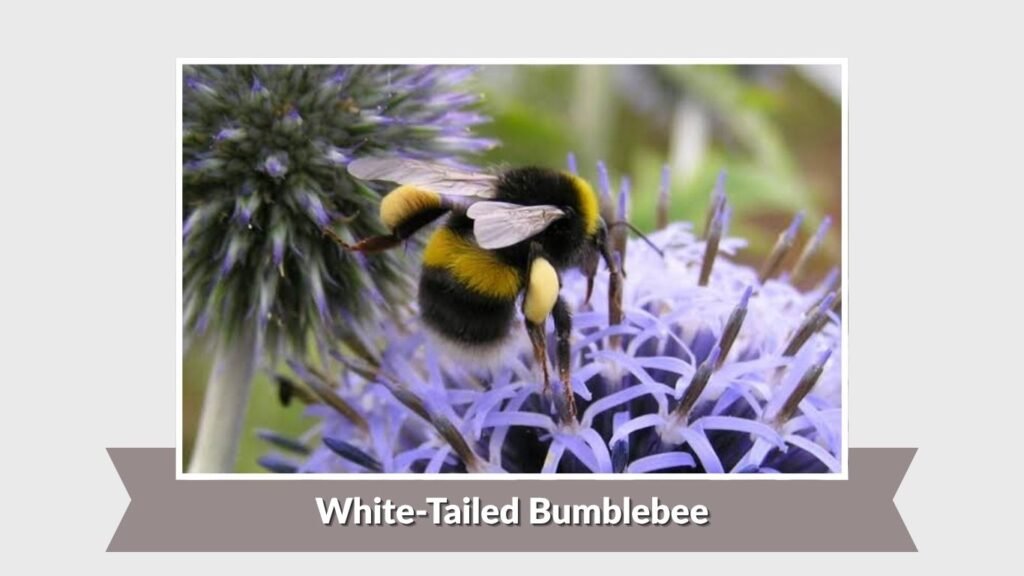
The white-tailed bumblebee (Bombus lucorum) is a common European species recognized by its bright white abdominal tip. It belongs to a group of closely related bumblebees that can be extremely difficult to separate using appearance alone.
Identification
- Queens are approximately 18–22 mm long.
- Workers generally measure 12–18 mm.
- The body is predominantly black.
- A lemon-yellow collar crosses the front of the thorax.
- Another yellow band appears on the abdomen.
- The tip of the abdomen is clean white.
- Males usually have additional yellow facial hair.
- The tongue is relatively short.
Habitat and Distribution
White-tailed bumblebees are widespread throughout Europe and parts of northern Asia. They occupy gardens, parks, farmland, woodlands, grasslands, heathlands, and coastal areas. Colonies are usually constructed underground in abandoned mouse or vole burrows.
Diet and Pollination
This species visits bramble, thistles, clover, lavender, knapweed, dandelions, and many other flowers. Its short tongue is well suited to shallow blossoms. Workers sometimes obtain nectar by biting holes near the bases of deeper flowers.
Behavior and Sting
White-tailed bumblebees are active and adaptable but rarely aggressive toward people. Workers may defend the nest when its entrance is disturbed. Their sting generally causes immediate pain followed by temporary redness, itching, or swelling.
13. Buff-Tailed Bumblebee
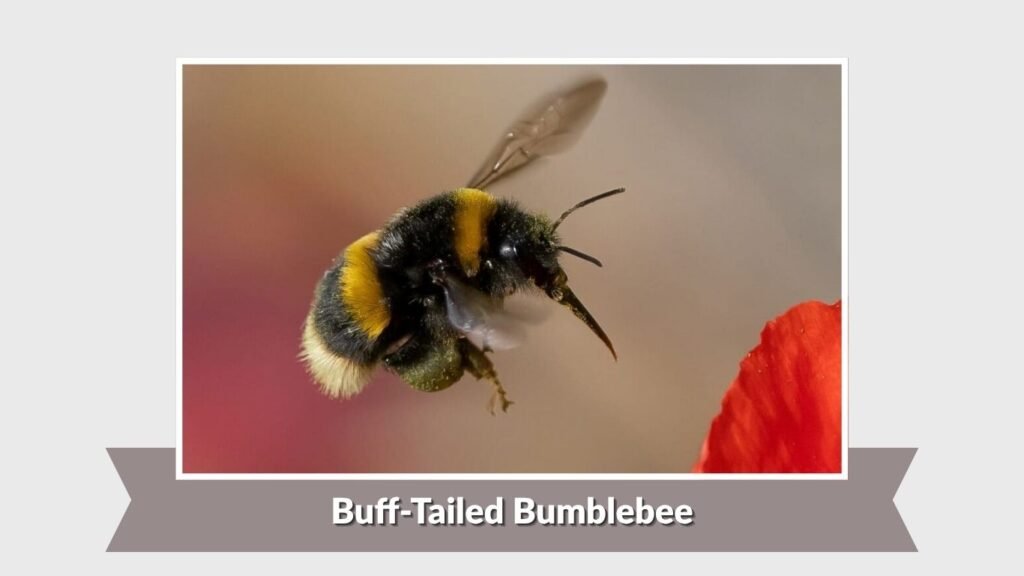
The buff-tailed bumblebee (Bombus terrestris) is one of Europe’s largest and most familiar bumblebees. It is widely used for commercial crop pollination, especially inside greenhouses. Introduced populations have also become established outside their natural range.
Identification
- Queens usually measure approximately 20–22 mm long.
- Workers are generally 11–17 mm long.
- Males measure around 14–16 mm.
- The body is mostly black.
- A dark-yellow band crosses the front of the thorax.
- Another yellow band appears on the abdomen.
- Queens have a buff or cream-colored tail.
- Workers often have a whiter tail and resemble white-tailed bumblebees.
Habitat and Distribution
Buff-tailed bumblebees are native to Europe, North Africa, and parts of western Asia. They live in gardens, parks, farmland, grasslands, woodland borders, and urban areas but are less common in high uplands. Nests are usually located underground in abandoned rodent burrows.
Diet and Pollination
These adaptable bees visit fruit-tree blossoms, clover, lavender, dandelions, bramble, and numerous cultivated plants. Their ability to perform buzz pollination makes them valuable pollinators of tomatoes, peppers, and greenhouse crops.
Behavior and Sting
Buff-tailed bumblebees are normally docile when feeding. Because their colonies can contain many workers, they may defend nests vigorously if disturbed. Females can sting multiple times, although they usually provide warning by buzzing or raising a leg.
14. Garden Bumblebee
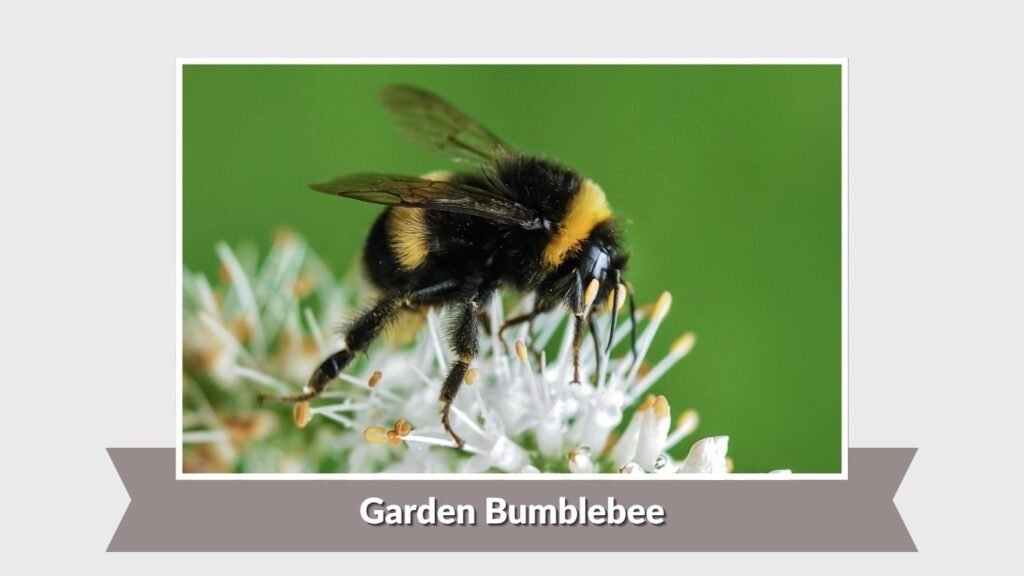
The garden bumblebee (Bombus hortorum) is a widespread European species with an exceptionally long tongue. This adaptation allows it to collect nectar from deep, tubular flowers that shorter-tongued bees may be unable to access.
Identification
- Queens generally measure approximately 17–22 mm long.
- Workers are usually around 11–16 mm long.
- The head and face are noticeably long.
- A yellow collar appears at the front of the thorax.
- A second yellow band crosses the rear of the thorax.
- A third yellow band occurs near the abdomen’s base.
- The tail is white.
- The body often has a long, somewhat untidy coat.
Habitat and Distribution
Garden bumblebees occur across most of Europe and parts of northern and central Asia. They have also been introduced into New Zealand. They inhabit gardens, parks, farmland, grasslands, woodland edges, and other flower-rich environments. Nests are commonly built underground in abandoned rodent burrows. Bumblebee Conservation Trust
Diet and Pollination
Their long tongues are particularly useful for feeding from foxglove, honeysuckle, red clover, comfrey, deadnettle, and vetch. Garden bumblebees are effective pollinators because pollen brushes against their head and thorax while they reach inside deep flowers.
Behavior and Sting
Garden bumblebees are peaceful and generally ignore humans while searching for flowers. Females can sting if handled or trapped, while males cannot sting. Underground nests should be protected from digging, flooding, and pesticide exposure.
15. Tree Bumblebee
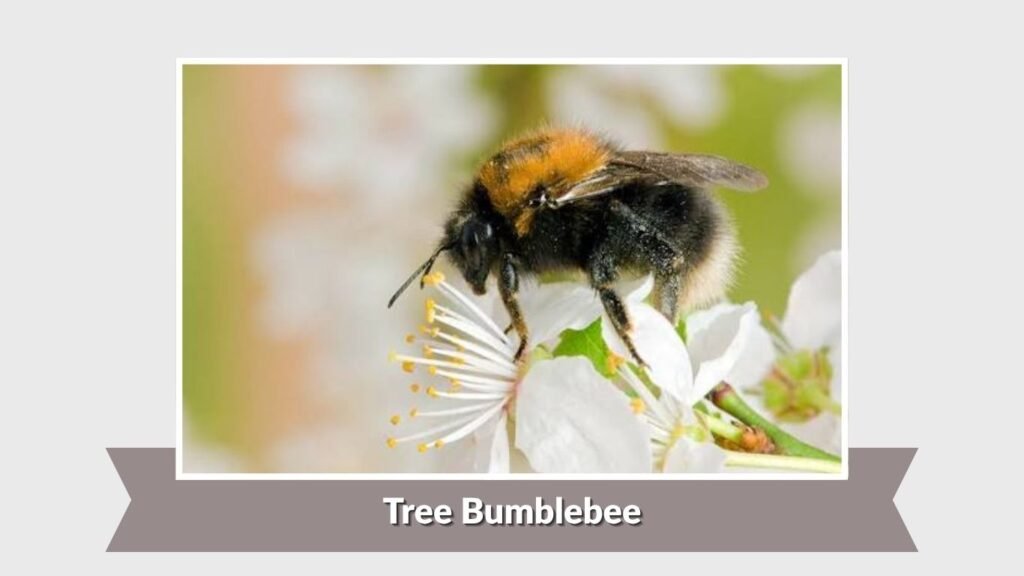
The tree bumblebee (Bombus hypnorum) is a distinctive Eurasian species that commonly nests above ground. It readily uses tree cavities, roof spaces, and abandoned bird boxes, allowing it to live successfully near human homes.
Identification
- Queens are generally around 17–20 mm long.
- Workers vary considerably but are smaller than queens.
- The top of the thorax is ginger or chestnut brown.
- The abdomen is predominantly black.
- The abdominal tip is bright white.
- Queens, workers, and males have similar color patterns.
- Males may have ginger hairs on the face and first abdominal segment.
Habitat and Distribution
Tree bumblebees are widespread across continental Europe and parts of northern Asia. They have expanded into Britain and Ireland and are now common in many urban and suburban locations. They occupy woodlands, parks, gardens, farms, and residential areas. Nests frequently appear in trees, walls, roof cavities, and bird boxes. Bumblebee Conservation Trust
Diet and Pollination
Tree bumblebees visit willow, raspberry, blackberry, cotoneaster, rhododendron, fruit blossoms, and many garden flowers. Their early seasonal activity makes them useful pollinators of flowering trees and shrubs.
Behavior and Sting
Workers may defend nests located in bird boxes or buildings, but they rarely sting people who remain at a reasonable distance. Groups of males sometimes hover outside the entrance while waiting for new queens. This behavior can look threatening, but males have no stingers.