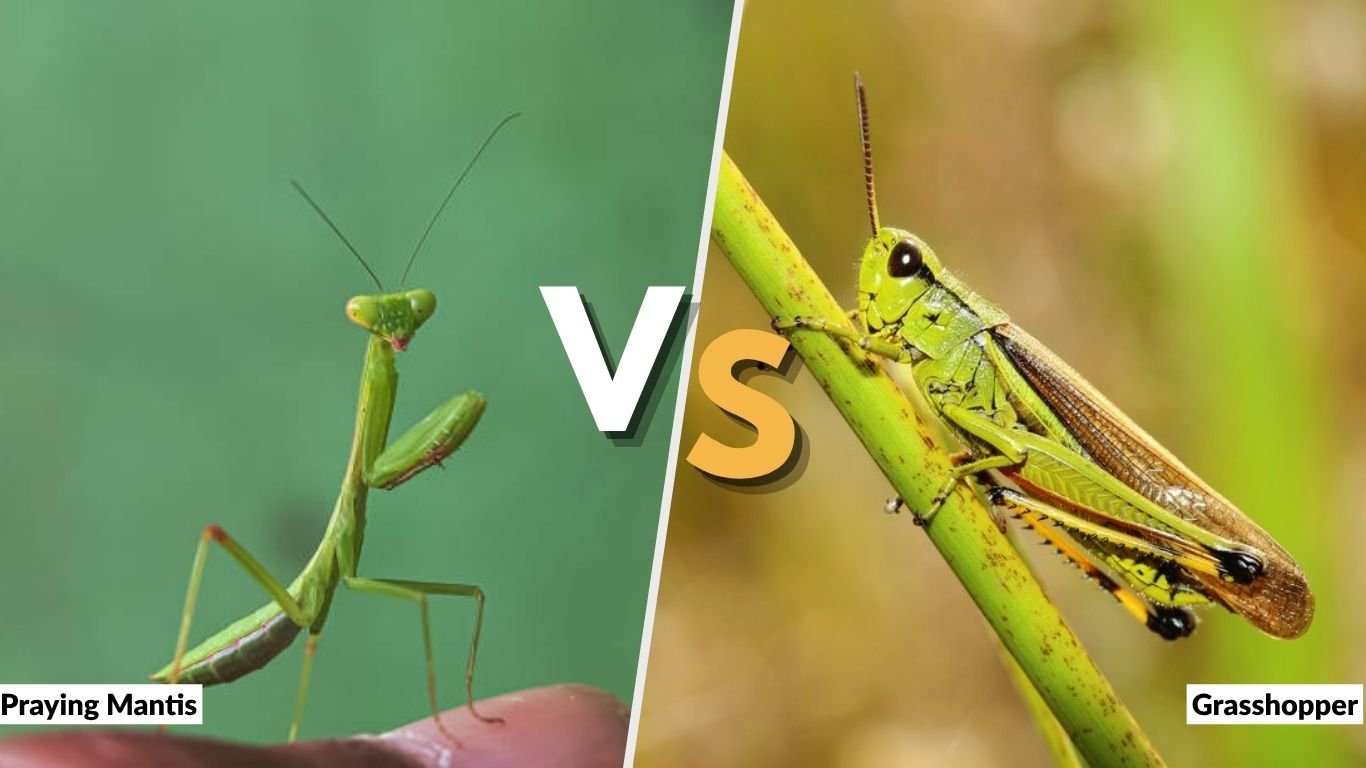
Praying mantises and grasshoppers are common insects that may share the same gardens, fields, and grasslands, but they live very different lives. A grasshopper is primarily a plant eater built for powerful jumping, while a praying mantis is a predatory hunter equipped with specialized front legs for capturing prey. Their body shape, diet, movement, behavior, and hunting strategies make them easy to distinguish once you know the signs. Here is a detailed praying mantis vs grasshopper comparison, including size, jumping ability, babies, and which insect would likely win in a fight.
Praying Mantis vs Grasshopper: Quick Comparison
Although both insects have six legs, wings in many adult species, and excellent camouflage, they belong to different insect groups. Grasshoppers belong to the order Orthoptera, while praying mantises belong to Mantodea. Their feeding habits provide one of the clearest differences: grasshoppers mostly consume vegetation, whereas mantises actively hunt other animals.
| Feature | Praying Mantis | Grasshopper |
| Diet | Carnivorous | Mainly herbivorous |
| Front legs | Raptorial, used to catch prey | Normal walking legs |
| Hind legs | Walking/climbing | Enlarged for jumping |
| Antennae | Relatively long | Usually short |
| Head | Triangular and highly mobile | Rounded or elongated |
| Main movement | Walking, climbing, flying | Jumping and flying |
| Hunting | Ambush predator | Does not normally hunt |
| Camouflage | Green, brown, leaflike | Green, brown, gray |
| Young | Nymph | Nymph |
Praying Mantis vs Grasshopper Appearance
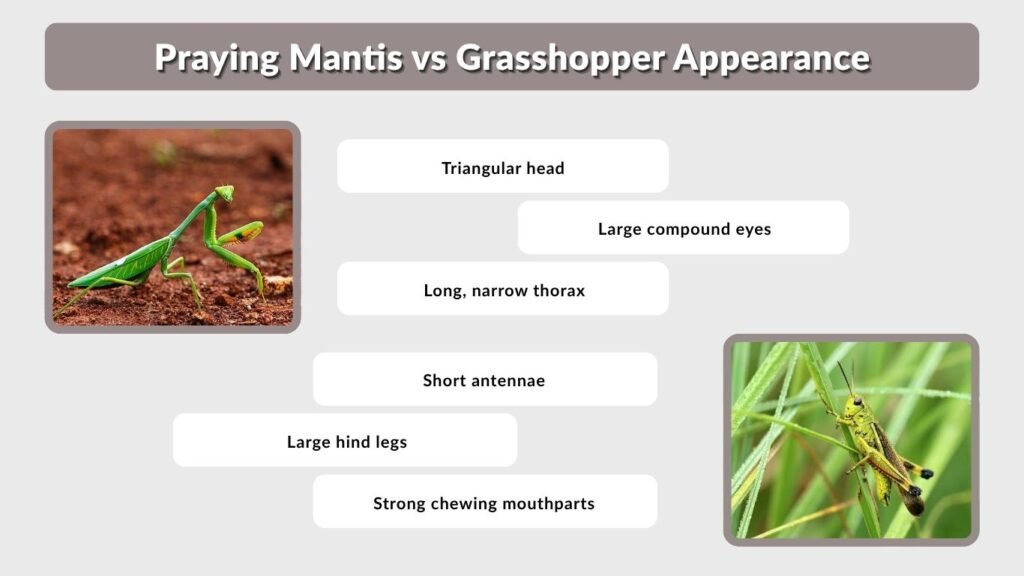
Appearance is one of the easiest ways to separate these insects. A mantis typically has an elongated body, triangular head, long necklike thorax, and distinctive folded front legs. Grasshoppers have heavier bodies and enormous muscular hind legs designed for jumping.
How to Identify a Praying Mantis
Important praying mantis identification features include:
- Triangular head
- Large compound eyes
- Head capable of considerable movement
- Long, narrow thorax
- Spiny grasping front legs
- Green or brown coloration
- Long body
- Wings in many adults
The front legs are usually held together in a position resembling hands folded in prayer, which explains the insect’s common name.
How to Identify a Grasshopper
Grasshoppers typically have:
- Short antennae
- Large hind legs
- Strong chewing mouthparts
- Thick or elongated bodies
- Large compound eyes
- Green, brown, yellow, or gray coloration
- Wings in most adults
Their massive hind legs are usually the most obvious identification feature.
Praying Mantis vs Grasshopper Size
Both groups include small and large species, so there is no single size that applies to every mantis or grasshopper. Some large mantises are longer than common grasshoppers, while giant grasshopper species can exceed the size of many mantises.
Praying Mantis Size
Many adult praying mantises are approximately 2 to 4 inches long, though individual species may be considerably smaller or larger.
Their slender bodies can make them appear longer than their actual mass suggests.
Grasshopper Size
Many familiar grasshoppers range from about 1 to 3 inches long. Giant species can grow substantially larger.
Grasshoppers tend to have bulkier bodies and heavier hind legs than mantises of similar length.
Praying Mantis vs Grasshopper Diet
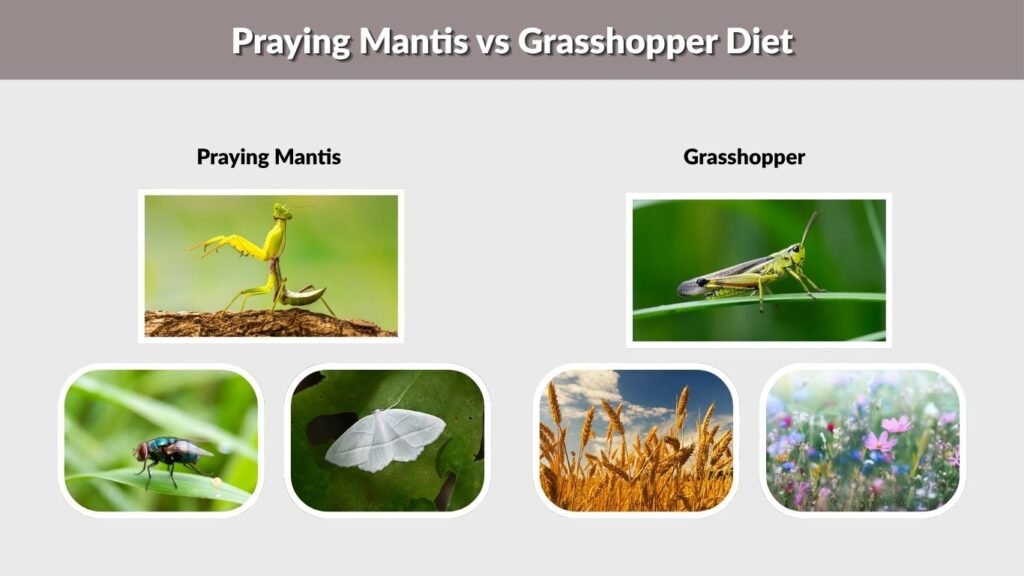
Diet is perhaps the biggest difference between these insects. Grasshoppers mostly obtain energy from plants. Praying mantises obtain their nutrition by capturing and eating other animals.
What Do Praying Mantises Eat?
Praying mantises commonly prey on:
- Flies
- Moths
- Crickets
- Grasshoppers
- Beetles
- Caterpillars
- Bees
- Other mantises
- Various small insects
Large mantises may occasionally capture other small animals, but insects make up the bulk of their typical diet.
What Do Grasshoppers Eat?
Grasshoppers commonly consume:
- Grass
- Leaves
- Weeds
- Flowers
- Seeds
- Grains
- Agricultural crops
- Garden plants
Most species are primarily herbivorous, although some may occasionally consume other organic material.
Praying Mantis vs Grasshopper Jump
Grasshoppers are far better known for jumping. Their enlarged hind legs act like powerful springs, allowing them to launch themselves rapidly away from predators.
Mantises can move quickly when necessary, and young mantises may jump short distances, but jumping is not their primary method of escape or transportation.
Why Can Grasshoppers Jump So Far?
Several features help grasshoppers jump efficiently:
- Enlarged hind-leg muscles
- Long hind legs
- Strong joints
- Lightweight bodies
- Rapid release of stored muscular energy
A grasshopper may combine jumping with flight, opening its wings after launching itself into the air.
How Does a Praying Mantis Move?
Mantises normally walk or climb slowly while stalking prey. Their deliberate movements help them remain unnoticed.
Adult mantises with functional wings can also fly, especially when searching for mates or moving between locations.
Praying Mantis vs Grasshopper Behavior
The two insects behave differently because they occupy different ecological roles. Mantises need to approach prey without being detected, while grasshoppers spend much of their time feeding on plants and escaping predators.
Praying Mantis Hunting Behavior
A praying mantis is an ambush predator. It may remain motionless among leaves until another insect comes within reach.
When prey approaches, the mantis rapidly extends its spiny front legs, grabs the animal, and holds it firmly while feeding.
Grasshopper Defensive Behavior
Grasshoppers generally avoid confrontation. Their main defenses include:
- Camouflage
- Powerful jumping
- Rapid flight
- Hiding in vegetation
- Sudden unpredictable movement
These defenses are particularly useful against predators such as birds, reptiles, spiders, and praying mantises.
Baby Praying Mantis vs Baby Grasshopper
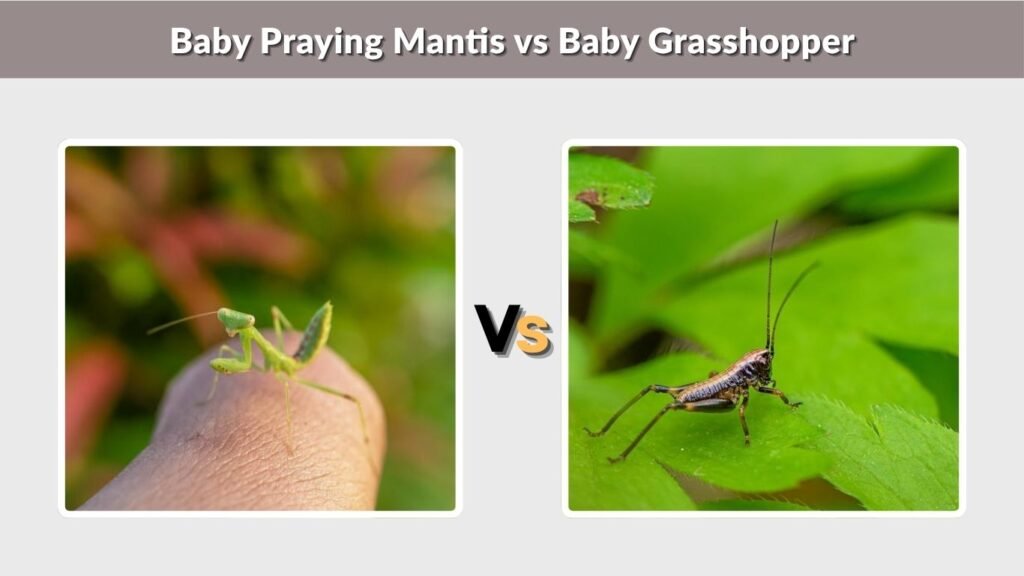
Both praying mantises and grasshoppers undergo incomplete metamorphosis. Their young are known as nymphs and resemble smaller, wingless versions of adults.
However, their body shapes become distinguishable soon after hatching.
Baby Praying Mantis
A young praying mantis already possesses grasping front legs and a mantis-like body. It begins hunting very small prey soon after emerging.
Young mantises molt repeatedly before becoming adults.
Baby Grasshopper
A grasshopper nymph has enlarged hind legs but lacks fully developed wings. It mainly feeds on vegetation and grows through a series of molts.
The wing pads gradually become larger until the final adult stage.
Praying Mantis vs Grasshopper: Who Would Win?
In a direct encounter, a praying mantis would generally have the advantage because it is specifically adapted to capture other insects. Grasshoppers can become prey for mantises, particularly when the mantis is similar in size or larger.
Why the Mantis Has an Advantage
A praying mantis has:
- Spiny grasping front legs
- Fast striking speed
- Strong mandibles
- Predatory instincts
- Excellent camouflage
- Good vision
If a grasshopper comes within striking range, the mantis may seize it before it can escape.
However, the grasshopper’s biggest advantage is its ability to jump away extremely quickly. A successful escape prevents the encounter from becoming a fight at all.
Praying Mantis vs Grasshopper vs Cricket
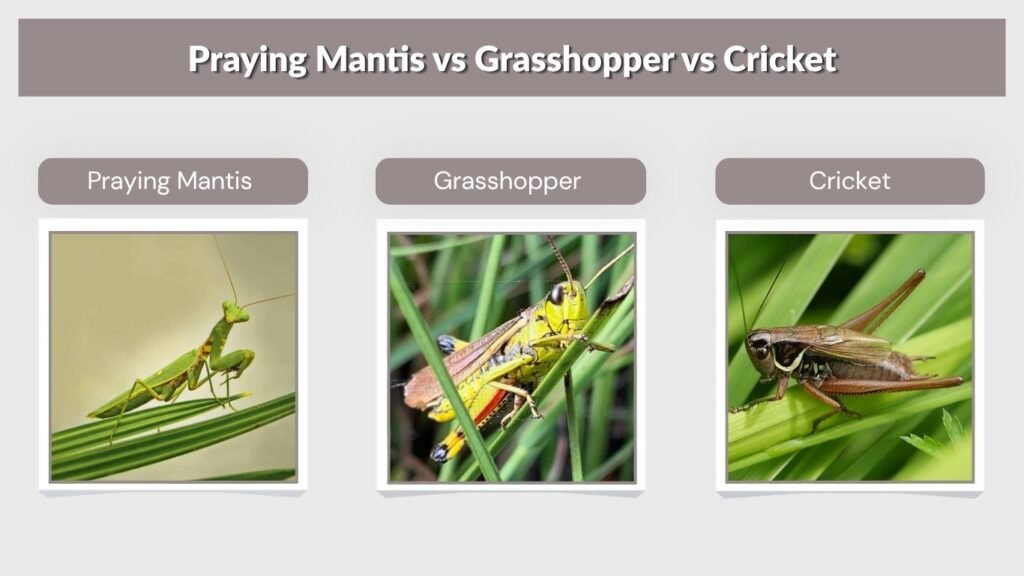
Crickets add another closely encountered jumping insect to the comparison. Grasshoppers and crickets are more closely related to each other than either is to a praying mantis.
How to Tell Them Apart
- Praying mantis: Long body with specialized grasping front legs.
- Grasshopper: Short antennae with exceptionally large hind legs.
- Cricket: Very long antennae and powerful hind legs.
- Locust: A type of grasshopper capable of entering a swarming phase.
- Katydid: Long antennae and often a broad, leaflike green body.
A quick examination of the legs and antennae will usually distinguish these insects.
FAQs
1. What is the main difference between a praying mantis and grasshopper?
A praying mantis is primarily a predator that catches other insects with specialized front legs, while a grasshopper mainly eats vegetation and has enlarged hind legs designed for jumping.
2. Do praying mantises eat grasshoppers?
Yes. Grasshoppers can be natural prey for praying mantises. A mantis may ambush and capture a grasshopper when it comes within striking distance.
3. Which jumps farther, a praying mantis or grasshopper?
Grasshoppers are generally much stronger jumpers because their enlarged hind legs are specifically adapted for powerful leaps.
4. Who would win, a praying mantis or grasshopper?
A similarly sized praying mantis would usually have the advantage in close contact because it is an active predator. However, a grasshopper can avoid capture by quickly jumping or flying away.
5. Are praying mantises and grasshoppers related?
They are both insects but belong to different orders. Grasshoppers belong to Orthoptera, while praying mantises belong to Mantodea.