

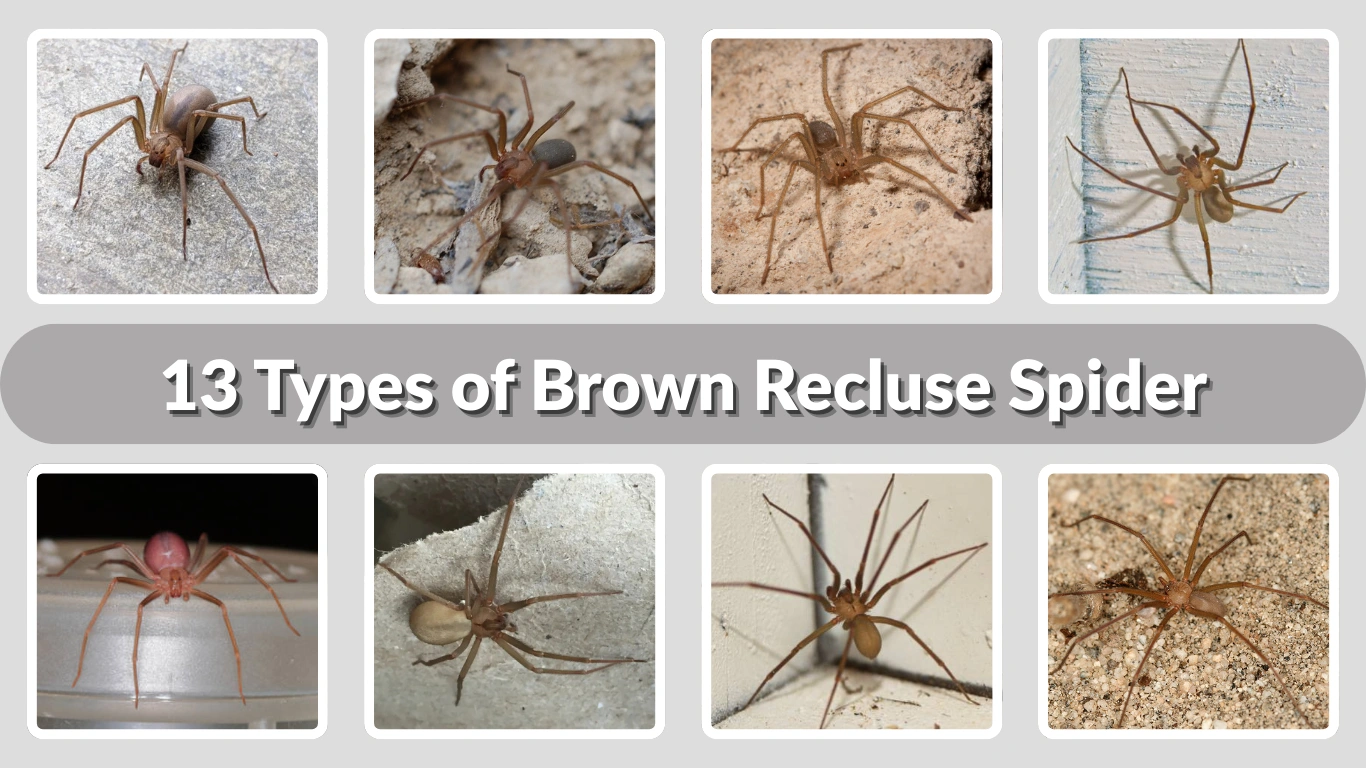
Brown recluse spiders are a group of shy, nocturnal spiders known for their violin-shaped markings and preference for dark, undisturbed environments. Although their venom can be medically significant, these spiders avoid human contact and typically remain hidden. Found in both desert and urban habitats, recluse species vary in color, size, and distribution. This guide introduces 13 different brown recluse types and highlights their unique traits and behaviors.
1. Brown Recluse

The brown recluse is one of the most recognized recluse spiders in North America, known for its violin-shaped marking and medically significant bite. Despite its reputation, it is shy, avoids confrontation, and prefers dark, undisturbed places.
Identification
- Light to medium brown body
- Distinct dark violin-shaped marking on cephalothorax
- Six eyes arranged in three pairs
- Long, slender legs without heavy spines
- Small to medium size (6–12 mm)
Habitat
Brown recluses prefer quiet, dark environments such as basements, attics, closets, garages, woodpiles, and storage areas. Outdoors, they live under rocks, bark, and debris. They are commonly found in the central and southern United States and often hide in undisturbed household items.
Behaviors
These spiders are nocturnal and avoid human contact. They spend the day hiding in sheltered spots and emerge at night to hunt. They do not build webs to catch prey but may create irregular silk retreats. When threatened, they retreat rather than attack.
Diet and Lifecycle
Brown recluses feed on small insects such as crickets, cockroaches, and beetles. They hunt actively at night and return to their hiding spots after feeding. Females lay egg sacs containing dozens of eggs. Spiderlings hatch and disperse, going through multiple molts before adulthood. Adults may live 1–2 years under favorable conditions.
2. Desert Recluse

The desert recluse is a light-colored recluse spider adapted to hot, arid environments. Known for its pale appearance and reclusive nature, it is found primarily in the deserts of the southwestern United States. Though venomous, it avoids conflict and remains hidden during the day.
Identification
- Pale tan to light brown body
- Faint or absent violin marking
- Six eyes arranged in three pairs
- Long, slender legs adapted for desert surfaces
- Small to medium size (similar to the brown recluse)
Habitat
Desert recluses inhabit dry, sandy, and rocky regions. They are found under stones, desert vegetation, logs, and debris. They may occasionally enter homes but prefer outdoor environments with minimal moisture. Their range includes parts of California, Nevada, Utah, and Arizona.
Behaviors
These spiders are nocturnal and spend daylight hours hiding in burrows or sheltered cracks. They are solitary and non-aggressive, hunting at night for insects. They do not rely on webs for catching prey, though they may create simple silk retreats.
Diet and Lifecycle
Desert recluses feed on small insects such as beetles, ants, and crickets. They hunt by stealth, capturing prey with quick strikes. Females lay egg sacs in protected crevices. Spiderlings disperse soon after hatching and molt several times before adulthood. Lifespan is typically 1–2 years.
3. Texas Recluse

The Texas recluse is a widespread recluse species native to Texas and surrounding regions. It closely resembles the brown recluse but is typically slightly larger and more variable in coloration. Like other recluse spiders, it is shy and prefers secluded environments.
Identification
- Light brown to dark brown body
- Violin-shaped marking present but may be faint
- Six eyes arranged in three pairs
- Long, slender legs
- Slightly larger on average than the brown recluse
Habitat
Texas recluses live in dry, sheltered environments such as barns, sheds, woodpiles, attics, and undisturbed household spaces. Outdoors, they hide under rocks, logs, and debris. They are most common in Texas but also appear in neighboring states.
Behaviors
These spiders are nocturnal hunters that avoid human activity. They hide in cracks and clutter during the day, emerging at night to search for prey. They do not rely on webs for hunting but may construct irregular silk retreats for resting or egg-laying.
Diet and Lifecycle
Their diet consists of beetles, ants, cockroaches, and other small insects. They stalk prey quietly, using quick strikes to subdue it. Females lay egg sacs containing dozens of eggs in hidden retreats. Spiderlings hatch, disperse, and molt several times before reaching adulthood. Adults commonly live 1–2 years.
4. Arizona Recluse

The Arizona recluse is a desert-adapted species found primarily in Arizona and nearby regions. It closely resembles other recluse spiders but is particularly well-suited to hot, dry environments. Though venomous, it avoids confrontation and remains hidden most of the time.
Identification
- Light tan to medium brown body
- Violin marking may be faint or moderately visible
- Six eyes in three pairs
- Long, thin legs with fine hairs
- Medium size, similar to the Texas recluse
Habitat
Arizona recluses inhabit desert scrublands, rocky slopes, dry woodlands, and sheltered outdoor debris. They hide under rocks, bark, logs, and man-made structures. Indoors, they may appear in garages, sheds, and basements, especially during hot weather.
Behaviors
These spiders are nocturnal and highly reclusive. They hunt at night and stay hidden in narrow cracks or crevices during the day. They do not build webs for hunting but may spin irregular silk retreats for shelter or egg-laying. They avoid humans whenever possible.
Diet and Lifecycle
Their diet includes beetles, crickets, ants, and other small insects. They rely on stealth to catch prey, striking quickly when within range. Females lay egg sacs in sheltered locations, each containing dozens of eggs. Spiderlings hatch and undergo multiple molts before reaching adulthood. Adults typically live 1–2 years.
5. Big Bend Recluse

The Big Bend recluse is a localized species found mainly in the Big Bend region of Texas. It resembles other recluse spiders but is noted for its adaptation to rugged, rocky habitats. Like its relatives, it is shy, venomous, and prefers undisturbed areas.
Identification
- Light brown to yellow-brown body
- Violin marking usually faint or lightly defined
- Six eyes arranged in three pairs
- Slender legs with minimal spines
- Similar size to the brown and Texas recluse
Habitat
Big Bend recluses live in rocky canyons, desert slopes, and dry woodlands of western Texas. They shelter under stones, bark, and debris, and may enter structures such as sheds or cabins in remote areas. They prefer warm, arid, and secluded environments.
Behaviors
These spiders are nocturnal and extremely secretive. They remain hidden during the day, emerging only at night to hunt for prey. They do not use webs for catching food but may create irregular silk retreats for resting or egg-laying. They avoid confrontation and flee when disturbed.
Diet and Lifecycle
Their diet consists of small insects, including beetles, crickets, and other arthropods found in desert terrain. Females lay egg sacs in protected hiding places, each containing numerous eggs. Spiderlings disperse shortly after hatching and pass through several molts before adulthood. Adults typically survive 1–2 years.
6. Baja Recluse

The Baja recluse is a species native to the Baja California Peninsula and neighboring regions. It is adapted to warm, dry climates and is known for its subtle coloration and reclusive behavior. Like all recluse spiders, it possesses venom but avoids contact with humans.
Identification
- Pale tan to light brown body
- Violin marking may be faint or barely visible
- Six eyes arranged in three pairs
- Long, thin legs with minimal spines
- Slightly smaller than some mainland recluse species
Habitat
Baja recluses inhabit dry desert areas, rocky hillsides, canyons, and sheltered outdoor spaces. They hide beneath rocks, dead vegetation, and debris. Indoor sightings are uncommon, but they may enter buildings in rural or desert communities.
Behaviors
These spiders are nocturnal hunters that remain hidden during the day. They avoid confrontation and will escape rather than bite. They do not construct webs for capturing prey, instead creating simple silk retreats used for hiding, molting, or laying eggs.
Diet and Lifecycle
Their diet includes small insects such as ants, beetles, and crickets. They track prey quietly and grab it quickly with their front legs. Females lay egg sacs containing numerous eggs in hidden retreats. Spiderlings hatch, disperse, and molt several times before adulthood. Adults live approximately 1–2 years.
7. Loxosceles laeta (Chilean Recluse)

Loxosceles laeta, commonly known as the Chilean recluse, is considered one of the most medically significant recluse spiders due to its potent venom. Native to South America, it is larger and more robust than many North American recluse species, yet remains extremely shy and avoids human interaction.
Identification
- Light to dark brown body
- Clearly defined violin-shaped marking
- Six eyes arranged in three pairs
- Long, slender legs
- Larger than the common brown recluse
Habitat
The Chilean recluse inhabits human dwellings, storage areas, woodpiles, basements, and dark, undisturbed spaces. Outdoors, it shelters under rocks, logs, and debris. It thrives in warm climates and has spread to some regions outside South America.
Behaviors
These spiders are nocturnal and remain hidden during the daytime. They avoid confrontation and prefer to flee rather than defend themselves. They do not build capture webs but create irregular silk retreats for hiding and laying eggs.
Diet and Lifecycle
Their diet consists of small insects such as beetles, crickets, and cockroaches. They stalk prey quietly and deliver quick bites. Females produce multiple egg sacs, each containing many eggs. Spiderlings disperse after hatching and molt several times before reaching adulthood. Lifespan can exceed 2 years, longer than many recluse species.
8. Loxosceles rufescens (Mediterranean Recluse)

Loxosceles rufescens, known as the Mediterranean recluse, is a widely distributed species found in Europe, the Middle East, and many warm regions worldwide. Although venomous, it is exceptionally shy and seldom bites humans. It often coexists quietly within human structures.
Identification
- Light tan to reddish-brown body
- Violin marking often faint or lightly outlined
- Six eyes arranged in three pairs
- Long, slender legs
- Medium size similar to the brown recluse
Habitat
Mediterranean recluses live in dark, sheltered areas such as basements, attics, closets, and storage spaces. Outdoors, they hide under stones, bark, and debris. Their adaptability has allowed them to spread through travel, shipping, and urban environments.
Behaviors
These spiders are nocturnal and reclusive. They avoid confrontation and flee when disturbed. They do not build webs to catch prey but may spin irregular silk retreats for hiding, resting, or protecting egg sacs.
Diet and Lifecycle
Their diet includes beetles, ants, cockroaches, and other small insects. They stalk prey at night and deliver quick, controlled bites. Females lay egg sacs in hidden retreats, each containing multiple eggs. Spiderlings hatch, disperse, and molt several times before adulthood. Adults typically live 1–2 years.
9. Loxosceles reclusa (Gertsch Variant)

The Gertsch variant of Loxosceles reclusa is a recognized form of the brown recluse that displays subtle differences in appearance due to regional variation. Though slightly different in coloration or pattern, it behaves similarly to the typical brown recluse and shares the same reclusive nature.
Identification
- Light to medium brown body
- Violin marking may appear lighter or more diffuse
- Six eyes arranged in three pairs
- Long, slender legs
- Slight regional variation in size or tone
Habitat
This variant inhabits the same environments as the common brown recluse—dark, dry, undisturbed areas such as basements, closets, attics, garages, woodpiles, and debris piles. It appears in regions where local populations have developed unique characteristics.
Behaviors
The Gertsch variant is nocturnal and avoids human interaction. It hides in sheltered places during the day and emerges at night to hunt small insects. Like other recluse spiders, it does not use webs for catching prey but creates irregular silk retreats for resting and egg-laying.
Diet and Lifecycle
Its diet includes beetles, ants, small roaches, and other insects. It stalks prey quietly and captures it with quick strikes. Females lay egg sacs hidden in protected areas. Spiderlings hatch, disperse, and molt several times before adulthood. Adults typically live 1–2 years, depending on conditions.
10. Loxosceles devia

Loxosceles devia is a lesser-known recluse species native to Mexico and parts of Central America. It shares the characteristic violin marking and six-eyed arrangement typical of recluse spiders. Though venomous, it is secretive and rarely encountered by humans.
Identification
- Light brown to yellowish-tan body
- Violin marking present but often faint
- Six eyes arranged in three pairs
- Long, thin legs
- Medium size similar to the brown recluse
Habitat
Loxosceles devia inhabits warm, dry environments such as rocky slopes, forest debris, old woodpiles, and sheltered crevices. In human settings, it may hide in basements, storage rooms, or behind unused objects, especially in rural areas.
Behaviors
This species is nocturnal and avoids confrontation. It spends daylight hours hiding in tight cracks or under debris and emerges at night to hunt. It does not spin webs to capture prey but may create simple silk retreats for shelter and egg protection.
Diet and Lifecycle
Its diet includes small insects like beetles, ants, and crickets. It captures prey using stealth, moving slowly before delivering a quick bite. Females produce egg sacs with multiple eggs, typically hidden in protected retreats. Spiderlings disperse after hatching and molt several times before reaching adulthood. Adults commonly live 1–2 years.
11. Loxosceles deserta (Desert Recluse Variant)

Loxosceles deserta is a desert-adapted recluse species found in the southwestern United States. Similar to other desert recluses, it is pale, elusive, and well-suited to arid environments. Despite its venomous bite, it avoids humans and remains hidden in sheltered areas.
Identification
- Pale tan or sandy-brown body
- Violin marking may be faint or barely visible
- Six eyes arranged in three pairs
- Long, slender legs adapted for desert terrain
- Slightly larger than some related species
Habitat
Loxosceles deserta inhabits dry, rocky deserts, canyons, and shrubland environments. It hides under rocks, bark, and debris. Indoors, it may appear in storage areas, sheds, or garages in desert regions. It prefers warm, low-moisture environments with minimal disturbance.
Behaviors
This species is nocturnal and reclusive, remaining hidden during the day. It hunts insects at night using stealth and quick strikes. It does not build webs for catching prey but creates irregular silk retreats for resting, molting, and laying eggs.
Diet and Lifecycle
Its diet includes beetles, ants, small roaches, and other insects common in desert regions. Females lay egg sacs in protected crevices, each containing multiple eggs. Spiderlings hatch and disperse to find new shelter. Adults grow through several molts and typically live 1–2 years.
12. Loxosceles alderi

Loxosceles alderi is a lesser-known recluse species found in parts of Mexico and Central America. Though similar in appearance to other members of the Loxosceles genus, it remains one of the more rarely encountered species. Like all recluses, it is timid and avoids confrontation.
Identification
- Light tan to medium brown body
- Violin marking present but often faint or narrow
- Six eyes arranged in three pairs
- Slender legs with fine hairs
- Small to medium size within the recluse range
Habitat
Loxosceles alderi inhabits dry forests, rocky hillsides, and sheltered outdoor spaces. Indoors, it may hide behind boxes, under furniture, or in quiet corners of storage areas. It prefers undisturbed, low-light environments with minimal traffic.
Behaviors
This species is nocturnal and spends daytime hours concealed in narrow cracks, crevices, or under debris. It does not spin capture webs but builds simple silk retreats for molting and egg-laying. When threatened, it retreats rather than bite.
Diet and Lifecycle
Its diet includes ants, beetles, and small insects it hunts at night. It approaches prey quietly and subdues it with a quick bite. Females lay egg sacs inside protected retreats, each containing multiple eggs. Spiderlings disperse soon after hatching and molt several times before becoming adults. Adults typically live 1–2 years.
13. Loxosceles misteca

Loxosceles misteca is a recluse species native to Mexico but now found in various countries due to accidental transport. It is sometimes confused with the brown recluse but tends to have slightly different coloration and habitat preferences. Like its relatives, it is secretive and prefers calm, dark spaces.
Identification
- Light tan to medium brown coloration
- Violin marking may be faint or somewhat elongated
- Six eyes arranged in three distinct pairs
- Long, thin legs typical of recluses
- Similar in size to the brown recluse
Habitat
Loxosceles misteca occupies dry, warm environments including homes, garages, attics, storage rooms, and outdoor debris. It is especially common in urban and rural settings where it can hide in undisturbed corners.
Behaviors
This species is nocturnal and rarely seen during the day. It hunts small insects without using webs, relying on stealth. It constructs irregular silk retreats for resting or guarding eggs. When disturbed, it flees rather than defend itself.
Diet and Lifecycle
Its diet includes ants, silverfish, beetles, and other small insects. It actively hunts at night and returns to hiding places before dawn. Females produce egg sacs containing numerous eggs. Spiderlings disperse shortly after hatching and molt several times before maturity. Adults typically live 1–2 years.
FAQs
1. Are brown recluse spiders dangerous to humans?
Brown recluse spiders have venom that can cause significant skin reactions in rare cases, but most bites are mild. They are very shy and avoid contact with humans. Bites typically occur only when the spider is accidentally pressed against the skin, such as in clothing or bedding.
2. How can you identify a brown recluse spider?
Brown recluse spiders have a distinct violin-shaped marking on their cephalothorax, six eyes arranged in three pairs, and long, slender legs. Their bodies are usually light to medium brown. They do not have stripes or heavy leg spines, which helps distinguish them from similar species.
3. Where do brown recluse spiders usually live?
Brown recluse spiders prefer dark, quiet, and undisturbed places such as basements, attics, closets, garages, and storage areas. Outdoors, they hide under rocks, logs, bark, and debris. They thrive in warm, dry environments and may reside in cluttered household spaces.
4. What do brown recluse spiders eat?
These spiders hunt small insects like ants, beetles, cockroaches, and crickets. They do not use webs to catch prey but instead stalk quietly and strike quickly. Their diet helps control pest populations in both indoor and outdoor environments.
5. How long do brown recluse spiders live?
Most brown recluse spiders live 1–2 years, although some individuals may survive longer under favorable conditions. Their lifecycle includes egg, spiderling, and adult stages, with spiderlings molting multiple times before maturity. Females tend to live longer than males.
