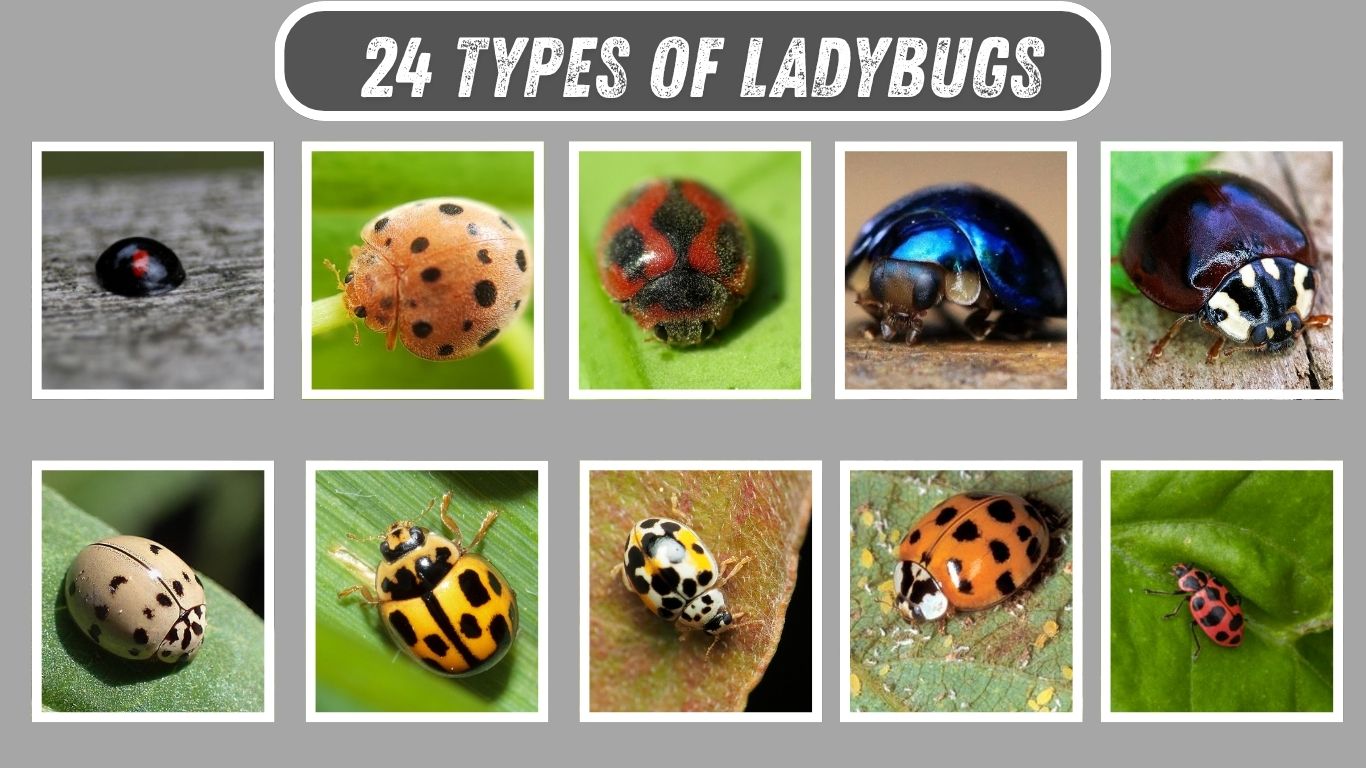
Ladybugs are more than just cute garden visitors—they’re hardworking insects with diverse appearances and behaviors. From helpful aphid-eaters to crop-damaging beetles, there are many types of ladybugs found worldwide. This guide introduces 24 different ladybug species, each with its unique color, pattern, and ecological role. Whether you’re a gardener, student, or insect enthusiast, you’ll discover fascinating facts about these tiny beetles.
Seven-Spotted Ladybug

The Seven-Spotted Ladybug (Coccinella septempunctata) is one of the most common and recognizable ladybugs found in gardens and farmlands across Europe, North America, and parts of Asia. Known for its bright red wing covers and distinctive seven black spots, this beneficial insect plays a crucial role in controlling aphid populations and other plant pests.
Identification
- Color: Bright red or orange elytra (wing covers)
- Spots: 7 black spots — three on each wing cover and one central spot that straddles both
- Size: About 7–10 mm in length
- Shape: Dome-shaped and oval
- Head: Black with small white patches near the eyes
Habitat and Behavior
Seven-Spotted Ladybugs are usually found on plants infested with aphids, especially in agricultural and garden areas. They are active during spring and summer, often seen crawling on leaves or flying between plants in search of prey.
Role in Pest Control
These ladybugs are natural predators of aphids, scale insects, and mites. Both the larvae and adults feed on pests, making them valuable allies in organic and sustainable farming.
2. Asian Lady Beetle

The Asian Lady Beetle (Harmonia axyridis) is a widespread species originally introduced for biological pest control. While beneficial, it is also known for invading homes during cooler months, making it both helpful and sometimes a nuisance.
Identification
- Color: Ranges from yellow-orange to red
- Spots: 0 to 22 black spots (varies widely)
- Size: 5–8 mm long
- Shape: Dome-shaped
- Distinct Feature: Black “M”-shaped mark on the white pronotum (behind the head)
Habitat and Behavior
Common in gardens, forests, and agricultural fields. During autumn, they gather in large numbers and often enter buildings to overwinter.
Impact and Concern
Though effective against aphids, they outcompete native species and can bite or emit a foul odor when disturbed.
3. Convergent Lady Beetle

The Convergent Lady Beetle (Hippodamia convergens) is a native North American species popular for its effectiveness in aphid control. It’s often used in greenhouse and field crop pest management.
Identification
- Color: Bright orange to red
- Spots: 12 or more small black spots
- Size: 4–7 mm
- Distinct Feature: Two white lines converging behind the head (on the pronotum)
- Shape: Elongated oval body
Habitat and Behavior
Common in gardens, meadows, and fields. Often seen clustering together in large groups during the winter.
Use in Agriculture
Frequently collected and sold for use in gardens and farms due to their high aphid-eating capacity.
4. Twice-Stabbed Lady Beetle

The Twice-Stabbed Lady Beetle (Chilocorus stigma) is a small, shiny black ladybug known for the two distinct red spots on its back. It is a valuable predator of scale insects, especially in orchards and forested areas.
Identification
- Color: Glossy black
- Spots: Two bright red spots — one on each elytron (wing cover)
- Size: About 3–5 mm
- Shape: Rounded and slightly flattened
- Head: Mostly hidden when viewed from above
Habitat and Behavior
Prefers wooded habitats and orchards. Active during the warmer months, often hiding under leaves and bark while feeding on armored scales and mealybugs.
Benefit to Ecosystem
Highly regarded for biological control, especially in fruit orchards and ornamental trees where scale insects can be problematic.
5. Pink Spotted Ladybug

The Pink Spotted Ladybug (Coleomegilla maculata), also called the “Spotted Lady Beetle,” is a pink or reddish-colored species known for its appetite for aphids and pollen.
Identification
- Color: Pink to reddish-orange
- Spots: 6 large black spots on each elytron
- Size: 5–6 mm
- Shape: Elongated oval
- Pronotum: Black with pale outer margins
Habitat and Behavior
Found in gardens, crops, and grasslands. Unlike most ladybugs, this species also feeds on pollen, making it a pollinator in addition to a pest controller.
Role in Agriculture
Helpful in managing aphid outbreaks in corn, soybean, and other field crops. Their dual role as predators and pollinators adds extra value.
6. Three-Banded Lady Beetle

The Three-Banded Lady Beetle (Coccinella trifasciata) is a distinctive species marked by three dark bands crossing its wing covers. Though not as commonly seen as other types, it plays a helpful role in aphid control.
Identification
- Color: Reddish-orange to yellow
- Markings: Three bold black bands across the elytra
- Size: 5–6 mm
- Shape: Oval and domed
- Head: Black with pale spots or margins
Habitat and Behavior
Often found in temperate forest regions, gardens, and crop fields, particularly where aphid populations thrive.
Ecological Role
Feeds on aphids and other soft-bodied insects, making it a natural ally for both gardeners and farmers.
7. Spotted Lady Beetle

The Spotted Lady Beetle (Coleomegilla quadrigemina) is a beneficial insect known for its spotted pattern and its ability to control aphids, mites, and other pests.
Identification
- Color: Reddish-orange or light pink
- Spots: Typically 16 small black spots (8 on each wing cover)
- Size: 4–6 mm
- Shape: Slightly elongated, oval-shaped
- Other Features: Black pronotum with pale edges
Habitat and Behavior
Inhabits gardens, meadows, and agricultural fields. Frequently seen crawling on flowers or vegetable crops.
Diet and Importance
Feeds on aphids, insect eggs, and some pollen—useful in both pest control and slight pollination activity.
8. Transverse Lady Beetle

The Transverse Lady Beetle (Coccinella transversoguttata) is a visually striking species with unique black markings that resemble transverse bars across its red wing covers. It is commonly found in North America and is effective in controlling aphids.
Identification
- Color: Bright red
- Markings: Black, horizontal bar-like markings across the elytra
- Size: About 6–7 mm
- Shape: Rounded and slightly domed
- Pronotum: Black with white edges
Habitat and Behavior
Found in fields, grasslands, and gardens, especially where aphid colonies are abundant. Active during warm months.
Natural Predator
Plays an essential role in aphid population suppression in crops like alfalfa and wheat.
9. Eye-Spotted Lady Beetle

The Eye-Spotted Lady Beetle (Anatis mali) is one of the largest native ladybugs in North America, known for the striking eye-like spots on its back that help deter predators.
Identification
- Color: Reddish-brown to orange
- Spots: Several black spots surrounded by pale rings (eye-like appearance)
- Size: 7–9 mm
- Shape: Broad and slightly flattened
- Pronotum: Black with white markings
Habitat and Behavior
Typically found on trees, especially apple and other hardwoods, where it hunts for aphids and other tree-dwelling pests.
Defensive Traits
The eye-like spots may help confuse predators, offering the beetle a form of natural camouflage or intimidation.
10. Thirteen-Spotted Lady Beetle

The Thirteen-Spotted Lady Beetle (Hippodamia tredecimpunctata) is a small but active predator, often found near water sources or damp vegetation. It is widely distributed in North America and parts of Europe.
Identification
- Color: Reddish-orange
- Spots: 13 distinct black spots on the elytra
- Size: 5–6 mm
- Shape: Narrow and slightly elongated
- Pronotum: Black with white or pale margins
Habitat and Behavior
Commonly found in marshes, wetlands, and crop fields near irrigation. Prefers cooler, moist environments where aphids thrive.
Pest Control Value
A strong aphid predator, especially helpful in wetland restoration projects and areas with leafy crops.
11. Fifteen-Spotted Lady Beetle

The Fifteen-Spotted Lady Beetle (Anatis labiculata) is a unique species because it is one of the few ladybugs that are primarily white or cream in color. It is larger than many other types and often found in forested regions.
Identification
- Color: Pale white or beige
- Spots: 15 dark brown to black spots
- Size: 7–9 mm
- Shape: Broad and domed
- Other Features: Slightly fuzzy texture on the elytra
Habitat and Behavior
Prefers coniferous forests and tree canopies, where it hunts for aphids and scale insects. Less commonly seen in open fields or gardens.
Uncommon Appearance
Its light coloration can sometimes cause it to be mistaken for a beetle from another family, but its behavior and diet align with typical ladybug traits.
12. Twenty-Spotted Lady Beetle

The Twenty-Spotted Lady Beetle (Psyllobora vigintimaculata) is a small and delicate-looking species known more for feeding on mildew than insects. It plays a unique role in ecosystems by helping to control fungal growth.
Identification
- Color: Pale yellow or cream
- Spots: 20 small black spots scattered across the elytra
- Size: 2–3 mm
- Shape: Rounded and compact
- Distinct Feature: Often mistaken for a pollen beetle due to its tiny size
Habitat and Behavior
Frequently found on leaves with powdery mildew, especially in shaded gardens and damp environments. Unlike many other ladybugs, it feeds primarily on fungal spores.
Ecological Role
While not a major insect predator, this species is beneficial for reducing plant diseases like powdery mildew.
13. Twenty-Two Spotted Lady Beetle

The Twenty-Two Spotted Lady Beetle (Psyllobora vigintiduopunctata) is another fungus-feeding species, closely related to the twenty-spotted variety. It is brightly colored and easy to recognize, especially in temperate regions of Europe and Asia.
Identification
- Color: Bright yellow
- Spots: 22 round black spots evenly distributed on the elytra
- Size: 3–4 mm
- Shape: Oval and rounded
- Pronotum: Yellow with black markings
Habitat and Behavior
Often found on low vegetation, shrubs, or trees where mildew is present. It avoids dry and sun-exposed locations.
Benefits to Plants
Helps suppress the growth of powdery mildew, supporting healthier foliage in gardens and natural ecosystems.
14. Twenty-Eight Spotted Lady Beetle

The Twenty-Eight Spotted Lady Beetle (Henosepilachna vigintioctopunctata), also known as the Hadda Beetle, is a plant-eating species rather than a predator. It is considered a pest in many parts of Asia and Australia due to its damage to crops.
Identification
- Color: Orange to reddish-brown
- Spots: 28 black spots arranged in symmetrical rows on the elytra
- Size: 6–8 mm
- Shape: Oval and slightly flattened
- Pronotum: Orange with small black markings
Habitat and Behavior
Feeds primarily on plants in the nightshade family, such as eggplant, tomato, and potato. Common in tropical and subtropical regions.
Agricultural Impact
Unlike most ladybugs, this species is harmful to crops and requires pest management in affected agricultural zones.
15. Two-Spotted Ladybug

The Two-Spotted Ladybug (Adalia bipunctata) is a well-known species in North America and Europe. It’s a beneficial predator and often used in biological control programs for aphids.
Identification
- Color: Red, orange, or even black
- Spots: Two large black spots — one on each wing cover
- Size: 4–5 mm
- Shape: Rounded and slightly domed
- Pronotum: Black with white outer edges
Habitat and Behavior
Found in gardens, meadows, and forests. Prefers plants with high aphid activity and often gathers in groups during cooler months.
Role in Biological Control
Actively preys on aphids, scale insects, and mealybugs, making it a reliable ally for organic pest control.
16. Fourteen-Spotted Lady Beetle

The Fourteen-Spotted Lady Beetle (Propylea quatuordecimpunctata) is a small, variable species with a checkerboard appearance. It is an effective predator of aphids and is commonly found across Europe and parts of North America.
Identification
- Color: Yellow to pale orange
- Spots: 14 black rectangular or square-like markings, often merging into irregular patterns
- Size: 3–4 mm
- Shape: Compact and rounded
- Pronotum: Black with pale yellow spots or margins
Habitat and Behavior
Inhabits fields, meadows, and gardens. Frequently seen on crops and ornamental plants where aphids are present.
Natural Variation
The pattern can vary significantly between individuals, ranging from clearly defined spots to blotchy markings, which can sometimes make identification tricky.
17. Ashy Gray Lady Beetle

The Ashy Gray Lady Beetle (Olla v-nigrum) is a unique species with color variations ranging from dull gray to black with contrasting markings. It’s common in North America and plays a valuable role in pest control.
Identification
- Color: Pale gray with black spots or all-black with two red spots (color morphs)
- Spots: Varies depending on color form
- Size: 4–6 mm
- Shape: Rounded and dome-like
- Distinct Feature: “V” or “M”-shaped mark on the pronotum
Habitat and Behavior
Found in woodlands, gardens, and crop fields. Active during spring through fall, especially on plants with aphid infestations.
Predator of Garden Pests
Feeds on aphids, scales, and small soft-bodied insects, contributing to natural pest management in both wild and cultivated environments.
18. Fifteen-Spotted Lady Beetle

The Fifteen-Spotted Lady Beetle (Anatis labiculata) is notable for its creamy-white to pale gray color and dark spots. Unlike the bright red ladybugs, its unusual coloration makes it stand out. It is native to North America and known for its effectiveness in pest control.
Identification
- Color: Creamy white or pale gray
- Spots: 15 black or dark brown spots
- Size: 7–9 mm
- Shape: Broad and slightly domed
- Other Feature: Fuzzy or matte texture on wing covers
Habitat and Behavior
Commonly found in deciduous and coniferous forests, especially on tree foliage. Prefers cool, wooded environments.
Ecological Importance
Plays a role in controlling aphid populations on trees, especially in forest ecosystems.
19. Checkered Lady Beetle

The Checkered Lady Beetle (Propylea dissecta) is a distinctively patterned species with a checkerboard appearance. Native to Asia, it has become widespread due to its use in pest control.
Identification
- Color: Yellow to orange background
- Markings: Black checkered or blotchy patterns across elytra
- Size: 4–5 mm
- Shape: Oval and rounded
- Pronotum: Black with pale spots or margins
Habitat and Behavior
Found in agricultural fields, gardens, and wooded areas. Prefers plants with aphid infestations.
Use in Agriculture
Frequently used in integrated pest management (IPM) programs, particularly for aphids and mealybugs. Adaptable to a wide range of climates and plant types.
20. Steelblue Ladybug

The Steelblue Ladybug (Halmus chalybeus) is a metallic-colored species native to Australia and New Zealand. Unlike the typical red-and-black ladybugs, this one has a shiny blue or greenish sheen and is a beneficial predator of scale insects.
Identification
- Color: Metallic steel blue to greenish-blue
- Spots: No visible spots
- Size: 3–4 mm
- Shape: Oval, compact, and glossy
- Surface: Smooth and reflective elytra
Habitat and Behavior
Primarily found on citrus trees, native shrubs, and ornamental plants. Prefers warm regions and is active in spring and summer.
Agricultural Role
Introduced in various regions to help control scale insects and other orchard pests, especially in citrus groves.
21. Mealybug Destroyer

The Mealybug Destroyer (Cryptolaemus montrouzieri) is a small, dark-colored ladybug used extensively in biological control programs. It’s not easily recognized as a typical ladybug due to its appearance but is a highly effective predator of mealybugs.
Identification
- Color: Dark brown to black body with orange-brown head and tail end
- Spots: No traditional spots
- Size: 3–4 mm
- Shape: Elongated and fuzzy-looking
- Larvae: White and waxy, resembling mealybugs
Habitat and Behavior
Often found in greenhouses, orchards, and gardens where mealybugs and scale insects are present. Active year-round in controlled environments.
Commercial Importance
Widely used in commercial agriculture and indoor plant production to naturally control mealybug outbreaks.
22. Cardinal Ladybird

The Cardinal Ladybird (Novius cardinalis), also known as the Vedalia beetle, is a small, red-colored ladybug introduced around the world for biological control of cottony cushion scale. It has a long history in agricultural pest management.
Identification
- Color: Bright red with dark markings
- Spots: Dark brown to black splotches, often on elytra edges
- Size: About 2–4 mm
- Shape: Rounded and slightly flattened
- Distinct Feature: Fine body hairs give it a slightly fuzzy look
Habitat and Behavior
Common in citrus orchards and gardens where scale insects are present. Prefers warm climates and sheltered plant areas.
Contribution to Pest Control
Famous for its successful introduction in California in the late 1800s to control cottony cushion scale, saving the citrus industry from collapse.
23. Mexican Bean Beetle

The Mexican Bean Beetle (Epilachna varivestis) is one of the few ladybug species that is considered a pest. It feeds on the foliage of bean plants and is known for causing significant crop damage in North and Central America.
Identification
- Color: Yellow to orange
- Spots: 8 black spots on each elytron (16 total)
- Size: 6–7 mm
- Shape: Dome-shaped and rounded
- Larvae: Yellow, spiny, and worm-like
Habitat and Behavior
Primarily found in soybean and bean fields. Adults and larvae skeletonize leaves, leaving only the veins behind.
Agricultural Impact
Unlike most ladybugs, this species damages crops instead of helping them. It requires active pest management in bean cultivation.
24. Twice-Stabbed Ladybird

The Twice-Stabbed Ladybird (Chilocorus orbus) is a close relative of the more common Chilocorus stigma, sharing its characteristic two red spots on a dark body. It is a valuable predator of scale insects and is often seen in orchards and forested areas of North America.
Identification
- Color: Shiny black
- Spots: Two distinct red spots — one on each wing cover
- Size: 3–5 mm
- Shape: Rounded and dome-shaped
- Pronotum: Typically black and smoothly curved
Habitat and Behavior
Prefers fruit trees, ornamental plants, and shrubs infested with scale insects. Most active in warm seasons, hiding under leaves and bark.
Ecological Benefit
Important in natural and managed landscapes for controlling soft scale and armored scale pests, especially in fruit orchards and nurseries.