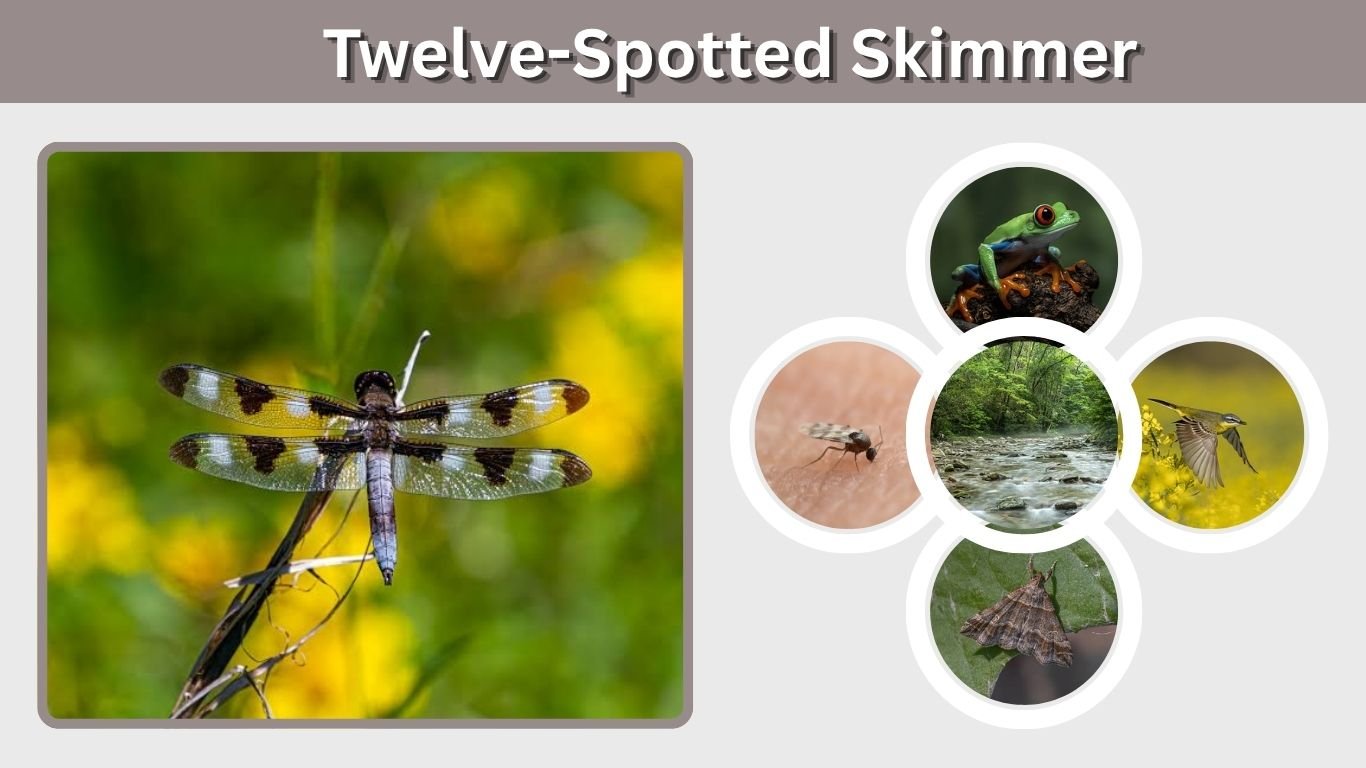
The twelve-spotted skimmer (Libellula pulchella) is a distinctive North American dragonfly named for the twelve dark patches spread across its four transparent wings. Mature males are especially eye-catching because additional white wing patches appear between the dark spots, while females retain a simpler brown-and-yellow pattern. These strong-flying predators commonly inhabit ponds, lakes, marshes, and slow waterways. They spend summer days patrolling open areas, perching on vegetation, and capturing mosquitoes, flies, and other small insects in flight.
What Is a Twelve-Spotted Skimmer?
The twelve-spotted skimmer belongs to the skimmer family Libellulidae, one of the largest families of dragonflies. It is widespread across the continental United States and reaches into southern Canada and Mexico. Adults are most conspicuous during warm weather, particularly around open freshwater where they breed and where males often establish territories.
Quick Facts
- Scientific name: Libellula pulchella
- Family: Libellulidae
- Order: Odonata
- Type: Dragonfly
- Adult length: About 48–53 mm
- Wing markings: Three dark spots on each wing
- Male wing pattern: Dark spots plus additional white patches
- Diet: Small flying insects
- Habitat: Ponds, lakes, marshes, bogs, and slow streams
- Range: Much of North America
- Young stage: Aquatic nymph or naiad
- Main activity season: Primarily summer
Scientific Name and Classification
The scientific name of the twelve-spotted skimmer is Libellula pulchella. It belongs to the class Insecta, order Odonata, family Libellulidae, and genus Libellula.
An older common name is the ten-spotted skimmer or ten-spot dragonfly. The difference comes from historical ways of counting the dark wing markings rather than from a different species.
Twelve-Spotted Skimmer Identification
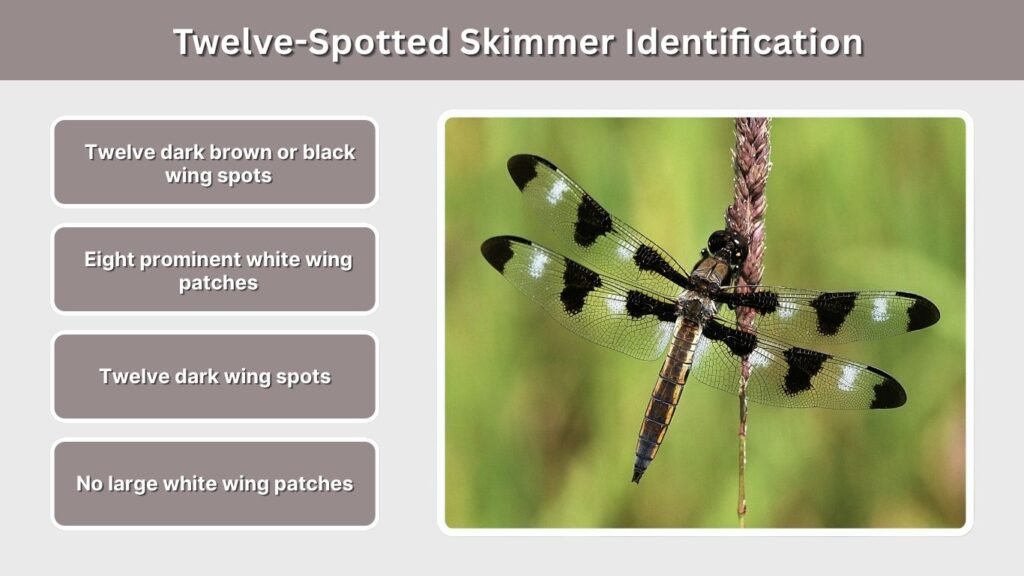
The patterned wings are the easiest feature to use when identifying this dragonfly. Both sexes have three dark brown or blackish patches on each of their four wings, creating twelve dark spots altogether. Adult males eventually develop bright white areas between those dark patches, making their wings much more contrasting than those of females and immature males.
Male Twelve-Spotted Skimmer
A mature male usually has:
- Twelve dark brown or black wing spots
- Eight prominent white wing patches
- A pale, powdery blue-gray abdomen
- A dark thorax that may become covered with pale pruinosity
- Large dark reddish-brown eyes
- Clear areas between the colored wing patches
The pale coating on mature males is called pruinosity. Newly emerged males initially resemble females, but the body gradually becomes increasingly pale or bluish as the insect ages.
Female Twelve-Spotted Skimmer
Females generally show:
- Twelve dark wing spots
- No large white wing patches
- Brown body coloration
- Yellow stripes along the sides of the abdomen
- Clear portions between the dark wing spots
- A more consistently brown-and-yellow appearance
Because young males also lack the adult male’s white patches, telling a female from an immature male can require close examination.
How Many Spots Does It Actually Have?
The name refers specifically to the twelve dark spots—three on each of four wings.
Mature males also possess additional white patches, so visually they can appear to have far more than twelve markings. Historically, the species was sometimes called the ten-spotted skimmer because certain basal patches were counted differently.
Twelve-Spotted Skimmer Size and Wingspan
The twelve-spotted skimmer is a medium-to-large skimmer with a powerful appearance. Its broad patterned wings can make it seem considerably larger when flying than when perched. Adults frequently hold all four wings horizontally when resting, allowing observers to clearly see the distinctive arrangement of dark and white markings.
How Big Is a Twelve-Spotted Skimmer?
Adult body length is generally around 48–53 mm, or approximately 1.9–2.1 inches.
Its wingspan can approach roughly three inches or somewhat more in large individuals. Exact measurements vary among individuals and between sexes.
The broad wings provide excellent maneuverability for hunting, territorial patrols, escaping predators, and catching insects in midair.
What Do the Wings Look Like?
Each wing contains three conspicuous dark patches positioned roughly near the base, middle, and outer portion.
Mature males additionally develop white patches between the dark areas. When a male flies, the alternating black-and-white pattern can create a flashing appearance that is visible from a considerable distance.
Females remain predominantly clear-winged with the twelve dark markings.
Twelve-Spotted Skimmer Habitat and Range
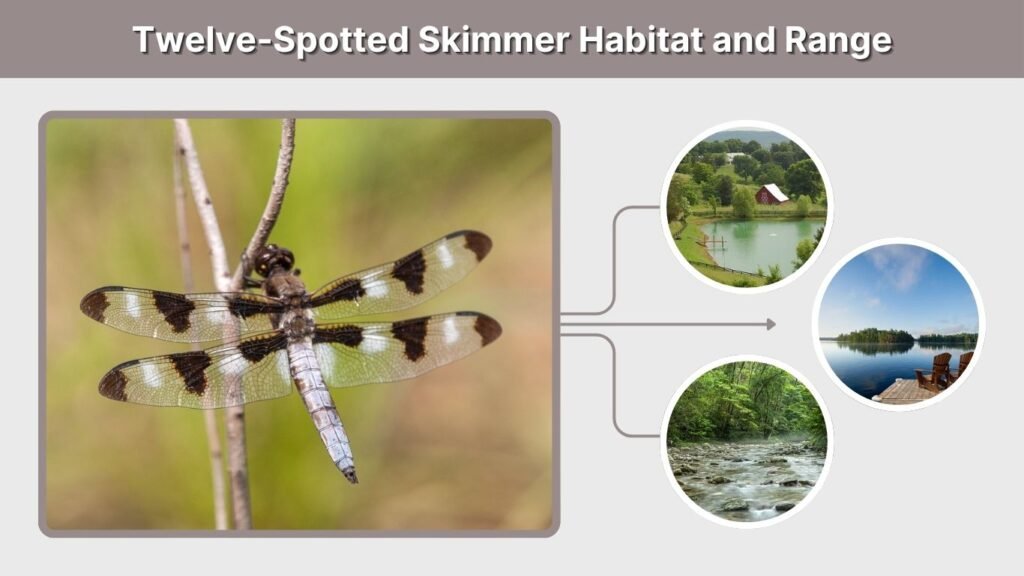
Twelve-spotted skimmers favor open freshwater habitats where sunshine reaches the shoreline and emergent vegetation provides places to perch. They are frequently observed near ponds and lakes but may also occupy bogs, marshes, and slower sections of streams. Adults can travel away from water while feeding, so an individual may appear in fields or gardens some distance from its breeding habitat.
Where Do Twelve-Spotted Skimmers Live?
Suitable habitat commonly combines quiet water, aquatic vegetation, muddy or vegetated margins, and nearby open hunting areas.
Adults frequently perch on reeds, grasses, twigs, shrubs, or other exposed plants. Males often choose conspicuous positions where they can watch both passing insects and rival dragonflies.
Missouri observations associate the species particularly with lakes and ponds containing cattails and reeds.
Range in North America and Ontario
The twelve-spotted skimmer has a remarkably broad distribution. It occurs throughout the 48 contiguous United States, extends north into southern portions of Canada, and continues south into Mexico. The species also occurs in Ontario and other suitable Canadian regions.
Its wide distribution makes it one of the more familiar patterned skimmers across much of North America.
What Do Twelve-Spotted Skimmers Eat?
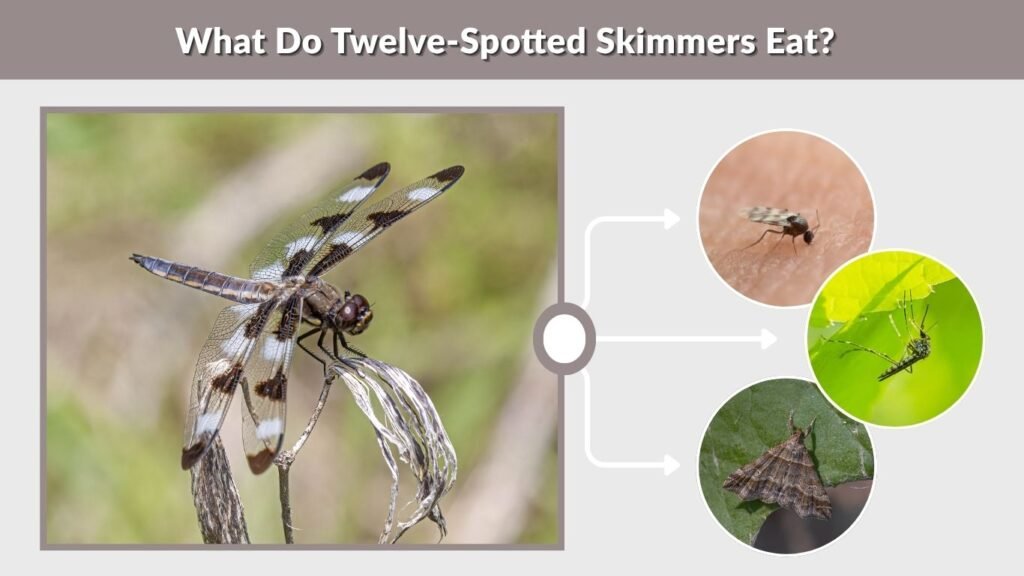
Both adult dragonflies and their aquatic nymphs are predators. Adults depend heavily on vision to locate insects moving through the air. Their strong wings allow them to rapidly accelerate, turn, and intercept prey. After making a capture, a skimmer may eat while flying or return to a favorite perch before hunting again.
Adult Diet
Twelve-spotted skimmers may capture:
- Mosquitoes
- Midges
- Gnats
- Small flies
- Flying ants
- Small moths
- Small beetles
- Other suitably sized flying insects
Their legs form a basket beneath the body that helps trap prey during aerial attacks.
Hunting Behavior
A twelve-spotted skimmer often uses an exposed perch as an observation point. When an insect passes, it launches rapidly, pursues the target, captures it, and may return to approximately the same perch.
Males also spend considerable time patrolling breeding territories around water and chasing competing males.
Twelve-Spotted Skimmer Life Cycle
The life cycle consists of egg, aquatic nymph, and adult stages. Like other dragonflies, the species undergoes incomplete metamorphosis and therefore has no pupal stage. A substantial portion of its development occurs underwater, where the nymph behaves as a predator long before it acquires wings.
Eggs and Reproduction
Adult males establish territories near suitable breeding water. When a receptive female enters, mating can occur in the characteristic dragonfly “wheel” position.
Following mating, the female deposits eggs into or near the water. The eggs eventually hatch into aquatic nymphs.
The exact timing of development depends on water temperature, food availability, climate, and other environmental conditions.
Twelve-Spotted Skimmer Nymph
The immature aquatic stage is commonly called a nymph or naiad. It spends its developmental period beneath the water, hunting small aquatic animals.
Instead of chasing insects through the air, the nymph relies on a specialized extendable lower mouthpart that can shoot forward to grab prey.
It molts repeatedly as it grows.
Emerging as an Adult
When development is complete, the mature nymph crawls from the water onto a plant stem, rock, log, or other support.
Its skin splits and the adult dragonfly slowly emerges. At first, the wings are soft and folded. Fluid is pumped into them until they expand to full size.
Once the body and wings harden, the adult begins flying.
Lifespan, Predators, and Ecological Role

A twelve-spotted skimmer’s complete lifespan is much longer than the period during which people typically see the colorful adult. The immature aquatic stage makes up an important part of its life, while the winged adult stage is concentrated around feeding, dispersal, mating, and reproduction.
Predators
Twelve-spotted skimmers can become prey for:
- Birds
- Frogs
- Fish
- Spiders
- Larger dragonflies
- Predatory aquatic insects
- Other wetland predators
Aquatic nymphs face fish and other underwater hunters, whereas adults are vulnerable mainly to aerial and shoreline predators.
Why Are Twelve-Spotted Skimmers Beneficial?
They help regulate populations of numerous small insects. Adults consume flying insects, while nymphs prey on aquatic organisms.
Their life cycle also connects aquatic and terrestrial food webs. Nutrients accumulated underwater eventually move onto land when adult dragonflies emerge, while adults themselves provide food for birds and other predators.
Twelve-Spotted Skimmer vs. Common Whitetail
These two dragonflies can be confused because both have strongly patterned wings and mature males can develop pale bodies. However, their wing patterns are useful for separating them.
How to Tell Them Apart
The twelve-spotted skimmer has three separate dark spots on each wing. Mature males also develop white patches between the dark marks.
The common whitetail has a different arrangement, including broader dark wing bands. Its abdomen also becomes conspicuously white in mature males.
Perching behavior can provide another clue, but wing pattern is usually much more reliable for identification.
FAQs
What is the scientific name of the twelve-spotted skimmer?
The scientific name is Libellula pulchella. It belongs to the skimmer dragonfly family Libellulidae.
Why is it called a twelve-spotted skimmer?
It has three dark brown or black patches on each of its four wings, producing a total of twelve dark spots.
What is the difference between male and female twelve-spotted skimmers?
Mature males have white wing patches between the twelve dark spots and develop a pale bluish coating on the body. Females lack the large white patches and generally have brown bodies with yellow abdominal stripes.
What do twelve-spotted skimmers eat?
Adults eat small flying insects such as mosquitoes, flies, gnats, midges, and small moths. Their aquatic nymphs prey on small animals living underwater.
Where do twelve-spotted skimmers live?
They inhabit ponds, lakes, marshes, bogs, and slow-moving streams across much of North America, including the contiguous United States and southern portions of Canada.