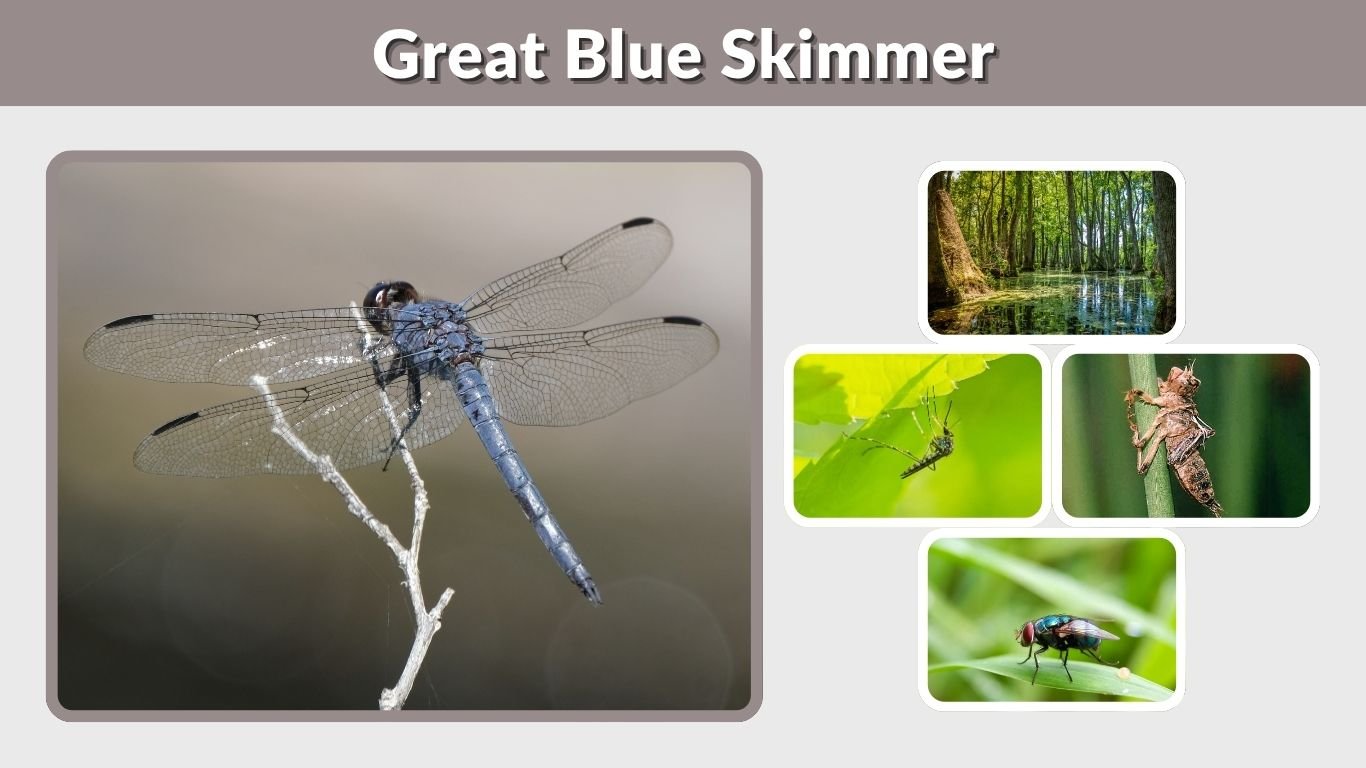
The great blue skimmer (Libellula vibrans) is one of the largest and most impressive skimmer dragonflies in eastern North America. Mature males develop a powdery blue body, pale face, and blue-green eyes, while females are usually brown or yellowish with contrasting abdominal markings. This dragonfly favors wooded ponds, swamps, lakes, and slow waterways, particularly in the southeastern United States. An agile aerial predator, it spends warm days patrolling vegetation, defending territories, and catching flies, mosquitoes, and other insects.
What Is a Great Blue Skimmer?
The great blue skimmer belongs to the family Libellulidae, commonly known as the skimmers. Its scientific name is Libellula vibrans. Adults are relatively large, measuring about 50–63 mm, or roughly 2–2.5 inches, in body length. The species is primarily associated with eastern and southeastern North America and favors freshwater habitats close to woodland.
Great Blue Skimmer Quick Facts
- Scientific name: Libellula vibrans
- Family: Libellulidae
- Order: Odonata
- Type: Dragonfly
- Body length: About 50–63 mm
- Male color: Powdery blue
- Female color: Brown, yellowish, or darker with age
- Face: Usually pale or white
- Eyes: Often blue or blue-green in mature adults
- Habitat: Swamps, ponds, lakes, and slow streams
- Diet: Flying insects
- Young stage: Aquatic nymph
- Range: Primarily eastern and southeastern North America
Why Is It Called a Great Blue Skimmer?
“Great” reflects its impressive size compared with many other skimmer dragonflies, while “blue” refers to the powdery coloration of mature males. The word “skimmer” is used for many members of Libellulidae, which are often seen flying low over ponds, wetlands, and other freshwater habitats.
Great Blue Skimmer Identification
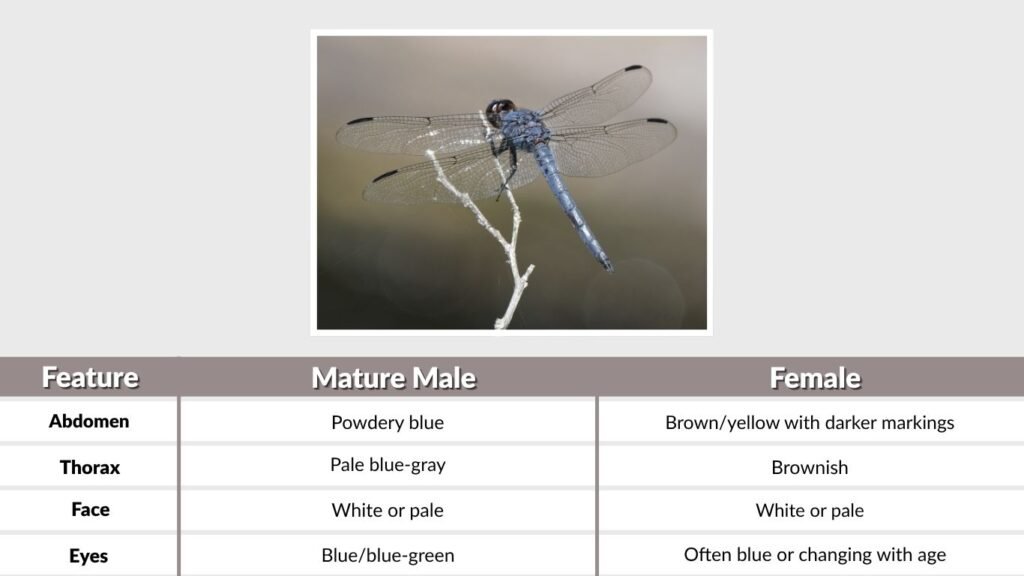
Identification is easiest when the dragonfly is perched. Mature males are highly distinctive, but females and immature males can appear quite different. The species is particularly notable for its large size, pale face, and dark markings near the wing tips. Both sex and age should be considered before identifying an individual solely by body color.
Male Great Blue Skimmer
A mature male usually shows:
- Powdery pale-blue abdomen
- Blue-gray thorax
- White or very pale face
- Blue or blue-green eyes
- Long black legs
- Mostly transparent wings
- Darkened patches near the wing tips
- Large, sturdy skimmer body
The blue coloration results from a waxy coating called pruinosity, which becomes more obvious as males mature. A white face and blue eyes are useful clues when separating adult males from the similar slaty skimmer.
Female Great Blue Skimmer
Females can look very different from mature males. Younger females are usually brownish or yellowish rather than blue. They often have a darker stripe running along the upper abdomen and paler markings along the sides.
Both males and females have a pale face, and Florida guidance notes that both sexes can show blue eyes even though their body coloration differs.
Older females may become darker, and some can acquire limited grayish or bluish pruinosity, making identification more difficult.
Male vs. Female Great Blue Skimmer
| Feature | Mature Male | Female |
| Abdomen | Powdery blue | Brown/yellow with darker markings |
| Thorax | Pale blue-gray | Brownish |
| Face | White or pale | White or pale |
| Eyes | Blue/blue-green | Often blue or changing with age |
| Overall appearance | Uniformly blue | More strongly patterned |
Great Blue Skimmer Habitat and Range
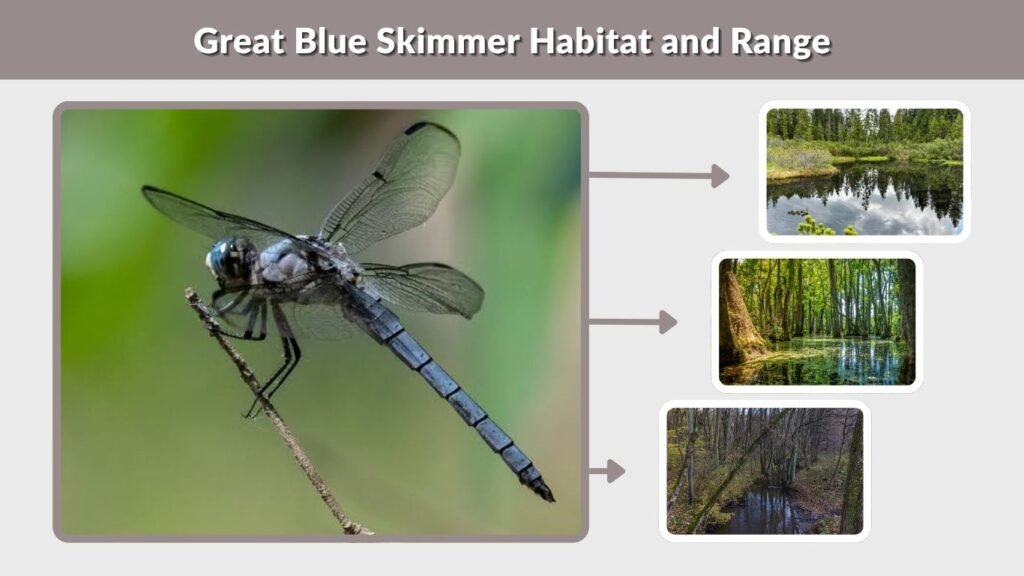
Great blue skimmers are freshwater dragonflies but often favor more shaded habitats than many sun-loving skimmers. Woodland ponds, swampy pools, and slow-moving creeks provide ideal breeding conditions. Adults also leave the immediate shoreline while feeding and may appear along trails, forest edges, gardens, and yards close to suitable aquatic habitats.
Where Do Great Blue Skimmers Live?
Typical locations include:
- Woodland ponds
- Shallow swamps
- Forested wetlands
- Slow-moving creeks
- Quiet streams
- Lake edges
- Shaded pools
- Vegetated ponds
- Wet woodland clearings
Maryland records associate the species strongly with swamps, forest ponds, and slow sections of swampy creeks, often where the bottom is muddy or mucky. Florida environmental guidance similarly describes a preference for shady, shallow, relatively still water.
Great Blue Skimmer Range
The species occurs mainly through the eastern United States, with its strongest presence in the Southeast. Individuals may wander farther north, and occasional records have occurred well beyond the core southern range.
Virginia lists the great blue skimmer as common around swamps and ponds, with adults recorded there from late April into early November.
Great Blue Skimmer in Florida
Florida provides excellent habitat for this dragonfly because the state has abundant swamps, shaded ponds, wetlands, and slow waterways.
Adults may be observed perched on branches near wooded water or flying through sunny openings. Their large size and blue coloration make mature males particularly conspicuous.
What Do Great Blue Skimmers Eat?
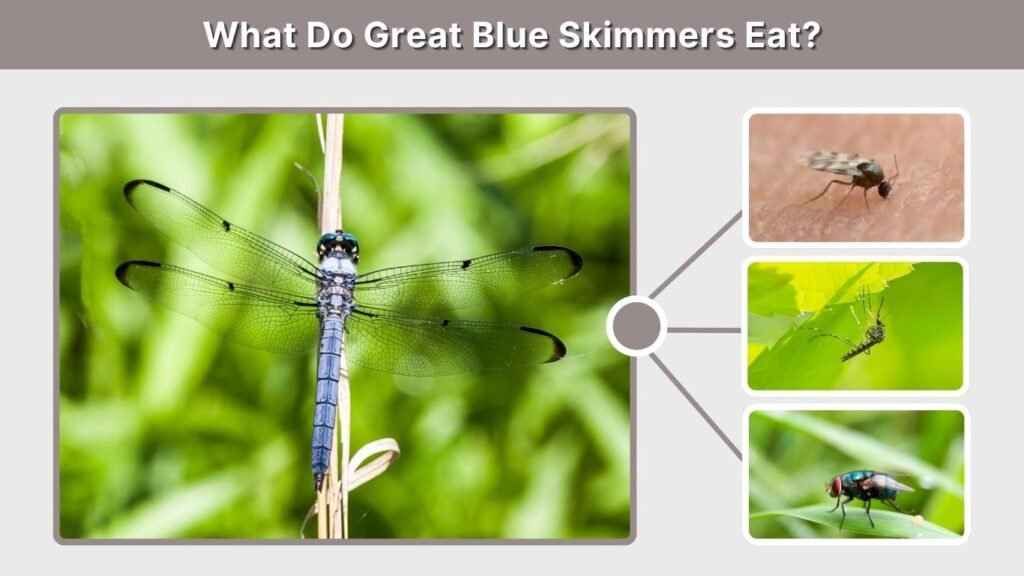
Great blue skimmers are predators during both their aquatic and adult stages. Adults use large compound eyes to locate movement and their powerful wings to intercept prey in flight. Instead of building traps, they actively patrol or wait from a perch before rapidly pursuing insects that enter their hunting area.
Adult Great Blue Skimmer Diet
Adults may eat:
- Mosquitoes
- Midges
- Gnats
- Flies
- Small moths
- Flying ants
- Small beetles
- Other small flying insects
Their six legs help form a basket underneath the body that can scoop prey from the air.
How Do They Hunt?
A great blue skimmer may sit quietly on a branch, twig, or leaf while watching the surrounding airspace. Once it detects a suitable insect, it launches rapidly and captures the prey during flight.
Dragonflies have excellent aerial control, allowing them to accelerate, hover briefly, change direction, and intercept moving insects efficiently.
After capturing prey, the skimmer may consume it while flying or return to a perch.
Great Blue Skimmer Life Cycle
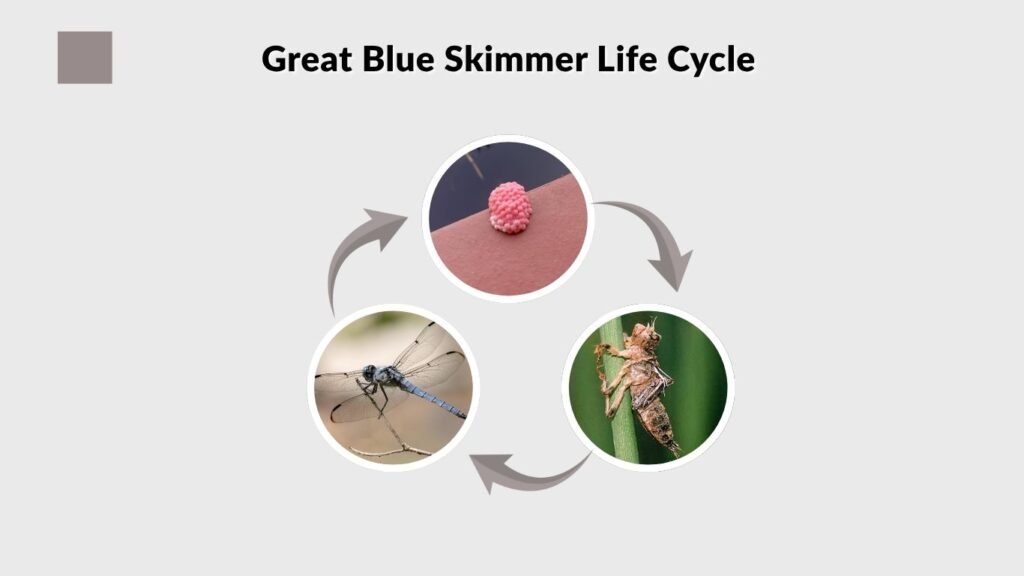
Like other dragonflies, Libellula vibrans undergoes incomplete metamorphosis. Its life consists of egg, aquatic nymph, and winged adult stages, with no pupal stage. Much of the insect’s development actually occurs underwater. Only after the nymph has completed numerous molts does it leave the water and transform into the familiar flying dragonfly.
Eggs and Reproduction
Adult males patrol suitable breeding sites and may defend sections of shoreline from competing males.
After mating, females deposit eggs in or around freshwater. Once the eggs hatch, the young dragonflies begin an entirely aquatic stage.
Great Blue Skimmer Nymph
Nymphs live underwater and are predators rather than plant eaters. They remain hidden among mud, vegetation, and debris where they can ambush small aquatic animals.
Potential prey includes:
- Mosquito larvae
- Midge larvae
- Small aquatic insects
- Tiny crustaceans
- Other suitably sized invertebrates
A dragonfly nymph has a specialized extendable lower mouthpart that can rapidly shoot forward and seize prey.
Emergence Into an Adult
When fully developed, the nymph crawls from the water and attaches itself to vegetation, wood, rocks, or another stable surface.
Its outer skin splits and the adult gradually pulls free. Initially, its wings are folded and soft. They expand as fluid moves through them and later harden.
The empty nymph skin, called an exuvia, remains behind.
Great Blue Skimmer Behavior and Ecosystem Role
Great blue skimmers are primarily daytime insects whose activity increases during warm weather. Adults may alternate between periods of perching and powerful flight. Males frequently patrol breeding areas, while females may spend more time away from the water except when feeding, mating, or laying eggs.
Typical Behavior
- Perches on branches and vegetation
- Hunts insects during daylight
- Patrols woodland ponds and swamps
- Males defend breeding areas
- Uses excellent eyesight to locate prey
- Can fly rapidly between perches
- Holds four wings spread while resting
Despite their large size, great blue skimmers are harmless to people. They have no stinger and do not attack humans.
Predators and Benefits
Great blue skimmers can themselves become food for:
- Birds
- Frogs
- Fish
- Spiders
- Larger dragonflies
- Predatory aquatic insects
They are beneficial predators because both adults and nymphs consume numerous small animals. Adults help regulate populations of flying insects, while nymphs participate in freshwater food webs.
Great Blue Skimmer vs. Blue Dasher
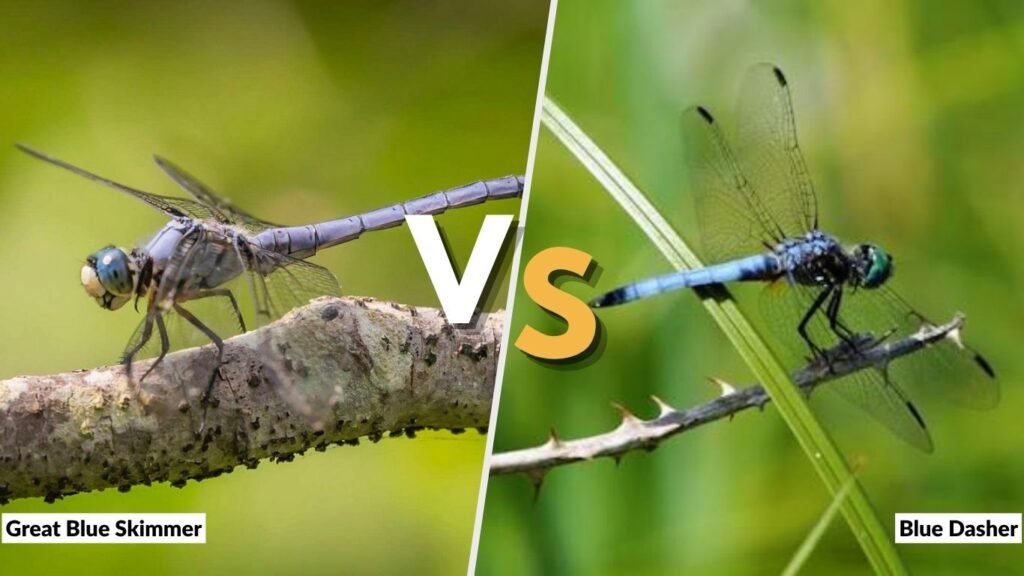
The great blue skimmer and blue dasher can look similar because mature males of both species develop blue bodies. Size, face coloration, body build, and other markings can help separate them. The great blue skimmer is considerably larger and is particularly associated with wooded and swampy habitats.
How to Tell Them Apart
Great blue skimmer: Usually 50–63 mm long, relatively large and robust, with a pale white face, blue eyes, and darkened wing tips.
Blue dasher: Considerably smaller, with a more compact body. Mature males have a blue abdomen but usually retain a darker tip and different thoracic patterning.
Habitat can also provide a clue. Great blue skimmers commonly favor shaded forest ponds and swampy waterways, whereas blue dashers are extremely common around open, sunny ponds and marshes.
FAQs
The great blue skimmer’s changing coloration and resemblance to other blue dragonflies can make identification challenging. Size, face color, wing markings, geographic location, and habitat should be considered together rather than relying on blue coloration alone. These common questions cover the most useful details for recognizing and understanding this large skimmer.
What is the scientific name of the great blue skimmer?
The scientific name is Libellula vibrans. It belongs to the dragonfly family Libellulidae.
How big is a great blue skimmer?
Adults are typically about 50–63 mm (2–2.5 inches) long, making this one of the larger skimmer dragonflies.
What does a female great blue skimmer look like?
Females are generally brown or yellowish with darker abdominal markings rather than the uniform powdery blue coloration of mature males. They typically have a pale face.
What do great blue skimmers eat?
Adults hunt mosquitoes, flies, midges, moths, and other small flying insects. Their aquatic nymphs prey on small animals living underwater.
Where can you find great blue skimmers?
They are primarily found in the eastern and southeastern United States around swamps, wooded ponds, lakes, and slow-moving streams.