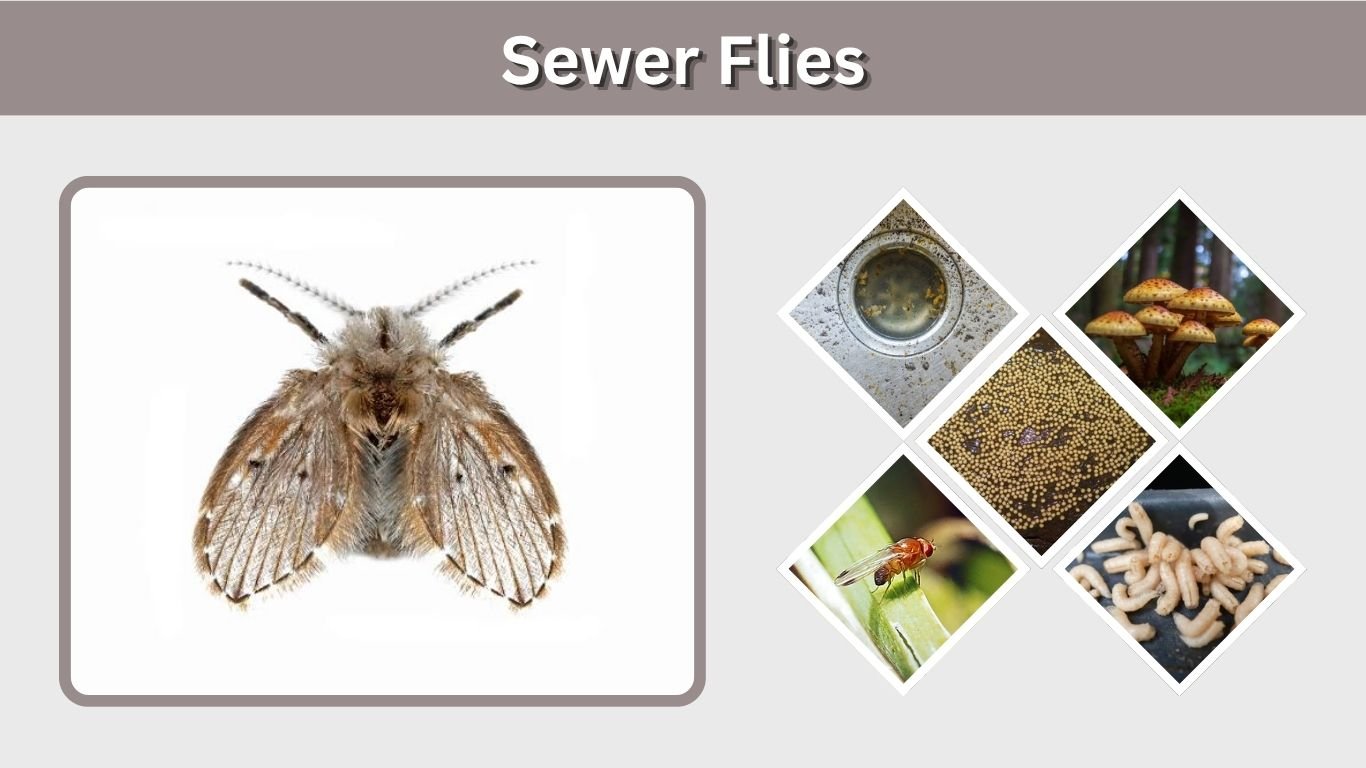
Sewer flies are tiny, fuzzy insects commonly seen resting on bathroom walls, shower tiles, sinks, and surfaces near drains. They are also known as drain flies, moth flies, filter flies, sink flies, or sewage flies. Although adults resemble miniature moths, they are true flies with only one functional pair of wings. Their presence usually indicates moisture and decomposing organic material somewhere nearby.
What Are Sewer Flies?
Sewer flies are mainly non-biting moth flies from the subfamily Psychodinae within the family Psychodidae. The name does not describe just one species; several closely related flies can reproduce in drains, sewer systems, septic tanks, wastewater filters, and other wet environments.
They are called moth flies because their bodies and wings are covered in dense, hair-like scales. These hairs give them a soft, fuzzy appearance that distinguishes them from fruit flies, fungus gnats, and phorid flies.
| Feature | Description |
| Scientific group | Psychodidae, mainly Psychodinae |
| Common names | Sewer fly, drain fly, moth fly, filter fly |
| Adult size | Usually 2–4 mm |
| Color | Gray, brown, tan, or nearly black |
| Main habitat | Drains and wet organic material |
| Diet | Biofilm, microorganisms, and decaying material |
| Bite risk | Adults do not bite |
| Flight | Weak, short, irregular flights |
Most common household species are approximately 2–4 millimeters long, although some may reach nearly 6 millimeters.
Sewer Fly Size and Appearance
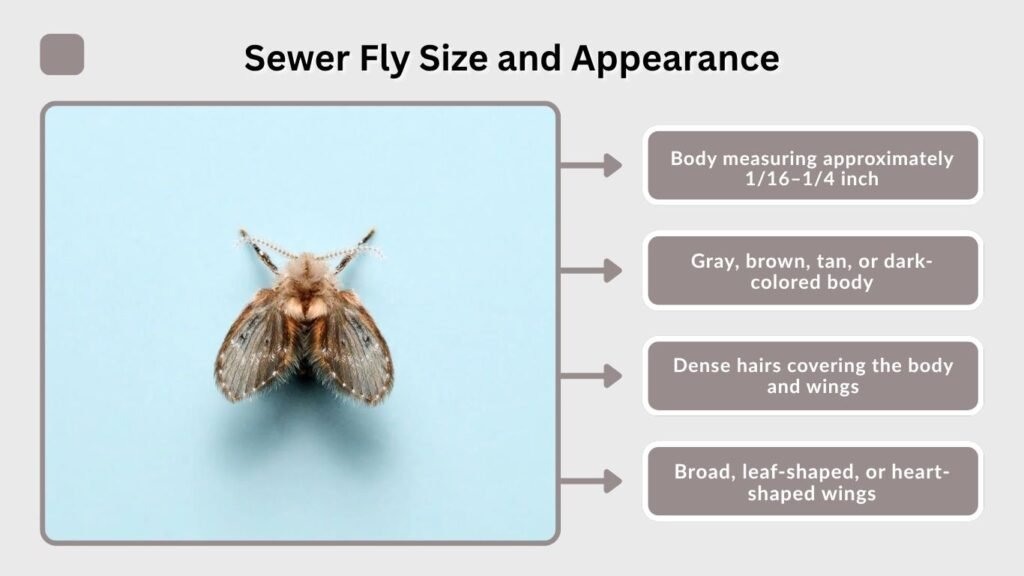
Sewer flies are much smaller than ordinary houseflies. Their broad, hairy wings and compact bodies can make them look like tiny moths when they rest on a wall.
Adult Sewer Fly Identification
Common identification features include:
- Body measuring approximately 1/16–1/4 inch
- Gray, brown, tan, or dark-colored body
- Dense hairs covering the body and wings
- Broad, leaf-shaped, or heart-shaped wings
- Long, segmented, fuzzy antennae
- Wings held roof-like over the body
- Short, hopping, or irregular flights
- Frequent resting on walls near drains
Some species have uniformly gray wings, while others have pale spots, dark patches, or visible patterns. Their weak flight muscles mean they usually remain close to their breeding site rather than flying throughout an entire building.
Sewer Fly Larvae
The larvae look completely different from the adults. They are slender, legless, worm-like creatures with cream, gray, or brown bodies and clearly defined heads.
Drain fly larvae possess breathing tubes near the end of the abdomen. These tubes allow them to obtain air while living inside wet, gelatinous slime where oxygen levels may be low. Larvae usually remain hidden unless the drain or breeding material is disturbed.
Sewer Fly Color
Most sewer flies are grayish-tan, dark gray, brown, or nearly black. Their fuzzy body covering can make them appear lighter or darker depending on lighting.
The wings may be:
- Pale gray
- Smoky brown
- Dark charcoal
- Mottled with lighter markings
- Patterned with small white spots
The bathroom moth fly, Clogmia albipunctata, is often recognized by pale or white spots near the ends of its wing veins. However, identifying similar moth flies to species level may require microscopic examination of the wings, antennae, and reproductive structures.
Sewer Fly Habitat
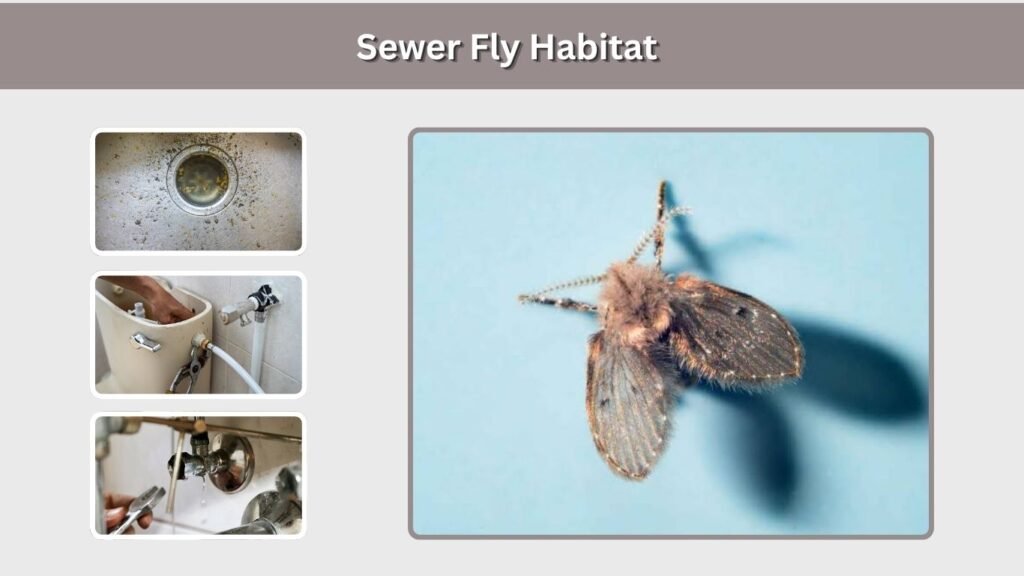
Sewer flies require moisture and decomposing organic material. They do not reproduce in clean, dry pipes; their larvae need a slimy film containing microorganisms and organic debris.
Indoor Breeding Sites
Common indoor habitats include:
- Bathroom sink drains
- Kitchen sink drains
- Shower and bathtub drains
- Floor drains
- Sink overflow channels
- Toilet drains and plumbing traps
- Refrigerator drip pans
- Air-conditioner condensate pans
- Dirty garbage containers
- Wet mop buckets
- Leaking pipes
- Damp areas beneath damaged flooring
Sewer flies may also emerge from unused plumbing lines, sewer backups, cracked waste pipes, or organic sludge hidden beneath a concrete slab. A persistent infestation that continues after visible drains have been cleaned can indicate a concealed moisture or plumbing problem.
Outdoor Habitat
Outside buildings, these flies may reproduce in septic tanks, storm drains, sewage treatment systems, wet compost, muddy soil, tree holes, stagnant containers, animal waste, and decaying vegetation.
Their natural habitat is not limited to plumbing. Many moth fly species normally live in wetlands and other moist environments containing algae, fungi, bacteria, and decomposing plant material.
What Do Sewer Flies Eat?
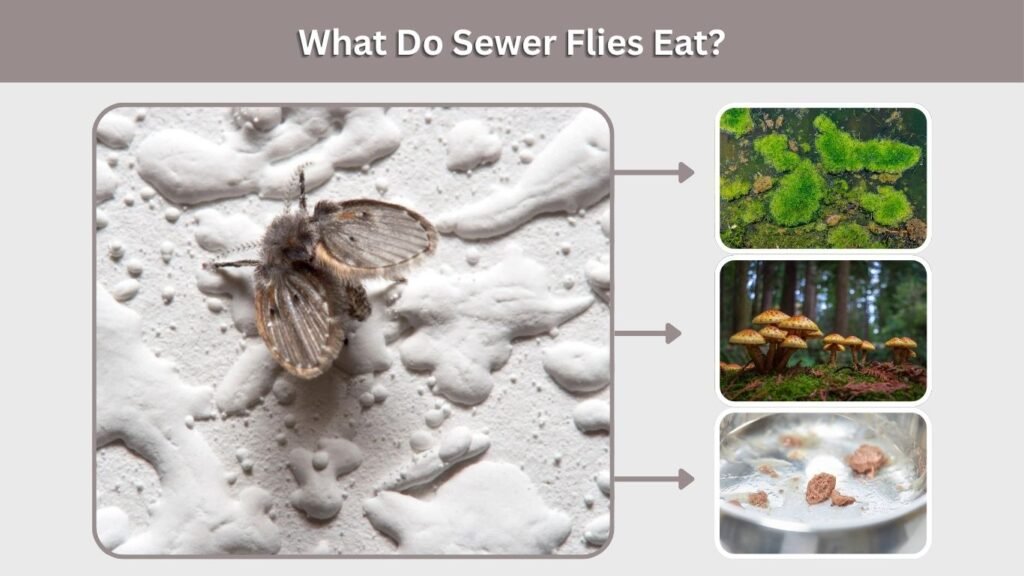
The larval and adult stages have different feeding habits. Larvae do most of the feeding and are responsible for developing within drain slime.
Larval Diet
Sewer fly larvae consume:
- Bacteria
- Algae
- Fungi
- Microscopic organisms
- Decaying vegetation
- Sewage particles
- Wet food residue
- Organic material in biofilm
The larvae scrape and consume the gelatinous film lining drains and wastewater systems. In sewage treatment environments, their feeding can help break organic waste into simpler substances.
Adult Diet
Adult sewer flies feed very little because their mouthparts are reduced. When food is available, they may consume small amounts of nectar, sugary liquids, or other liquid carbohydrates.
Adults spend most of their brief lives resting, mating, and locating damp places in which to lay eggs.
Common Sewer Fly Species
Several moth fly species can occur around homes, drains, and wastewater facilities. Their ranges overlap, and photographs may not be enough for reliable species identification.
1. Psychoda alternata
Known as the trickling filter fly or common drain fly, Psychoda alternata is strongly associated with wastewater treatment systems, sewer filters, and household drains.
It originated in North America but has become established in parts of Europe, Asia, and South America. Adults are fuzzy and dark-colored, while larvae develop in wet biofilm and sewage material.
2. Clogmia albipunctata
This species is commonly called the bathroom moth midge or filter fly. It is widespread in tropical, subtropical, and many temperate regions and frequently lives around human buildings.
Its dark wings often have noticeable pale spots near the ends of the veins. It may breed in bathrooms, kitchens, sewers, trash containers, water-filled tree holes, and wastewater facilities.
3. Psychoda phalaenoides
Psychoda phalaenoides is another moth fly associated with drains and damp organic material. It is small, delicate, fuzzy, and brownish-gray to dark-colored.
Like related species, its larvae feed on algae, fungi, bacteria, and decomposing material inside wet slime.
4. Other Psychoda Species
Many additional Psychoda species live in moist natural or artificial habitats. Several are almost identical without magnification, so identifying a household specimen simply as a drain fly or Psychoda species is often more accurate than assigning a precise species name.
Sewer Fly Life Cycle
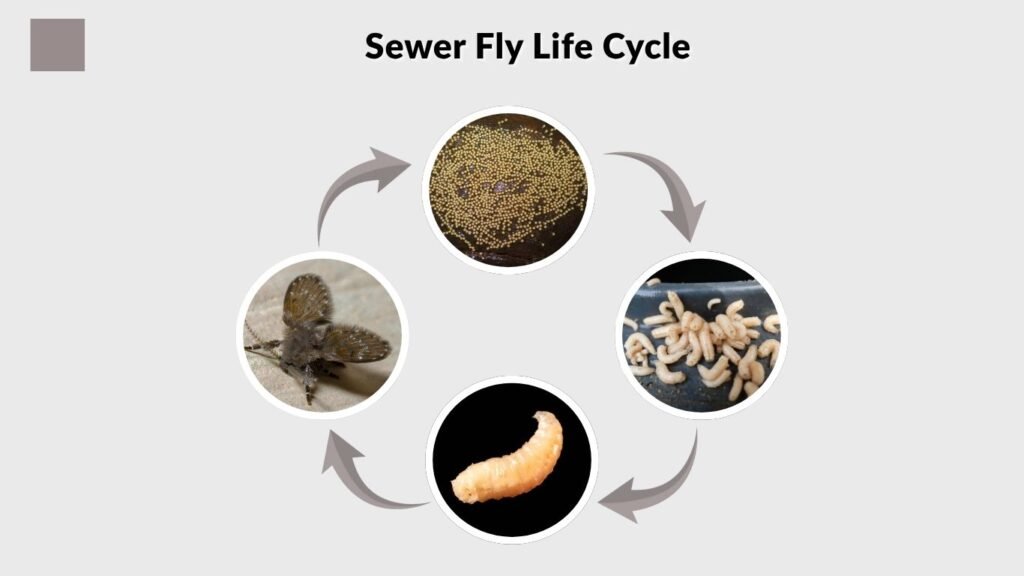
Sewer flies undergo complete metamorphosis with four stages: egg, larva, pupa, and adult. The entire cycle may require one to four weeks, depending on the species, temperature, moisture, and food availability.
Eggs and Larvae
Females lay their eggs in moist organic film rather than directly in clean water. A typical mass may contain approximately 15–40 eggs, although larger groups are possible.
Eggs can hatch in less than two days under favorable conditions. The larvae then feed and grow for around 9–15 days, making the larval stage the longest part of the lifecycle.
Pupae and Adults
Mature larvae form pupae within or near the breeding material. The pupal stage may last only 24–48 hours before adults emerge.
Adults generally survive from several days to approximately two weeks. Because new adults can emerge daily, an infestation may continue even when visible flies are repeatedly killed.
Are Sewer Flies Dangerous?
Sewer flies do not bite or sting humans or pets. Most household infestations are considered a nuisance rather than a serious health threat.
Because they breed in drains, sewage, and decaying material, adults may pick up microorganisms on their bodies. Some research has detected bacteria on drain flies, but evidence showing that they commonly transmit disease to people is limited. Large infestations may also contribute to allergic reactions or respiratory irritation in sensitive individuals.
Sewer Flies vs. Other Small Flies
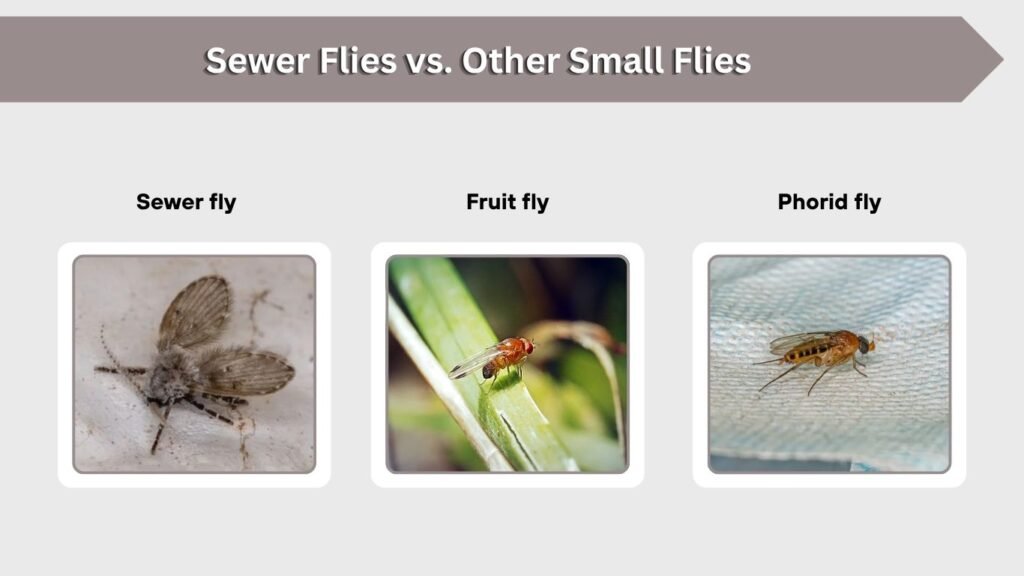
| Feature | Sewer fly | Fruit fly | Phorid fly |
| Appearance | Fuzzy and moth-like | Smooth, tan or yellow-brown | Hump-backed and dark |
| Wings | Broad and hairy | Clear and smooth | Narrow and clear |
| Main habitat | Drain slime and wet biofilm | Fermenting fruit and food | Decay, sewage, and plumbing leaks |
| Flight | Weak and hopping | Active hovering | Often runs rapidly |
| Attraction | Moist organic buildup | Sweet or fermented food | Decaying organic material |
A fuzzy fly resting near a sink or shower is likely a sewer fly. Smooth-bodied flies circling fruit are more likely fruit flies, while small hump-backed flies that run across counters may be phorid flies.
Why Are Sewer Flies in the House?
Sewer flies appear when a suitable breeding site is available. A rarely used drain may dry slowly and collect organic residue, while a partially clogged drain may retain enough moisture and slime for larvae.
Their presence may indicate:
- Organic buildup inside a drain
- Standing water
- An unused plumbing fixture
- A clogged overflow channel
- A dirty condensate tray
- A sewage backup
- A leaking or damaged pipe
Placing clear tape loosely over part of a suspected drain overnight can help identify the source. Emerging adults may become attached to the tape. Do not completely seal the opening because airflow encourages the flies to emerge.
FAQs
Are sewer flies the same as drain flies?
Yes. Sewer fly, drain fly, moth fly, filter fly, and sink fly are commonly used for the same group of small, fuzzy flies that reproduce in wet organic material.
Do sewer flies bite?
No. The common sewer flies found around household drains are non-biting insects. They do not feed on human or animal blood.
How big are sewer flies?
Most adults measure approximately 2–4 millimeters long. Larger females or species may reach around 5–6 millimeters, excluding the antennae and extended wings.
Why do sewer flies sit on bathroom walls?
Adults normally remain close to the drain or wet material where they developed. Their weak flight ability makes nearby walls, tiles, windows, and sinks convenient resting surfaces.
Can sewer flies come from a broken sewer pipe?
Yes. A damaged or leaking sewer line can create hidden accumulations of wet organic material where larvae develop. Persistent flies emerging away from visible drains may justify a plumbing inspection.