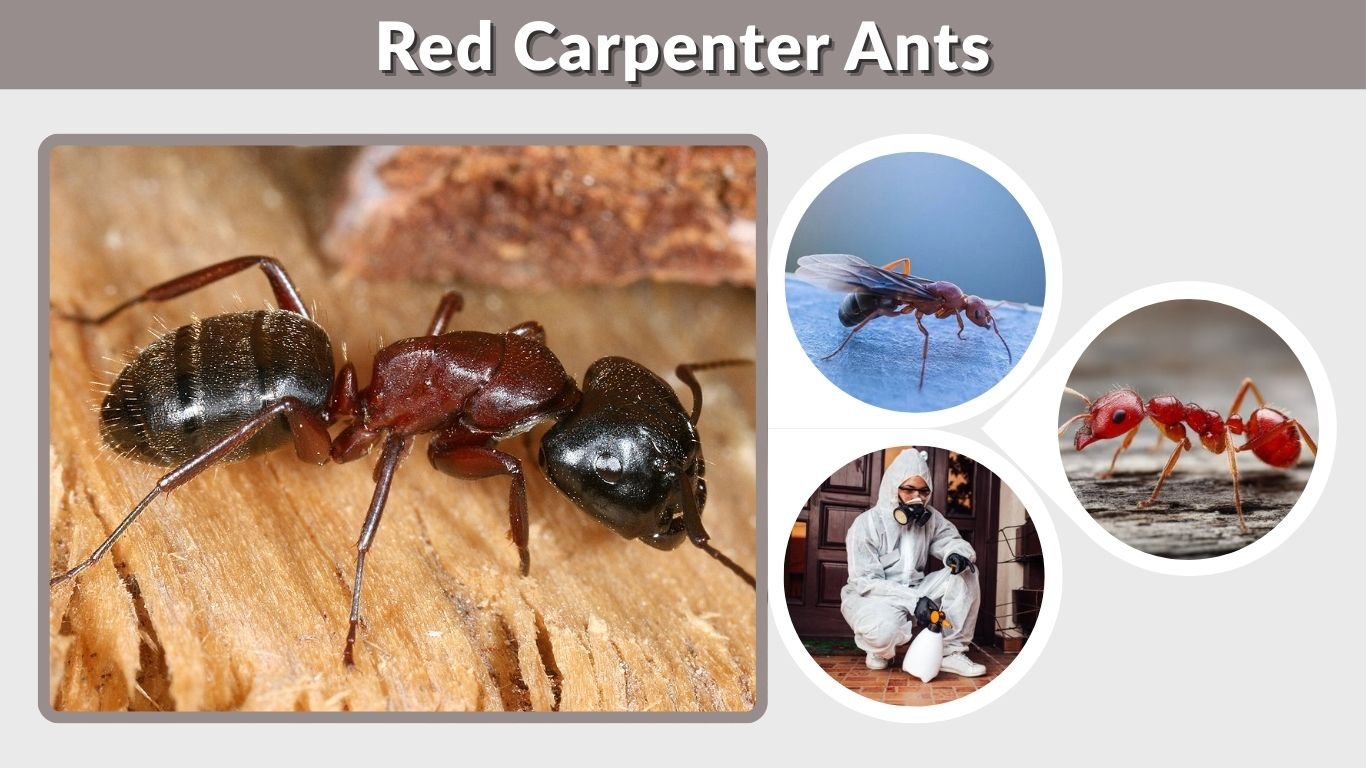
Red carpenter ants are large ants that may appear reddish, orange, chestnut, or red and black depending on the species. Many people confuse them with fire ants or ordinary red ants, but carpenter ants are different because they can nest in wood and may become a structural concern indoors. This guide explains how to identify red carpenter ants, what their bites feel like, how large their colonies can become, and what to do if you find them in your house.
What Is a Red Carpenter Ant?
A red carpenter ant is not always one single species. It usually refers to reddish or red-and-black ants in the Camponotus genus. Carpenter ants are known for making smooth tunnels and galleries in wood, which is why they are called carpenter ants. Rutgers notes that carpenter ants belong to the genus Camponotus and nest in wood by creating smooth tunnels and galleries.
Red Carpenter Ant Scientific Name
The most commonly discussed red carpenter ant is Camponotus castaneus, often called the chestnut carpenter ant, reddish carpenter ant, or red hazelnut carpenter ant. BugGuide describes this species as a large, uniformly reddish-orange carpenter ant found in the eastern United States.
Another red-and-black species is Camponotus chromaiodes, sometimes called the rust-colored or red carpenter ant. Mississippi Entomological Museum describes it as a large species with reddish areas on the legs, petiole, and base of the abdomen, while much of the body may be black.
Are Carpenter Ants Red or Black?
Carpenter ants can be black, reddish, yellowish, brown, or red and black. Color helps, but it is not enough for identification. The University of Minnesota Extension explains that ants may be brownish, black, yellowish, reddish, or black and red, and that color alone is not always reliable for identification.
Red Carpenter Ant Identification
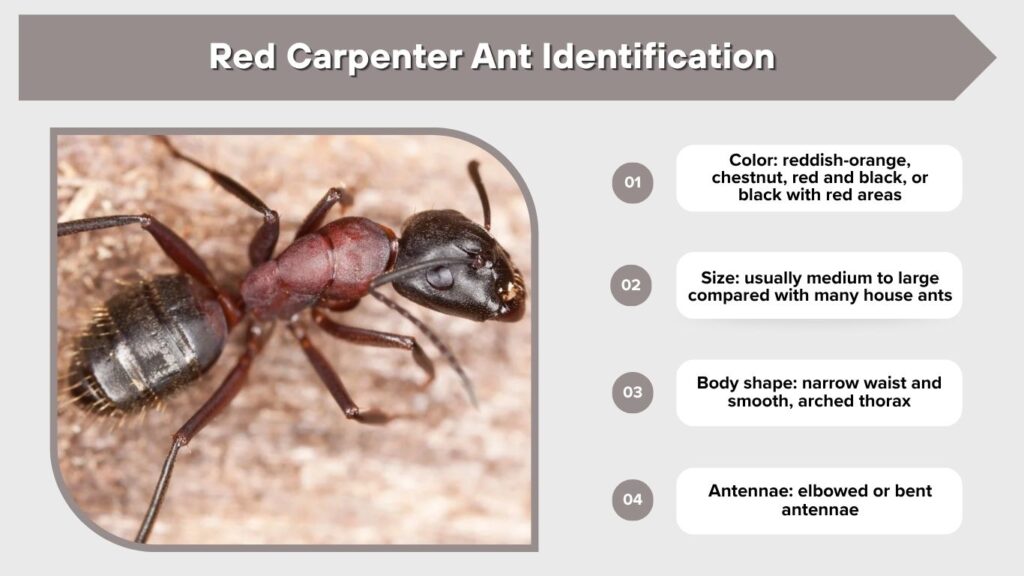
Red carpenter ants are usually larger than many household ants. They have a narrow waist, bent antennae, and a smoothly rounded thorax when viewed from the side. Rutgers lists the arched thorax as a key carpenter ant feature and gives typical worker sizes of about 6–13 mm.
Key Identification Signs
- Color: reddish-orange, chestnut, red and black, or black with red areas
- Size: usually medium to large compared with many house ants
- Body shape: narrow waist and smooth, arched thorax
- Antennae: elbowed or bent antennae
- Wings: winged reproductives have front wings longer than hind wings
- Nest signs: sawdust-like frass near wood, windows, walls, or baseboards
Red and Black Carpenter Ants
Red and black carpenter ants are often mistaken for fire ants because of their color. However, red-and-black carpenter ants are usually larger and have the classic carpenter ant body shape. Camponotus chromaiodes often has a black body with reddish legs or reddish body sections, although color can vary.
Red Carpenter Ant Size
Red carpenter ants vary by species and worker caste. Some workers are smaller, while major workers are larger. BugGuide lists Camponotus castaneus workers at about 7–10 mm, with major workers larger. Rutgers gives a broader carpenter ant worker range of 6–13 mm.
| Type | Common Size | Notes |
| Minor worker | Smaller worker | Foraging, feeding, nest duties |
| Major worker | Larger worker | Defense and heavy work |
| Queen | Larger than workers | Starts and maintains the colony |
| Winged male/female | Larger reproductive ants | Appear during swarming season |
Red Carpenter Ants With Wings
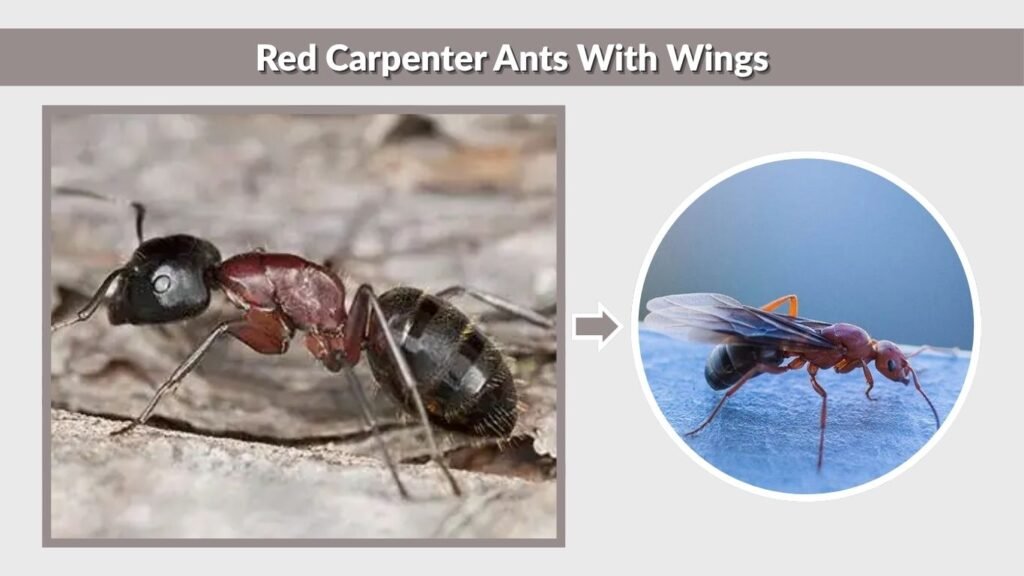
Red carpenter ants with wings are usually reproductive ants, also called swarmers or alates. They leave mature colonies to mate and start new colonies. Winged carpenter ants can worry homeowners because they may signal a mature nest nearby.
Winged Carpenter Ant vs Winged Termite
Winged carpenter ants have bent antennae, a narrow waist, and uneven wing pairs, with hind wings shorter than front wings. The University of Minnesota Extension uses these traits to separate carpenter ants from termites, which have straighter antennae, broad waists, and equal-length wings.
Red Carpenter Ant Queen
A red carpenter ant queen is larger than workers and may have wings before mating. After mating, queens usually shed their wings and begin a new colony. Winged ants often appear after rain or during warm seasonal swarms; reproductive males die after mating, while queens attempt to start new nests.
How Many Red and Black Carpenter Ants Are in a Colony?
A mature carpenter ant colony can contain thousands of ants. The Illinois Department of Public Health states that a mature carpenter ant colony may contain as many as 10,000 individuals, and only about 10% to 15% of workers may be outside the nest searching for food.
This is important because seeing only a few red carpenter ants indoors may not show the full size of the colony.
| Colony Stage | Possible Signs | What It Means |
| New colony | Few ants, little activity | Colony is still developing |
| Growing colony | Regular foraging trails | Workers are feeding larvae and queen |
| Mature colony | Winged ants, many workers | Colony may be large enough to produce swarmers |
| Indoor satellite nest | Ants in walls, frass, moisture areas | Nest may be connected to a larger parent colony |
Red Carpenter Ant Bite: Are They Dangerous?
Red carpenter ants can bite, but they do not sting like fire ants. The University of Kentucky Entomology notes that carpenter ants are mainly a nuisance and usually bite only if their nest is disturbed or if they are handled.
What Does a Red Carpenter Ant Bite Feel Like?
A carpenter ant bite may feel like a pinch or mild burning sensation. Some people may notice redness, itching, or a small irritated spot. Cleveland Clinic explains that ant bites may leave pimple-like marks, while fire ant stings can cause painful, itchy blisters.
Are Red Carpenter Ants Poisonous?
Red carpenter ants are not considered poisonous to humans. They do not inject venom like fire ants. However, bites can still hurt, and people with insect allergies should watch for unusual swelling, breathing problems, dizziness, or widespread reactions after any insect bite.
Red Carpenter Ants vs Fire Ants vs Red Ants
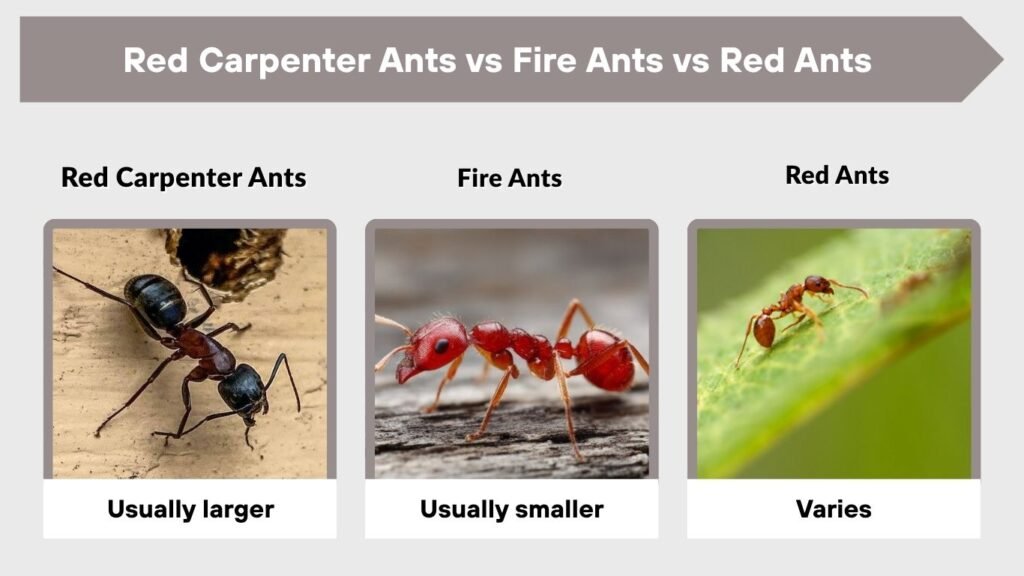
Many people search “red carpenter ants vs fire ants” because both can be reddish. The easiest difference is behavior. Carpenter ants are larger and associated with wood nesting, while fire ants are aggressive mound-building ants known for painful stings.
| Feature | Red Carpenter Ant | Fire Ant | General Red Ant |
| Size | Usually larger | Usually smaller | Varies |
| Nest | Wood, rotten logs, damp structures, soil | Outdoor mounds | Varies by species |
| Sting | Does not sting | Stings and may cause blisters | Depends on species |
| Home risk | Can damage wood by tunneling | Usually outdoor nuisance and sting risk | Depends on species |
| Body shape | Narrow waist, arched thorax | Smaller, more aggressive | Varies |
Carpenter ants do not eat wood like termites. They excavate it to create nesting galleries. NC State Extension explains that carpenter ant damage may include slit-like openings where ants push out sawdust and frass, and the galleries often follow the wood grain.
Red Carpenter Ants in the House
Finding red carpenter ants in the house can mean they are foraging from an outdoor nest, but repeated indoor sightings may suggest a nest inside or near the structure. Carpenter ants prefer moist or damaged wood, so bathrooms, kitchens, windows, crawl spaces, attics, and wall voids are common problem areas.
Signs of Red Carpenter Ant Infestation
- Large red or red-and-black ants indoors, especially at night
- Winged red carpenter ants near windows or lights
- Sawdust-like frass near baseboards, beams, or wall openings
- Rustling sounds inside walls
- Damp, rotting, or water-damaged wood
- Ant trails leading to trees, stumps, decks, or structural wood
Why Red Carpenter Ants Enter Homes
Red carpenter ants may enter homes looking for food, moisture, or nesting sites. Sugary foods, meats, pet food, leaking pipes, wet wood, and gaps around doors or windows can attract them. Outdoor colonies may also move into wall voids or damaged wood when conditions are suitable.
How to Get Rid of Red Carpenter Ants
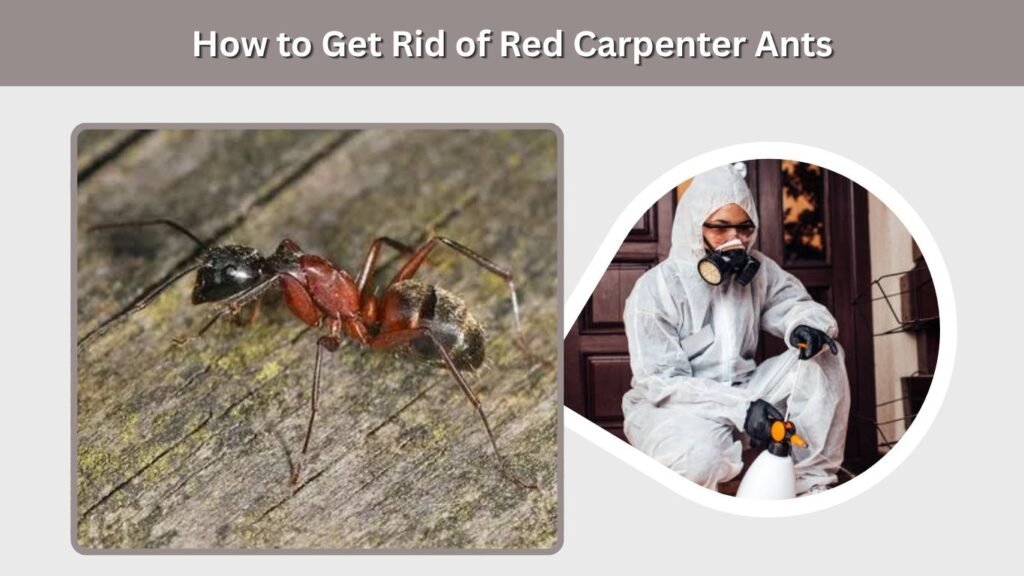
Getting rid of red carpenter ants starts with finding the nest. Spraying visible ants may kill a few workers but often does not remove the queen or the hidden colony. Since most workers may remain inside the nest, the ants you see are only a small part of the colony.
Find the Nest First
Look for trails at night when carpenter ants are most active. Follow ants back to cracks, wall gaps, tree limbs, stumps, decks, or damp wood. Check areas with moisture problems because carpenter ants commonly use softened or damaged wood.
Remove Moisture and Damaged Wood
The best long-term control is prevention. Repair leaks, improve ventilation, replace rotting wood, and keep wood piles away from the house. Seal cracks around windows, doors, utility lines, and foundation gaps.
Use Baits Carefully
Ant baits can help when workers carry bait back to the colony. Avoid spraying strong repellents near bait stations because it may scatter ants and reduce bait feeding. Always follow the product label, and keep baits away from children and pets.
Call a Professional When Needed
Professional pest control may be needed if you see winged carpenter ants indoors, hear activity in walls, find repeated frass piles, or cannot locate the nest. Carpenter ants can cause structural damage over time if the colony remains active in wood.
How to Prevent Red Carpenter Ants Naturally
Prevention focuses on making your home less attractive to ants. Keep food sealed, clean sticky spills, remove pet food overnight, and trim branches away from the roof. Store firewood off the ground and away from exterior walls. Fix moisture problems quickly because damp wood is one of the biggest reasons carpenter ants settle near homes.
FAQs
Are there red carpenter ants?
Yes, there are red carpenter ants. The name often refers to reddish species such as Camponotus castaneus or red-and-black species such as Camponotus chromaiodes. Not every red ant is a carpenter ant, so body shape, size, antennae, and nesting behavior are important for identification.
Do red carpenter ants bite?
Yes, red carpenter ants can bite if handled or if their nest is disturbed. Their bite may feel like a pinch and can cause mild redness or irritation. They do not sting like fire ants, but sensitive people should watch for allergic reactions.
Are red carpenter ants fire ants?
No, red carpenter ants are not fire ants. Fire ants are usually smaller, aggressive, and known for painful stings. Red carpenter ants are larger and are linked with wood nesting. Color alone is not enough to tell them apart.
What is the size of a red carpenter ant?
Red carpenter ant size depends on the species and worker type. Camponotus castaneus workers are often about 7–10 mm, while carpenter ant workers in general may range around 6–13 mm. Queens are usually larger than workers.
How do you get rid of red carpenter ants?
Find the nest, remove moisture problems, seal entry points, and use ant baits correctly. Replace rotting wood and keep firewood away from the house. If you see winged ants indoors or repeated frass piles, professional treatment may be needed.