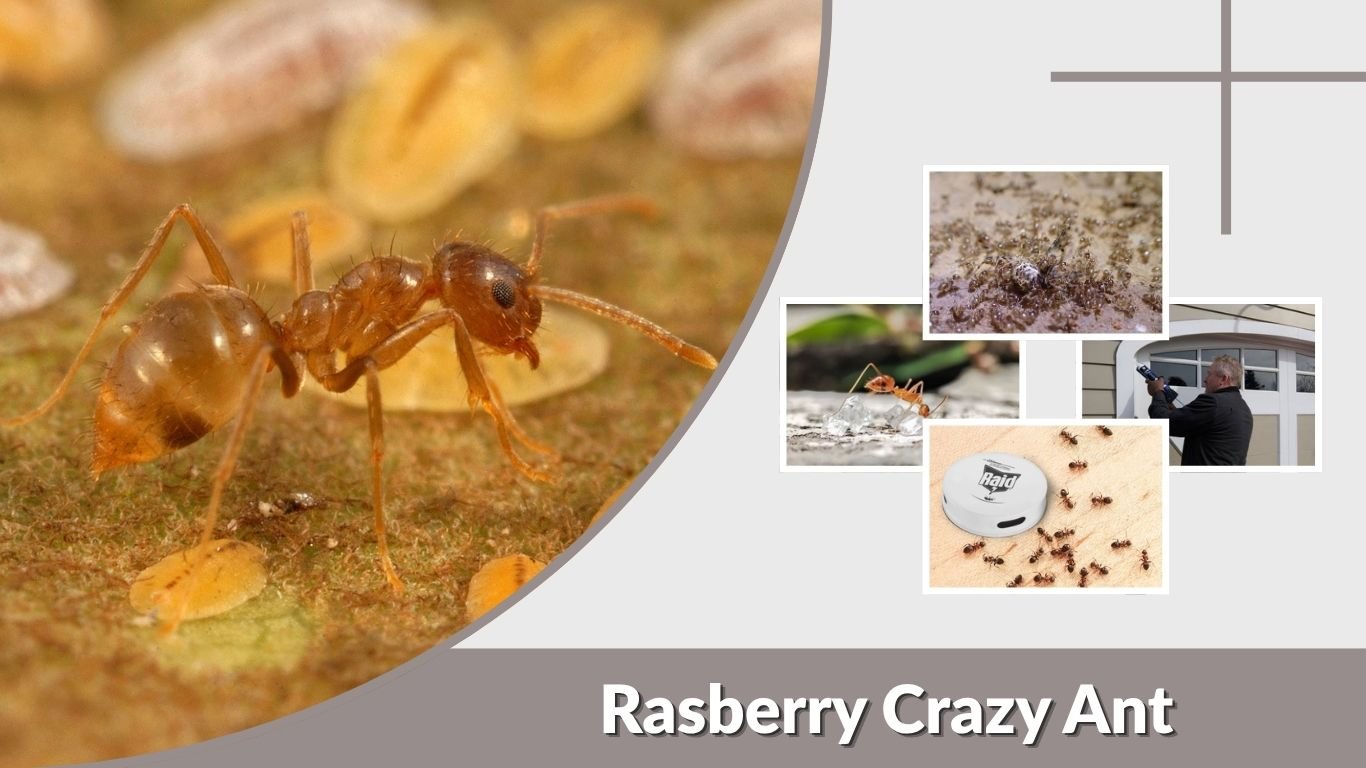
The Rasberry crazy ant is a highly invasive pest capable of forming enormous colonies around homes, businesses, farms, and natural habitats. Now officially called the tawny crazy ant, this small reddish-brown ant is recognized by its fast, unpredictable movements. Although it does not deliver the painful sting associated with fire ants, it can become a serious nuisance, damage electrical equipment, displace native wildlife, and prove exceptionally difficult to control.
What Is a Rasberry Crazy Ant?
The Rasberry crazy ant is an invasive ant species with the scientific name Nylanderia fulva. Its accepted common name is the tawny crazy ant, although “Rasberry crazy ant” remains widely used, especially in Texas.
The ant was named after pest-control professional Tom Rasberry, who noticed rapidly growing populations near Houston in 2002. The word “crazy” describes the ant’s quick, erratic running behavior. Instead of traveling in the organized trails associated with many other ants, workers often scatter and change direction unpredictably when disturbed.
Rasberry Crazy Ant Classification
| Classification | Information |
|---|---|
| Scientific name | Nylanderia fulva |
| Official common name | Tawny crazy ant |
| Other name | Rasberry crazy ant |
| Family | Formicidae |
| Order | Hymenoptera |
| Worker size | Approximately 2.6–3 millimeters |
| Color | Golden-brown to reddish-brown |
| Native range | South America |
| Primary U.S. range | Southern and Gulf Coast states |
Rasberry Crazy Ant Characteristics
Correct identification is important because ordinary treatments used for fire ants or household ants may not work well against Rasberry crazy ants.
Physical Appearance
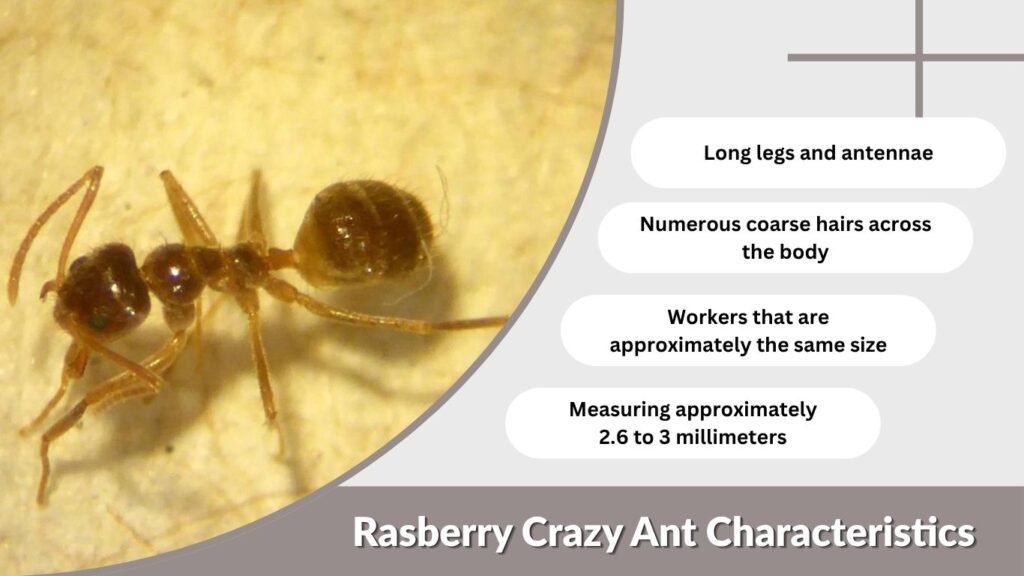
Rasberry crazy ant workers are relatively small, measuring approximately 2.6 to 3 millimeters, or about one-eighth of an inch, in length. They are generally golden-brown, tan, or reddish-brown.
Their most noticeable physical characteristics include:
- Long legs and antennae
- Numerous coarse hairs across the body
- Workers that are approximately the same size
- A slender body without an obvious stinger
- A small acid-producing opening at the abdomen’s tip
- Rapid, seemingly uncoordinated movement
The abdomen may appear faintly striped after the ant feeds because the lighter membranes between its abdominal segments become visible as the abdomen expands.
Movement and Foraging Behavior
Movement is often the easiest field characteristic to recognize. When disturbed, the ants run quickly in different directions instead of moving in a neat line.
Large infestations may produce loose trails along foundations, tree trunks, sidewalks, pipes, utility lines, and landscape borders. Thousands of workers can cover the soil and surrounding objects, making an infestation difficult to overlook.
Where Do Rasberry Crazy Ants Live?
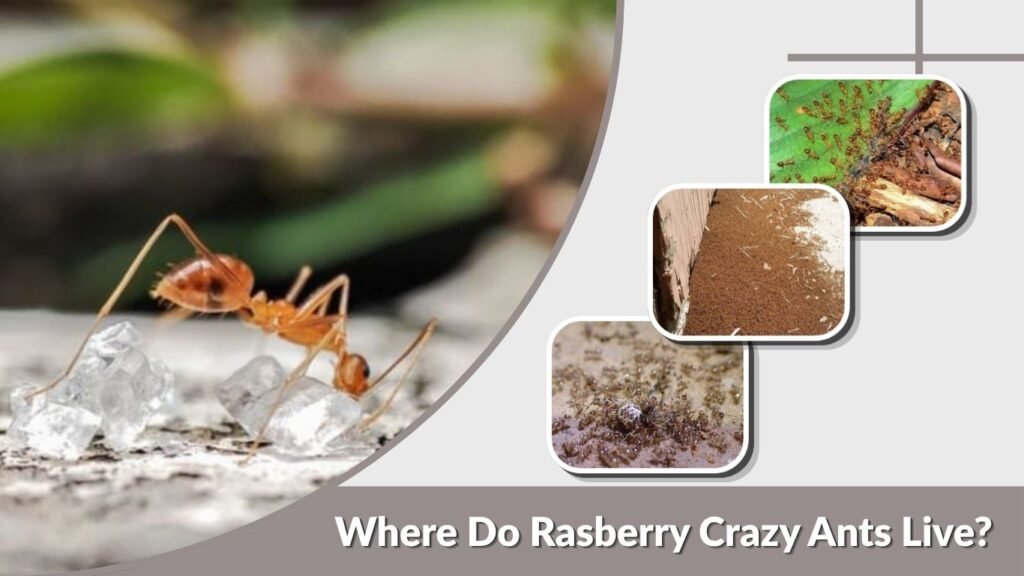
Rasberry crazy ants prefer warm, humid environments. In the United States, they have become established primarily in Gulf Coast areas, including parts of Texas, Louisiana, Florida, Mississippi, Alabama, and Georgia.
Their exact U.S. entry route is uncertain, but the species is believed to have arrived from South America through commercial transportation. Human activity continues to spread colonies when infested soil, plants, compost, landscape materials, rubbish, equipment, or vehicles are moved to new locations.
Common Nesting Locations
Unlike fire ants, Rasberry crazy ants generally do not construct obvious soil mounds with central openings. They frequently establish temporary or loosely organized nests beneath protected objects.
Common nesting areas include:
- Rocks, bricks and landscape timbers
- Fallen logs, leaf litter and tree stumps
- Potted plants and piles of yard debris
- Compost, mulch and stored lumber
- Outdoor electrical boxes
- Wall voids and crawl spaces
- Beneath sidewalks and pavement
- Around air conditioners and utility equipment
Colonies can relocate when conditions become too dry, hot, cold, or flooded. Their ability to use numerous nesting sites makes it difficult to locate and eliminate every part of an infestation.
Rasberry Crazy Ant Colony and Queen
Rasberry crazy ant colonies may contain many queens rather than depending on a single reproductive queen. Multiple connected nests can cooperate without displaying the strong aggression normally seen between separate ant colonies.
These connected populations may develop into enormous “supercolonies.” Workers, queens, brood, and food resources can be distributed among many outdoor nesting locations.
The colonies usually expand through budding. Queens and groups of workers leave an established nest and form another colony nearby. This process allows the infestation to spread steadily across neighboring properties without depending entirely on long-distance mating flights.
What Do Rasberry Crazy Ants Eat?
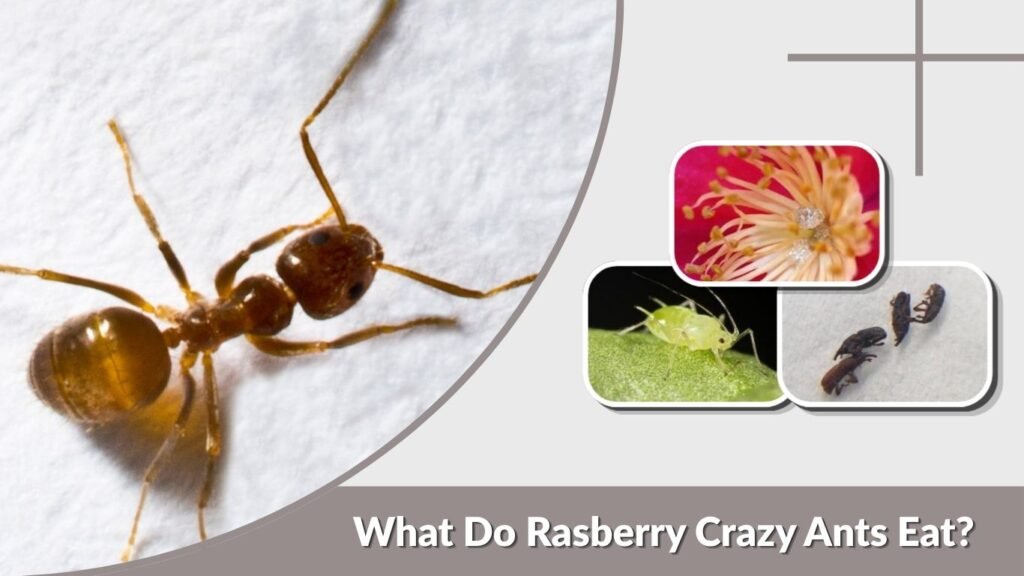
Rasberry crazy ants are opportunistic omnivores with a broad diet. Their ability to consume numerous foods helps them survive in urban, agricultural, and natural environments.
They commonly feed on:
- Honeydew produced by aphids, scales and mealybugs
- Flower nectar and plant secretions
- Overripe or damaged fruit
- Dead insects and small animals
- Living arthropods
- Household sweets, grease and protein
- Pet food and food waste
The ants often protect honeydew-producing insects from predators. As a result, plants may experience larger populations of aphids, scales, whiteflies, or mealybugs, increasing plant stress and agricultural damage.
Why Are Rasberry Crazy Ants a Problem?
A small number of foraging workers may appear harmless, but mature infestations can contain millions of ants. Their population density is the primary reason they become such destructive pests.
Damage to Electronics
Rasberry crazy ants frequently invade electrical devices and utility systems. Large numbers can accumulate inside breaker boxes, air-conditioning units, pumps, computers, security systems, switching equipment, and other machinery.
Their bodies may clog small mechanisms, bridge electrical contacts, cause short circuits, and contribute to equipment failure. Killing only the ants visible inside a device does not solve the underlying problem when large outdoor colonies remain nearby.
Electrical equipment should be disconnected and inspected by a qualified technician whenever an infestation creates sparks, repeated outages, overheating, or other safety concerns.
Environmental Impact
Rasberry crazy ants can displace native ants and other invertebrates. Dense populations may also interfere with ground-nesting birds, reptiles, small mammals, and livestock.
They have even displaced red imported fire ants in heavily infested areas. Although that may initially appear beneficial, replacing one invasive ant with another does not restore the local ecosystem. Tawny crazy ants can dominate landscapes, increase populations of plant-feeding insects, and reduce food resources for native species.
Rasberry Crazy Ants vs. Fire Ants
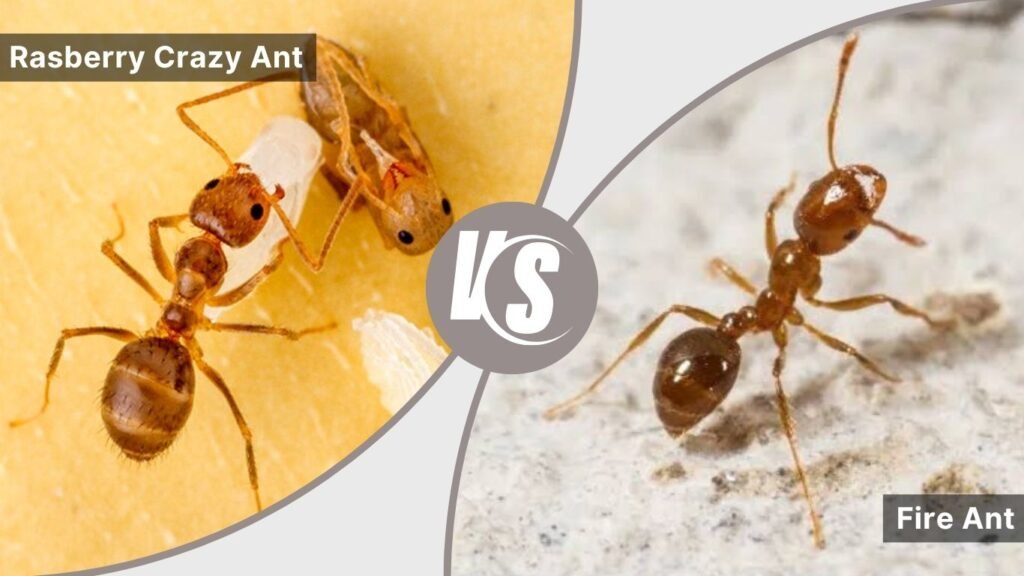
Although both species may have a reddish-brown appearance, their behavior and nests are noticeably different.
| Feature | Rasberry Crazy Ant | Fire Ant |
|---|---|---|
| Movement | Fast and erratic | More organized trails |
| Worker sizes | Mostly uniform | Several worker sizes |
| Nest | Usually beneath objects | Visible soil mound |
| Stinger | No functional stinger | Painful stinger |
| Colony structure | Many queens and connected nests | Often more centralized |
| Main concern | Huge populations and electrical damage | Aggressive stinging |
Rasberry crazy ants use formic acid as a chemical defense. They do not attack people with the repeated venomous stings associated with imported fire ants.
Do Rasberry Crazy Ants Bite?
Rasberry crazy ants can bite with their mouthparts, but they are not generally considered dangerous to healthy people. The bite is usually mild and may cause brief irritation.
They lack the prominent stinger of fire ants. Instead, they can release formic acid through an opening at the end of the abdomen. Sensitive individuals may experience localized redness, itching, or discomfort after extensive exposure.
Wash the affected area with soap and water, avoid scratching, and seek medical attention if severe swelling, breathing difficulty, dizziness, or another serious reaction develops.
How to Get Rid of Rasberry Crazy Ants
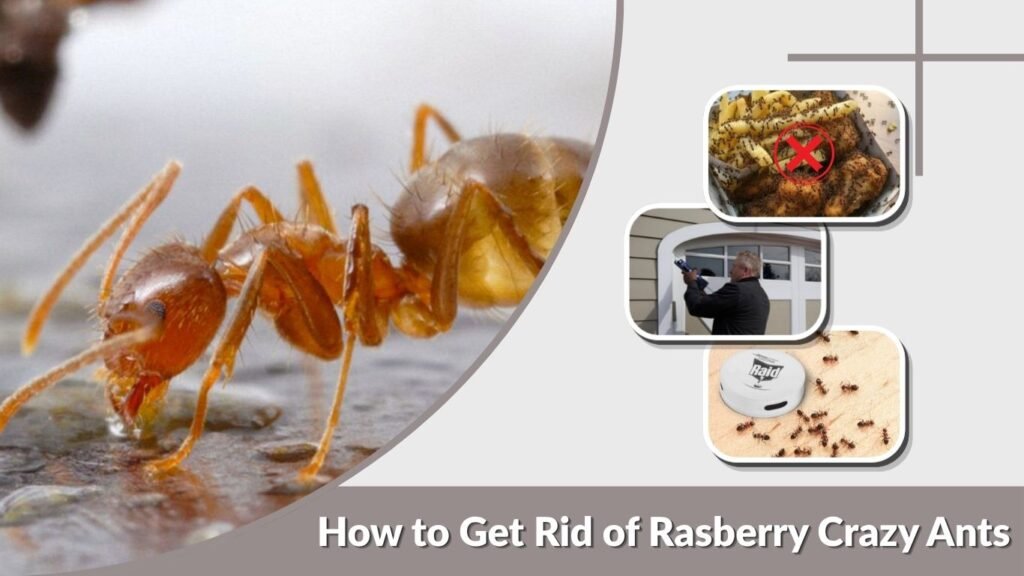
Controlling Rasberry crazy ants requires an integrated approach. Spraying visible workers may provide temporary relief, but it rarely reaches the many queens and hidden nests supporting the infestation.
1. Confirm the Species
Collect several workers safely or photograph them closely. A local extension office, agriculture department, or licensed pest-management professional may help confirm the identification.
This step matters because Rasberry crazy ants resemble other small brown ants, including closely related crazy-ant species.
2. Remove Food and Nesting Materials
Clean spilled food, store pet food in sealed containers, repair leaking faucets, and keep rubbish bins closed. Remove unnecessary boards, stones, leaf piles, plant pots, and other objects that provide protected nesting spaces.
Prune vegetation touching the building and manage aphids, scales, and other honeydew-producing pests on landscape plants.
3. Seal Building Entry Points
Seal openings around windows, doors, pipes, cables, vents, foundations, and utility penetrations. Repair damaged screens and install suitable weather stripping.
Exclusion will not eliminate outdoor colonies, but it can reduce the number of ants entering living areas.
4. Use Appropriately Labeled Baits
Baits can be more useful than fast-acting contact sprays because workers may carry the active ingredient back to hidden colony members. However, Rasberry crazy ants may ignore baits designed for other species, and their food preferences can change.
USDA research indicates that properly developed slow- and fast-acting liquid baits can help reduce tawny crazy ant activity. Contact sprays alone are frequently inadequate against extensive colonies.
Use only products specifically labeled for ants and for the treatment location. Never apply pesticides to electrical equipment unless the label explicitly permits that use.
5. Consider Professional Treatment
Large infestations commonly extend across several properties. A licensed professional can locate major foraging routes, identify nesting zones, select appropriate products, and plan repeated treatments.
Long-term suppression may be more realistic than complete eradication, particularly when surrounding properties remain infested.
Will Boric Acid Kill Rasberry Crazy Ants?
Boric acid or borate-based bait may kill workers when prepared at an appropriate concentration and accepted by the ants. However, simply scattering boric acid powder around an infested property is unlikely to eliminate a widespread colony.
A mixture that is too strong may kill workers before they share it, while an unattractive mixture may not be eaten. Recent USDA research found that a slow-acting boron bait showed potential for broader distribution through colonies and possibly longer-lasting suppression.
Homeowners should follow labeled product instructions rather than preparing untested pesticide mixtures.
FAQs
Are Rasberry crazy ants and tawny crazy ants the same?
Yes. Rasberry crazy ant is an earlier common name for Nylanderia fulva. Tawny crazy ant is now the official common name. “Rasberry” refers to Tom Rasberry, the pest-management professional who recognized major populations near Houston, Texas.
How large are Rasberry crazy ants?
Workers are usually around 2.6 to 3 millimeters long, or approximately one-eighth of an inch. They are golden-brown to reddish-brown and have long legs, long antennae, and numerous visible body hairs when examined closely.
Why do Rasberry crazy ants enter electronics?
Electrical boxes and devices provide enclosed, protected spaces that may offer warmth and shelter. Large numbers of ants can accumulate inside, clog components, bridge contacts, and contribute to short circuits or equipment failure.
Can Rasberry crazy ants kill fire ants?
Large Rasberry crazy ant populations can displace red imported fire ants and dominate areas previously occupied by them. Their chemical defenses help them survive encounters, but their presence should not be considered beneficial because they create serious ecological and property problems.
What is the best way to kill Rasberry crazy ants?
The most reliable strategy combines species identification, sanitation, removal of nesting materials, exclusion, properly labeled baiting, and targeted professional treatment. Spraying visible workers alone normally provides only temporary relief because numerous queens and hidden outdoor nests remain active.