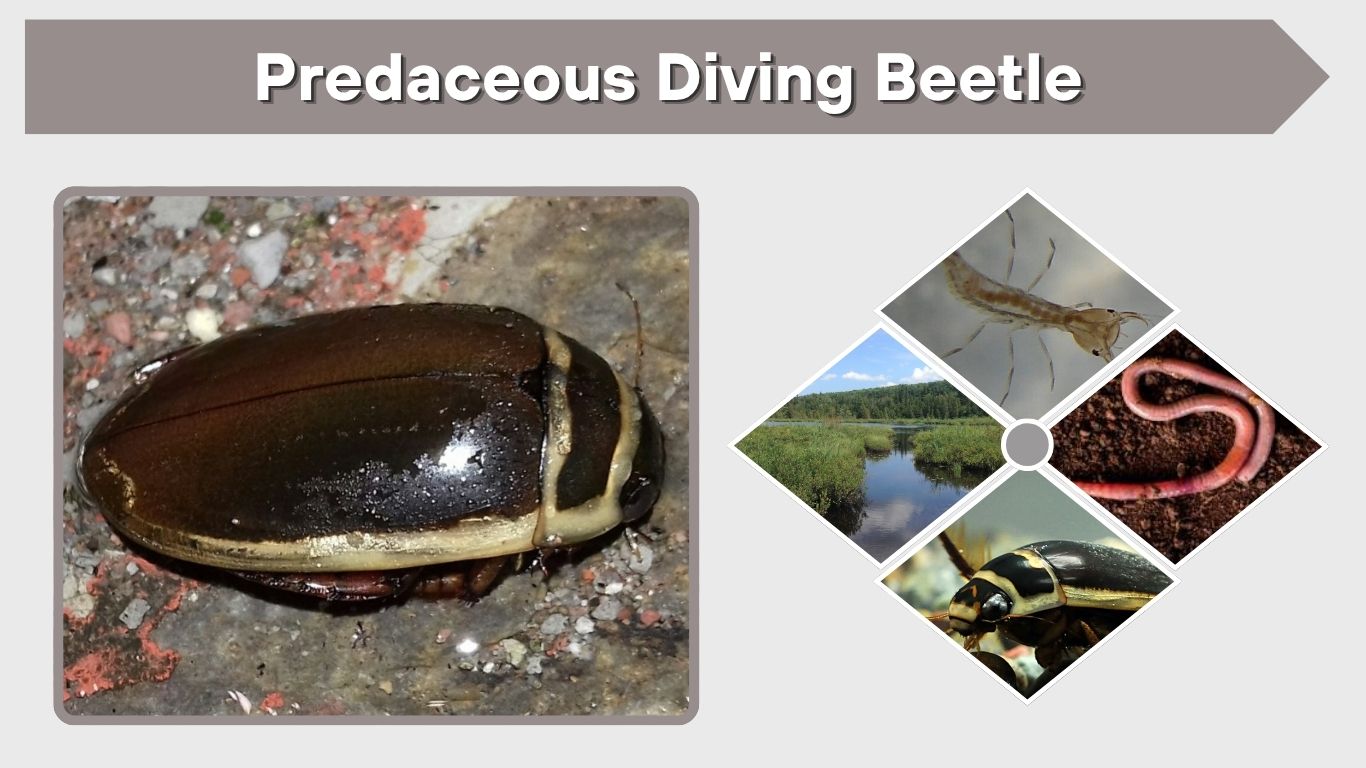
A predaceous diving beetle is one of the most fascinating insects found in ponds, lakes, wetlands, and slow-moving freshwater. These aquatic beetles are strong swimmers, active hunters, and important members of freshwater ecosystems. Adults look smooth and oval, while their larvae, often called water tigers, are fierce predators. This guide explains their identification, size, bite, diet, habitat, larvae, and life cycle.
What Is a Predaceous Diving Beetle?
Predaceous diving beetles are aquatic beetles in the family Dytiscidae. The word “predaceous” means predatory, which fits these beetles well because both adults and larvae hunt other small aquatic animals.
They are true beetles, meaning they belong to the order Coleoptera. Like other beetles, adults have hardened front wings called elytra. Unlike many land beetles, however, predaceous diving beetles are specially adapted for life in water.
Scientific Name and Classification
The scientific family name for predaceous diving beetles is Dytiscidae. There are thousands of species in this family, so “predaceous diving beetle” is a common name for many related aquatic beetles rather than one single species.
Basic classification:
- Kingdom: Animalia
- Phylum: Arthropoda
- Class: Insecta
- Order: Coleoptera
- Family: Dytiscidae
- Common name: Predaceous diving beetle
Why Are They Called Diving Beetles?
They are called diving beetles because adults dive underwater to hunt, swim, and hide. They must return to the surface to collect air. Many species trap a bubble of air under their wing covers or near the end of the abdomen, allowing them to breathe while submerged.
This behavior makes them easy to notice in ponds or aquariums. A beetle may swim quickly through the water, pause on vegetation, then rise to the surface with the tip of its abdomen touching the air.
Predaceous Diving Beetle Identification
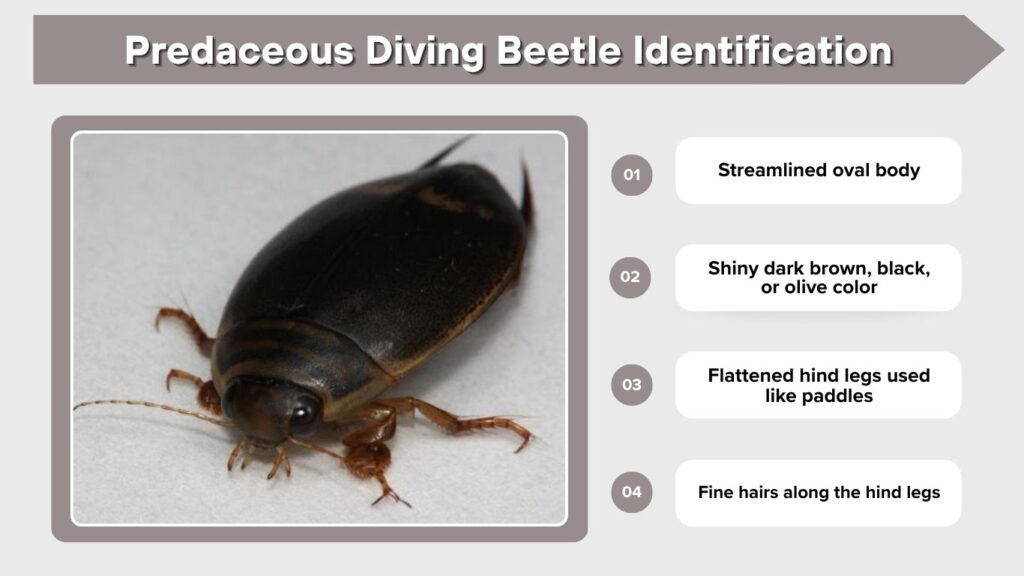
Predaceous diving beetles have a distinctive look once you know what to watch for. Most adults are oval, smooth, and somewhat flattened. Their bodies are usually dark brown, black, or olive, sometimes with yellowish edges or markings.
Key Features of Adult Beetles
Look for these identification signs:
- Streamlined oval body
- Shiny dark brown, black, or olive color
- Flattened hind legs used like paddles
- Fine hairs along the hind legs
- Threadlike antennae
- Fast, smooth swimming movement
- Habit of surfacing for air
Their hind legs are one of the easiest clues. Instead of walking legs, they look like swimming paddles. The legs move together in a rowing motion, helping the beetle move quickly through water.
Predaceous Diving Beetle vs Whirligig Beetle
People sometimes confuse predaceous diving beetles with whirligig beetles. Both are aquatic beetles, but they behave differently. Whirligig beetles usually spin and circle on the water surface in groups. Predaceous diving beetles spend more time underwater and swim through the water column.
| Feature | Predaceous Diving Beetle | Whirligig Beetle |
| Main habitat zone | Underwater and near surface | Mostly water surface |
| Movement | Dives and swims with hind legs | Spins or circles rapidly |
| Body shape | Oval, streamlined, often larger | Smaller, shiny, compact |
| Feeding style | Hunts underwater prey | Scavenges and hunts at surface |
| Common clue | Surfaces for air with abdomen tip | Swirls in groups on top of water |
Predaceous Diving Beetle Size
Predaceous diving beetle size depends on the species. Many adults are small to medium-sized, while giant predaceous diving beetles can be much larger and easier to notice.
Most common species are around 1/4 inch to 1 inch long, though some large species can exceed that. Giant diving beetles may look intimidating because of their size, strong legs, and powerful jaws, but they usually avoid people unless handled.
Giant Predaceous Diving Beetles
A giant predaceous diving beetle is usually a larger species within the family Dytiscidae. These beetles may prey on larger aquatic animals than smaller species, including tadpoles, small fish, aquatic insects, and even other beetles.
Large species are often found in ponds, marshes, slow streams, and wetlands with plenty of vegetation. They may also appear in backyard ponds or swimming pools, especially if lights attract flying adults at night.
Predaceous Diving Beetle Larvae
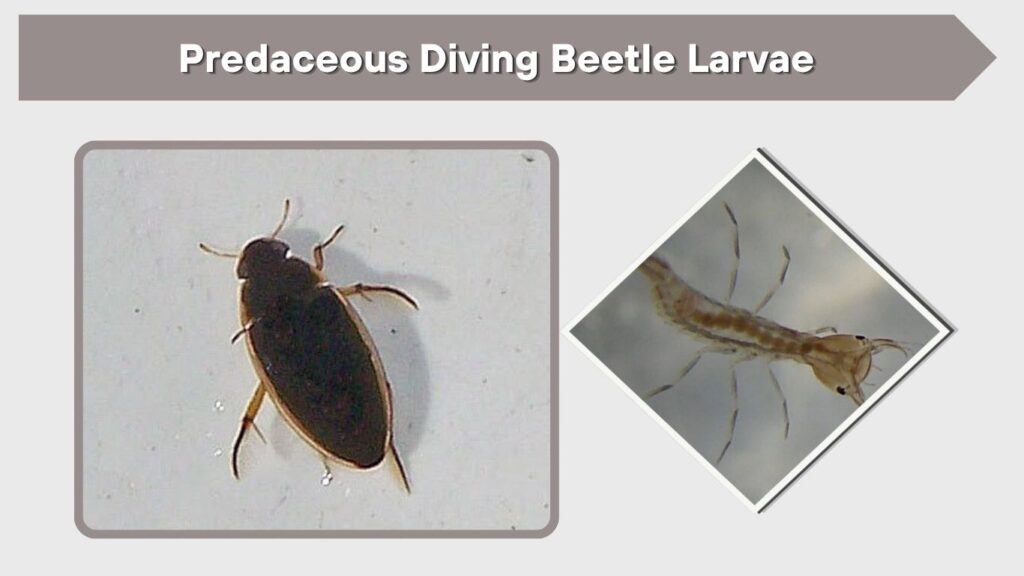
Predaceous diving beetle larvae are often called water tigers. This name comes from their aggressive feeding behavior. The larvae are long-bodied, active hunters with curved jaws that can grab prey quickly.
Unlike adults, larvae do not look like beetles. They look more like narrow aquatic insects with a large head and strong mouthparts. Their body is usually elongated, and they move through the water searching for prey.
What Do Predaceous Diving Beetle Larvae Eat?
Predaceous diving beetle larvae eat many types of small aquatic animals. Their diet may include:
- Mosquito larvae
- Midge larvae
- Tadpoles
- Small fish or fish fry
- Aquatic worms
- Small crustaceans
- Other insect larvae
- Other diving beetle larvae
The larvae use sharp jaws to seize prey. In many species, they inject digestive fluids and then consume the softened body contents. This feeding method is one reason larvae have such a fierce reputation.
Do Predaceous Diving Beetle Larvae Bite?
Yes, predaceous diving beetle larvae can bite if handled. A larval bite may feel like a sharp pinch because the jaws are designed for catching prey. They are not venomous in the way a wasp or spider may be, but the bite can be painful.
The best approach is simple: do not pick them up with bare hands. If you need to move one from a pool, pond, or container, use a small net, cup, or jar.
What Do Predaceous Diving Beetles Eat?
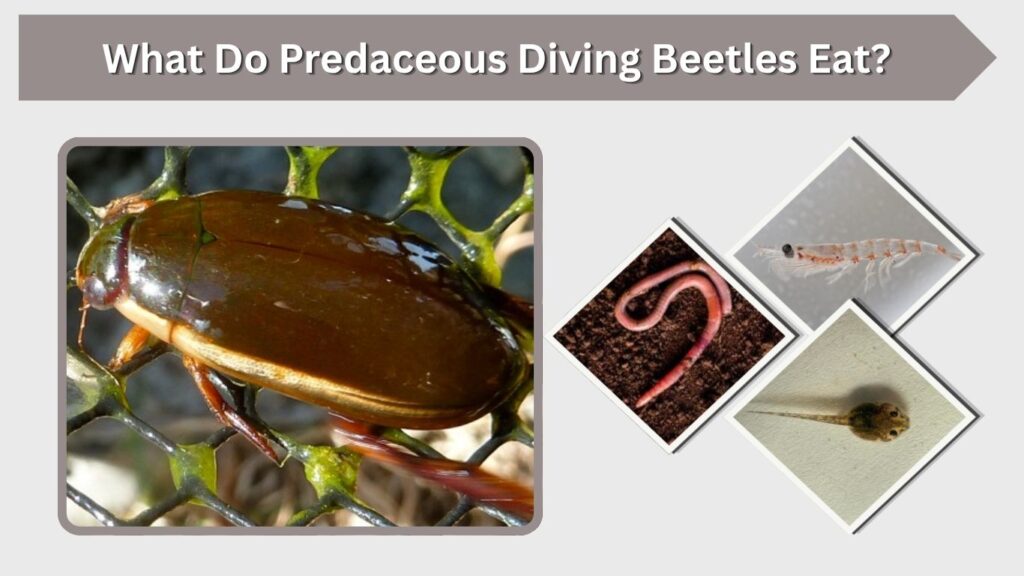
Adult predaceous diving beetles are carnivorous and opportunistic. They hunt live prey but may also feed on dead animals, making them both predators and scavengers in freshwater habitats.
Their diet commonly includes insects, larvae, worms, small crustaceans, tadpoles, and weak or injured small fish. In ponds, they help recycle nutrients by feeding on dead or dying organisms.
Are They Good for Mosquito Control?
Predaceous diving beetles may help reduce mosquito larvae in ponds and wetlands because both adults and larvae feed on small aquatic organisms. However, they should not be viewed as a complete mosquito control solution.
A healthy pond usually depends on a balance of predators, plants, water movement, and good maintenance. Diving beetles can be part of that natural balance, especially in ponds without too many fish.
Predaceous Diving Beetle Habitat
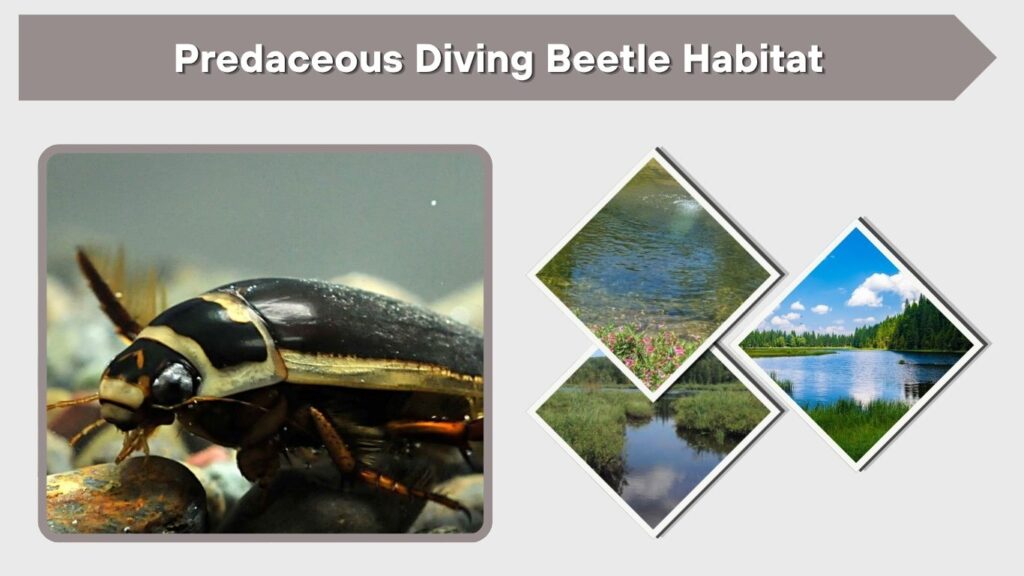
Predaceous diving beetles live in many freshwater habitats. They are commonly found in ponds, lakes, marshes, wetlands, ditches, slow streams, and temporary pools. Some can also tolerate brackish or unusual aquatic environments, depending on the species.
They often prefer water with vegetation because plants provide hiding places, egg-laying sites, and hunting areas. Aquatic plants also attract smaller animals, which become food for both adults and larvae.
Why Are They in My Swimming Pool?
A predaceous diving beetle in a swimming pool is usually there by accident. Adult beetles can fly, especially at night, and may be attracted to lights or reflective water surfaces. A pool can look like a pond from above.
If you find one in your pool:
- Remove it with a skimmer or net
- Avoid handling it with bare hands
- Move it to a natural pond or wetland if possible
- Reduce bright lights near the pool at night
- Keep the pool covered when not in use
Finding one beetle does not mean your pool is dirty or infested. It usually means a flying adult landed there while searching for water.
Predaceous Diving Beetle Adaptations
Predaceous diving beetles have several adaptations that help them survive underwater. Their bodies are built for speed, hunting, and breathing in aquatic environments.
Swimming Adaptations
The most obvious adaptation is the pair of flattened hind legs. These legs work like oars, pushing the beetle forward with strong strokes. Fine hairs on the legs increase surface area and help the beetle move efficiently.
Their oval, streamlined body also reduces drag. This makes them fast enough to chase prey and escape predators.
Breathing Underwater
Adult predaceous diving beetles breathe air, not dissolved oxygen like fish. They come to the surface and trap air beneath their wing covers or along the abdomen. This air supply lets them dive and remain underwater for a period of time.
You may see an adult hang head-down near the surface with the rear end touching the air. This is normal breathing behavior.
Defense and Survival
Predaceous diving beetles avoid danger by diving, swimming fast, hiding in vegetation, or flying away when conditions are poor. Some species can also release defensive chemicals that make them less appealing to predators.
Their predators may include fish, birds, frogs, larger aquatic insects, and other beetles.
Predaceous Diving Beetle Life Cycle
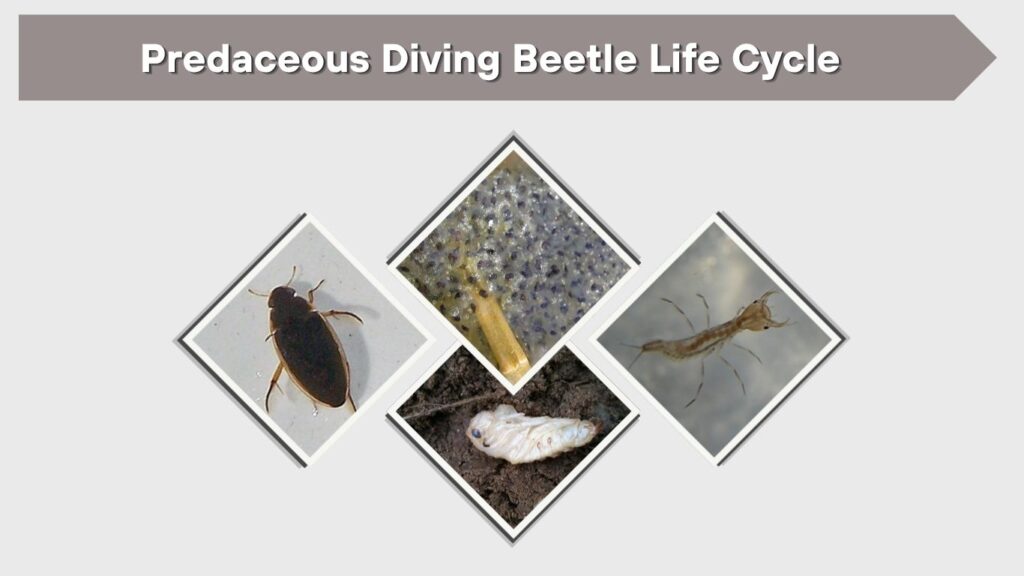
Predaceous diving beetles go through complete metamorphosis. That means their life cycle includes egg, larva, pupa, and adult stages. Each stage looks and behaves differently.
Egg Stage
Females lay eggs in or near water. Depending on the species, eggs may be placed on aquatic plants, inside plant tissue, in wet debris, or near the edge of a pond.
Larval Stage
The larval stage is the active hunting stage. Larvae grow by feeding on aquatic prey and molting as they get larger. This is the stage most often called the water tiger stage.
Larvae are important predators in ponds because they feed on mosquito larvae, tadpoles, insect larvae, and other small aquatic animals.
Pupal Stage
When the larva is ready to transform, it usually leaves the water and pupates in damp soil, mud, or debris near the water’s edge. During the pupal stage, the insect changes into an adult beetle.
Adult Stage
The adult returns to aquatic life. Adults swim, hunt, mate, breathe at the surface, and may fly to new water bodies. Their ability to fly helps them colonize ponds, temporary pools, wetlands, and even backyard water features.
Do Predaceous Diving Beetles Bite Humans?
Predaceous diving beetles can bite humans if they are handled roughly or trapped against the skin. The bite is usually defensive, not aggressive. These beetles do not seek out people, do not infest homes, and do not feed on humans.
A bite may cause brief pain, redness, or irritation. Wash the area with soap and water if bitten. People with unusual swelling, allergic symptoms, or signs of infection should seek medical advice.
For most people, the main rule is to admire them without grabbing them.
Are Predaceous Diving Beetles Harmful or Beneficial?
Predaceous diving beetles are generally beneficial in natural freshwater ecosystems. They help control small aquatic animals, feed on mosquito larvae, clean up dead organisms, and serve as food for larger wildlife.
However, in very small backyard ponds or fish tanks, large diving beetles or larvae may eat fish fry, tadpoles, or other small aquatic pets. This is why pond owners sometimes remove them from ornamental ponds.
When to Leave Them Alone
Leave predaceous diving beetles alone when they are in:
- Natural ponds
- Wetlands
- Marshes
- Ditches with wildlife
- Large balanced backyard ponds
When to Remove Them
Consider removing them when they are in:
- Swimming pools
- Small aquariums
- Fish breeding tanks
- Tadpole rearing containers
- Tiny ornamental ponds with fish fry
Use a net or container rather than bare hands.
Predaceous Diving Beetle Water Quality and Pollution Tolerance
Predaceous diving beetles are often associated with freshwater habitats that support aquatic life. Their presence can suggest that a pond or wetland has enough prey, shelter, and oxygen access to support a food web.
However, they are not a perfect water-quality test by themselves. Some species are more tolerant than others, and adults can fly into temporary or unsuitable water. To judge water quality, it is better to look at the whole community of aquatic insects, plants, algae, fish, and water conditions.
Fun Facts About Predaceous Diving Beetles
Predaceous diving beetles are more than just pond predators. They have unusual behaviors and adaptations that make them stand out.
- Their larvae are called water tigers because they are fierce hunters.
- Adults carry air underwater like a tiny scuba tank.
- Many species can fly from one pond to another.
- They use paddle-like hind legs to swim quickly.
- Both adults and larvae are predators.
- Some species are large enough to catch tadpoles or small fish.
- They can appear in swimming pools by mistake.
- They belong to one of the most important aquatic beetle families.
FAQs
What is a predaceous diving beetle?
A predaceous diving beetle is an aquatic beetle in the family Dytiscidae. It lives in freshwater habitats such as ponds, wetlands, lakes, and slow streams. Both adults and larvae are predators that feed on small aquatic animals, including insect larvae, tadpoles, worms, and sometimes small fish.
Do predaceous diving beetles bite?
Yes, predaceous diving beetles can bite if handled, and their larvae can also give a painful pinch. They do not attack humans on purpose, but they may bite defensively. It is best to move them with a net, cup, or container instead of bare hands.
What do predaceous diving beetles eat?
Predaceous diving beetles eat aquatic insects, mosquito larvae, worms, small crustaceans, tadpoles, fish fry, and dead aquatic animals. Adults are both predators and scavengers, while larvae are active hunters known for grabbing prey with strong jaws.
Are predaceous diving beetle larvae dangerous?
Predaceous diving beetle larvae are dangerous to small aquatic animals, not to people. They can bite if picked up, but they are not household pests and do not seek humans. In small ponds or tanks, they may eat tadpoles, fish fry, and other tiny aquatic pets.
Why are predaceous diving beetles in my pool?
Predaceous diving beetles may land in swimming pools by mistake because adults can fly and may be attracted to lights or reflective water. A pool can look like a pond from above. Remove the beetle with a skimmer and release it near a natural freshwater habitat if possible.