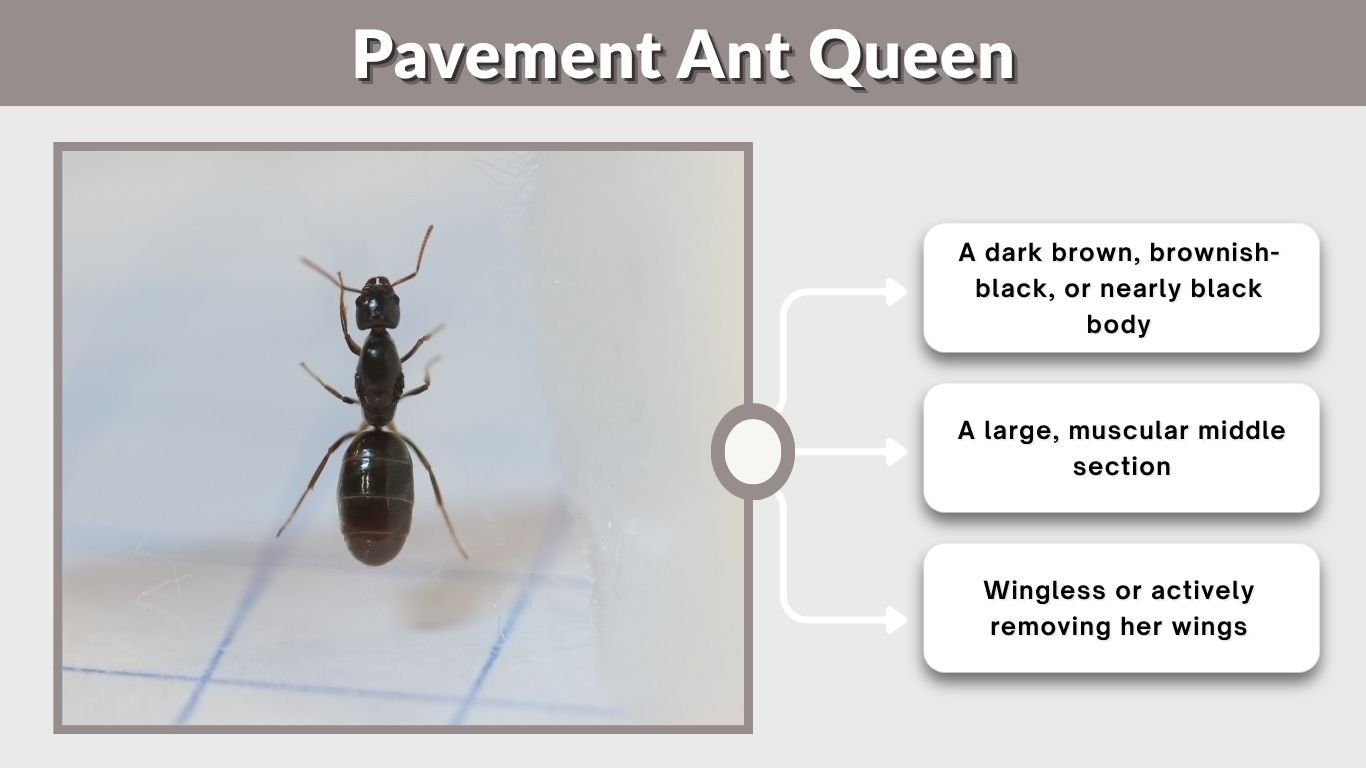
A pavement ant queen is the reproductive female responsible for establishing and maintaining a pavement ant colony. She is considerably larger and heavier than ordinary workers, with a broad chest, rounded abdomen, and wings before mating. Queens are most often noticed on sidewalks and driveways during early-summer mating flights. Whether you found a winged queen outdoors, discovered one inside your home, or are considering keeping one, correct identification is essential because several small dark ant species look similar.
Pavement Ant Queen Overview
The pavement ant commonly found across North American cities is the immigrant pavement ant, Tetramorium immigrans. Older sources may call it Tetramorium caespitum, but a taxonomic revision established T. immigrans as the common introduced pavement ant in North America.
| Feature | Pavement ant queen |
| Scientific name | Tetramorium immigrans |
| Approximate size | Usually around 6–7 mm |
| Color | Dark brown to nearly black |
| Legs and antennae | Often reddish brown |
| Wings | Present before mating |
| Colony role | Lays eggs and produces the colony |
| Usual queen number | One in most established colonies |
| Nuptial-flight period | Late May through July in many northern areas |
| Scientific lifespan record | Unknown |
What Does a Pavement Ant Queen Look Like?
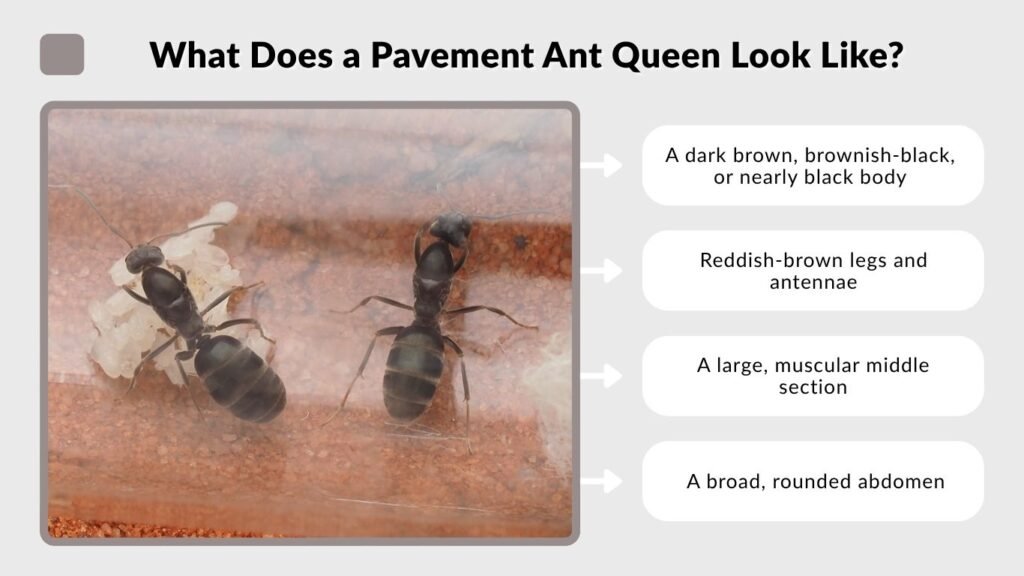
A pavement ant queen has the same basic dark coloring as her workers, but her body proportions are noticeably different. She has a larger middle body section, called the mesosoma, because it contains the muscles needed to power her wings.
Identification Features
A pavement ant queen usually has:
- A dark brown, brownish-black, or nearly black body
- Reddish-brown legs and antennae
- A large, muscular middle section
- A broad, rounded abdomen
- Two small nodes forming her narrow waist
- Twelve-segmented antennae with a three-segmented club
- Fine grooves across the head and mesosoma
- Three tiny simple eyes, called ocelli, on top of the head
- Wings or visible wing scars, depending on her mating status
Queens also have numerous stiff body hairs and a head marked with longitudinal grooves. These details may require a magnifying glass or macro photograph to see clearly.
Pavement Ant Queen Size
A pavement ant queen is commonly around 6–7 millimeters long, although individual size may vary. One documented T. immigrans queen measured 6 millimeters, while workers are generally only about 2.5–4 millimeters long. The queen therefore looks roughly twice as large as many workers, especially when her broad chest and swollen abdomen are considered.
Size alone cannot confirm the species. Other small ant queens may fall within a similar range, so body shape, color, waist structure, location, and flight season should also be considered.
Black and Red Pavement Ant Queens
A queen may appear completely black under dim lighting, leading people to call her a “black pavement ant queen.” Under brighter light, her body is normally dark brown or brownish-black, while her legs, antennae, and some body edges may appear reddish brown. This can also produce searches for a “red pavement ant queen,” although these are usually color variations rather than separate common forms.
Winged vs Wingless Pavement Ant Queens
The presence or absence of wings provides useful information about a queen’s reproductive stage.
Pavement Ant Queen With Wings
A winged reproductive female is called an alate. She develops inside a mature colony and leaves during a nuptial flight to mate. She has two pairs of wings, with the front pair larger than the rear pair.
A winged queen is not necessarily fertilized. She may be preparing to fly, participating in a mating flight, or searching for a landing place after leaving her original nest.
Wingless Pavement Ant Queen
After mating, a queen normally removes or sheds her wings. She retains small scars on the sides of her enlarged mesosoma where the wings were attached.
A wingless queen found walking alone shortly after a local mating flight has a better chance of being fertilized than one that still has wings. However, wing loss does not guarantee successful mating, and some fertilized queens may retain their wings for a while.
Queen vs Male Pavement Ant
Winged males can be mistaken for queens, but males usually have:
- Smaller, narrower bodies
- A less rounded abdomen
- Relatively large eyes
- Longer-looking antennae
- A slimmer chest and waist
- No ability to establish a colony
The queen has a heavier, more powerful-looking body because she stores resources and develops the reproductive system needed to produce a colony.
Pavement Ant Queen Nuptial Flight
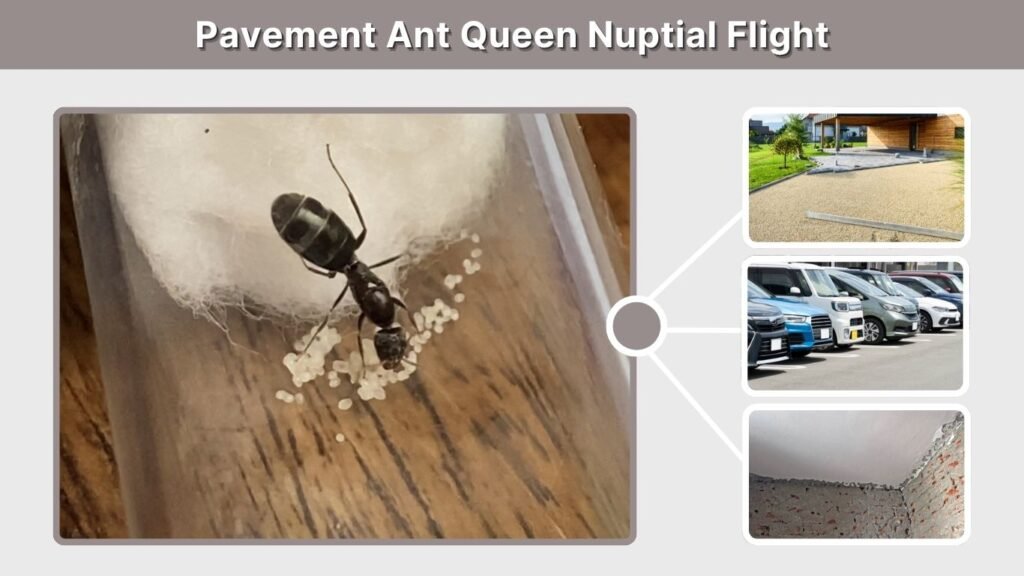
Pavement ant colonies produce winged females and males in early summer. Their nuptial flights generally occur between late May and July in the Northern Hemisphere, depending on location and weather. Flights often begin near sunrise on calm days and may be stopped by excessive wind or high temperatures.
During a flight, reproductive ants emerge from mature nests, take to the air, and mate. A mated queen lands, removes her wings, and searches for a protected location in which to begin a new colony.
Good places to look after a flight include:
- Sidewalks and driveways
- Parking areas
- Foundation edges
- Patios and concrete steps
- Areas around pavement cracks
- Warm ground near established nests
Queens are easier to spot after a large local flight because several may be walking across paved surfaces at the same time.
How a Pavement Ant Queen Starts a Colony
A newly mated queen normally enters soil or finds an existing gap beneath a stone or paved surface. She seals herself inside a small founding chamber and begins laying eggs.
Pavement ants generally use claustral colony founding. This means the queen remains inside the chamber and supports her first brood largely with nutrients stored in her body, including resources associated with her flight muscles. Once the first small workers mature, they leave the chamber, find food, expand the nest, and care for later brood.
Development from a fertilized egg to a worker takes approximately 42–63 days at temperatures of 21–24°C in an established colony, although development during initial colony founding may differ.
How Many Queens Are in a Pavement Ant Colony?
Most established Tetramorium immigrans colonies are monogynous, meaning they contain one reproductive queen. Some reports suggest that colonies may occasionally contain more than one, but a major scientific review found no confirmed wild, multi-queen founding colonies of this species. Cooperative founding has been observed under laboratory conditions, yet colonies generally end up with a single surviving queen.
This matters for ant keepers. Placing several queens together may initially appear successful, but aggression can develop after workers emerge. Keeping each queen separately is the safer approach.
Pavement Ant Queen Lifespan
The exact lifespan of a pavement ant queen remains scientifically unknown. Hobbyists have reported queens surviving for eight or nine years, but these observations have not established a verified maximum lifespan for the species. Researchers continue to describe queen and colony longevity as understudied.
A healthy queen can potentially support a colony for many years. Her survival depends on temperature, moisture, food availability, disease, disturbance, predation, and the overall health of her workers.
Pavement Ant Queen Care
A legally collected, correctly identified queen can be temporarily housed in a clean test-tube-style founding chamber containing a protected water reservoir, a humid section, and a dry air space.
Because a pavement ant queen normally founds her colony claustrally, she should be kept dark, quiet, and mostly undisturbed while raising her first brood. Frequent handling, vibration, overheating, flooding, and repeated exposure to bright light can interfere with founding.
Once workers appear, the small colony will require:
- A secure escape-proof enclosure
- A dependable water source
- Small portions of sugar solution
- Appropriately sized insect protein
- Prompt removal of uneaten food
- Seasonal care appropriate to a temperate ant
Do not mix queens from separate locations or release a captive colony somewhere new. Before collecting, buying, selling, or transporting a queen, verify the applicable wildlife and agricultural regulations in your area.
How to Find a Pavement Ant Queen
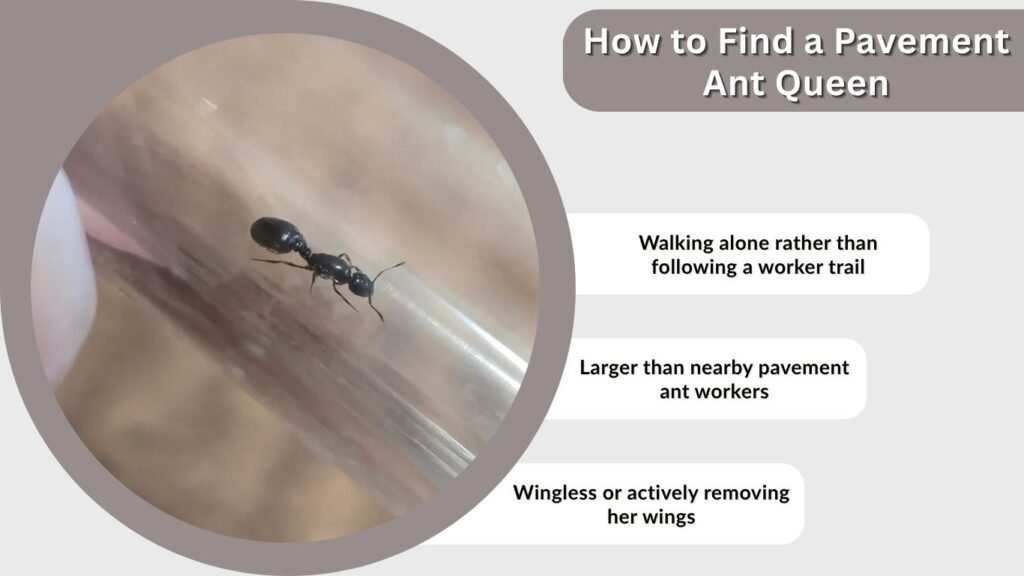
The most effective approach is to watch for nuptial flights rather than excavating an established nest. Search paved areas during the late-spring and summer flight period, especially in the morning after suitable calm weather.
A likely newly mated queen will be:
- Walking alone rather than following a worker trail
- Larger than nearby pavement ant workers
- Wingless or actively removing her wings
- Searching along pavement edges and cracks
- Equipped with a broad chest and large abdomen
Digging through a mature nest is unlikely to be efficient because pavement ant nests can extend deeply into the soil and contain many chambers. Some nests reach approximately 0.45–0.90 meters deep and occupy several square meters.
How to Eliminate a Pavement Ant Queen in a House
Finding and crushing the queen is rarely a practical pest-control method. She normally remains protected deep beneath a slab, inside soil, or within a structural void while workers travel to food.
Use a slow-acting ant bait beside active worker trails. Foraging workers collect the bait and transport it back to the hidden nest, where it can eventually reach the queen and developing brood. Avoid spraying the trail while baiting because rapidly killing or repelling workers prevents them from carrying the treatment into the colony.
Food sanitation, moisture repairs, and sealing cracks should accompany baiting. An indoor winged queen or several swarmers may indicate a colony beneath a heated slab or within the building, particularly when they appear outside the normal outdoor flight season.
FAQs
How big is a pavement ant queen?
A pavement ant queen is usually around 6–7 millimeters long. She is much larger and more heavily built than a worker, which generally measures about 2.5–4 millimeters. Her enlarged chest and rounded abdomen make the size difference especially noticeable.
Can a pavement ant queen fly?
A virgin queen can fly while she still has wings. She leaves her original colony during a nuptial flight, mates, lands, and normally sheds her wings before founding a nest. A queen without wings usually cannot fly again.
When do pavement ant queens fly?
Flights commonly occur from late May through July in northern regions. Exact timing depends on local climate and weather. Flights often begin around sunrise on calm days when temperatures and wind conditions are suitable.
Can two pavement ant queens live together?
Multiple queens may cooperate briefly under artificial conditions, but established T. immigrans colonies are normally single-queen colonies. Aggression may occur after workers emerge, so housing unrelated queens together can lead to injury or death.
How can I tell whether a pavement ant queen is fertile?
There is no immediate visual test that guarantees fertility. A wingless queen found after a nuptial flight is a promising candidate, but confirmation comes when she produces developing female workers. Unfertilized queens may lay only male-producing eggs or fail to establish a colony.