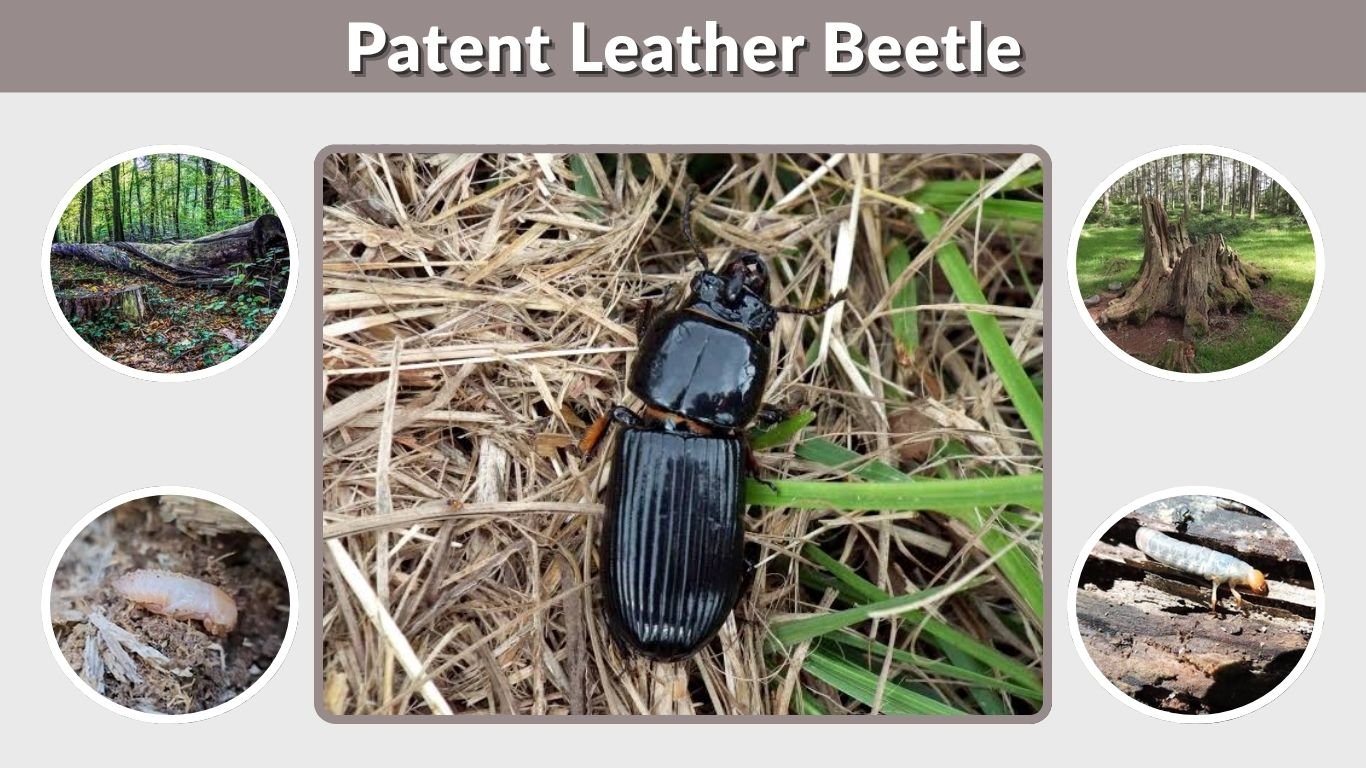
The patent leather beetle (Odontotaenius disjunctus) is a large, shiny black beetle commonly found in forests across eastern North America. Also known as the bess beetle or horned passalus, this fascinating insect is recognized by its glossy body, small head horn, and unusual squeaking sounds. Despite its intimidating appearance and powerful jaws, the patent leather beetle is harmless to humans and plays an important role in decomposing dead wood. Learning about its identification, diet, habitat, larvae, and life cycle reveals why this remarkable beetle benefits forest ecosystems.
What Is a Patent Leather Beetle?
The patent leather beetle belongs to the family Passalidae, a group of wood-dwelling beetles known for their social behavior and important ecological functions. Its common name comes from its smooth, glossy black exoskeleton, which resembles polished patent leather.
Unlike many solitary beetles, patent leather beetles live in family groups inside decaying logs. Adults cooperate to protect their offspring, prepare food, and maintain tunnels within decomposing wood. They are particularly interesting because both adults and larvae can communicate through sounds.
Patent Leather Beetle Facts
- Scientific name: Odontotaenius disjunctus
- Family: Passalidae
- Common names: Patent leather beetle, bess beetle, horned passalus, betsy beetle
- Size: Approximately 30–40 mm
- Color: Glossy black
- Diet: Decaying wood and microbe-enriched wood material
- Habitat: Rotting hardwood logs and forest floors
- Distribution: Eastern North America
- Lifespan: Adults commonly live up to one year
These characteristics distinguish patent leather beetles from many other beetles found in North American forests.
Patent Leather Beetle Identification and Appearance
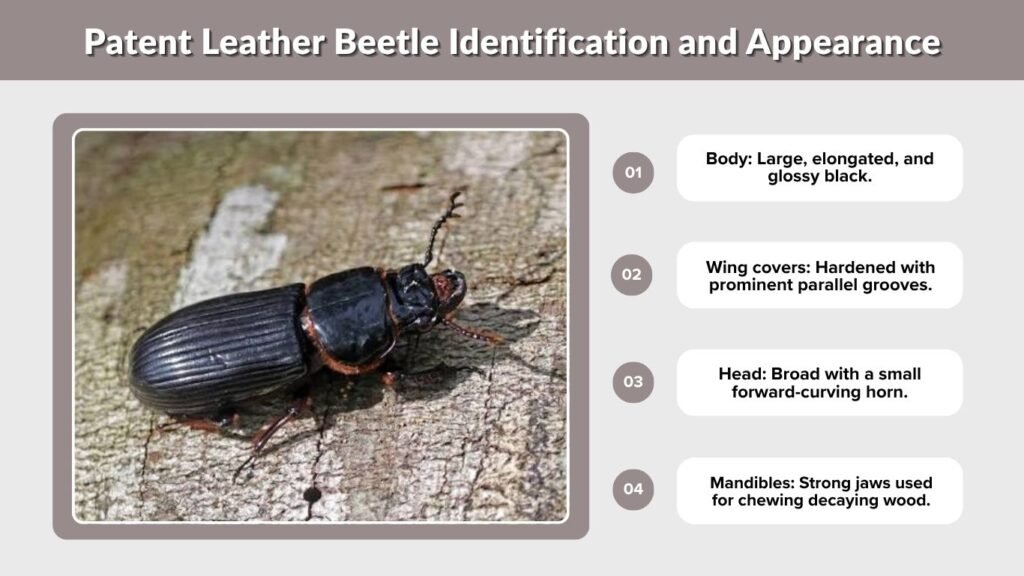
Identifying a patent leather beetle is relatively easy because of its distinctive appearance. Its dark, polished body, deeply grooved wing covers, and prominent mandibles make it recognizable among wood-dwelling beetles.
Adult beetles have an elongated, cylindrical body with a broad thorax and hardened outer wings. Their sturdy appearance reflects their ability to move through rotting wood and construct tunnels.
Physical Characteristics
- Body: Large, elongated, and glossy black.
- Wing covers: Hardened with prominent parallel grooves.
- Head: Broad with a small forward-curving horn.
- Mandibles: Strong jaws used for chewing decaying wood.
- Antennae: Short, segmented, with distinctive club-shaped tips.
- Legs: Six strong legs with small spines for gripping wood.
- Body hairs: Fine golden hairs around parts of the thorax, legs, and antennae.
How Big Is a Patent Leather Beetle?
An adult patent leather beetle generally measures 1.2–1.6 inches (30–40 mm) long. Its robust body makes it noticeably larger than many common household beetles.
The small horn on its head is not a stinger. Both males and females possess this feature, and it helps distinguish the species from similar shiny black beetles.
Patent Leather Beetle Habitat and Distribution
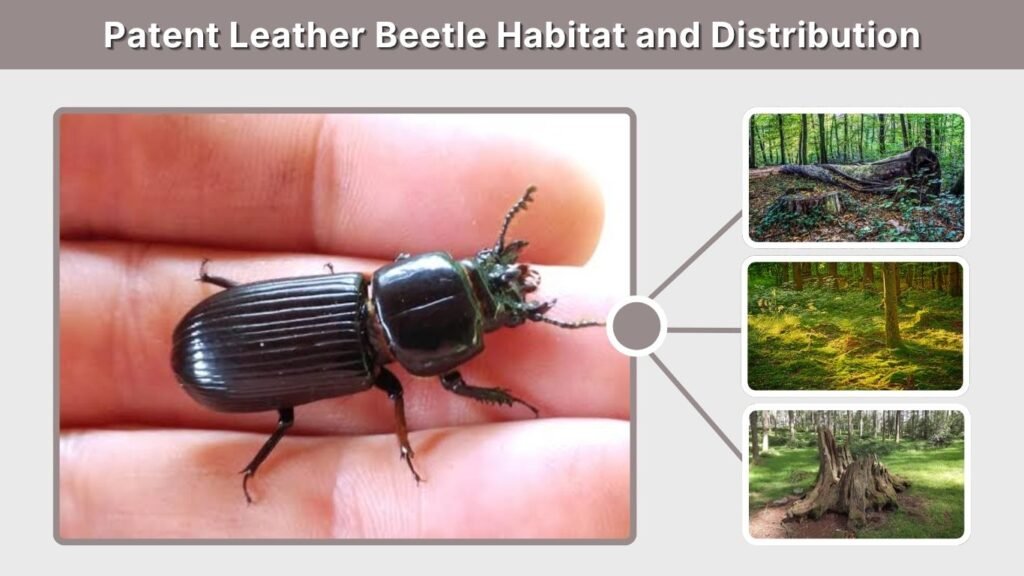
Patent leather beetles inhabit wooded environments where fallen trees and decaying hardwood are abundant. They depend on moist, decomposing wood for shelter, reproduction, and nutrition.
This species occurs widely across the eastern United States and portions of southern Canada. It prefers hardwood forests, where rotting logs provide stable conditions for developing larvae and adults.
Where Do Patent Leather Beetles Live?
- Decaying logs: Their primary nesting and feeding habitat.
- Fallen hardwood trees: Especially oak, elm, and other decomposing hardwoods.
- Forest floors: Beneath moist wood and fallen branches.
- Old tree stumps: Within soft, partially decomposed wood.
- Woodland debris: Sheltered places offering moisture and protection.
These beetles typically avoid dry environments because they depend on moist wood and the microorganisms growing within it.
What Do Patent Leather Beetles Eat?
Patent leather beetles primarily consume decomposing wood, making them important organisms in forest nutrient recycling. Their feeding behavior differs significantly from predatory beetles that hunt insects.
Adults use their powerful mandibles to chew softened wood into smaller pieces. Fungi and bacteria help break down this material, making nutrients more accessible.
An especially interesting feeding behavior involves consuming their own processed wood waste, called frass. Microorganisms enrich this material, improving its nutritional value.
Young larvae depend on adults to prepare suitable food because they cannot efficiently process tough wood independently. This unusual relationship allows entire beetle families to survive within a single decaying log.
Do Patent Leather Beetles Bite Humans?
Patent leather beetles are generally harmless to humans. Although they possess large, powerful mandibles, they do not normally bite people.
Their jaws are adapted for chewing rotten wood rather than attacking animals. When handled, these beetles usually respond by making squeaking noises instead of biting.
They are not venomous, do not sting, and are not known to transmit diseases to humans.
However, it is still better to avoid squeezing or roughly handling them. Their mandibles could potentially cause a minor pinch under unusual circumstances.
Why Do Patent Leather Beetles Make Squeaking Sounds?
One of the most fascinating characteristics of patent leather beetles is their ability to produce audible squeaking sounds.
This behavior is called stridulation. Adults create sounds by rubbing specialized structures associated with their hind wings and abdomen together.
These noises serve several purposes, including communication, defensive signaling, and interactions between parents and offspring.
Researchers have identified numerous distinct acoustic signals in horned passalus beetles. Remarkably, larvae can also make sounds using specially modified legs.
This communication system contributes to their cooperative social behavior and helps adults interact with developing young.
Patent Leather Beetle Larvae and Life Cycle
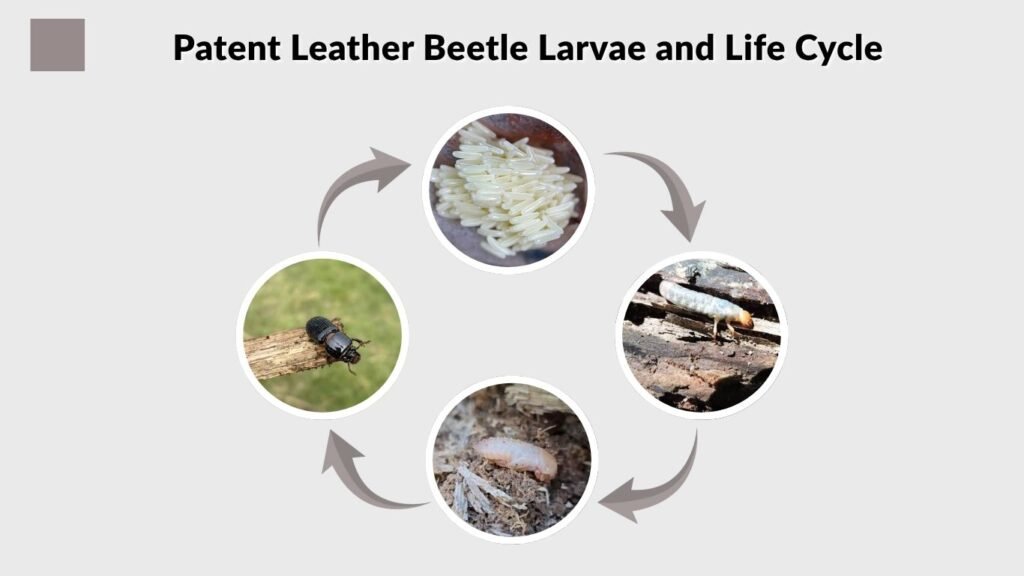
Patent leather beetles undergo complete metamorphosis, passing through four developmental stages. Their life cycle is unusual because adults provide extensive parental care, which is uncommon among many beetle species.
Four Stages of the Life Cycle
- Egg: Females deposit relatively large eggs in protected chambers inside decaying wood. Adults guard and reposition them when necessary.
- Larva: White, grub-like larvae hatch and consume wood material prepared by adults.
- Pupa: Mature larvae transform within protected pupal chambers constructed inside the wood.
- Adult: Newly emerged beetles initially appear reddish before gradually developing their characteristic glossy black coloration.
Development time varies considerably depending on moisture, temperature, and environmental conditions.
What Do Patent Leather Beetle Larvae Look Like?
Patent leather beetle larvae have pale, curved bodies and light brown heads. They appear to possess only two pairs of walking legs because the third pair is reduced and adapted for producing sounds.
Larvae live alongside adults in their shared wooden tunnels. Both parents participate in caring for their young, providing food and helping protect them from environmental threats.
Are Patent Leather Beetles Harmful in the House?
Patent leather beetles are not considered household pests. They feed on already-decaying wood rather than sound structural timber, furniture, or other household materials.
Occasionally, one may appear indoors after being carried inside with firewood or other rotting wood.
If you discover a patent leather beetle inside your house, gently collect it using a container and release it near a moist, decaying log outdoors.
Keeping firewood dry and elevated above the ground can help prevent these beetles from occupying stored logs.
There is generally no reason to apply insecticides when encountering a single patent leather beetle indoors.
Patent Leather Beetle vs. Leatherwing Beetle
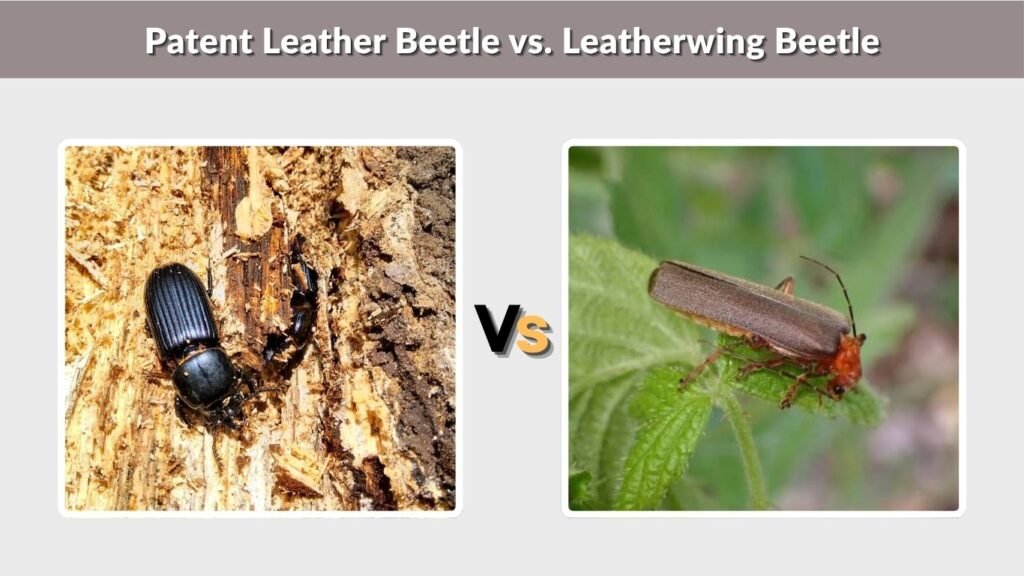
Patent leather beetles and leatherwing beetles are different insects despite their similar common names.
Patent leather beetles belong to the Passalidae family and have hard, glossy black wing covers. They primarily inhabit rotting wood and feed on decomposing organic material.
Leatherwing beetles, also called soldier beetles, belong to the Cantharidae family. They usually have softer, flexible wing covers and are often seen on flowers feeding on pollen, nectar, or small insects.
The downy leather-winged beetle (Podabrus pruinosus) is another soldier beetle, not a patent leather beetle.
FAQs
1. Are Patent Leather Beetles Dangerous?
No, patent leather beetles are not dangerous to humans or pets. They do not sting or carry venom. Although their strong jaws can occasionally produce a minor pinch, these beetles are peaceful insects that prefer living inside decaying wood.
2. Can Patent Leather Beetles Fly?
Yes, patent leather beetles can fly, although they spend most of their lives inside decaying logs. Their hardened wing covers protect the functional wings underneath. Adults occasionally fly to locate new habitats, find mates, or establish colonies elsewhere.
3. Why Are They Called Patent Leather Beetles?
Patent leather beetles receive their common name from their smooth, shiny black exoskeleton, which resembles polished patent leather. Their glossy appearance, deeply grooved wing covers, and sturdy bodies make them easily recognizable among other wood-dwelling beetles found in forests.
4. How Long Do Patent Leather Beetles Live?
Adult patent leather beetles can live for approximately one year or longer under favorable conditions. Their lifespan depends on temperature, moisture, food availability, and habitat quality. They spend much of their lives inside decaying logs alongside other family members.
5. Are Patent Leather Beetles Beneficial?
Yes, patent leather beetles are beneficial insects that help decompose dead wood and recycle nutrients into forest ecosystems. Their feeding activities support microorganisms, improve organic matter breakdown, and contribute to healthy woodland habitats without damaging living trees or household furniture.