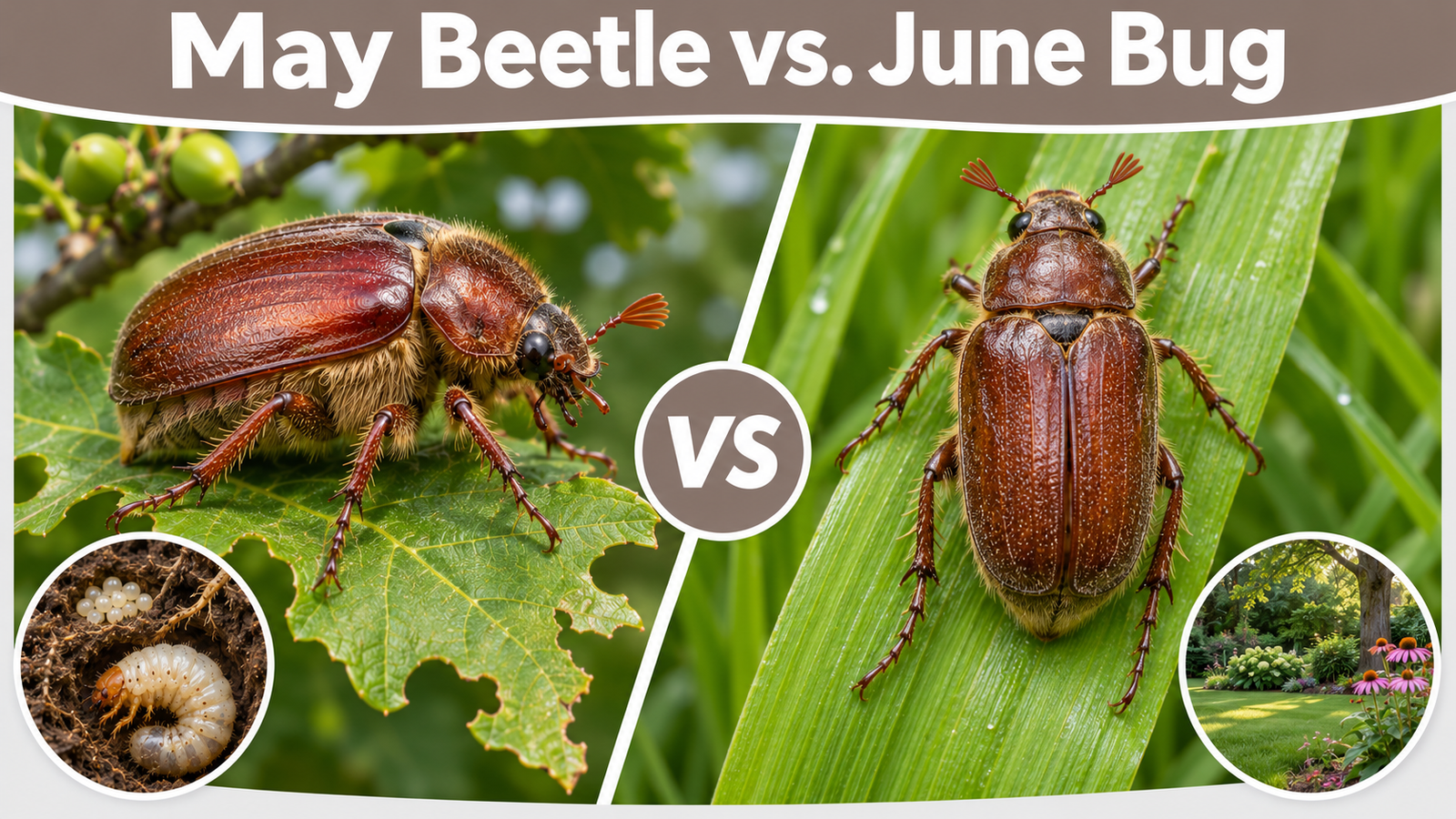
May beetles and June bugs are common insects that appear during late spring and early summer, often flying around porch lights and feeding on plants. Although their names suggest they are different insects, May beetles and June bugs frequently belong to the same group of scarab beetles, particularly the genus Phyllophaga. Their reddish-brown bodies, nighttime activity, and underground larvae make them difficult to distinguish. However, the names can sometimes refer to other beetle species. This guide explains May beetle vs. June bug identification, appearance, behavior, habitat, life cycle, and potential damage.
What Is the Difference Between a May Beetle and a June Bug?
The main difference between a May beetle and a June bug is usually their common name rather than their biological characteristics. Both names commonly describe beetles belonging to the genus Phyllophaga, a large group within the scarab beetle family.
The term May beetle is often used for insects emerging during May, while June bug is commonly associated with beetles appearing in June. However, emergence times overlap considerably.
In some regions, June bug also refers to other scarab beetles, including green June beetles.
| Feature | May Beetle | June Bug |
|---|---|---|
| Scientific classification | Often Phyllophaga spp. | Often Phyllophaga spp. |
| Family | Scarabaeidae | Scarabaeidae |
| Common color | Brown or reddish-brown | Brown, reddish-brown, or sometimes green |
| Average size | 12–25 mm | Varies by species |
| Active season | Late spring to summer | Late spring to summer |
| Activity | Mostly nocturnal | Mostly nocturnal in Phyllophaga |
| Larvae | White grubs | White grubs |
| Main difference | Common naming convention | Broader regional naming convention |
Therefore, a beetle called a May beetle in one location might be called a June bug elsewhere.
May Beetle vs. June Bug Identification
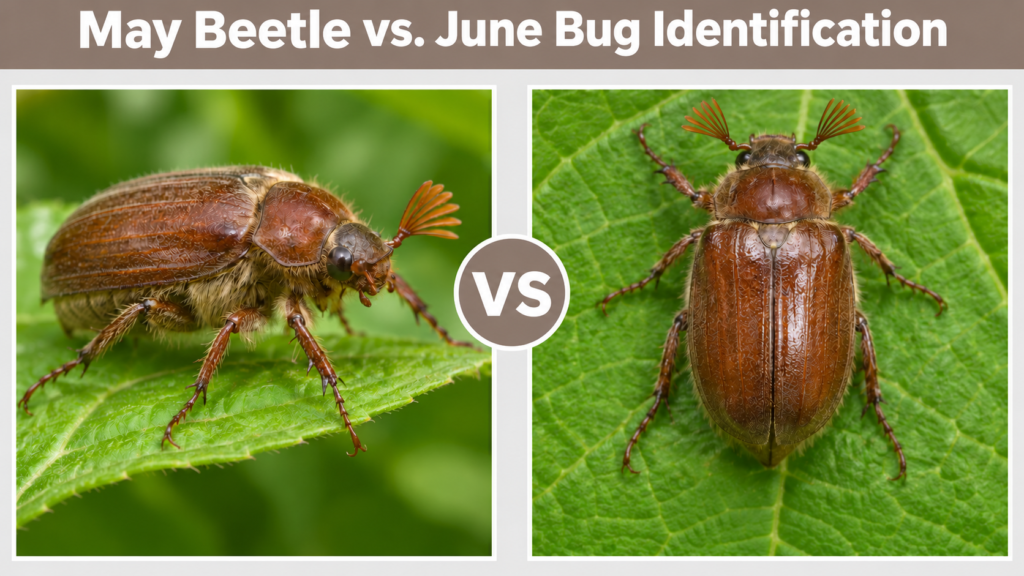
May beetles and typical brown June bugs have remarkably similar physical characteristics. Both generally possess robust bodies, hardened wing covers, strong legs, and short antennae ending in movable, leaflike clubs.
Accurate identification sometimes requires examining specific anatomical features because many scarab beetles look alike.
May Beetle Identification
May beetles commonly display the following characteristics:
- Size: Approximately 12–25 mm long.
- Color: Reddish-brown, chestnut, or dark brown.
- Body: Oval and slightly elongated.
- Wing covers: Smooth or lightly textured.
- Antennae: Distinctive fanlike clubs.
- Legs: Strong legs adapted for digging and climbing.
May beetles are generally active after sunset and may fly toward artificial lights.
Their relatively plain brown appearance distinguishes them from some brightly colored scarab beetles.
June Bug Identification
The appearance of a June bug depends on which species receives the common name.
Typical brown June bugs belonging to Phyllophaga resemble May beetles almost exactly.
However, green June beetles have metallic green bodies and behave differently from the familiar brown species.
Some June bugs are active during daylight, particularly green June beetles, while typical brown Phyllophaga species are primarily nocturnal.
May Beetle vs. June Bug Size and Appearance
The size and appearance of May beetles and June bugs vary according to species, age, and sex.
Many brown May and June beetles measure approximately half an inch to one inch long. Their sturdy bodies and shiny wing covers make them easy to recognize.
| Physical Feature | May Beetle | Brown June Bug |
|---|---|---|
| Body length | 12–25 mm | 12–25 mm |
| Body shape | Oval and robust | Oval and robust |
| Wing appearance | Hard, brown covers | Hard, brown covers |
| Antennae | Fan-shaped clubs | Fan-shaped clubs |
| Leg count | Six | Six |
| Body texture | Smooth to slightly hairy | Smooth to slightly hairy |
When both names refer to Phyllophaga beetles, physical appearance alone cannot reliably distinguish them.
May Beetle vs. June Bug Habitat

May beetles and June bugs inhabit similar environments because many belong to the same genus. They occur throughout much of North America, especially in areas containing suitable soil, trees, shrubs, and grasses.
Adult beetles typically remain near vegetation, while larvae develop underground.
Where Do May Beetles Live?
May beetles commonly inhabit:
- Forests and woodland edges
- Lawns and residential yards
- Agricultural fields
- Gardens and parks
- Grasslands and pastures
They prefer environments offering sufficient vegetation for adults and suitable soil for egg development.
Where Do June Bugs Live?
Brown June bugs occupy many of the same habitats as May beetles.
They frequently appear around houses, gardens, and agricultural landscapes during warm evenings.
Adults may gather near outdoor lights, while larvae remain hidden beneath grass or garden soil.
May Beetle vs. June Bug Diet

May beetles and typical brown June bugs are herbivorous insects that feed on vegetation during adulthood.
Their larvae consume underground plant roots, which can occasionally cause significant damage to lawns and agricultural crops.
What Do May Beetles Eat?
Adult May beetles generally consume leaves from deciduous trees, shrubs, and other plants.
Some species feed on oak, maple, willow, and various agricultural plants.
Their feeding can produce irregular holes in leaves or damaged leaf margins.
What Do June Bugs Eat?
Brown June bugs belonging to Phyllophaga consume similar plant materials.
However, June bugs belonging to other genera may have different diets.
For example, adult green June beetles commonly feed on ripe or damaged fruit and other sugary plant materials.
What Do Their Larvae Eat?
May beetle and brown June bug larvae generally feed on plant roots.
Heavy grub infestations can weaken grass and produce yellow or brown patches.
The larvae can remain underground for extended periods before developing into adults.
May Beetle vs. June Bug Life Cycle
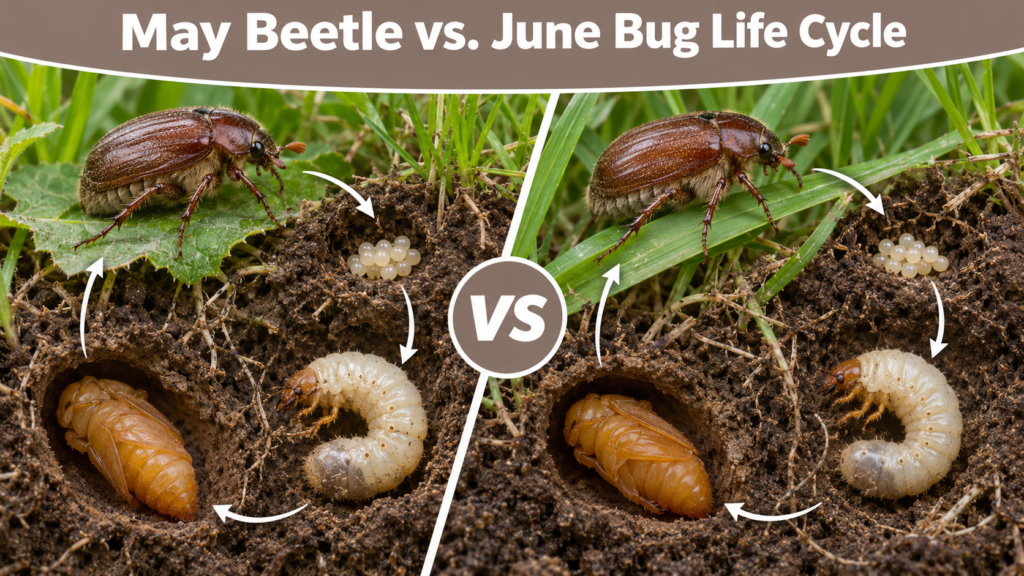
May beetles and June bugs undergo complete metamorphosis, developing through egg, larval, pupal, and adult stages.
Many Phyllophaga species require two or three years to complete development, although some have shorter or longer life cycles.
Egg Stage
Female beetles deposit eggs beneath the soil after mating.
The eggs develop underground, where moisture and temperature influence hatching.
Larval Stage
Newly hatched larvae begin feeding on plant roots.
These C-shaped white grubs grow through several molts and may remain underground for multiple growing seasons.
Pupal Stage
Mature larvae construct chambers in the soil and transform into pupae.
During this stage, their bodies undergo the changes necessary to become adult beetles.
Adult Stage
Adult beetles emerge during favorable seasonal conditions.
They feed, mate, and reproduce before completing their adult life stage.
The precise emergence period depends on species, climate, and geographic location.
May Beetle vs. June Bug: Which Causes More Damage?
Neither May beetles nor typical brown June bugs are automatically more destructive because they commonly refer to the same insects.
Damage depends primarily on the species, population size, and life stage.
Adult beetles may damage foliage, while root-feeding larvae can cause more serious problems.
| Type of Damage | May Beetle | Brown June Bug |
|---|---|---|
| Leaf damage | Yes | Yes |
| Root damage | Larvae | Larvae |
| Lawn damage | Possible | Possible |
| Agricultural damage | Possible | Possible |
| Structural damage | No | No |
| Dangerous to humans | Generally no | Generally no |
Severe grub infestations may cause grass to lose its connection to the soil because damaged roots can no longer support the turf.
How to Get Rid of May Beetles and June Bugs
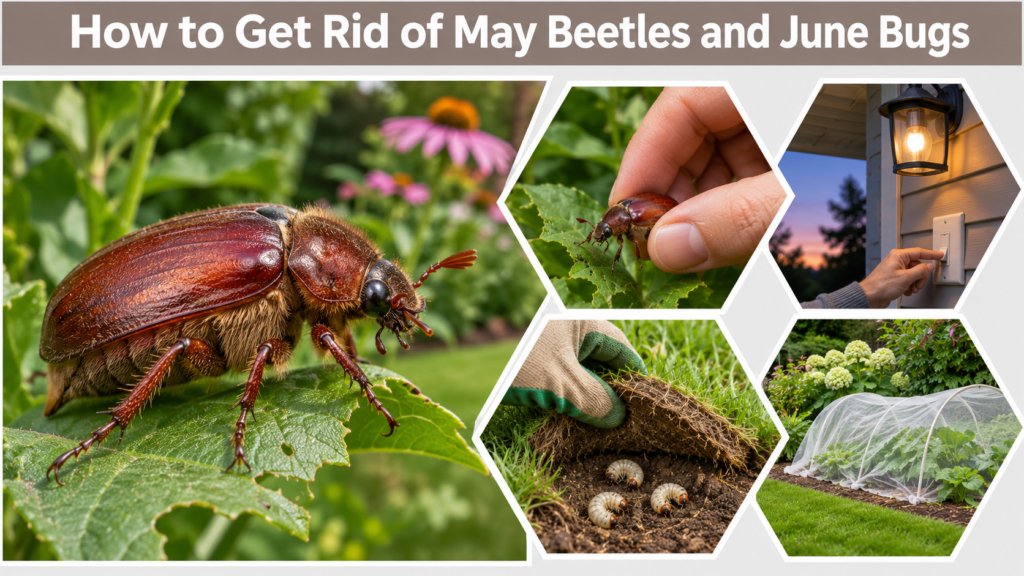
Controlling May beetles and June bugs requires identifying whether adults or underground grubs are causing problems.
When populations are small, extensive treatment is often unnecessary.
Natural Control Methods
Several practical methods can reduce beetle activity:
- Remove adult beetles by hand from affected plants.
- Reduce unnecessary outdoor lighting.
- Install screens around doors and windows.
- Encourage insect-eating birds and other natural predators.
- Inspect damaged lawn areas for white grubs.
- Maintain healthy grass through proper watering and mowing.
Beneficial nematodes may help control certain grub species, although effectiveness varies with environmental conditions and the target insect.
Preventing Future Infestations
Regular lawn inspection is important because underground grubs can remain unnoticed until plant damage becomes visible.
Maintain appropriate soil moisture, monitor vulnerable plants, and avoid unnecessary pesticide applications.
When significant root damage occurs, identify the grub species before selecting a treatment.
FAQs
1. Are May beetles and June bugs the same insect?
Yes, May beetles and June bugs often refer to the same insects, especially species belonging to the genus Phyllophaga. Their common names are frequently used interchangeably. However, June bug is also used for other scarab beetles, including green June beetles, which belong to a different genus.
2. Why are May beetles called June bugs?
The names May beetle and June bug are associated with the months when adult beetles commonly emerge. Depending on geographic location, temperature, and species, adults may appear during May, June, or later in summer. These seasonal names do not necessarily identify different beetle species.
3. Do May beetles and June bugs bite humans?
May beetles and typical brown June bugs are not aggressive toward humans and rarely bite. They possess chewing mouthparts designed primarily for consuming vegetation. Although their legs may feel prickly when handled, these beetles are not venomous and generally pose little risk to people.
4. How long do May beetles and June bugs live?
Many May and June beetles belonging to Phyllophaga complete their life cycles over approximately two or three years. Most of this period is spent underground as a larva. Their adult stage is much shorter and primarily involves feeding, mating, and laying eggs.
5. Are May beetles and June bugs harmful to gardens?
Both can damage gardens when populations become large. Adults may chew leaves, while larvae feed on underground roots. Heavy grub infestations can weaken grass, garden plants, and certain crops. However, occasional adult beetles usually do not justify treatment unless noticeable plant damage develops.