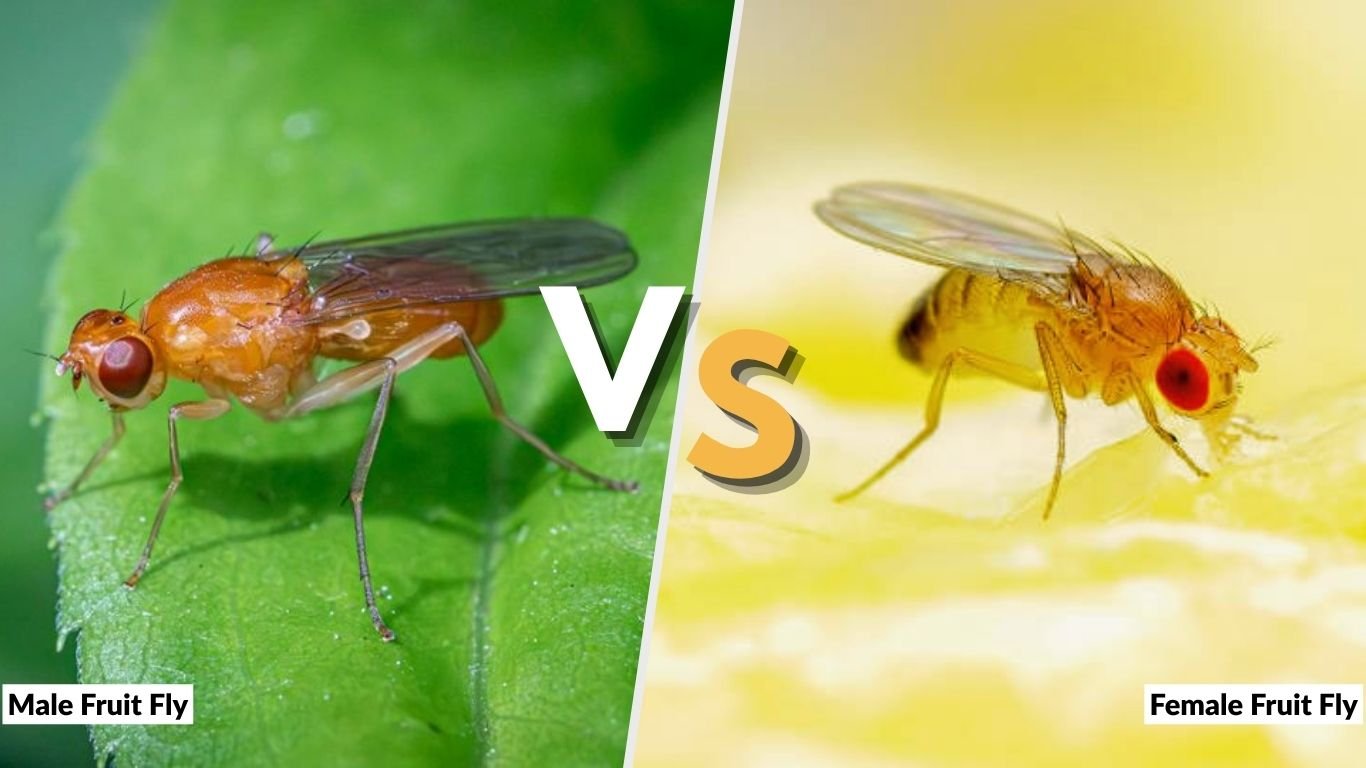
Male and female fruit flies look very similar at first glance, but several physical features make them easy to distinguish under magnification. Female fruit flies are generally larger, with longer and more pointed abdomens. Males are usually smaller, have darker rounded abdomens, and possess specialized structures called sex combs on their front legs.
These differences are most noticeable in the common laboratory fruit fly, Drosophila melanogaster. Learning how to identify each sex is useful for pest identification, breeding studies, genetics experiments, and understanding fruit fly behavior.
Male vs. Female Fruit Fly at a Glance
The easiest way to tell male and female fruit flies apart is to compare their size, abdomen, coloration, and front legs.
| Feature | Male fruit fly | Female fruit fly |
| Body size | Usually smaller | Usually larger |
| Abdomen shape | Shorter and rounded | Longer and more pointed |
| Abdomen color | Darker at the rear | Lighter with visible bands |
| Number of visible abdominal segments | Usually fewer | Usually more |
| Sex combs | Present on front legs | Absent |
| Reproductive role | Produces sperm | Lays eggs |
| Behavior | Performs courtship displays | Selects mates and egg-laying sites |
Although these characteristics are useful, identifying very young or recently emerged adults may be harder because their bodies have not yet fully darkened.
Size Difference Between Male and Female Fruit Flies
Female fruit flies are generally larger than males. This difference is particularly noticeable when several adults are viewed together.
A typical adult fruit fly measures approximately 3–4 millimeters long. Females often fall toward the larger end of this range because their abdomens must accommodate developing eggs. Males tend to have shorter, more compact bodies.
Size alone is not always reliable. Nutrition, temperature, larval crowding, age, and genetics can affect body size. A well-fed male may be larger than a poorly developed female, so other features should also be examined.
Abdomen Shape and Color
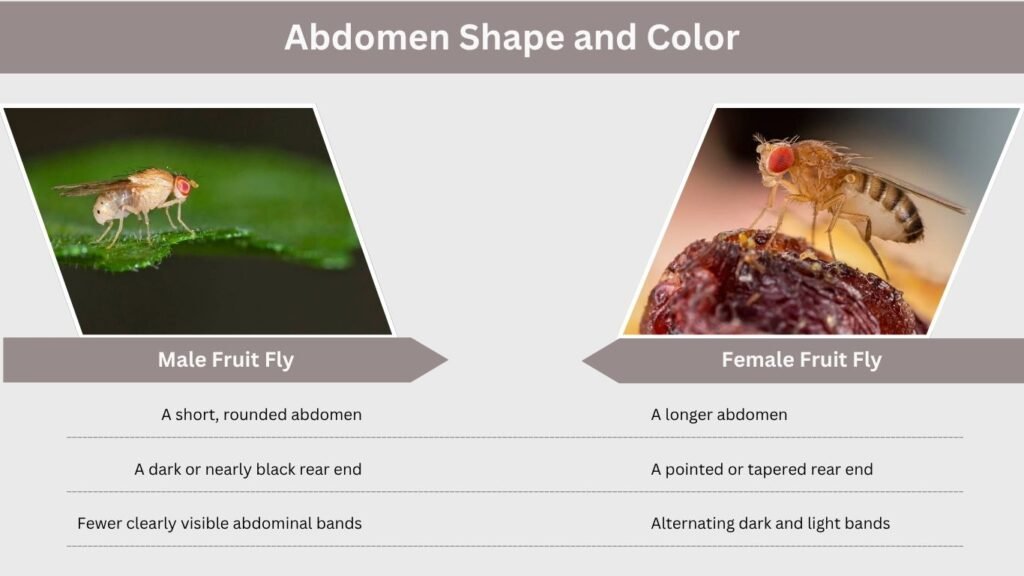
The abdomen is one of the most reliable areas for distinguishing the sexes. View the fly from above or slightly from the side using a magnifying glass or microscope.
Male Fruit Fly Abdomen
A male fruit fly typically has:
- A short, rounded abdomen
- A dark or nearly black rear end
- Fewer clearly visible abdominal bands
- A compact, blunt appearance
The last few abdominal segments are heavily pigmented and may blend together, making the tip look almost completely black.
Female Fruit Fly Abdomen
A female fruit fly usually has:
- A longer abdomen
- A pointed or tapered rear end
- Alternating dark and light bands
- More visible abdominal segments
The female abdomen may become larger after mating or while carrying mature eggs. Its pointed end helps distinguish it from the rounded abdomen of a male.
Sex Combs on Male Fruit Flies
The presence of sex combs is one of the clearest differences between male and female fruit flies.
Sex combs are rows of short, dark bristles found on the front legs of male Drosophila melanogaster. Males use these structures during mating to hold and position females.
Females do not have sex combs.
Because the structures are extremely small, they usually cannot be seen clearly with the naked eye. A hand lens, macro photograph, or low-powered microscope is generally needed.
How to Find the Sex Combs
To identify them:
- Observe the fly from the side or below.
- Locate the first pair of legs near the head.
- Examine the lower leg segments.
- Look for a dark row of closely arranged bristles.
If sex combs are clearly present, the fruit fly is male. Their absence suggests a female, although poor viewing angles can make them difficult to see.
Male and Female Reproductive Structures
The reproductive organs provide another reliable distinction, especially in laboratory identification.
Male fruit flies have external genital structures near the rounded tip of the abdomen. Under magnification, these may appear darker and more complex than the surrounding tissue.
Females have an egg-laying structure near the pointed abdominal tip. This area is adapted for placing eggs into suitable food or moist organic material.
Using genital structures for identification usually requires more magnification than examining size or abdomen shape.
Behavioral Differences
Male and female fruit flies also behave differently, particularly during courtship and reproduction.
Male Courtship Behavior
A male detects a nearby female and begins a sequence of courtship actions. He may:
- Follow the female
- Tap her body with his front legs
- Extend and vibrate one wing
- Produce a courtship song
- Lick the female’s genital area
- Attempt to mount her
The wing-generated courtship song is too quiet for people to hear without specialized equipment. It helps the female recognize an appropriate mate.
Males may also court other males briefly, especially in crowded environments where chemical and visual signals are difficult to interpret.
Female Mating Behavior
The female decides whether to accept or reject a courting male. She may slow down and become still if receptive. An unreceptive female may run away, kick at the male, flick her wings, or bend her abdomen to prevent mating.
After mating, females search for moist, fermenting material where their larvae will have access to food. Suitable sites may include overripe fruit, compost, trash residue, spilled beverages, and fermenting plant material.
Egg-Laying Differences
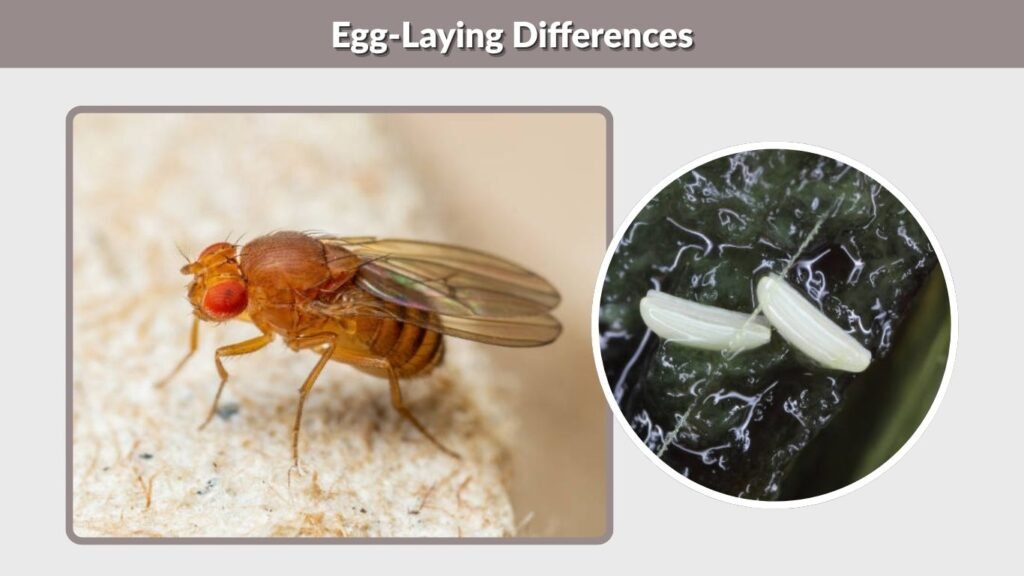
Only female fruit flies lay eggs. A female may produce hundreds of eggs during her adult life when food, moisture, and temperature are favorable.
She generally places eggs on or near fermenting organic material. The eggs hatch into small, pale larvae that feed on yeast and microorganisms.
Male fruit flies do not contribute to egg care. Their reproductive role is limited to mating and passing genetic material to the offspring.
Finding eggs or larvae does not necessarily mean that females are still present. Eggs may continue developing after adult flies have been trapped or removed.
Male vs. Female Fruit Fly Lifespan
Both male and female fruit flies can live for several weeks under favorable conditions. Their exact survival time depends on:
- Temperature
- Food availability
- Humidity
- Mating activity
- Genetics
- Disease
- Larval nutrition
- Exposure to pesticides or traps
There is no single rule stating that one sex always lives longer. Some laboratory studies find males living slightly longer under certain conditions, while others find that females survive longer.
Female lifespan may be influenced by the energy required to produce and lay eggs. Male lifespan can be affected by competition, courtship, and repeated mating. Environmental conditions often have a greater effect than sex alone.
Male and Female Fruit Fly Genetics
Fruit flies are widely used in genetics because they reproduce quickly, have easily observed traits, and share many basic biological processes with other animals.
In Drosophila melanogaster, females normally have two X chromosomes, while males usually have one X and one Y chromosome.
However, fruit fly sex determination is not exactly the same as human sex determination. The balance between X chromosomes and sets of autosomes plays the central role in determining whether an individual develops as male or female.
The Y chromosome is important for normal male fertility, but it is not the primary signal that creates a male body. This feature has made fruit flies especially valuable for studying chromosomes, inherited traits, mutations, and reproductive biology.
Can You Tell Male and Female Larvae Apart?
Fruit fly larvae cannot be reliably sexed by ordinary visual inspection. Male and female larvae have similar pale, legless, segmented bodies.
Researchers can sometimes determine larval sex through genetic markers, molecular testing, or specialized examination of internal structures. These methods are not practical for household identification.
Pupae are also difficult to sex visually. The major external differences become clear after the adult emerges.
How to Tell Male and Female Fruit Flies Apart
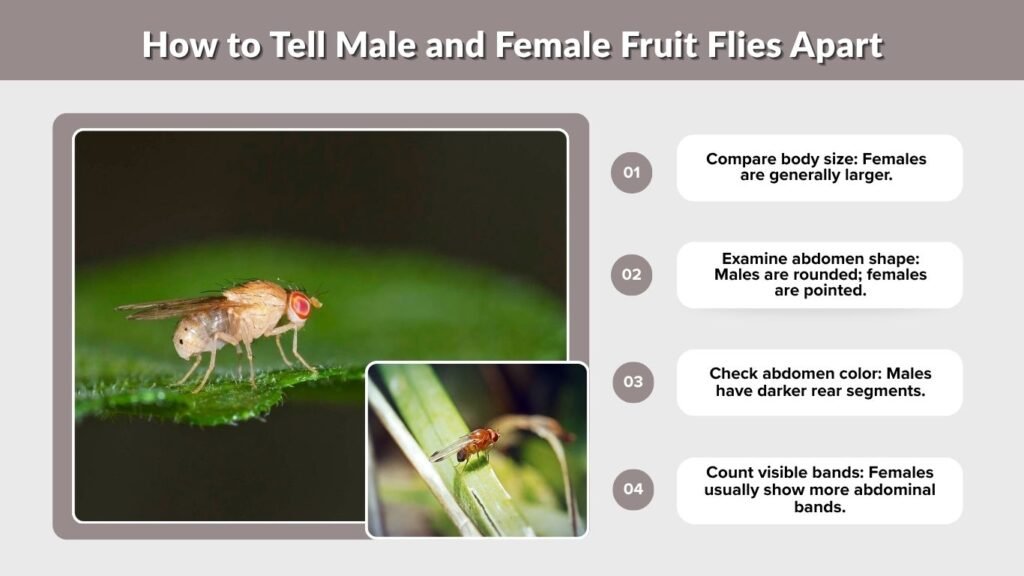
For the easiest identification, place the fly in a clear container and examine it with a magnifying glass. Do not rely on only one feature.
Identification Steps
- Compare body size: Females are generally larger.
- Examine abdomen shape: Males are rounded; females are pointed.
- Check abdomen color: Males have darker rear segments.
- Count visible bands: Females usually show more abdominal bands.
- Inspect the front legs: Only males have sex combs.
- Observe behavior: Males may follow and court other flies.
The abdomen and sex combs provide more reliable identification than size alone.
Why Are Female Fruit Flies Important in an Infestation?
Female fruit flies are responsible for establishing and expanding an infestation because they lay the eggs. Eliminating visible males may reduce mating activity, but already-mated females can continue laying eggs.
A single female may place eggs in several locations, including:
- Ripe or damaged fruit
- Trash cans
- Compost containers
- Recycling residue
- Dirty drains
- Empty beverage bottles
- Garbage disposals
- Food spills beneath appliances
For this reason, trapping adult fruit flies is not enough. The breeding material must be found, removed, and cleaned.
FAQs
Are female fruit flies larger than males?
Yes. Female fruit flies are usually larger and have longer abdomens because they produce and carry eggs. However, size can vary with nutrition and development, so abdomen shape and sex combs provide more reliable identification.
Do female fruit flies have black abdomens?
Females may have dark bands across the abdomen, but the rear generally remains lighter and more pointed than that of males. Male fruit flies usually have a rounded, heavily darkened tip that may appear almost black.
Do all male fruit flies have sex combs?
Male Drosophila melanogaster have visible sex combs on their front legs. However, sex-comb appearance varies among fruit fly species, and some related species may have differently shaped structures or lack prominent combs.
Can a female fruit fly lay eggs without a male?
An unmated female may produce eggs, but the eggs normally require fertilization to develop into offspring. Once a female mates, she can store sperm and fertilize multiple batches of eggs over time.
Which fruit fly sex lives longer?
Neither sex always lives longer. Survival depends on genetics, food, temperature, mating, reproduction, and environmental stress. Different studies may find males or females living longer under different experimental conditions.