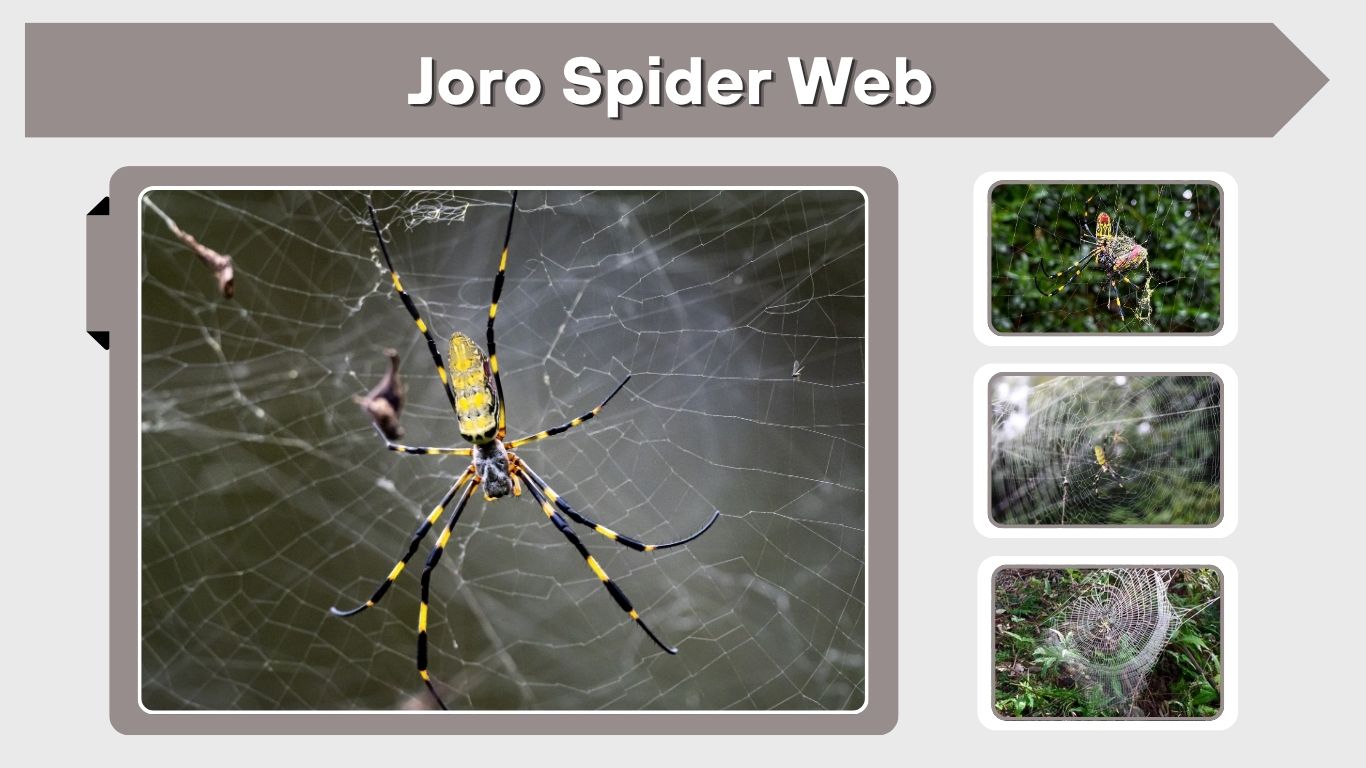
A Joro spider web is large, golden, strong, and often hard to miss. These webs are built by the Joro spider, scientifically known as Trichonephila clavata, an orb-weaving spider native to East Asia. In the United States, Joro spiders are especially associated with Georgia and nearby southeastern states, where their huge webs appear on trees, porches, fences, power lines, shrubs, and outdoor structures during late summer and fall.
What Is a Joro Spider Web?
A Joro spider web is an orb-style web made by the Joro spider. Orb webs are the classic round or wheel-shaped webs many people imagine when they think of spiders. However, Joro spider webs are usually larger, stronger, and more noticeable than many common backyard spider webs.
Joro spiders belong to a group often called golden orb-weavers. These spiders are known for producing large webs with a yellow or golden appearance. The web may look especially golden when sunlight hits it from the right angle.
Unlike small house spider webs in corners, Joro spider webs are often built in open outdoor spaces. They can stretch between trees, across shrubs, from rooflines to railings, or between human-made structures. This is why many people suddenly notice them in yards, driveways, gardens, and around porches.
Joro spiders do not build webs to attack people. The web is a hunting tool. Flying insects get trapped in the sticky silk, and the spider senses vibrations through the web.
Joro Spider Web Size
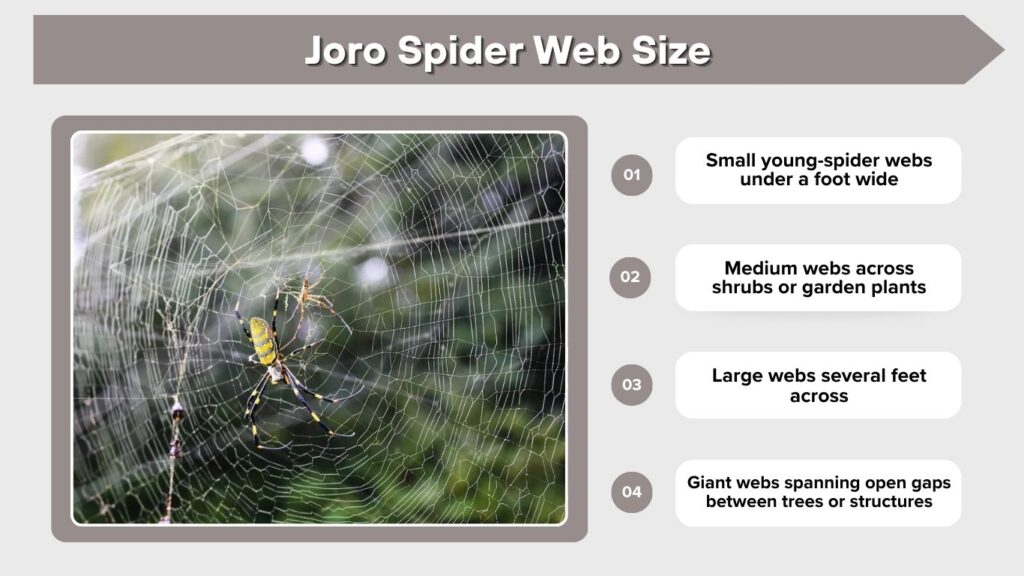
Joro spider web size is one of the main reasons people notice this species. These webs can be several feet wide, and some may span large gaps between branches, railings, or structures. Clemson Extension notes that Joro spiders often put webs on houses, carports, and landscape plants, which makes them highly visible around people.
A mature female Joro spider can have a body length up to about 1 inch and a leg span up to 4 inches, according to Penn State Extension. A spider that large can support a much larger web than many smaller orb-weavers.
The web may look even bigger because it is not always a single flat circle. Joro spider webs can be multi-layered, with supporting lines, messy outer strands, and a main orb section. University of Georgia Extension describes Joro spiders as golden orb-weavers that create large, multi-layered webs that are exceptionally strong.
Common Joro web sizes may include:
- Small young-spider webs under a foot wide
- Medium webs across shrubs or garden plants
- Large webs several feet across
- Giant webs spanning open gaps between trees or structures
- Multi-layered web systems that look much larger than the central orb
When people ask, “How big are Joro spider webs?” the most accurate answer is that they vary by spider size, age, location, and available anchor points. A web built between two nearby plants will be smaller than one built between trees or porch beams.
Why Are Joro Spider Webs Yellow or Golden?
Joro spider webs often look yellow, gold, or warm-toned. This is why searches like “Joro spider golden web,” “Joro spider yellow web,” and “Joro spider web color” are common.
The golden appearance comes from the silk itself and from how light reflects through the web. In direct sunlight, the strands may glow yellow or gold. In shade, the same web may look pale, grayish, or nearly transparent.
The golden color is not a sign that the web is poisonous or dangerous. It is simply part of the spider’s silk and web appearance. Many golden orb-weavers produce silk that can appear yellow or golden.
A Joro spider web may look:
- Golden in sunlight
- Yellow against dark backgrounds
- Pale gray in shade
- Silvery when covered with dew
- Nearly invisible until light hits it
Morning is often the best time to see the full structure of the web. Dew can outline the silk strands, while low sunlight can make the yellow color stand out.
Joro Spider Web Strength
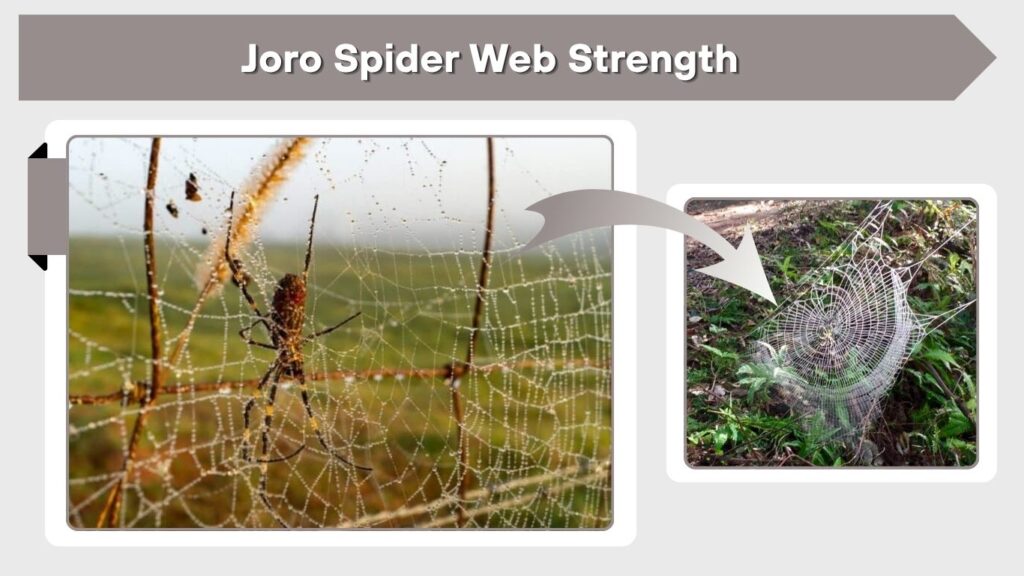
Joro spider web strength is another reason these webs get attention. People often describe the silk as tough, sticky, and surprisingly hard to break. A large Joro web may feel stronger than a typical small house spider web when you walk into it or try to brush it away.
University of Georgia Extension describes Joro spider webs as large, multi-layered, and exceptionally strong. This strength helps the web hold flying insects, survive light disturbance, and remain anchored across wide spaces.
Some searches ask whether a Joro spider web is “stronger than steel.” This phrase comes from broader discussions about spider silk, not necessarily a direct measurement of every Joro web strand in your yard. Spider silk is famous for being strong relative to its weight, but that does not mean a backyard Joro web is like a steel cable. It means the silk is an impressive biological material for its thinness and flexibility.
Joro web strength depends on:
- Silk type
- Web age
- Weather exposure
- Anchor points
- Web size
- Number of supporting strands
- Whether the web is fresh or damaged
A fresh web may feel stronger and stickier than an old web exposed to wind, rain, dust, or falling leaves.
Joro Spider Web Structure
A Joro spider web is usually more complex than a simple flat circle. It often includes a central orb web surrounded by extra support lines and irregular outer webbing. This layered structure can make the whole web look messy, huge, and three-dimensional.
The main orb section is where insects are most likely to be caught. The support lines anchor the web to branches, gutters, fences, porch rails, or other surfaces. The extra layers may help stabilize the web and create a larger capture area.
A typical Joro spider web may include:
- A central wheel-like orb
- Sticky spiral threads
- Strong radial lines
- Outer support strands
- Extra three-dimensional layers
- A resting area where the spider waits
The spider usually positions itself near the center or an active part of the web. When an insect hits the web, vibrations travel through the silk. The spider can then move toward the prey and secure it.
Joro Spider Web Pictures: What to Look For
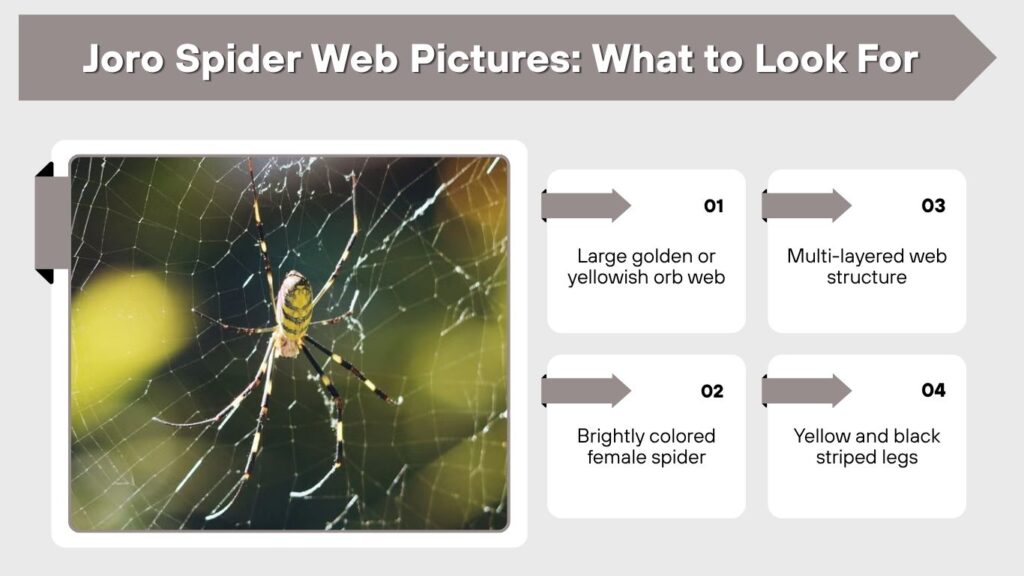
If you are comparing Joro spider web pictures to a web in your yard, look for both the web and the spider. The web alone may not be enough for a definite identification, because several orb-weaving spiders make large webs.
A Joro spider web is often large, golden, and placed in open spaces. The spider is usually brightly colored. Adult female Joro spiders have yellow, black, blue-green, and red markings. Georgia Invasives describes adult females as having bodies up to 1.25 inches long, with yellow and blue-green bands on the abdomen and yellow and red markings underneath.
Look for these visual clues:
- Large golden or yellowish orb web
- Multi-layered web structure
- Brightly colored female spider
- Yellow and black striped legs
- Web built high or across open gaps
- Webs appearing in late summer or fall
- Webs on trees, shrubs, porches, or power lines
Not every big golden web belongs to a Joro spider. Golden silk orb-weavers, garden spiders, and other orb-weavers can also make impressive webs. Location and spider appearance matter.
Joro Spider Webs in Georgia
Joro spider webs in Georgia are especially common search topics because Georgia was the first known U.S. state where the species became established. University of Georgia Extension says Joro spiders were first found in North America in 2014 in Madison County, Georgia.
Since then, they have spread through parts of Georgia and nearby states. Their webs are most noticeable in late summer and fall, when adult females are large and producing big webs. Georgia Invasives and Joro Watch both note that Joro spiders are most often seen in September and October when they build large golden webs.
In Georgia, Joro spider webs may appear on:
- Trees
- Porches
- Decks
- Fences
- Gardens
- Shrubs
- Carports
- Outdoor lights
- Utility lines
- Sheds and garages
Many residents notice them because the webs are built at face height or across walking paths. This can make them annoying even if the spiders themselves are not dangerous.
Are Joro Spider Webs Dangerous?
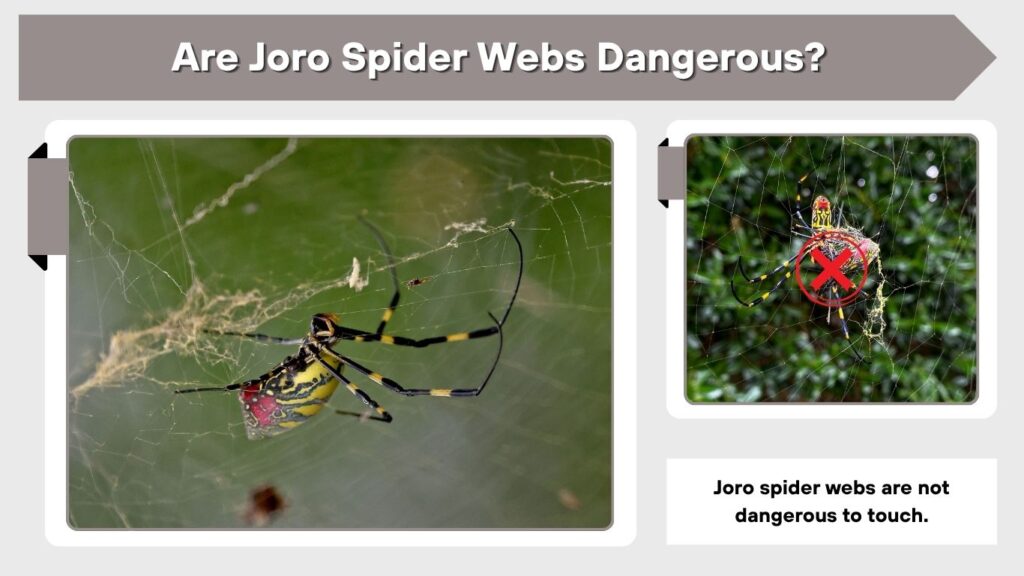
Joro spider webs are not dangerous to touch, although they may be unpleasant because they are sticky and strong. The main concern is surprise: walking into a large web can be startling, especially if the spider is nearby.
The spider itself is not considered a serious threat to people or pets. Clemson Extension explains that Joro spiders are docile and pose little threat to humans or pets. It also notes that their venom is not medically relevant and is not known to harm people or pets.
A Joro spider may bite if it is trapped or handled roughly, but it is not aggressive. Most people who encounter the webs are dealing with nuisance webbing, not a medical risk.
You should still avoid handling the spider directly. Use gloves, a broom, a stick, or a container if you need to move or remove it.
Joro Spider Web Parachute and Ballooning
Searches like “Joro spider web parachute” and “Joro spider parachute web” usually refer to a behavior called ballooning. Ballooning happens when young spiders release silk strands that catch the wind. The wind can carry the tiny spiderlings to new places.
This does not mean adult Joro spiders fly with giant parachute webs. Adults are too large for that kind of wind travel. The “flying spider” idea is mostly about spiderlings dispersing on silk.
Ballooning is common in many spider species. It helps young spiders spread away from their birthplace and find new habitat. In Joro spiders, this behavior may help local spread, while longer-distance movement can also happen when spiders or egg sacs hitchhike on vehicles, cargo, plants, or outdoor items.
Why Joro Spider Webs Appear Suddenly
Many people feel like Joro spider webs appear overnight. In a way, they can. Orb-weaving spiders are capable web builders, and a web can be rebuilt or repaired quickly.
However, the bigger reason they seem sudden is seasonal growth. Young Joro spiders are small and easy to overlook earlier in the year. By late summer and fall, females are much larger, their webs are bigger, and their colors are more noticeable.
You may suddenly see many webs because:
- Spiders have reached adult size
- Webs are larger than earlier in the season
- Females are more visible
- Morning light reveals golden silk
- Webs are built around homes and paths
- Several spiders may live in the same area
This seasonal visibility is why September and October are peak months for many sightings.
How to Get Rid of Joro Spider Webs
If a Joro spider web is in the woods or an unused part of the yard, the simplest option is to leave it alone. Joro spiders catch insects and are not known to damage plants, wood, or buildings.
If the web is across a doorway, walkway, deck, or carport, you can remove it physically. Clemson Extension says Joro spiders can be moved away from the area, such as from a porch to the edge of the woods, which is likely to keep them from returning to that location. It also mentions physical removal with a stick or broom.
Safe removal steps:
- Wear gloves if you are uncomfortable
- Use a broom, stick, or long-handled tool
- Knock down the web gently
- Move the spider with a container if possible
- Relocate it away from doors or paths
- Repeat if new webs appear
- Seal gaps and reduce outdoor lights if insects attract webs
Avoid spraying pesticides unless there is a strong reason. Sprays can affect other insects, spiders, and beneficial organisms. Physical removal is usually enough for webs in inconvenient spots.
Will Joro Spiders Rebuild Their Webs?
Yes, Joro spiders may rebuild webs if the location is still useful. A good web site has strong anchor points, insect traffic, and shelter from heavy disturbance. If you remove a web but leave the spider in the same spot, it may build again nearby.
Relocating the spider farther away can reduce the chance of rebuilding in the same doorway or porch area. Moving it to shrubs, trees, or the edge of a wooded area is often more practical than killing it.
If webs keep appearing in the same place, the location may be attracting flying insects. Outdoor lights, porch lights, and bright windows can bring insects at night, which may make the area more attractive to orb-weaving spiders.
Joro Spider Web vs Other Spider Webs
A Joro spider web can look similar to webs made by other orb-weavers. The best comparison is with yellow garden spiders and golden silk orb-weavers. All can make large, impressive webs and may have yellow or black body markings.
The Joro spider web is often recognized by its large size, golden color, and layered structure. The spider itself is the strongest clue. Joro spiders have long yellow-and-black banded legs and a colorful abdomen, while yellow garden spiders and other orb-weavers have different body patterns.
Quick comparison:
- Joro webs are large, golden, and often multi-layered
- Yellow garden spider webs may have a zigzag stabilimentum
- Golden silk orb-weaver webs can also look golden and very strong
- Joro spiders are strongly associated with recent spread in Georgia and nearby states
- Accurate ID depends on the spider, not just the web
If you only have a web picture, identification may be uncertain. A clear photo of the spider is much better.
Do Joro Spider Webs Help the Environment?
Joro spiders catch insects, including flies, mosquitoes, stink bugs, and other flying insects. This can make them useful around some outdoor spaces. However, because they are nonnative in the U.S., researchers are still studying their ecological impact.
The best balanced view is that Joro spiders are not currently considered a major direct danger to people, pets, or buildings, but their long-term effects on native ecosystems are still being evaluated. They may compete with native spiders in some areas, but they also consume insects.
Homeowners usually do not need to panic when they see Joro webs. At the same time, reporting sightings in new areas can help researchers track their spread.
FAQs
How big are Joro spider webs?
Joro spider webs can be several feet wide and may look even larger because they are often multi-layered. Their size depends on the spider’s age, location, and available anchor points. Mature females build the largest webs, especially in late summer and fall around trees, porches, shrubs, fences, and outdoor structures.
Why are Joro spider webs yellow?
Joro spider webs look yellow or golden because of the silk and the way it reflects light. Sunlight can make the strands glow gold, while shade may make the same web look pale or gray. The color is normal and does not mean the web is poisonous or dangerous.
Are Joro spider webs strong?
Yes, Joro spider webs are known for being strong and sticky. They are part of the golden orb-weaver group, and their webs can be large, multi-layered, and durable. However, claims like “stronger than steel” refer broadly to spider silk’s strength relative to weight, not to a web acting like metal.
How do I remove a Joro spider web?
Use a broom, stick, or long-handled tool to remove a Joro spider web from doorways, decks, or walking paths. If possible, move the spider away from the area instead of killing it. Relocating it to shrubs or woods can reduce the chance that it rebuilds in the same spot.
Are Joro spiders dangerous if I touch the web?
Touching a Joro spider web is not dangerous, but it can be sticky and unpleasant. The spider may retreat or stay still if disturbed. Joro spiders are considered docile and are not known to pose a serious threat to people or pets. Avoid grabbing the spider directly to prevent accidental bites.