Honey bees make honey by collecting flower nectar, changing its sugars with enzymes, removing most of its water, and storing the finished food inside wax cells. The process involves thousands of worker bees performing different jobs, from visiting flowers to receiving nectar and ventilating the hive. Bees do not turn pollen directly into honey; nectar provides the liquid starting material, while pollen supplies protein and other nutrients. Once the honey has ripened sufficiently, workers seal each storage cell beneath a protective beeswax cap.
How Do Bees Make Honey Step by Step?
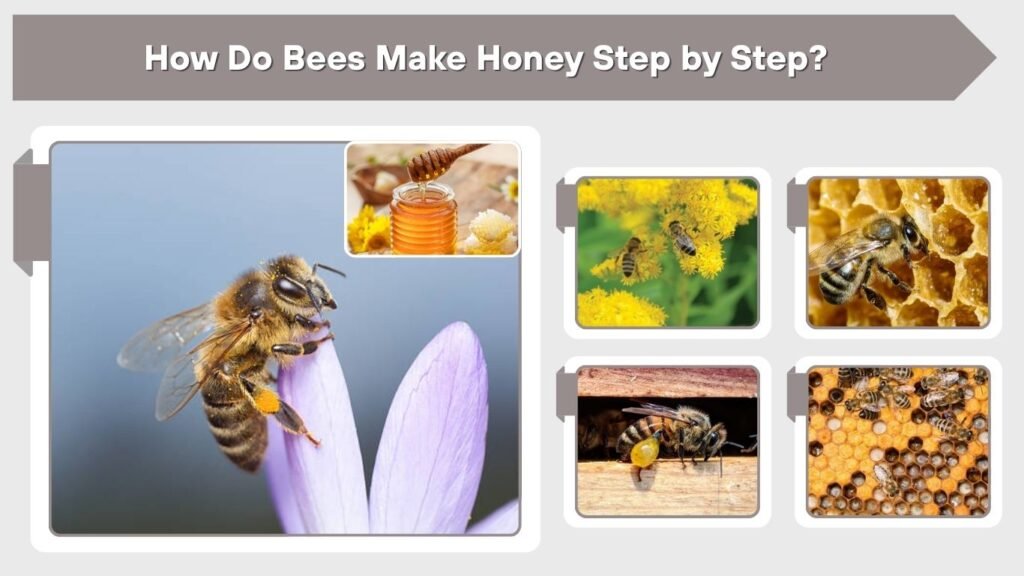
Honey production begins outside the colony and finishes inside the honeycomb. Foragers, receiver bees, wax-producing workers, and ventilating bees all contribute to the process.
1. Foragers Find Nectar-Rich Flowers
Worker bees search for flowers producing nectar, a sweet liquid plants secrete to attract pollinators. The bee extends its proboscis, a straw-like mouthpart, into the flower and draws up the liquid.
During the visit, pollen sticks to the bee’s body. Some of it reaches another flower, allowing pollination to occur.
2. Nectar Enters the Honey Stomach
The collected nectar travels into a storage organ called the crop or honey stomach. It is separate from the digestive stomach, although the bee can divert some nectar for its own energy.
A forager continues visiting flowers until her crop is sufficiently full. She then returns to the colony carrying the nectar.
3. Enzymes Begin Changing the Sugars
Nectar contains water and several sugars, often including a substantial amount of sucrose. Bees add enzymes from their glands while collecting and handling it.
One important enzyme is invertase. It separates sucrose into the simpler sugars glucose and fructose. Other enzyme-driven reactions contribute to honey’s acidity, stability, flavor, and antimicrobial properties.
4. Nectar Passes to Receiver Bees
After returning, the forager transfers nectar to a receiver bee through a mouth-to-mouth exchange called trophallaxis. The receiving worker may process it further or pass it to another bee.
The nectar is repeatedly exposed to enzymes and air during handling. This is more complex than simply “bee vomit” because it involves controlled transfer, chemical transformation, and dehydration.
5. Bees Actively Remove Water
Fresh nectar may contain approximately 70–80% water, making it too watery for long-term storage. Workers can repeatedly expose small droplets on their mouthparts, increasing the surface area and allowing moisture to evaporate.
This active dehydration begins before the concentrated nectar is distributed within honeycomb cells.
6. Bees Deposit Nectar in Honeycomb
Workers place partially processed nectar into wax cells. They may initially spread it across multiple cells, creating a shallow layer with more surface area.
Warm temperatures, airflow through the colony, and wing fanning promote further evaporation. Research describes honey ripening as a combination of active evaporation by bees and passive evaporation within the ventilated nest.
7. Workers Cap the Finished Honey
When enough water has evaporated—usually leaving honey around 17–18% water—the concentrated food is far less likely to ferment or spoil.
Workers cover the filled cell with a thin beeswax cap. The sealed honey becomes a stable food reserve that the colony can use during winter, bad weather, or periods without flowers.
Simple Explanation for Children
Bees visit flowers and drink sweet nectar. They carry it home in a special honey stomach, where enzymes begin changing it.
Inside the hive, worker bees share the nectar, place it in honeycomb, and fan it with their wings. The moving air removes water and makes the nectar thick. When it becomes honey, the bees close the cell with a wax lid.
Do Bees Make Honey From Pollen?
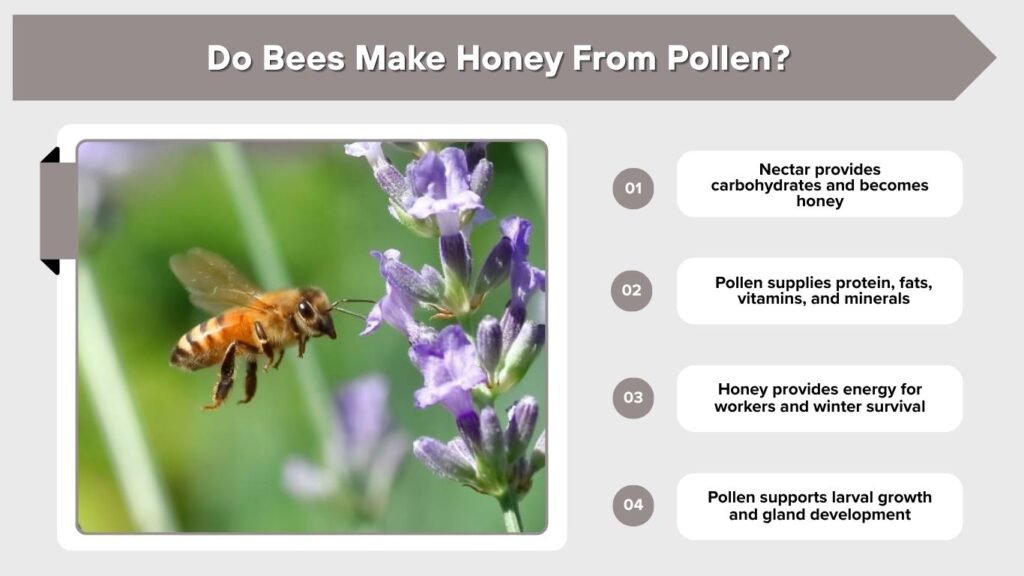
Bees do not normally convert pollen into honey. Nectar and pollen serve different nutritional purposes within the colony.
Nectar vs. Pollen
- Nectar provides carbohydrates and becomes honey
- Pollen supplies protein, fats, vitamins, and minerals
- Honey provides energy for workers and winter survival
- Pollen supports larval growth and gland development
- Small pollen grains may naturally remain in honey
Workers pack pollen into comb cells and mix it with nectar or honey and bee secretions. The stored, fermented material is commonly called bee bread.
How Do Honey Bees Make Beeswax?
Young adult worker bees produce wax using four pairs of glands located on the underside of the abdomen. The wax emerges as tiny transparent or white scales.
Building Honeycomb
Workers remove the scales with their legs, soften them with their mandibles, and combine them with other wax. Groups of bees hang together while constructing the comb.
Honeycomb contains cells used for:
- Storing honey
- Storing pollen and bee bread
- Raising worker larvae
- Raising drone larvae
- Developing new queens in specialized queen cells
Wax production requires substantial energy. Workers consume honey and convert its sugars into wax, making comb construction expensive for the colony.
Why Is Honeycomb Hexagonal?
The six-sided arrangement allows cells to share walls while filling space without large gaps. This creates an efficient structure that can store considerable honey while using relatively little wax.
Workers build from multiple locations and continuously measure, heat, and reshape the developing comb. The combined effects of bee behavior, wax temperature, and pressure between neighboring cells help produce the regular hexagonal pattern.
How Do Honey Bees Make a Hive?
Honey bees do not manufacture the hollow space commonly called a hive. In nature, a colony selects an existing cavity inside a tree, rock formation, or building and constructs its wax combs within it.
Hive vs. Nest
A hive usually refers to a human-made box occupied by managed honey bees. The nest is the internal structure built by the bees, including:
- Wax combs
- Brood cells
- Honey-storage areas
- Pollen stores
- The adult bee population
- Propolis around gaps and surfaces
Workers coat cracks with propolis, a sticky material made from plant resins. Propolis helps seal small openings and maintain the nest environment.
Why Do Bees Make Honey?
Honey is the colony’s long-lasting carbohydrate supply. It powers flight, wax production, temperature regulation, brood care, and other activities.
A honey bee colony remains active throughout the year. During winter, the bees cluster together and consume stored honey to generate energy and heat. Producing a large reserve allows the entire colony to survive when flowers are unavailable.
How Long Does It Take Bees to Make Honey?
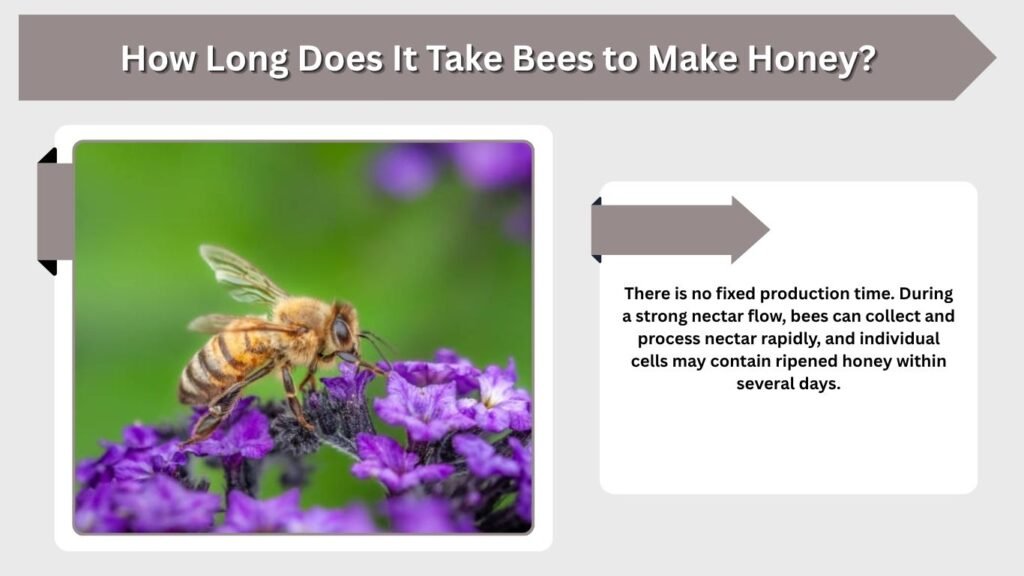
There is no fixed production time. During a strong nectar flow, bees can collect and process nectar rapidly, and individual cells may contain ripened honey within several days.
Creating a substantial seasonal reserve takes weeks or months. Production speed depends on:
- Colony population
- Flower availability
- Nectar sugar concentration
- Weather
- Temperature and humidity
- Distance to flowers
- Colony health
- Available empty comb
- Competition with other pollinators
Rain, drought, cold temperatures, swarming, disease, or a shortage of flowers can slow or stop production.
How Much Honey Do Bees Make?
Honey output varies enormously among regions and years. A strong managed colony may produce tens of pounds of harvestable surplus during a favorable season, while another colony may produce only enough for its own survival.
Beekeepers should harvest only honey the bees do not need. A colony must retain sufficient stores for winter and periods of food scarcity.
A single worker contributes only a tiny amount during her life. The colony’s total supply results from the combined work of tens of thousands of bees visiting vast numbers of flowers.
How Do Bees Make Special Types of Honey?
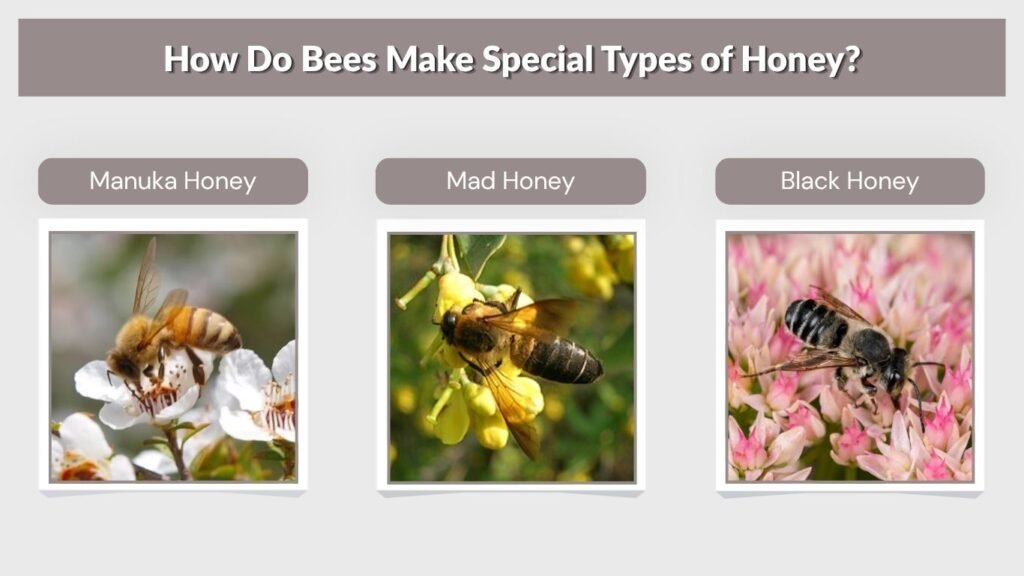
The basic process remains the same, but the nectar source changes the honey’s color, aroma, taste, chemistry, and texture.
Manuka Honey
Bees make mānuka honey by collecting nectar primarily from mānuka flowers. Its distinctive properties come from the plant source, not from a different production method.
Mad Honey
Mad honey may result when bees collect substantial amounts of nectar from certain rhododendrons containing grayanotoxins. It can cause serious poisoning and should not be consumed casually.
Red, Purple, or Black Honey
Unusual coloration may come from particular flowers, honeydew, minerals, storage conditions, or non-floral food sources. Very dark honey is often associated with its botanical source and does not necessarily indicate spoilage.
Do Bumblebees and Vulture Bees Make Honey?
Bumblebees store small quantities of nectar in wax pots. However, their colonies are seasonal and do not create the large long-term reserves associated with honey bees.
Vulture bees are stingless bees that use carrion as a protein source instead of relying entirely on pollen. Their honey-like stores still come from sugary plant resources rather than being made from meat.
FAQs
How do bees know how to make honey?
Honey production is an inherited behavior coordinated by instincts, chemical signals, environmental conditions, and interactions among workers.
How fast can bees make honey?
A strong colony can process nectar quickly during a major nectar flow, but producing a harvestable surplus usually takes weeks or months.
Do bees make honey without a queen?
Workers can temporarily collect nectar without a queen, but a queenless colony cannot replace its worker population normally and will eventually decline.
How do honey bees make a new queen?
Workers place a young female larva in a special queen cell and feed it abundant royal jelly. This diet and developmental environment produce a queen rather than a worker.
Can bees make honey from sugar water?
Bees can process and store sugar syrup, but it is not genuine floral honey. Beekeepers should not feed syrup when honey intended for human harvest is being stored.