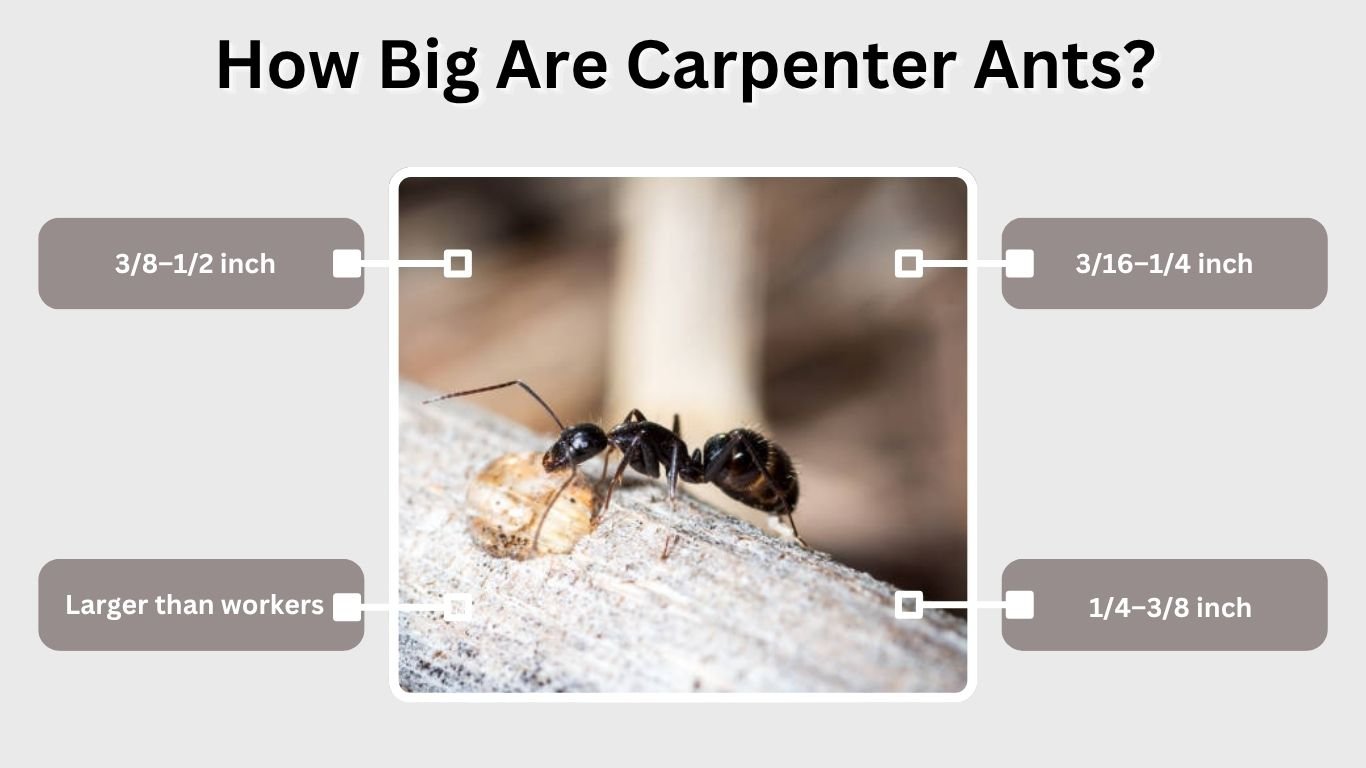
Carpenter ants are among the larger ants commonly found around homes. Their size is one of the main reasons people notice them crawling on walls, windows, decks, kitchens, or bathrooms. Most carpenter ants are much bigger than tiny house ants, but their exact size depends on species, caste, and whether the ant is a worker, queen, male, or winged swarmer. This guide explains how big carpenter ants are in inches, how large queens get, and what their size can tell you about an infestation.
How Big Are Carpenter Ants?
Carpenter ant workers are usually about 1/4 to 1/2 inch long, or roughly 6 to 13 mm. Rutgers gives carpenter ant worker size as 6–13 mm, while Penn State lists workers as 1/4 to 1/2 inch long.
That means a carpenter ant can be large enough to spot easily without magnification. Some smaller carpenter ant species may be closer to 3/16 inch, but many household carpenter ants are noticeably larger than common pavement ants, odorous house ants, or Argentine ants. The University of Minnesota Extension notes that most carpenter ant workers are 3/8 to 1/2 inch long, though one species is only about 3/16 inch.
Carpenter Ant Size in Inches
- Small worker: about 3/16 to 1/4 inch
- Average worker: about 1/4 to 3/8 inch
- Large worker: about 3/8 to 1/2 inch
- Queen: usually larger than workers
- Winged reproductives: often larger-looking because of wings
A carpenter ant may look even bigger when it is moving quickly or carrying food. Winged ants can also appear larger because their wings extend past the body.
Why Carpenter Ants Come in Different Sizes
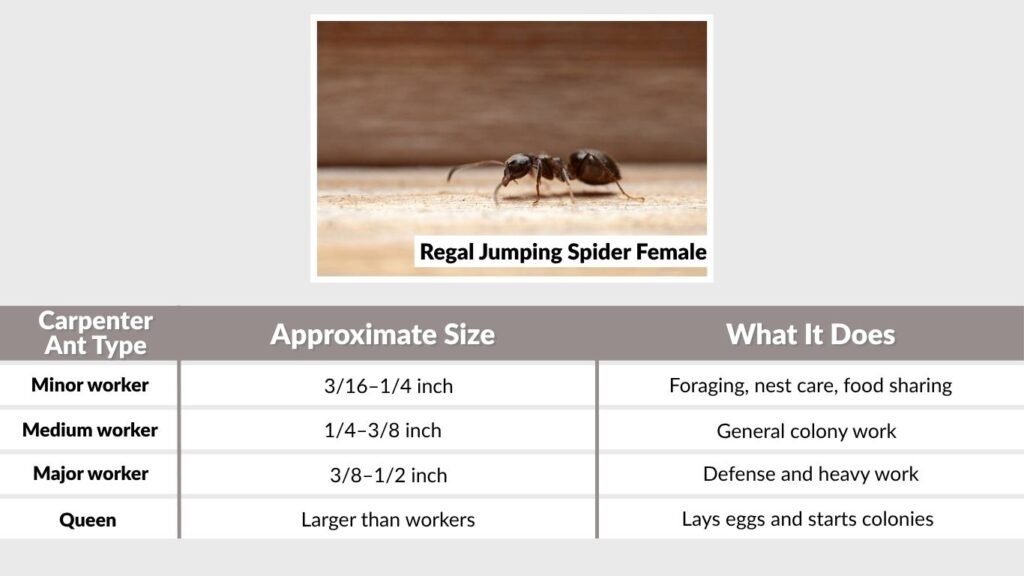
Carpenter ants do not all look the same size, even inside one colony. Many colonies have minor workers, medium workers, and major workers. Rutgers explains that a colony can include different worker sizes, including major, media, and minor workers.
Major and Minor Workers
Major workers are the larger workers in the colony. They may help defend the nest, cut food, and perform heavier tasks. Minor workers are smaller and may do more routine work such as caring for larvae, foraging, and maintaining tunnels.
This size variation is one reason homeowners may think they are seeing different ant species. In reality, the small and large ants may belong to the same carpenter ant colony.
| Carpenter Ant Type | Approximate Size | What It Does |
| Minor worker | 3/16–1/4 inch | Foraging, nest care, food sharing |
| Medium worker | 1/4–3/8 inch | General colony work |
| Major worker | 3/8–1/2 inch | Defense and heavy work |
| Queen | Larger than workers | Lays eggs and starts colonies |
| Winged ants | Often large-looking | Reproduction and swarming |
How Big Are Queen Carpenter Ants?
Queen carpenter ants are usually larger than worker ants. Rutgers describes the queen as slightly larger than major workers, with a smaller head and larger abdomen.
A queen may look especially large because her abdomen is broader and fuller. If she still has wings before mating, she may appear even bigger. After mating, a queen usually loses her wings and begins a new nest. The University of Minnesota Extension notes that queens and males are larger than workers and have wings, while queens lose their wings after starting a new nest.
How to Recognize a Queen Carpenter Ant
- Larger body than most workers
- Fuller, rounded abdomen
- Wing scars or wings if unmated
- Usually found during swarming or nest-starting periods
- Not commonly seen unless a nest is disturbed
Finding a queen inside the house is more serious than seeing a few foraging workers. It may mean a colony is nesting nearby or inside a structure.
How Big Are Flying Carpenter Ants?
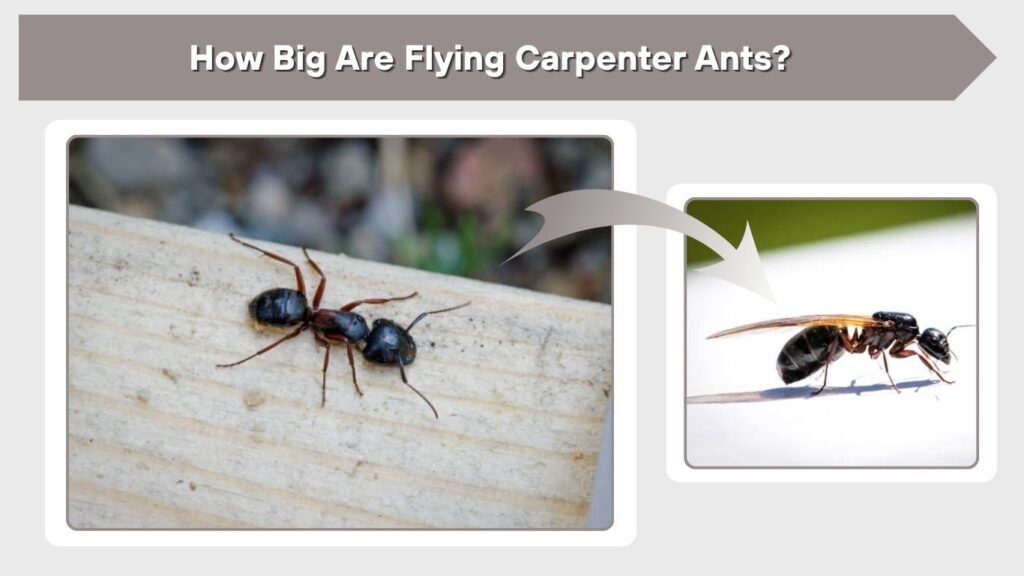
Flying carpenter ants are reproductive ants, also called swarmers or alates. They are usually queens and males produced by a mature colony. Their bodies may be close to worker size or larger, but their wings make them appear longer.
Winged carpenter ants are often confused with termites. Carpenter ants have a narrow waist, elbowed antennae, and front wings longer than the hind wings. Termites have a thicker waist, straight antennae, and equal-length wings. The University of Minnesota Extension lists the rounded thorax, one-node waist, and winged reproductive traits as key carpenter ant identification features.
Are Winged Carpenter Ants Bigger Than Workers?
Often, yes. Winged queens are larger than workers, while winged males may be smaller than queens but still look noticeable because of their wings. If you see many winged carpenter ants indoors, especially near windows or lights, it may suggest a mature colony nearby.
How Big Are Black Carpenter Ants?
Black carpenter ants are often among the larger carpenter ants found around homes. Mature workers are commonly around 1/4 to 1/2 inch long. Penn State describes carpenter ant workers as dark, shiny brown to black and about 1/4 to 1/2 inch long.
Black carpenter ants may look larger than reddish carpenter ants simply because their dark color stands out against walls, floors, or countertops. However, size alone cannot confirm the species. Some carpenter ants are black, some are red and black, and some are brownish or reddish.
How Big Are Carpenter Ants Compared to Regular Ants?
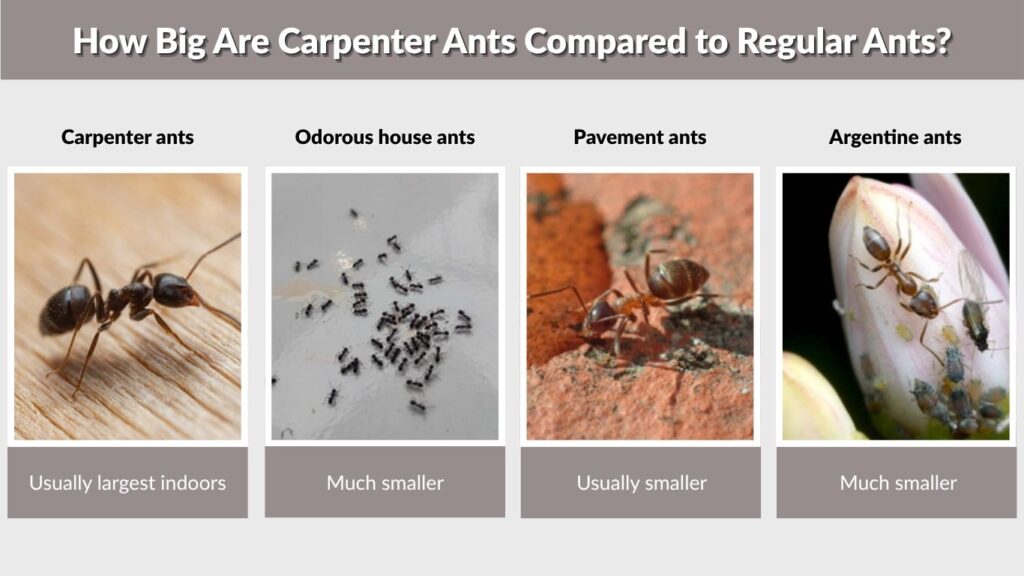
Carpenter ants are usually larger than many common household ants. For example, tiny sugar ants or odorous house ants are often much smaller and may appear as small moving dots. Carpenter ants are big enough that you can often see the head, thorax, abdomen, and bent antennae.
| Ant Type | Typical Appearance | Size Compared With Carpenter Ants |
| Carpenter ants | Large, black or red-black, rounded thorax | Usually largest indoors |
| Odorous house ants | Small, dark ants | Much smaller |
| Pavement ants | Small to medium, dark ants | Usually smaller |
| Argentine ants | Small, brown ants | Much smaller |
| Fire ants | Reddish, aggressive, outdoor mounds | Often smaller than carpenter ants |
Color can be misleading. A red or black ant is not automatically a carpenter ant. Size, body shape, nesting behavior, and signs like frass are better clues.
How Big Are Carpenter Ant Colonies?
A carpenter ant colony can become very large over time. The University of Missouri Extension states that mature black carpenter ant colonies may contain 15,000 to 20,000 individuals, while colonies of other carpenter ant species often number 3,000 to 4,000.
A colony does not usually reach that size immediately. It starts with one queen and grows slowly as workers are produced. Mature colonies may also create satellite nests, including nests in walls, insulation, trees, stumps, or damp structural wood.
Why Colony Size Matters
A few carpenter ants in your house may only be foragers from an outdoor nest. However, repeated sightings, nighttime trails, frass, or winged ants indoors can point to a larger colony. Large colonies are harder to control because only a small percentage of ants may be visible outside the nest.
How Big Are Carpenter Ant Nests and Holes?
Carpenter ants do not eat wood like termites. They remove wood to make galleries and tunnels for nesting. The University of Minnesota Extension explains that carpenter ants remove wood as they create galleries and tunnels.
Their visible openings are not always round holes like carpenter bee holes. NC State Extension notes that damaged wood may have slit-like openings where carpenter ants push out sawdust and frass, and their galleries often run with the wood grain.
Common Nest Signs
- Small slit-like openings in wood
- Sawdust-like frass below openings
- Smooth galleries inside wood
- Ant trails at night
- Winged ants near windows
- Activity near damp or damaged wood
The nest itself may be much larger than the visible opening. A small frass pile can mean the ants are excavating hidden galleries inside a wall, beam, window frame, porch, or tree.
How Big Are Carpenter Ants in the House?
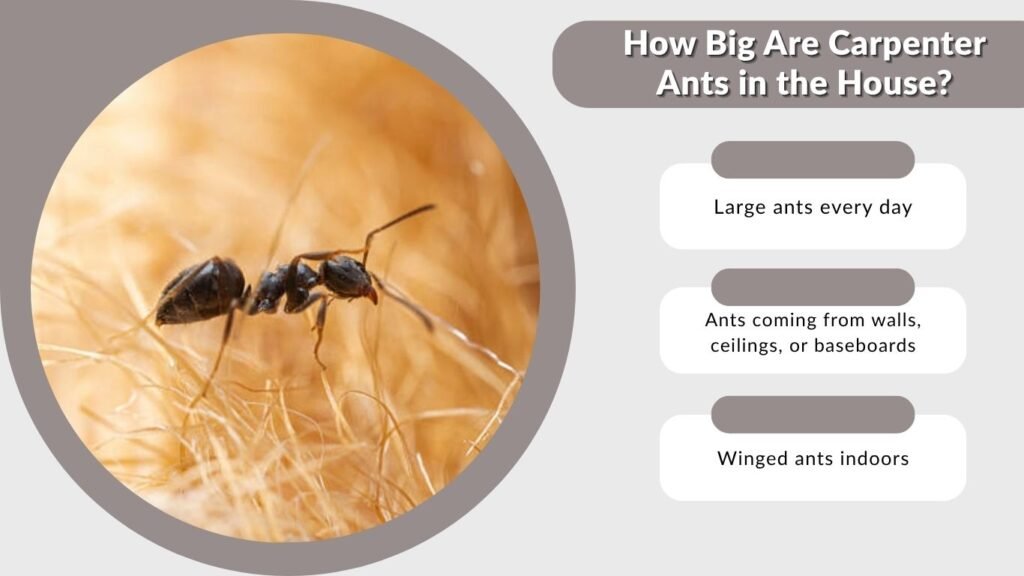
Carpenter ants found inside the house are usually worker ants. Most indoor workers are large enough to be noticed easily, often around 1/4 to 1/2 inch. If the ants are very tiny, they may be another household ant species.
Large carpenter ants in the house are more concerning when you see them often. One or two ants may be exploring for food, but repeated sightings suggest a nearby nest or steady trail.
When Size Becomes a Warning Sign
A large ant indoors is not automatically an infestation, but you should inspect further when you see:
- Large ants every day
- Ants coming from walls, ceilings, or baseboards
- Winged ants indoors
- Frass piles near wood
- Large ants near wet or damaged wood
- Ant activity at night
FAQs
How big are carpenter ants in inches?
Most carpenter ant workers are about 1/4 to 1/2 inch long. Some species are smaller, around 3/16 inch, but many household carpenter ants are large enough to notice clearly. Queens and winged reproductives are usually larger-looking than ordinary workers.
How big are queen carpenter ants?
Queen carpenter ants are usually larger than worker ants. They often have a fuller abdomen and may have wings before mating. After mating, the queen usually sheds her wings and begins a new nest. A queen indoors may suggest a nesting issue nearby.
How big are flying carpenter ants?
Flying carpenter ants often look bigger than workers because their wings extend beyond the body. Winged queens are usually larger than workers, while winged males may be smaller than queens. Many flying carpenter ants indoors can mean a mature colony is nearby.
How big are carpenter ant colonies?
Mature carpenter ant colonies can contain thousands of ants. Black carpenter ant colonies may reach 15,000 to 20,000 individuals, while other species may have around 3,000 to 4,000 ants. Colony size depends on species, age, food, and nesting conditions.
How big are carpenter ant holes?
Carpenter ant openings are often small and slit-like rather than perfectly round. They use these openings to push out sawdust-like frass from hidden galleries. The visible opening may be small, but the nest galleries inside wood can be much larger.