

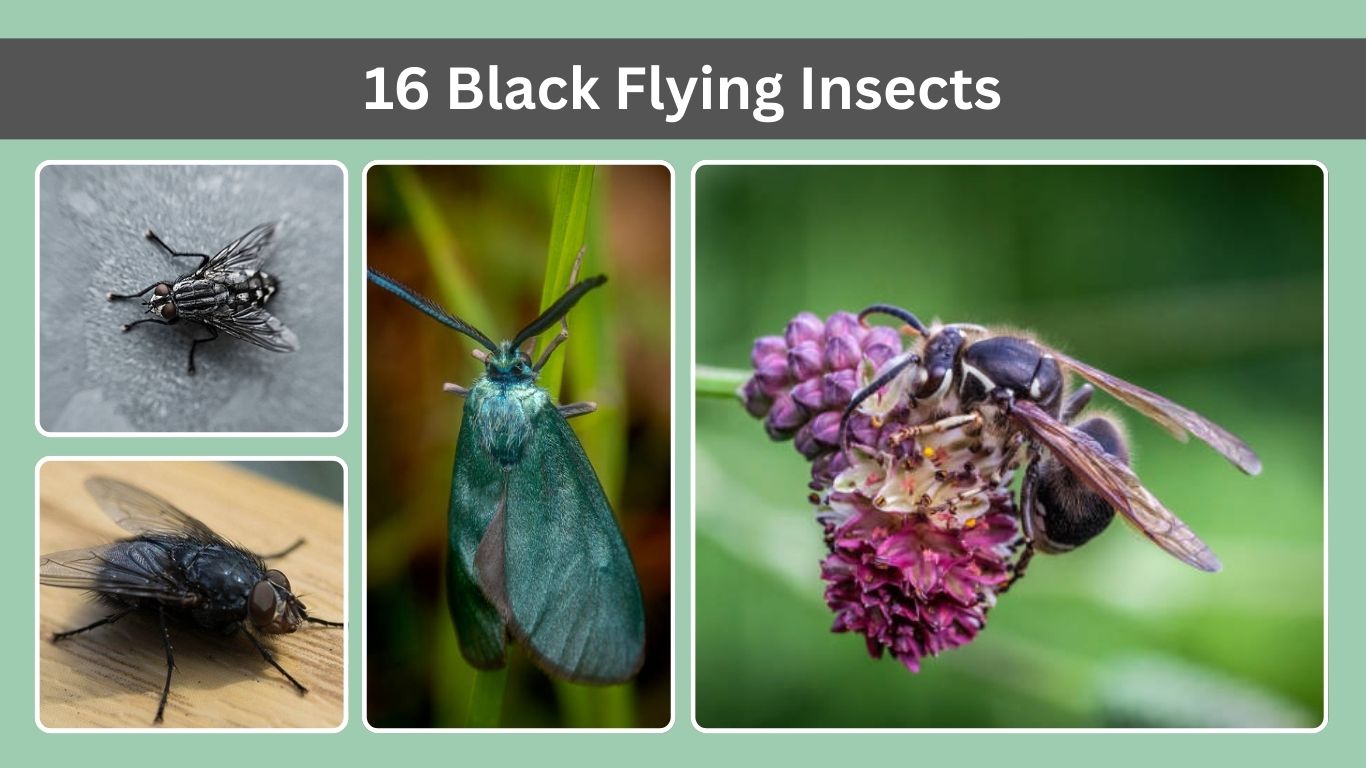
Black flying insects are diverse and widespread, ranging from tiny gnats and fungus flies to large hornets, horse flies, and wasps. Their appearance may include solid black bodies, or combinations of red, yellow, orange, blue, or white markings. Many are harmless nectar feeders, while others are biting or stinging pests that affect humans, animals, and crops. This guide explores 17 notable black flying insects, detailing their identification, habitats, behaviors, and ecological roles.
1. Black Horse Fly (Tabanus atratus)

The black horse fly is a large, intimidating all-black flying insect from the family Tabanidae. Known for its painful bite, it is among the largest horse flies in North America. Females are blood-feeders, while males primarily consume nectar.
Identification
- Length: 20–25 mm, sometimes larger
- Entirely black body and wings
- Large, iridescent compound eyes (greenish or purple hues)
- Stout body with short antennae
- Strong, fast flier with six black legs
Habitat and Range
Black horse flies are common across the eastern and southern United States, especially in wetlands, pastures, forests, and near bodies of water. They thrive in areas with livestock or wildlife, as females need blood meals for egg production.
Behavior and Feeding Habits
Females are aggressive biting insects, cutting the skin with sharp mouthparts and feeding on blood. They target horses, cattle, deer, and sometimes humans, causing painful bites that can draw blood. Males do not bite; instead, they feed on nectar and plant juices. These flies are strong fliers and pursue hosts persistently.
Notable Facts
- Females are vectors for livestock diseases due to blood-feeding.
- Bites are painful and can cause allergic swelling in humans.
- Larvae develop in moist soil or mud, preying on smaller invertebrates.
- Their large black size and aggressive flight make them easy to identify.
2. Black Blowfly (Phormia regina)

The black blowfly, also known as the greenbottle fly (dark morph), is a common shiny black flying insect in the family Calliphoridae. It is strongly associated with carrion, waste, and decaying matter, where it lays its eggs.
Identification
- Size: 6–9 mm long
- Metallic black to bluish-black sheen on body
- Transparent wings with dark veins
- Large reddish-brown compound eyes
- Six short black legs and bristly body
Habitat and Range
This blowfly is found worldwide in urban areas, farms, forests, and grasslands, especially near decaying organic material. It thrives in warm, moist environments and is common around garbage and carcasses.
Behavior and Feeding Habits
Adult blowflies feed on nectar, carrion fluids, and waste, while larvae (maggots) develop in decaying flesh, dung, or rotting vegetation. Their activity makes them important in forensic entomology, as maggot growth helps determine time of death.
Notable Facts
- Early colonizers of carcasses, vital in decomposition.
- Sometimes confused with house flies but appear shinier.
- Serve as pollinators when feeding on nectar.
- Used in forensic science for crime investigations.
3. Black House Fly (Musca domestica – dark morph)

The black house fly is a darker form of the common housefly, a small black flying insect often found indoors. Belonging to the family Muscidae, it is one of the most widespread household pests.
Identification
- Size: 5–8 mm long
- Dark gray to nearly black thorax and abdomen
- Transparent wings with four distinct dark veins
- Large reddish eyes, short antennae
- Six black legs with sticky pads for clinging to surfaces
Habitat and Range
House flies are found worldwide in homes, farms, cities, and rural areas. They thrive in warm, moist conditions, breeding in decaying organic matter such as garbage, manure, and food waste.
Behavior and Feeding Habits
Adults feed on a wide variety of liquids, often using sponging mouthparts to dissolve solid food with saliva. They are mechanical disease vectors, carrying bacteria, viruses, and parasites from waste to human food sources. Indoors, they are often seen buzzing near windows.
Notable Facts
- Life cycle is rapid—egg to adult in under 10 days in warm conditions.
- Known to spread pathogens like salmonella and E. coli.
- Harmless bite-wise, but a significant hygiene pest.
- Easily controlled with sanitation and fly screens.
4. Black Fungus Gnat (Sciaridae)

The black fungus gnat is a tiny black flying insect often found indoors, especially in homes with houseplants. Belonging to the family Sciaridae, they are weak fliers but highly noticeable around soil surfaces.
Identification
- Size: 2–4 mm long
- Slender black body with long legs and antennae
- Clear wings held flat over the back
- Mosquito-like appearance but much smaller
- Six delicate legs adapted for hovering flight
Habitat and Range
Fungus gnats are found worldwide, thriving in damp soils, greenhouses, potted plants, and gardens. They are particularly common indoors where soil remains moist.
Behavior and Feeding Habits
Adults are nuisance fliers but do not bite. Larvae develop in soil, feeding on fungal growth, organic debris, and fine roots. Heavy infestations can damage seedlings and houseplants. Adults live only about a week but reproduce rapidly.
Notable Facts
- Attracted to moisture and overwatered soil.
- Controlled by drying soil or using biological agents like nematodes.
- Often confused with fruit flies but smaller and darker.
- More a nuisance than a health risk.
5. Black Mosquito (Culex spp.)

The black mosquito is a small black biting flying insect, widely known for its nuisance and role as a disease vector. Belonging to the family Culicidae, females feed on blood while males feed on nectar.
Identification
- Size: 3–6 mm long
- Slender black or dark gray body with long legs
- Narrow wings with fine scales
- Long proboscis for piercing skin
- Six delicate legs adapted for hovering
Habitat and Range
Culex mosquitoes are found worldwide in wetlands, gardens, and urban areas. They breed in stagnant water sources such as ponds, drains, and containers.
Behavior and Feeding Habits
Females feed on the blood of humans, birds, and mammals, transmitting diseases like West Nile virus and encephalitis. Males feed exclusively on plant nectar. Most are active during dusk and night.
Notable Facts
- Only females bite for blood meals.
- Life cycle requires water for egg laying.
- Bites can cause itching, redness, and swelling.
- Important vectors of human and animal diseases.
6. Black Gnat (Simuliidae) – Black Fly

The black gnat, more accurately called a black fly, is a small but aggressive tiny black flying insect that bites. Belonging to the family Simuliidae, they are notorious for swarming and painful bites, especially near rivers and streams.
Identification
- Size: 2–5 mm long
- Hump-backed, stocky black body
- Short legs and broad wings
- Antennae short and stubby
- Six legs, giving them a compact, fly-like form
Habitat and Range
Black flies are common in North America, Europe, and tropical regions, especially near fast-flowing rivers and streams where larvae attach to submerged rocks.
Behavior and Feeding Habits
Females are biting insects, cutting the skin and feeding on blood from humans and animals. Males feed only on nectar. Swarms can cause severe irritation, allergic reactions, or livestock stress. Their bites inject anticoagulants, making them especially itchy.
Notable Facts
- Known carriers of river blindness (Onchocerciasis) in Africa.
- Attracted to dark clothing and carbon dioxide.
- Swarms make them a major outdoor nuisance.
- Nicknamed “buffalo gnats” due to humped backs.
7. Carpenter Bee (Xylocopa spp.)

The carpenter bee is a large black flying insect often mistaken for bumblebees. Belonging to the family Apidae, these bees are solitary nesters that bore into wood to create nesting tunnels.
Identification
- Size: 12–25 mm long
- Shiny, hairless black abdomen (distinguishes from fuzzy bumblebees)
- Yellow thorax hairs in some species
- Large black wings with violet or blue sheen
- Six strong black legs and robust body
Habitat and Range
Carpenter bees are found worldwide in woodlands, gardens, and urban areas, especially in regions with exposed wooden structures. They excavate tunnels in dead wood, fences, or eaves for nesting.
Behavior and Feeding Habits
Adults feed on nectar and pollen, often seen hovering around flowers. Females bore into wood to lay eggs, while males guard territories. Though intimidating, they rarely sting unless provoked. Their large, all-black flight makes them easy to recognize.
Notable Facts
- Important pollinators of many wild and cultivated plants.
- Can cause damage to wooden structures.
- Males lack stingers; females sting only defensively.
- Strong fliers, often hovering loudly near humans.
8. Great Black Wasp (Sphex pensylvanicus)

The great black wasp is a large black flying insect with a stinger, belonging to the family Sphecidae. Despite its intimidating size, it is solitary and non-aggressive unless handled. It is well known as both a predator and a pollinator.
Identification
- Size: 25–40 mm long
- Glossy all-black body and wings
- Long, narrow waist typical of wasps
- Six long black legs and threadlike antennae
- Strong flier with loud buzzing flight
Habitat and Range
This wasp is widespread in North America, inhabiting gardens, meadows, and woodland edges. Nests are usually dug in soil, with burrows provisioned for larvae.
Behavior and Feeding Habits
Females hunt katydids and grasshoppers, paralyzing them with their sting and placing them in burrows as food for larvae. Adults feed on nectar from goldenrod, milkweed, and other flowers. Despite their size, they rarely sting humans unless threatened.
Notable Facts
- Considered beneficial for controlling grasshopper populations.
- Active mainly during summer.
- Pollinate many wildflowers while feeding on nectar.
- Males are territorial but harmless.
9. Ichneumon Wasp (Ichneumonidae)

The ichneumon wasp is a diverse group of long black flying insects, often with orange, red, or yellow markings. Belonging to the family Ichneumonidae, they are parasitoids that regulate insect populations naturally.
Identification
- Size: 5–40 mm long, depending on species
- Slender black body, often with orange or red abdomen sections
- Long, threadlike antennae
- Females possess long ovipositors, sometimes mistaken for stingers
- Two pairs of narrow, clear wings
Habitat and Range
Ichneumon wasps occur worldwide in forests, gardens, and fields, especially in areas rich in caterpillars or beetle larvae.
Behavior and Feeding Habits
Females lay eggs inside or on host insects such as caterpillars, beetle grubs, or aphid colonies. Developing larvae feed on the host until pupation. Adults consume nectar and honeydew. Their black-and-orange coloration often mimics stinging wasps, though they are harmless to humans.
Notable Facts
- Harmless despite their intimidating ovipositor.
- Vital in biological pest control.
- Extremely diverse, with over 25,000 known species.
- Often confused with aggressive stinging wasps due to appearance.
10. Cinnabar Moth (Tyria jacobaeae)

The cinnabar moth is a striking red-and-black flying insect, commonly seen in open landscapes. Belonging to the family Erebidae, it is most recognizable for its bold wing markings and its association with ragwort plants.
Identification
- Wingspan: 32–42 mm
- Black forewings with bright red stripes and spots
- Hindwings red with black margins
- Slender black body with fine hairs
- Six black legs and feathery antennae
Habitat and Range
Native to Europe and western Asia, it has been introduced to North America and New Zealand as a biocontrol agent for ragwort. Found in grasslands, meadows, dunes, and heaths, wherever ragwort grows.
Behavior and Feeding Habits
Adults are day-flying nectar feeders, often seen in sunshine. Larvae are striped black-and-orange caterpillars, feeding on ragwort leaves and absorbing toxins that make them unpalatable to predators.
Notable Facts
- Example of aposematism (warning coloration).
- Larvae often feed in large groups.
- Used to control invasive ragwort populations.
- Adults live only a few weeks in summer.
11. Paper Wasp (Polistes spp.)

The paper wasp is a common black-and-yellow flying insect, resembling hornets but generally slimmer. Belonging to the family Vespidae, they build umbrella-shaped nests of chewed plant fibers mixed with saliva.
Identification
- Size: 16–20 mm long
- Slender body with black-and-yellow striped abdomen
- Narrow “waist” between thorax and abdomen
- Long black legs that dangle in flight
- Two pairs of transparent wings
Habitat and Range
Found worldwide in gardens, meadows, and urban areas, especially near human structures where they attach nests to eaves, branches, or fences.
Behavior and Feeding Habits
Paper wasps feed on nectar, fruit juices, and insects (especially caterpillars, which they chew to feed larvae). Colonies are relatively small compared to hornets. They are defensive near nests and can sting repeatedly if provoked.
Notable Facts
- Play an important role in natural pest control.
- Less aggressive than hornets or yellowjackets.
- Recognizable by their dangling legs in flight.
- Nests are made from gray, papery material.
12. Bald-Faced Hornet (Dolichovespula maculata)

The bald-faced hornet is a large black-and-white flying insect known for its aggressive defense of nests. Despite the name, it is actually a type of yellowjacket wasp. Its striking black-and-white coloration makes it easy to recognize.
Identification
- Size: 15–20 mm long
- Predominantly black body with white markings on face and abdomen
- Two pairs of clear wings
- Six strong black legs and long antennae
- Large, rounded head with powerful mandibles
Habitat and Range
Found throughout North America, bald-faced hornets build large, enclosed paper nests often hanging from trees, shrubs, or building eaves. They thrive in gardens, woodlands, and urban areas.
Behavior and Feeding Habits
These hornets are omnivorous, feeding on nectar, fruit, and other insects, especially flies. They aggressively defend nests, delivering painful stings. Colonies last only one season, with new queens overwintering to start fresh nests in spring.
Notable Facts
- Known for highly aggressive nest defense.
- Stings multiple times and injects venom.
- Important in controlling fly populations.
- Nests can house hundreds of workers.
13. Male Velvet Ant (Dasymutilla occidentalis)

The male velvet ant is a winged wasp, unlike the wingless female. It is a black-and-orange flying insect belonging to the family Mutillidae. Though males cannot sting, they resemble their notorious female counterparts, nicknamed “cow killers.”
Identification
- Size: 12–20 mm long
- Fuzzy orange-red thorax and abdomen with black bands
- Transparent wings in males (females wingless)
- Six black legs and long antennae
- Robust, hairy body
Habitat and Range
Widespread in the southern United States, they inhabit fields, sandy soils, and meadows, often near ground-nesting bees and wasps, which serve as hosts for their larvae.
Behavior and Feeding Habits
Males feed on nectar and are harmless to humans, while females lay eggs in the nests of ground bees and wasps. Larvae develop as parasitoids, consuming host larvae. Their bright orange-and-black coloration warns predators of potential danger.
Notable Facts
- Males lack stingers but resemble stinging females.
- Serve as natural regulators of ground-nesting insects.
- Females are more commonly seen running on the ground.
- Bright colors serve as aposematic warning signals.
14. Blue Mud Dauber (Chalybion californicum)

The blue mud dauber is a sleek metallic blue-black flying insect, belonging to the family Sphecidae. Despite its intimidating appearance, it is solitary and non-aggressive, well known for hunting spiders and shaping mud nests.
Identification
- Size: 18–23 mm long
- Shiny metallic blue-black body and wings
- Long, narrow waist typical of mud daubers
- Six long black legs and threadlike antennae
- Slender, elongated body adapted for aerial hunting
Habitat and Range
Found widely in North America, they inhabit gardens, meadows, and urban areas, often nesting in sheds, barns, or building eaves. They reuse or remodel old nests from other mud daubers.
Behavior and Feeding Habits
Adults feed on nectar and honeydew, while females hunt spiders, paralyze them, and place them inside mud cells as food for larvae. They are beneficial, helping control spider populations. Non-aggressive and rarely sting humans.
Notable Facts
- Known to prey on black widow spiders.
- Reuse nests abandoned by other wasps.
- Play a role in both pollination and pest control.
- Recognized by their metallic sheen and smooth flight.
15. Boxelder Bug (Boisea trivittata) – Flying Adult

The boxelder bug is a black-and-red flying insect, often considered a nuisance pest due to its habit of clustering around homes in large numbers. Belonging to the family Rhopalidae, it feeds primarily on seeds and leaves of boxelder and maple trees.
Identification
- Size: 12–14 mm long
- Elongated black body with red or orange wing margins and stripes
- Long black legs and antennae
- Membranous wings folded flat over the body
- Six legs, typical of true bugs
Habitat and Range
Native to North America, they are most common in gardens, fields, and urban areas near host trees. In autumn, they invade houses to overwinter, often gathering in cracks and crevices.
Behavior and Feeding Habits
Adults feed on boxelder seeds, maple leaves, and other plants using piercing-sucking mouthparts. They do not bite humans or damage structures but can be a nuisance indoors. Their red-and-black coloration deters some predators.
Notable Facts
- Overwinter indoors in large swarms.
- Harmless but release a foul odor if crushed.
- Often confused with firebugs.
- Active in late summer and early autumn.
16. Forester Moth (Adscita statices)

The forester moth is a small day-flying moth often mistaken for a wasp due to its bold hues. It is a black-and-blue flying insect with metallic tones, belonging to the family Zygaenidae.
Identification
- Wingspan: 25–30 mm
- Metallic greenish-blue to black wings with shimmering sheen
- Slender, furry black body
- Long black antennae with slight clubs at the tips
- Six thin black legs adapted for clinging to flowers
Habitat and Range
Found widely across Europe and parts of Asia, the forester moth thrives in meadows, heaths, and coastal grasslands. They prefer flower-rich habitats, especially where sorrel and dock grow (larval host plants).
Behavior and Feeding Habits
Adults are nectar feeders, frequently seen on knapweeds, thistles, and clovers. Larvae feed on dock and sorrel leaves. Their dark metallic black-blue wings act as camouflage in shady meadows, contrasting with bright flowers when feeding.
Notable Facts
- Active mainly in sunny weather, unlike many moths.
- Serve as pollinators for meadow plants.
- Caterpillars are greenish with yellow markings.
- Sometimes confused with small butterflies due to their daytime fligh
FAQs
Why are there so many black flying insects in my house?
Most small black flying insects indoors are fungus gnats or house flies, attracted to moisture, organic matter, or overwatered plants. They are nuisance pests rather than harmful invaders.
Which black flying insects bite humans?
Biting species include black flies (gnats), horse flies, and mosquitoes. Their bites can cause itching, swelling, or allergic reactions. Female insects usually bite to obtain blood meals for egg production.
Are large black flying insects dangerous?
Not always. Carpenter bees and great black wasps look intimidating but are usually harmless if left alone. However, hornets and bald-faced wasps can sting aggressively when nests are disturbed.
How can I identify a stinging black flying insect?
Look for narrow waists, long antennae, and banded patterns. Wasps, hornets, and velvet ants often show bright warning colors such as yellow, white, orange, or red along with black.
How do I control small black flying insects indoors?
Reduce excess moisture, cover drains, and avoid overwatering plants. For fungus gnats, let soil dry between waterings. For flies, proper sanitation and screens help prevent infestations.
