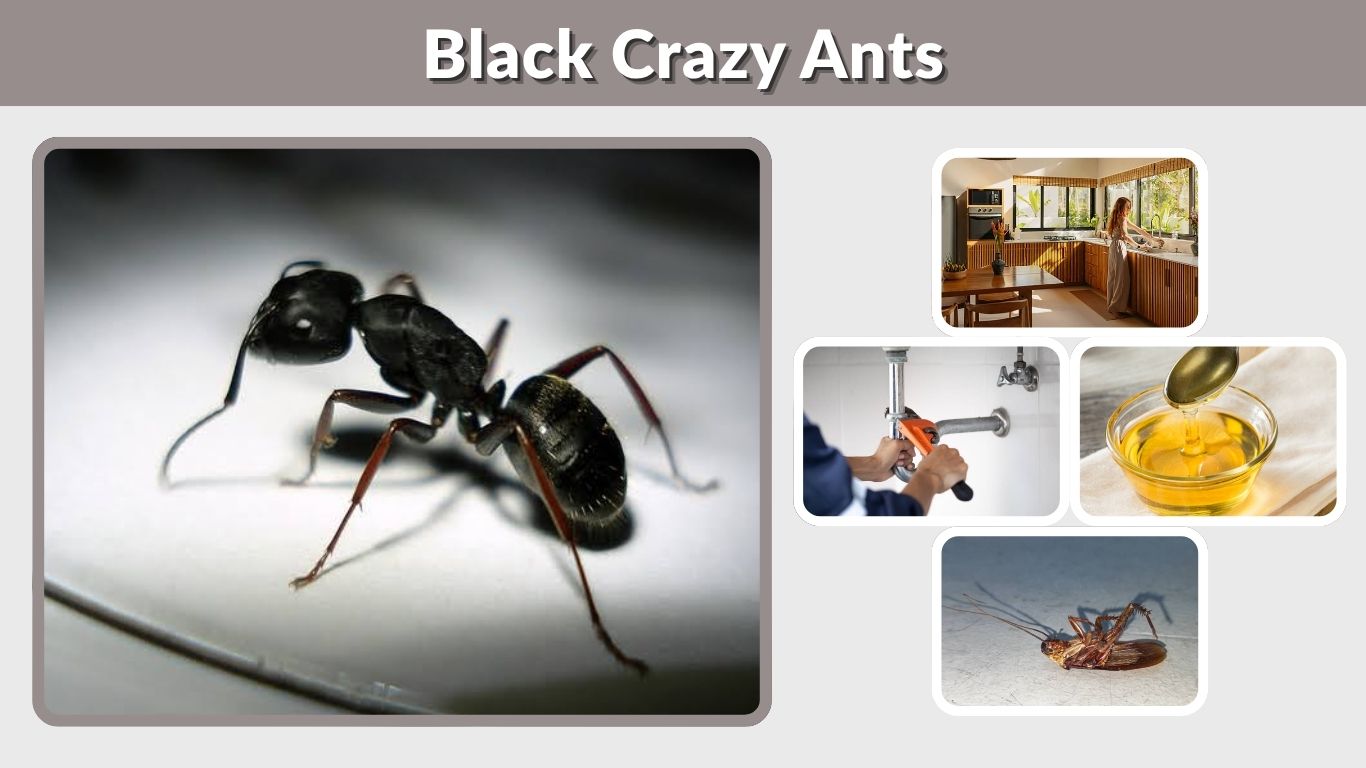
Black crazy ants are small, fast-moving ants known for their long legs, long antennae, and unpredictable running pattern. They are also called longhorn crazy ants, and their scientific name is Paratrechina longicornis. These ants are common household and outdoor pests in warm regions, but they can also survive inside buildings in cooler areas. They do not sting like fire ants, but they can become a major nuisance when they invade kitchens, bathrooms, cars, gardens, and stored materials.
What Are Black Crazy Ants?
Black crazy ants are a species of formicine ant that often appears around homes, warehouses, gardens, sidewalks, and disturbed urban areas. Their common name comes from their quick, erratic movement. Instead of marching in straight, steady trails, they often run in sudden, scattered directions when disturbed. UF/IFAS notes that Paratrechina longicornis occurs in large numbers indoors and outdoors, and nests may be hard to control because workers forage far from the nest.
These ants are not the same as tawny crazy ants or yellow crazy ants, although all of them may be called “crazy ants” because of their movement.
Black Crazy Ant Scientific Name
| Common Name | Scientific Name | Other Name |
| Black crazy ant | Paratrechina longicornis | Longhorn crazy ant |
The name “black crazy ant” is commonly used because of the ant’s dark body color and erratic behavior. UF/IFAS also notes that some authorities use the name black crazy ant, while others prefer longhorned crazy ant to separate it from other crazy ant species.
How to Identify Black Crazy Ants
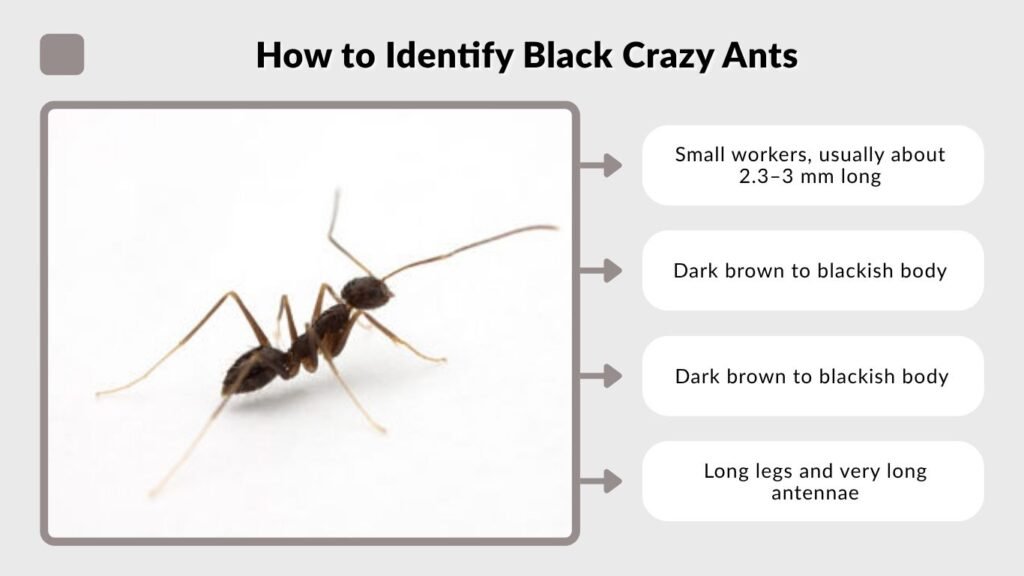
Black crazy ants are usually easier to identify by movement and body shape than by color alone. They are small, dark, and very quick. Their legs and antennae are unusually long compared with many other household ants.
Identification Signs
- Small workers, usually about 2.3–3 mm long
- Dark brown to blackish body
- Long legs and very long antennae
- Fast, erratic movement
- No stinger
- Scattered whitish or grayish body hairs
- Often seen foraging far from the nest
- May appear indoors around food or moisture
The Texas Invasive Species Institute describes black crazy ant workers as 2.3–3 mm long, dark brown to blackish, with very long antennae and extraordinarily long legs.
Where Do Black Crazy Ants Live?
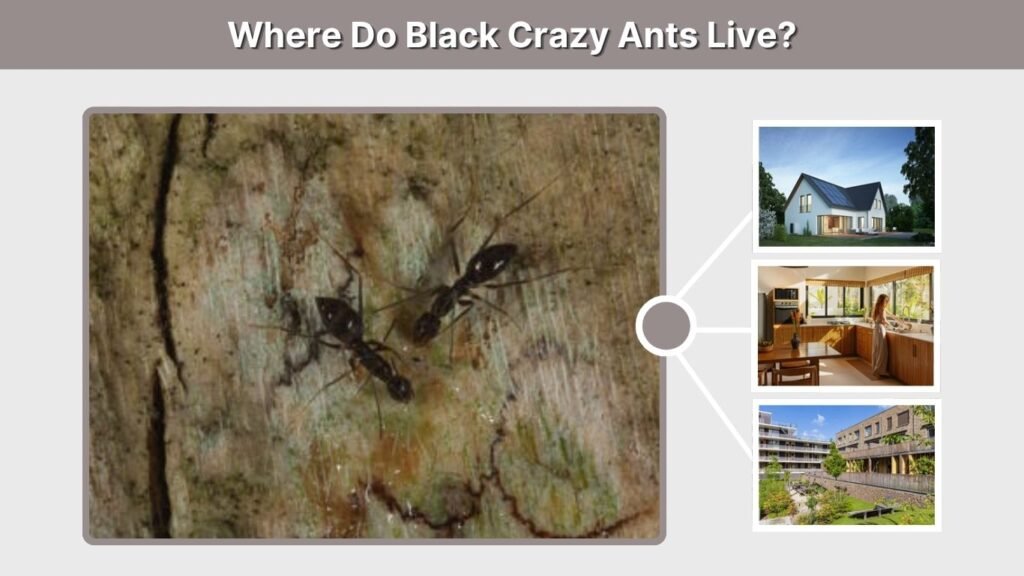
Black crazy ants are widespread in tropical and subtropical regions. They are strongly associated with human disturbance, which helps them spread through buildings, cargo, nursery plants, vehicles, and urban areas. UF/IFAS reports that they are pests in tropical and subtropical regions and can also become indoor pests in temperate areas because they survive well inside human structures.
Common Locations
- Houses and apartments
- Kitchens and bathrooms
- Warehouses
- Hotels and restaurants
- Gardens and patios
- Rotten wood and tree cavities
- Trash piles and debris
- Soil, mulch, and plant containers
- Cars parked near infested areas
In the United States, black crazy ants have been reported in several warm and urbanized states, including Florida, Texas, California, Arizona, Hawaii, and parts of the eastern U.S.
Are Black Crazy Ants Invasive?
Yes, black crazy ants are considered invasive in many places. They spread easily through human activity and can live in disturbed, artificial habitats. CABI describes Paratrechina longicornis as one of the most widely distributed ant species, occurring throughout much of the tropics and subtropics.
Their invasiveness comes from their adaptability. They can live in dry or moist areas, forage long distances, nest in many hidden places, and move with human goods. This makes them difficult to eliminate once they become established around buildings.
Do Black Crazy Ants Bite or Sting?
Black crazy ants do not sting. They lack a stinger, so they are not like fire ants. However, they may bite when threatened and can apply formic acid to the bite area. This is usually not medically serious for most people, but it may cause mild irritation.
UF/IFAS explains that the crazy ant lacks a stinger but may bite and curve its abdomen forward to apply formic acid secretion.
| Question | Answer |
| Do they sting? | No |
| Do they bite? | Sometimes |
| Are bites usually dangerous? | Usually no |
| Main defense | Formic acid secretion |
| Fire ant comparison | Much less painful than fire ants |
Are Black Crazy Ants Dangerous?
Black crazy ants are usually not dangerous to humans, but they can be serious nuisance pests. Their biggest problems are indoor invasion, food contamination, plant pest protection, and difficulty of control. They can also be annoying in cars, kitchens, bathrooms, and businesses.
They may protect honeydew-producing insects such as aphids, mealybugs, and scale insects. This can indirectly harm plants because those pests feed on plant sap. UF/IFAS notes that crazy ants obtain honeydew by tending aphids, mealybugs, and soft scales.
What Do Black Crazy Ants Eat?
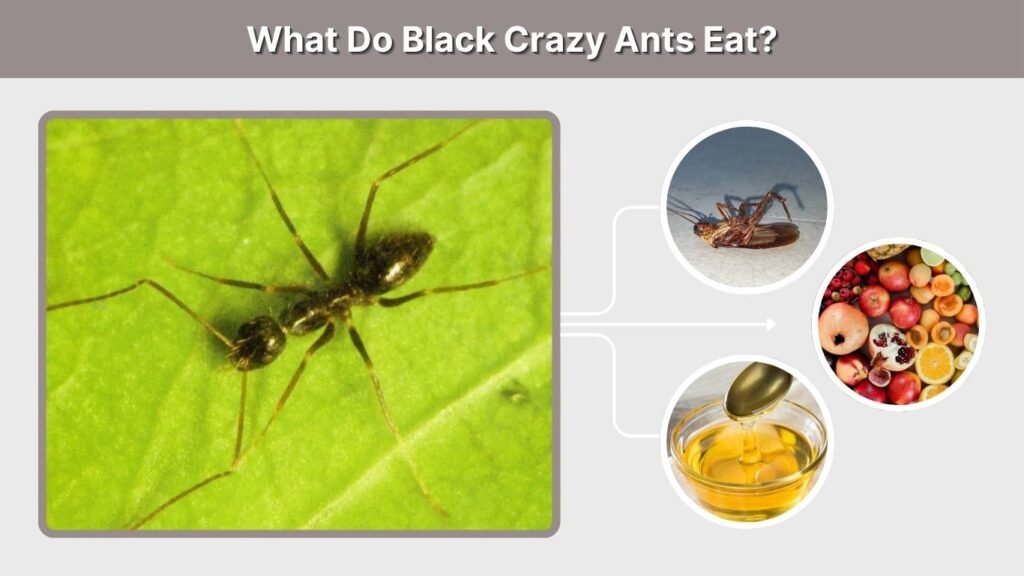
Black crazy ants are omnivores. They feed on a wide range of foods, which is one reason they do well around people.
Common Foods
- Live and dead insects
- Honeydew from aphids and scale insects
- Fruits and plant fluids
- Seeds
- Crumbs and household food
- Grease and protein foods
- Sugary liquids
- Dead animals or organic matter
UF/IFAS says workers feed on live and dead insects, seeds, honeydew, fruits, plant exudates, and many household foods. They may also shift toward high-protein foods during some seasons.
Black Crazy Ant Queen and Colony
Black crazy ant colonies may contain multiple queens. This allows colonies to grow and recover more easily if part of the colony is disturbed. The Texas Invasive Species Institute notes that colonies are polygyne, meaning they may have multiple queens.
Colony Features
- Multiple queens may be present
- Workers forage far from the nest
- Nests may be hidden outdoors
- Colonies may appear indoors when searching for food
- Workers may quickly relocate when disturbed
Because the nest may be far from where workers are seen, killing only visible ants usually does not solve the infestation.
Why Are Black Crazy Ants in the House?
Black crazy ants enter homes when they find food, water, or shelter. They often appear around sinks, pet bowls, trash cans, pantries, windows, doors, and wall gaps. They may also enter after rain, drought, heat, or outdoor disturbance.
Common Attractants
- Food crumbs
- Sweet spills
- Pet food
- Dirty dishes
- Leaky pipes
- Damp bathrooms
- Outdoor mulch touching the house
- Cracks around doors and windows
- Garbage bins near entry points
A clean house helps reduce activity, but sanitation alone may not remove the nest if the colony is outdoors.
Black Crazy Ants in Cars
Black crazy ants may enter cars parked near infested soil, mulch, trees, or trash. They may be attracted to food wrappers, drink spills, moisture, or warm hidden spaces.
To reduce ants in a car, remove all food trash, vacuum the seats and floor, clean sticky spills, and avoid parking near active ant trails. Also inspect the area where the car is parked, because the main nest is usually outside the vehicle.
Black Crazy Ants vs Fire Ants
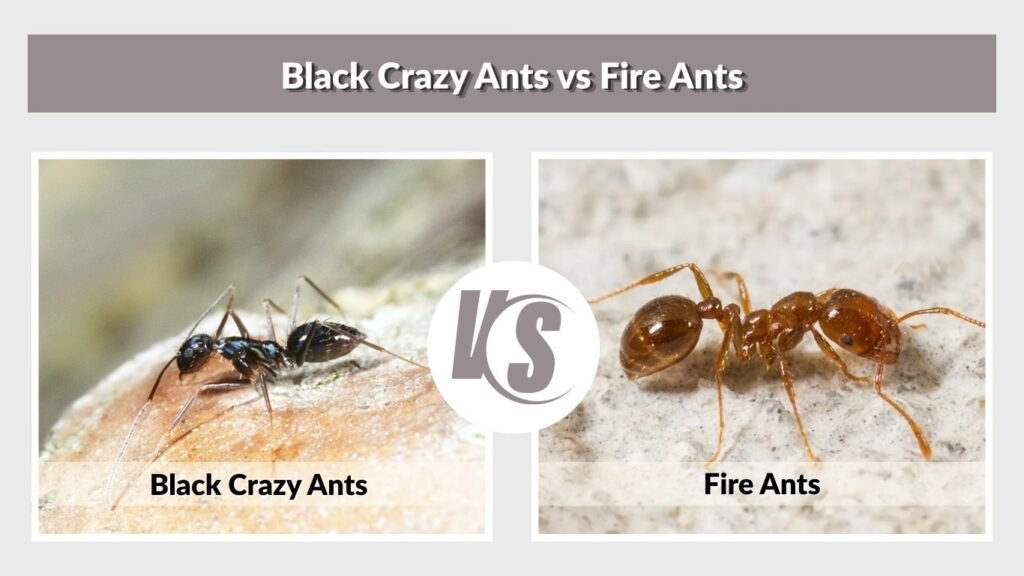
Black crazy ants and fire ants are very different. Fire ants are known for painful stings and visible soil mounds. Black crazy ants are known for long legs, quick movement, hidden nests, and nuisance indoor activity.
| Feature | Black Crazy Ant | Fire Ant |
| Scientific group | Paratrechina longicornis | Solenopsis species |
| Body color | Dark brown to black | Red-brown to dark |
| Movement | Fast and erratic | More organized trails |
| Sting | No | Yes |
| Nest | Often hidden | Often visible mounds |
| Main problem | Nuisance invasion | Painful stings |
How to Get Rid of Black Crazy Ants
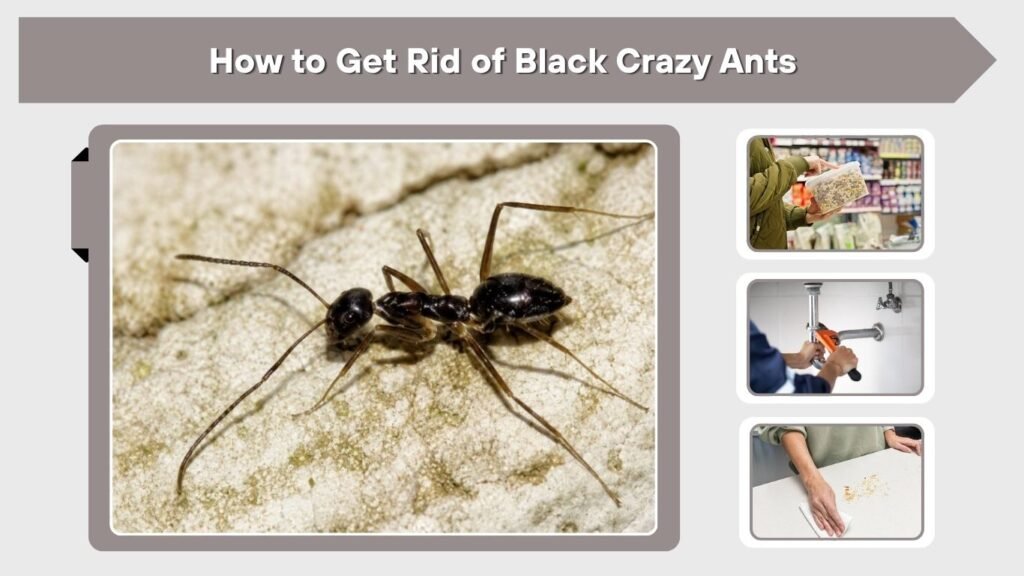
Black crazy ant control works best when you combine sanitation, exclusion, baiting, and outdoor nest management. Spraying visible ants may give quick results, but it often fails long term because workers forage far from hidden nests.
Control Steps
- Clean crumbs, grease, and sugary spills.
- Store food in sealed containers.
- Remove pet food after feeding.
- Fix leaking pipes and reduce moisture.
- Seal cracks around doors, windows, and utility lines.
- Trim plants away from the house.
- Move mulch, wood, and debris away from the foundation.
- Use ant baits instead of relying only on sprays.
- Follow the product label carefully.
- Call a pest-control professional for heavy infestations.
UF/IFAS recommends exclusion by removing food sources, caulking exterior penetrations, weather-stripping entry points, and using baits, dusts, spot treatments, granules, or sprays where appropriate.
Should You Buy Black Crazy Ant Queens?
Some searches include “black crazy ant queen for sale,” but buying or keeping invasive ants can be risky and may be illegal depending on location. Black crazy ants are widely spread by human activity, so moving queens, colonies, soil, or infested containers can help them invade new areas.
For ant keeping, it is safer to choose legal, native, non-invasive species from your region and follow local rules.
FAQs
Are black crazy ants dangerous?
Black crazy ants are not usually dangerous to humans. They do not sting like fire ants, but they may bite lightly and apply formic acid. Their bigger problem is nuisance invasion, food contamination, plant pest protection, and difficulty of control.
Do black crazy ants bite?
Yes, black crazy ants may bite when threatened, but they do not have a stinger. The bite is usually mild. They may also apply formic acid, which can cause minor irritation for some people.
Where are black crazy ants found?
Black crazy ants are found in many tropical and subtropical regions worldwide. They also live indoors in cooler areas, especially in buildings, warehouses, hotels, apartments, and other human-made structures.
What do black crazy ants eat?
They eat insects, seeds, fruit, honeydew, plant fluids, crumbs, sweets, grease, and many household foods. They also tend aphids, mealybugs, and scale insects for honeydew, which can indirectly harm plants.
How do you get rid of black crazy ants?
Remove food and moisture, seal entry points, reduce outdoor debris, and use suitable ant baits. Since nests may be far from visible ants, heavy infestations often need outdoor treatment or professional pest control.