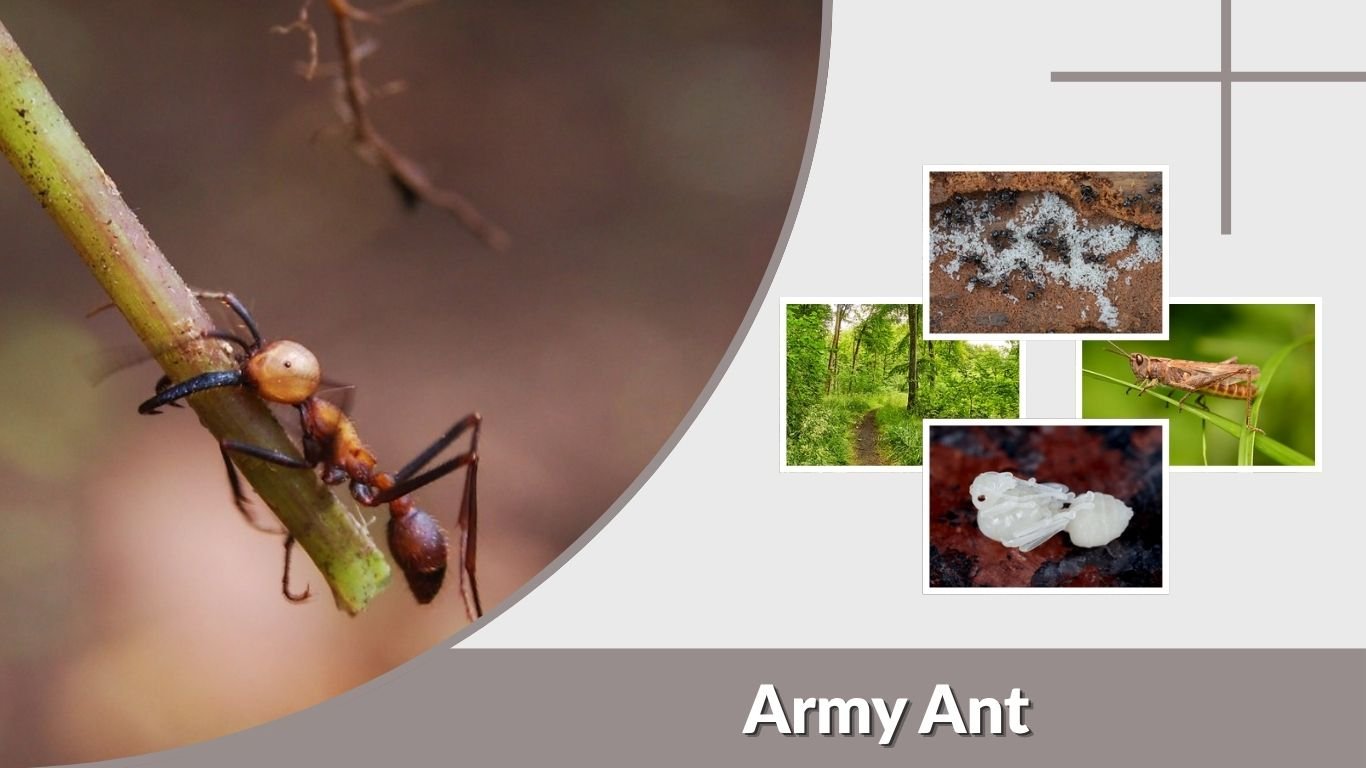
Army ants are famous for forming enormous hunting swarms that move across forest floors in search of prey. However, “army ant” does not describe one species. It refers to numerous related ants that share three notable characteristics: coordinated group hunting, temporary nests, and nomadic colony movement. Species occur mainly in tropical regions of Central and South America, Africa, and Asia. Instead of relying on individual scouts, thousands of workers may advance together, overpowering insects and raiding the nests of other social insects.
Army Ant Overview
Army ants belong to the ant family Formicidae. Well-known groups include Eciton ants of the Americas, African Dorylus driver ants, and Asian Aenictus ants. Their appearance, size, diet, and behavior vary by species, but they all depend heavily on cooperation.
| Characteristic | Description |
| Common name | Army ant |
| Family | Formicidae |
| Typical worker size | About 3–12 mm in Eciton burchellii |
| Common colors | Golden brown, reddish brown, dark brown or black |
| Habitat | Tropical forests, soil, leaf litter and wooded areas |
| Diet | Insects, spiders and the brood of ants and wasps |
| Nest type | Temporary living nest called a bivouac |
| Social structure | Queen, workers, soldiers, males and developing brood |
| Activity | Coordinated raids and colony migrations |
Army Ant Size
Army ants differ greatly in size because a colony contains several physical castes. In the well-studied species Eciton burchellii, workers generally measure approximately 3–12 millimeters long. Small workers care for eggs and larvae, medium workers hunt and transport prey, and larger soldiers protect the colony.
Workers
Ordinary workers are usually small, slender ants with long legs. Their size allows them to move rapidly through leaf litter, cracks, vegetation and tunnels. Smaller workers often handle brood care, while larger workers participate in hunting and transportation.
Soldiers
Soldiers are larger than ordinary workers and have broader heads with long, curved mandibles. These jaws are useful for defense, gripping attackers and protecting the sides of a marching column. Soldiers may look threatening, but the majority of individuals in a colony are smaller workers.
Queens and Males
The wingless queen is much larger than the workers, particularly when her abdomen becomes swollen with developing eggs. Males are winged and can also be unusually large. African Dorylus males are sometimes called “sausage flies” because of their thick, elongated bodies.
What Color Are Army Ants?
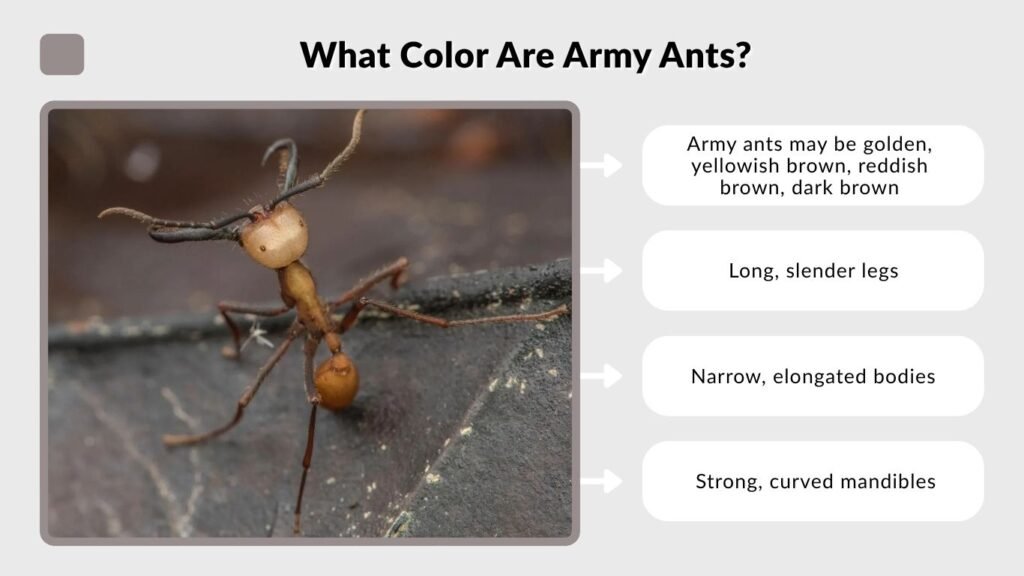
Army ants may be golden, yellowish brown, reddish brown, dark brown or nearly black. In Eciton burchellii, individuals can range from deep golden shades to dull brown. Some species have darker heads and thoraxes combined with reddish or orange abdomens.
Freshly emerged workers may appear pale because their exoskeleton has not completely hardened. They gradually become darker as they mature. Color alone is therefore not enough to identify an army ant.
Army Ant Identification
Common identification features include:
- Long, slender legs
- Narrow, elongated bodies
- Strong, curved mandibles
- Reduced eyes or almost complete blindness
- Workers of several different sizes
- Dense marching columns or broad hunting swarms
- Large soldiers positioned around the edges of trails
Their feet have specialized hooks that allow workers to cling to one another when forming bridges and temporary nests.
Where Do Army Ants Live?
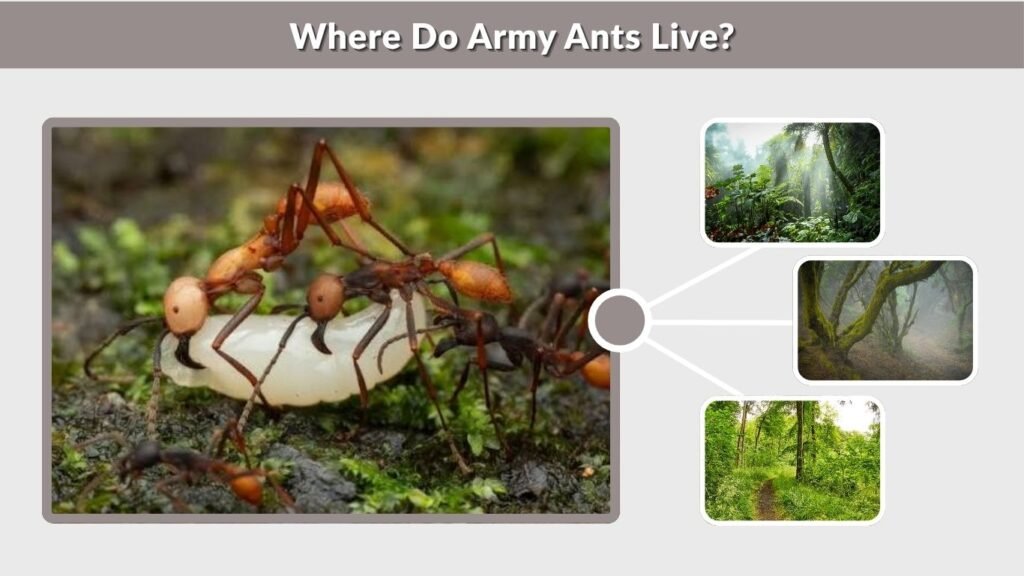
Army ants are most strongly associated with warm tropical environments. New World species inhabit Central and South America, while other groups occur across Africa and parts of Asia. Many live in rainforests, moist woodlands, scrub forests and other shaded habitats with high humidity.
Eciton burchellii, for example, prefers warm, humid forests but may occasionally forage through open land or agricultural areas near suitable forest habitat. Colonies usually travel across the ground, although they may temporarily gather inside hollow trees or above the forest floor.
Temporary Army Ant Nests
Army ants do not build permanent nests like carpenter ants or fire ants. Instead, workers connect their bodies to create a temporary living structure called a bivouac.
Inside the bivouac, workers surround and protect:
- The queen
- Eggs
- Larvae
- Pupae
- Recently captured food
The structure contains less-dense internal spaces that function like chambers. Workers cling together with hooks on their feet, forming a protective outer layer around the queen and brood.
Bivouacs may form inside hollow logs, underground cavities, tree bases or exposed locations. Some colonies remain in one location during part of their reproductive cycle and move almost every day during their active nomadic phase.
What Do Army Ants Eat?
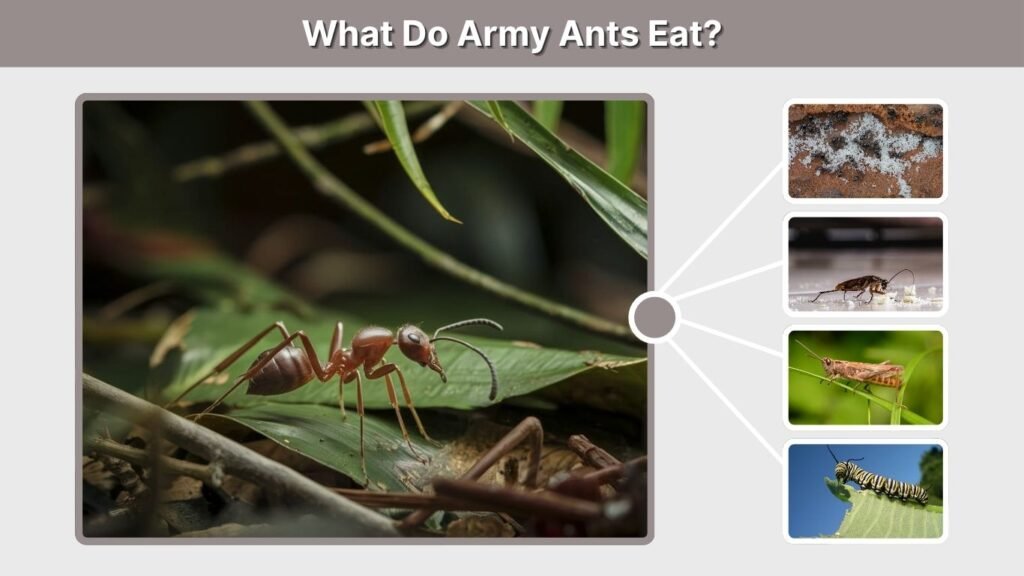
Army ants are predators that mainly eat other invertebrates. The exact diet depends on the species, season and habitat. Some are general hunters, while others specialize in raiding ant or wasp colonies.
Common army ant foods include:
- Ant eggs
- Ant larvae and pupae
- Wasp brood
- Cockroaches
- Crickets
- Beetles
- Caterpillars
- Spiders
- Scorpions and other small arthropods
- Injured or slow-moving invertebrates
For Eciton burchellii, ant and wasp brood may make up a large share of food during wet periods, while cockroaches and crickets can become more important during drier conditions.
How Army Ants Hunt
Army ants hunt through coordinated raids rather than sending out one scout. Workers leave the bivouac in a large column that may expand into a fan-shaped swarm.
They follow pheromone trails and rely heavily on touch, scent and vibrations because many workers have greatly reduced eyesight. When prey is discovered, numerous ants surround it, sting or restrain it and pull it apart with their mandibles. Pieces are then carried back to the colony.
Some species primarily attack the nests of other ants, stealing their eggs, larvae and pupae. Others sweep through leaf litter and low vegetation, causing insects and spiders to flee from their hiding places.
Army Ant Life Cycle
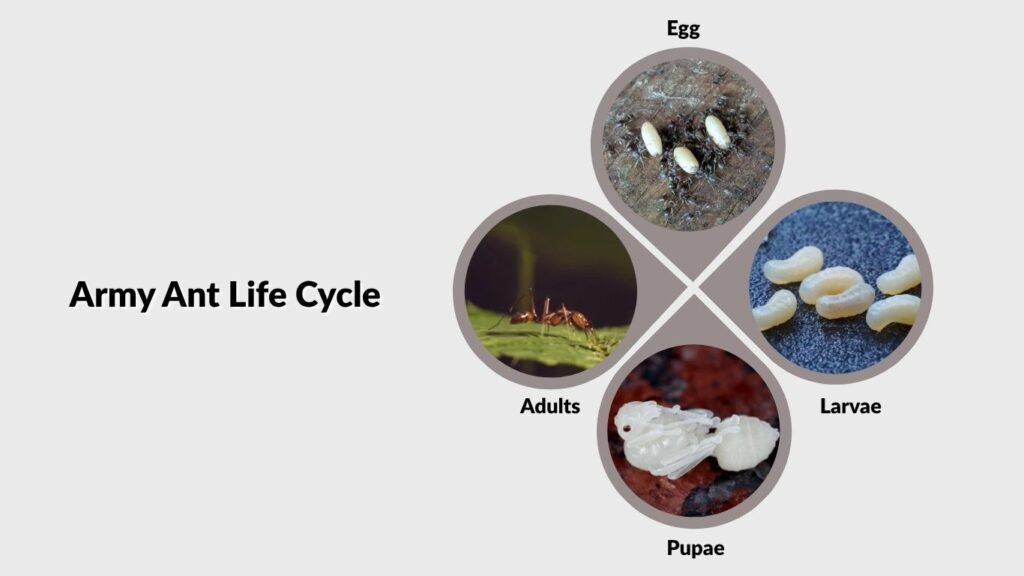
Army ants undergo complete metamorphosis with four developmental stages:
- Egg
- Larva
- Pupa
- Adult
The colony’s life is synchronized with the development of its brood. This creates alternating stationary and nomadic periods.
Egg Stage
The queen lays batches of eggs while the colony is relatively stationary. Workers collect the eggs and arrange them safely inside the bivouac. The queen remains protected and does not forage or care for her offspring herself.
Larval Stage
Larvae hatch from the eggs and require regular feeding. Workers supply them with protein- and fat-rich prey collected during raids.
In Eciton burchellii, larvae pass through several growth stages before pupating. The increased demand for food stimulates more frequent raids and colony movement.
Pupal Stage
Mature larvae form silk cocoons and enter the pupal stage. During this period, their bodies transform into adult ants.
Workers move the cocoons to suitable areas of the bivouac and regulate their temperature and humidity. When development is complete, workers may help newly formed adults emerge from their cocoons.
Adult Stage
New adults begin with pale, soft bodies. Their exoskeleton gradually hardens and darkens. They then assume responsibilities according to their size, age and caste.
Workers may care for the brood, maintain trails, hunt, transport prey or defend the colony. Soldiers concentrate on protection, males seek queens from other colonies, and the queen produces nearly all the colony’s eggs.
Nomadic and Stationary Phases
Army ant colony movement is closely linked to brood development.
Nomadic Phase
The nomadic phase begins when large numbers of hungry larvae require food. The colony conducts intense raids and frequently relocates its bivouac. Workers carry the queen, larvae, pupae and food along organized trails to the next resting site.
Stationary Phase
The stationary phase occurs when larvae become pupae and no longer need frequent feeding. The colony remains at one bivouac location for a longer period, and the queen produces another batch of eggs. Once the new larvae hatch and workers emerge, active migration begins again.
Army Ant Colony Structure
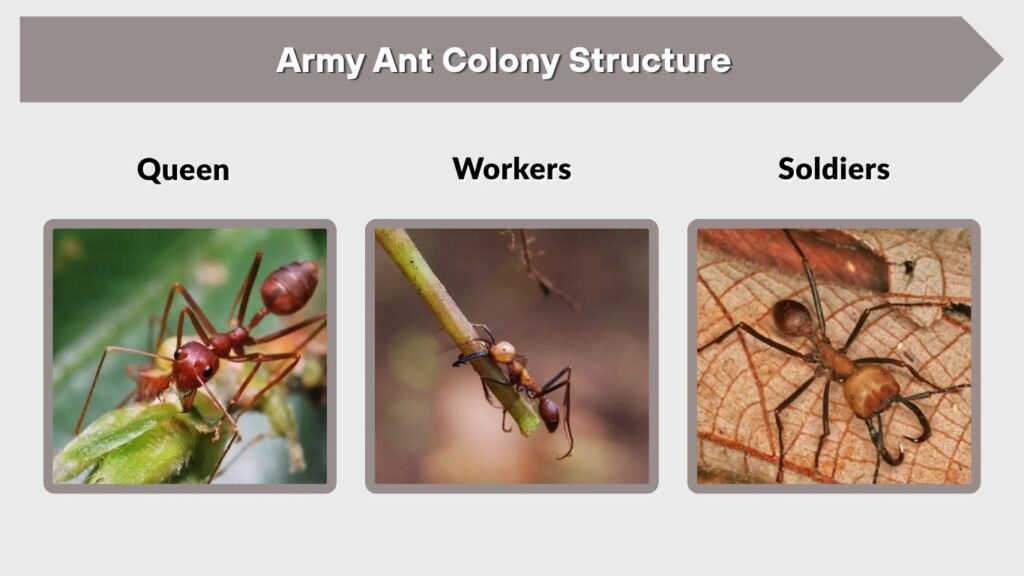
A colony functions almost like a single large organism. Its members are divided into several groups.
Queen
The queen is wingless and has an enlarged abdomen suited for producing eggs. She usually remains deep inside the bivouac, surrounded by protective workers.
Workers
Workers are sterile females that perform nearly every daily task, including brood care, foraging, trail maintenance, transportation and nest formation.
Soldiers
Soldiers are large workers with powerful mandibles. They guard the marching column, defend the bivouac and confront animals that disturb the colony.
Males
Males have wings and leave their birth colony to find a queen. A reproductive brood may contain thousands of males but only a small number of young queens.
Are Army Ants Dangerous?
Army ants can bite or sting when handled, stepped on or trapped against the skin. African driver ants have especially strong mandibles, while many New World species possess functional stingers.
However, army ants do not normally chase humans as prey. Their raids primarily target insects and other small animals. A person who encounters a marching column should avoid standing in its path and allow the colony to pass.
Their dramatic reputation is partly caused by the enormous number of individuals moving together. While a single worker is small, thousands of coordinated ants can overwhelm many invertebrates.
Importance in the Ecosystem
Army ants help regulate populations of insects and other arthropods. Their raids also flush cockroaches, spiders, crickets and other creatures from hiding places.
Birds known as ant-following birds take advantage of this behavior. They follow army ant swarms and capture fleeing insects rather than eating the ants themselves. Army ant colonies also support mites, beetles, flies and other organisms that live near or inside their bivouacs.
FAQs
Do army ants have a permanent nest?
No. True army ants form temporary living nests called bivouacs. Workers connect their bodies around the queen and developing brood. Depending on the colony’s reproductive stage, the bivouac may remain in one location temporarily or be rebuilt at a new site almost every day.
How big can an army ant colony become?
Colony size varies by species. Colonies of Eciton burchellii may contain roughly 100,000 to two million adult ants. Other army ant groups can also form enormous colonies containing hundreds of thousands or millions of workers.
Can army ants see?
Many army ant workers have greatly reduced eyes and depend little on vision. They navigate primarily through pheromone trails, touch and vibrations. Their chemical communication helps the colony organize raids, recognize nestmates and move between bivouac locations.
Do army ants eat humans?
No. Humans are not part of an army ant’s diet. Army ants mainly eat insects, spiders and the brood of other social insects. They may bite or sting people defensively, especially when trapped in clothing or when their marching column is disturbed.
Why are they called army ants?
They receive their name from their coordinated marching and hunting behavior. Thousands of workers travel in organized columns and broad raiding fronts, resembling an advancing army. The colony acts collectively without needing a single ant to lead the movement.