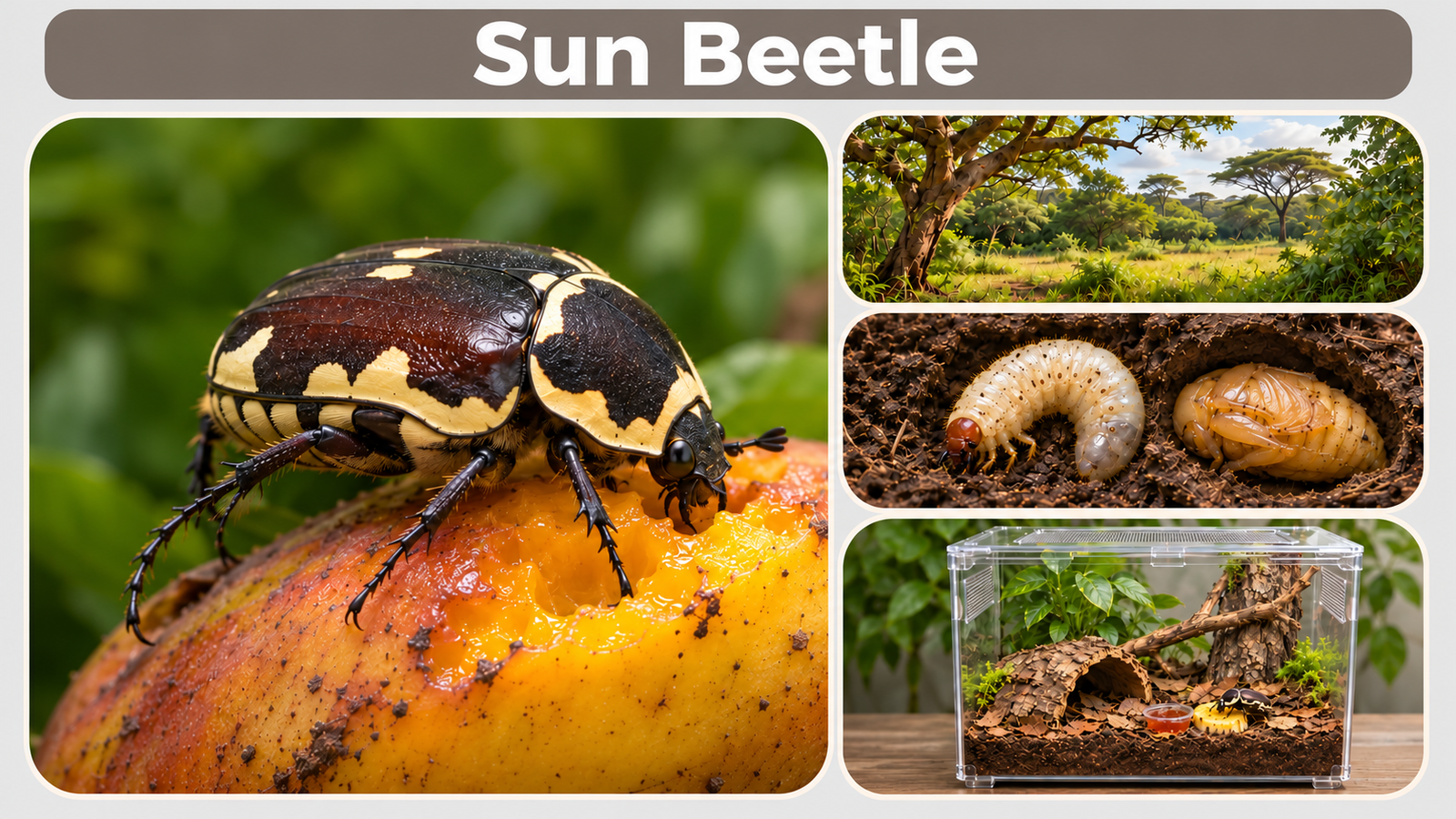
The sun beetle is a colorful African flower chafer known for its dark wing covers and bright yellow or orange markings. Its scientific name is Pachnoda marginata, and it belongs to the scarab beetle family. Sun beetles spend their lives in two very different forms: active adults that feed on fruit and plant matter, and soil-dwelling larvae that eat decaying material. Here’s how to identify a sun beetle, understand its natural behavior, and care for one in captivity.
What Is a Sun Beetle?
The name “sun beetle” commonly refers to Pachnoda marginata, a species of flower chafer in the family Scarabaeidae. It is also known as the African fruit chafer or Congo chafer. Several related forms and subspecies are described, so the precise pattern and coloration may vary among beetles sold under this common name.
Like other beetles, a sun beetle has a hard outer pair of wing covers called elytra. These protect the flight wings folded beneath them. The insect can lift the elytra and fly when it needs to move or escape. Though its body looks compact and heavy, the sun beetle is capable of strong flight.
Sun beetles are active during the day, which makes them easier to observe than many nocturnal beetles. Adults often climb, explore their surroundings, and gather around food. Their contrasting markings and daytime activity are two reasons they are popular in insect displays and as beginner beetles for hobbyists.
Sun Beetle Identification
Adult sun beetles are usually around 2–3 centimeters long. Their bodies are oval and somewhat flattened, with six jointed legs and club-shaped antennae typical of scarab beetles. The back is often dark brown or black, with cream, yellow, or orange markings along the wing covers and edges. Markings vary, so an individual may not match every picture labeled “sun beetle.”
The larvae look very different from the adults. They are pale, curved grubs with a brown head and three pairs of small legs near the front. A mature larva may grow larger than the adult beetle, sometimes reaching around 6 centimeters. Larvae spend most of their time hidden in their food substrate, so they are less commonly seen than the bright adults.
| Feature | Sun beetle |
|---|---|
| Scientific name | Pachnoda marginata |
| Family | Scarabaeidae |
| Adult size | About 2–3 cm |
| Common colors | Dark brown or black with yellow, cream, or orange markings |
| Activity | Mostly active during the day |
| Larval form | Pale, C-shaped grub |
Sun Beetle Habitat and Distribution
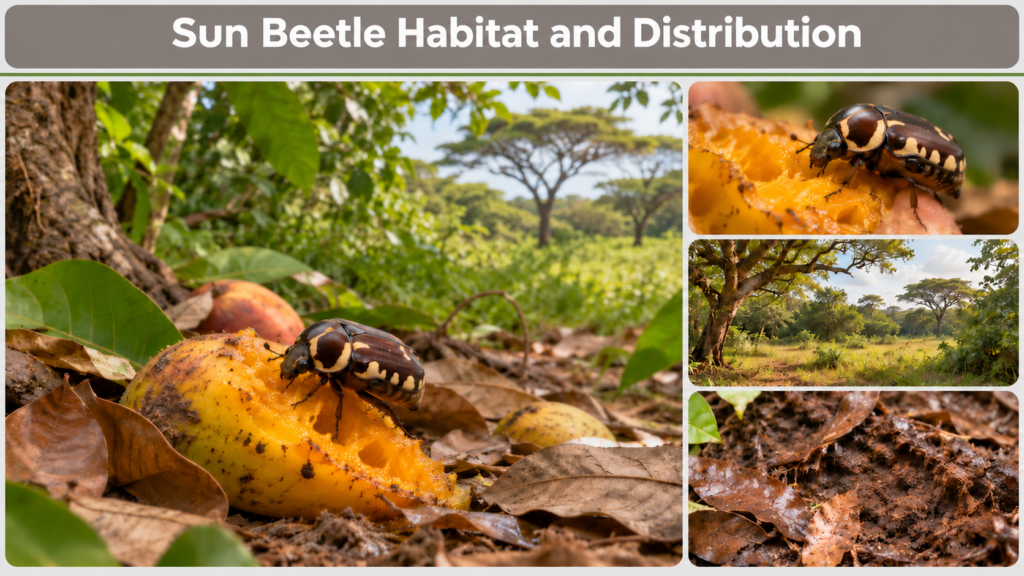
Sun beetles are native to parts of West and Central Africa. They occur in warm environments, including forests and savannahs, and may be found around trees such as acacias. Adults visit fruit, sap, and other plant material, while larvae develop in soil or decomposing organic matter.
A sun beetle’s habitat needs change as it grows. The adult benefits from places to climb and access to fruit or sap. The larva needs a suitable layer of moist, decomposing material where it can feed and burrow. In nature, fallen leaves, rotting wood, and decaying fruit contribute to this food-rich environment.
What Do Sun Beetles Eat?
Adult sun beetles feed mainly on ripe fruit, sap, and soft plant material. In captivity, keepers commonly offer small pieces of banana, apple, or orange, as well as beetle jelly made for fruit-feeding beetles. Remove uneaten fresh food regularly, since it can spoil, attract mites, or grow mold.
The larvae have a different diet. They feed on decaying leaves, decomposed wood, and other organic matter mixed into their substrate. A suitable larval substrate is not simply ordinary garden soil: it must provide the decomposed plant material the grubs rely on for food. Care guidance commonly uses leaf mulch and rotten hardwood, while cautioning against coniferous wood.
Sun beetles help break down rotting fruit and plant material. As they feed, they contribute to the return of nutrients to the soil. This role as decomposers connects their diet to the health of the ecosystems where they live.
Sun Beetle Life Cycle
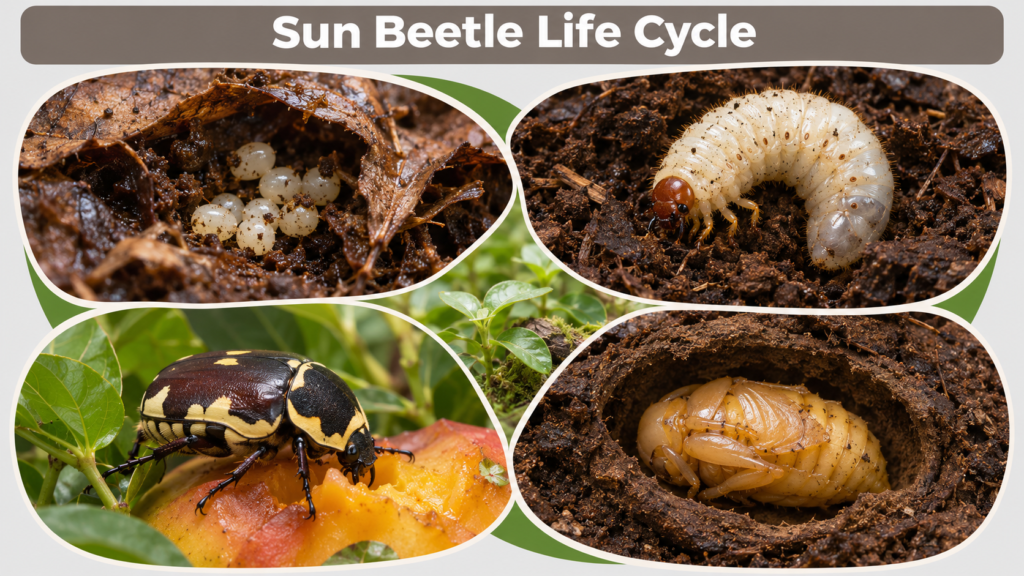
Sun beetles undergo complete metamorphosis, passing through four stages: egg, larva, pupa, and adult.
- Egg: After mating, a female lays eggs in moist substrate.
- Larva: The egg hatches into a grub that feeds and grows below the surface. The larval period may last a few months, depending on conditions.
- Pupa: A mature larva forms a protective chamber in the substrate and changes into an adult. This stage lasts several weeks.
- Adult: The adult emerges, hardens, and begins feeding and reproducing.
The exact timing varies with temperature, food, and other conditions. An older husbandry guide gives a complete life cycle of about 3.5–5 months, with larvae developing for roughly 2–3 months and adults emerging from their pupal chambers several weeks later.
Sun Beetle Lifespan
The adult stage lasts several months, but published care and zoo descriptions give different estimates. Some sources report about five to seven months for adults, while others give a broader range. Development time also varies with conditions, so it is more useful to think of lifespan as a range than as a fixed number.
The larval period is an important part of the beetle’s total life, even though the grubs remain hidden in their substrate. Temperature, food quality, moisture, and crowding can affect how quickly the larvae develop and whether pupation succeeds.
Sun Beetle Care in Captivity
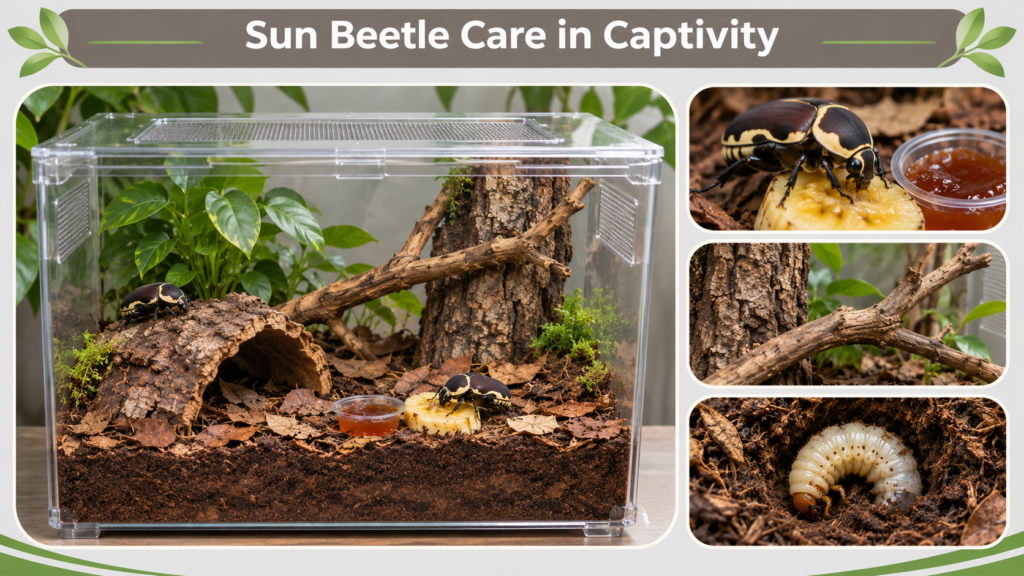
Sun beetles are often described as suitable for beginner beetle keepers, but a healthy enclosure still needs to support both adult activity and larval development. Use a secure, ventilated container with enough space for adults to climb and enough suitable substrate for larvae to burrow. Include stable branches or pieces of bark, and make sure the lid prevents escape.
The larval substrate should stay slightly moist without becoming waterlogged. Too much dryness can harm developing grubs, while overly wet conditions can encourage mold and other problems. If you keep adults and larvae together, monitor food and substrate carefully; some husbandry guidance recommends separating them to protect eggs and young larvae.
Provide ripe fruit or a suitable beetle food for adults, and remove leftovers before they spoil. Replace exhausted substrate when needed, taking care not to injure larvae or disturb pupal chambers. A pupa’s protective case should be left alone while the beetle completes its transformation.
Temperature and humidity recommendations differ between life stages and care setups. Use a reliable care guide for the specific colony and enclosure you have, and avoid overheating the container. Keepers should also confirm the beetles’ identity and source, since similar Pachnoda species may be sold under overlapping common names.
Are Sun Beetles Dangerous?
Sun beetles are not considered dangerous to people. They are small plant- and fruit-feeding beetles, not predators that seek out humans. Handle them gently, since their legs can grip skin or clothing and a beetle may try to fly if startled.
If you keep one, avoid squeezing its body or pulling on its legs. A calm approach and a secure enclosure are usually enough to observe the beetle without stressing it.
Why Are Sun Beetles Important?
Sun beetles help break down decaying fruit and plant material. This feeding activity supports nutrient recycling in their habitats. Their larvae also process organic matter beneath the surface, while adults can move between feeding sites and help make these insects visible in the forest and savannah environments where they live.
Their life cycle also makes them useful for learning about insect development. By observing the larval, pupal, and adult stages, people can see how a beetle changes shape as it grows. In zoos and educational settings, sun beetles can introduce visitors to the roles insects play in ecosystems.
FAQs About Sun Beetles
What is the scientific name of the sun beetle?
The sun beetle is commonly identified as Pachnoda marginata. It belongs to the scarab beetle family, Scarabaeidae. Some sellers use subspecies names or apply the common name to similar beetles, so check the scientific name and source when identifying a captive specimen.
What do sun beetles eat?
Adult sun beetles eat ripe fruit, sap, and other soft plant material. In captivity, they may accept banana, apple, or beetle jelly. Their larvae feed on decomposing leaves, rotten hardwood, and other organic matter in the substrate.
Where do sun beetles live?
Sun beetles are native to parts of West and Central Africa. They are associated with warm habitats such as forests and savannahs, where adults may visit trees and feed on fruit or sap. Their larvae live in soil or decaying organic matter.
How long does a sun beetle live?
The lifespan varies with conditions and life stage. Adults live for several months, while the larval and pupal stages add to the total time from egg to adult. Captive care sources report different ranges, so a single exact lifespan should be treated cautiously.
Can sun beetles fly?
Yes. Adult sun beetles have flight wings protected beneath hardened wing covers. They can fly when disturbed or when moving between feeding places, so a captive enclosure should have a secure lid.