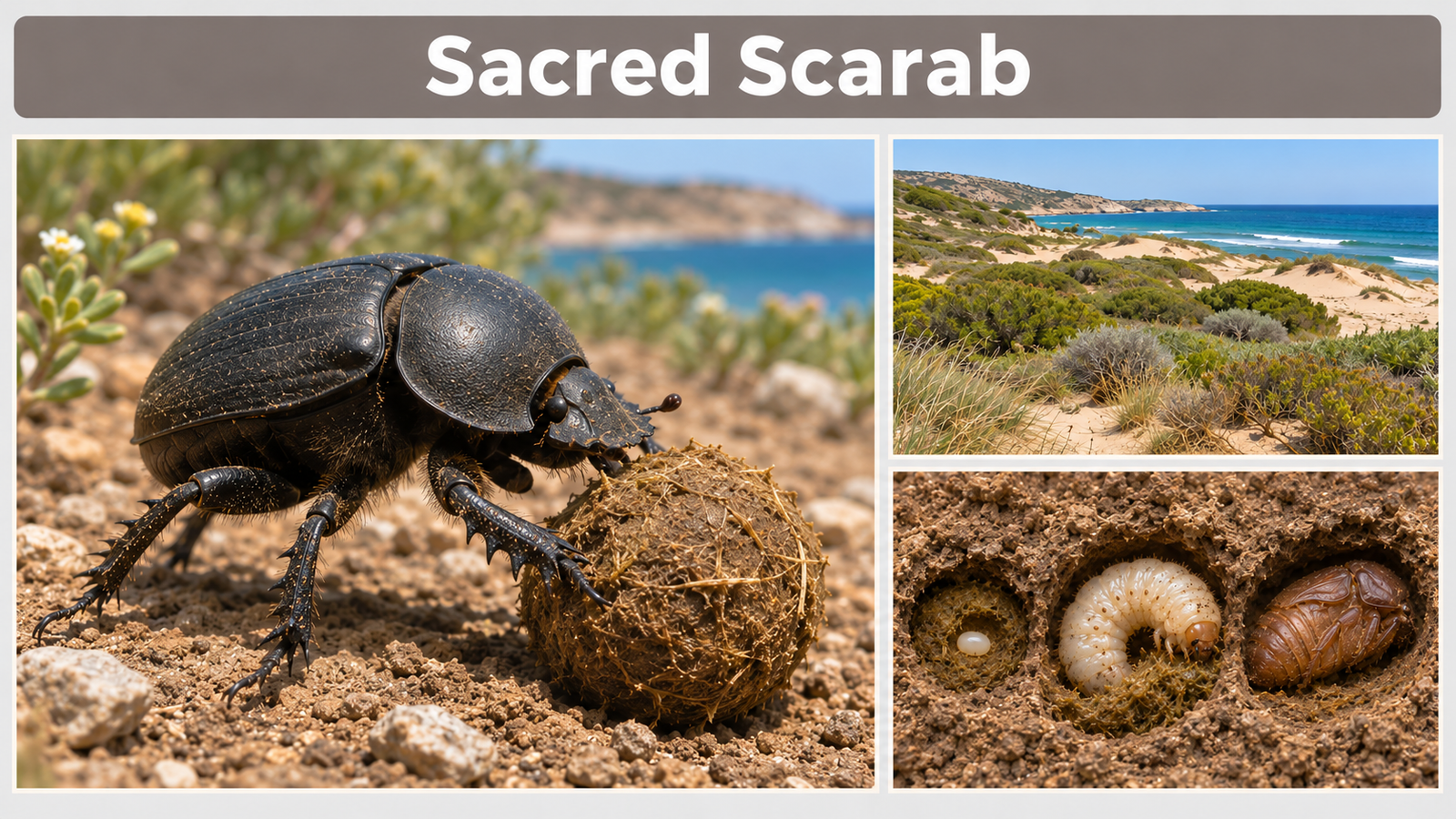
The sacred scarab is a dung beetle best known for rolling balls of animal waste across the ground. Its scientific name is Scarabaeus sacer, and its behavior helped make the beetle a powerful symbol in ancient Egypt. But the real insect is fascinating beyond its history: it uses the sun and other sky cues to navigate, helps recycle nutrients, and raises its young in underground chambers supplied with dung. This guide explains how to identify the sacred scarab, where it lives, what it eats, and why it matters.
What Is a Sacred Scarab?
The sacred scarab, Scarabaeus sacer, is a species of dung beetle in the scarab family, Scarabaeidae. It belongs to the group known as “rollers”: dung beetles that shape dung into a ball, roll it away from where they found it, and bury it. The ball may serve as food for an adult or as a protected supply for developing young.
The name can also refer more broadly to the scarab-shaped amulets used in ancient Egypt. Those objects were modeled on dung beetles, especially S. sacer, but not every Egyptian scarab artifact represents this single species. The living beetle and the carved symbol are related, but they are not the same thing.
Sacred Scarab Identification
An adult sacred scarab has a broad, sturdy body and is usually dark, often black. Its body is covered by hardened forewings called elytra, which protect the delicate flight wings underneath. Like other beetles, it has six jointed legs and a pair of antennae. Its front legs are adapted for digging and shaping dung, while the rear legs help it push a ball backward.
Sacred scarabs are medium-sized dung beetles, but size can vary among individuals and populations. Their robust build and distinctive ball-rolling behavior can help identify them in the field. Still, color and body shape alone may not reliably distinguish them from other dark dung beetles. Accurate identification may require looking at several physical features and considering the beetle’s location.
| Feature | Sacred scarab |
|---|---|
| Scientific name | Scarabaeus sacer |
| Family | Scarabaeidae |
| Group | Dung beetle; ball roller |
| Typical color | Dark brown to black |
| Distinctive behavior | Forms and rolls dung balls |
Sacred Scarab Habitat and Distribution
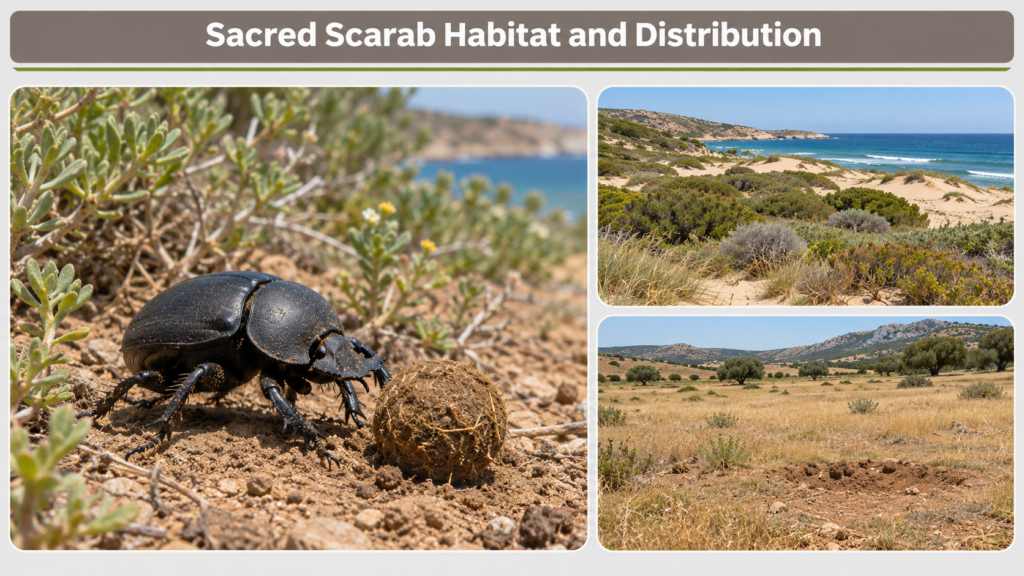
The sacred scarab is found around the Mediterranean region, including parts of southern Europe, North Africa, and western Asia. It occurs in habitats where it can find suitable dung and ground for digging. In some Mediterranean areas, it is associated with coastal landscapes such as dunes and marshes.
A useful habitat needs more than open ground. The beetle depends on access to dung from large herbivores and on soil that it can dig and use to bury food or brood balls. Availability of food, moisture, temperature, and suitable nesting sites can affect where it is active.
Sacred scarabs are adapted to warm environments, but activity can change with local conditions. Temperature matters because a beetle that is active in the heat of the day risks overheating. Research on closely related ball-rolling dung beetles shows that these insects can use environmental cues, including the sun and polarized skylight, to maintain a direction while rolling.
What Does the Sacred Scarab Eat?
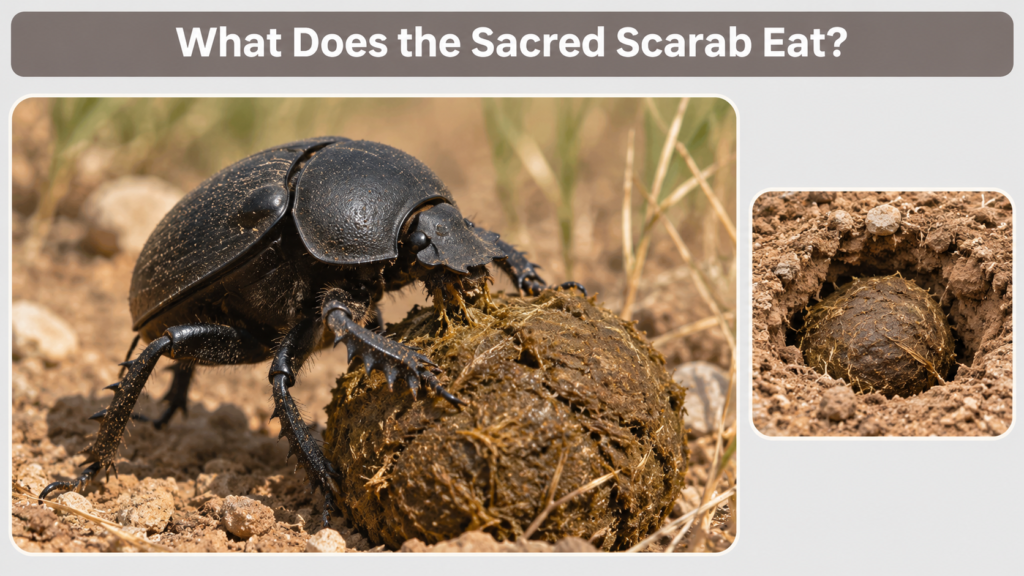
Sacred scarabs feed on dung, especially the soft material in fresh animal waste. To people, dung may seem like an unlikely food source, but it contains nutrients and moisture that beetles can use. Adults use their mouthparts to take in suitable material, and they may also collect dung to carry away from the original deposit.
The beetle’s feeding behavior is closely linked to its breeding. A dung ball can be buried underground and used as a food store for a developing larva. Depending on the beetle’s behavior and reproductive stage, dung may be shaped into a ball for eating or prepared as part of a brood chamber.
Dung beetles help break down animal waste and return nutrients to the soil. By moving dung away from the surface and burying it, they also influence how organic material is distributed in the ground. Their work supports nutrient cycling and can benefit the habitats where they live.
How Does a Sacred Scarab Roll a Dung Ball?
When a beetle finds a suitable dung deposit, it gathers material and shapes it into a rounded ball. It then pushes the ball backward with its hind legs, often moving away from the original food source. The ball can be much larger than the beetle’s head, so rolling it over uneven ground takes strength and coordination.
Moving away quickly may reduce the chance that another dung beetle will take the ball. Once the beetle reaches a suitable location, it can bury the ball. Some balls are food for the adult; others are used to provide nourishment for the next generation.
The route is not random. Ball-rolling dung beetles can use cues in the sky to keep moving in a relatively straight direction. Depending on conditions, those cues may include the sun or patterns of polarized light. If a beetle is diverted by an obstacle, it can reorient and continue along its earlier course.
Sacred Scarab Life Cycle
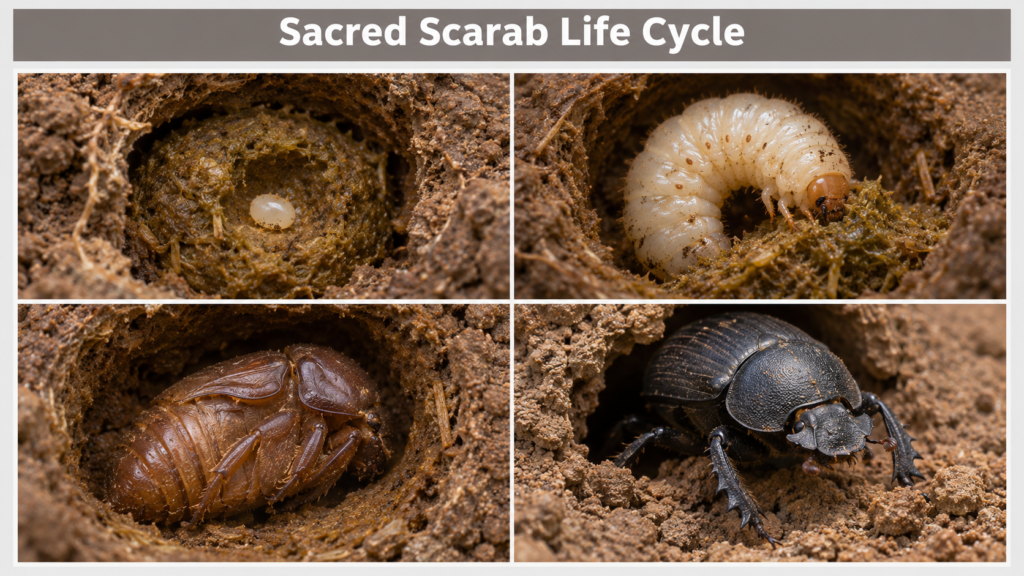
Like other beetles, the sacred scarab undergoes complete metamorphosis, developing through four stages: egg, larva, pupa, and adult.
- Egg: A female lays an egg in or near a prepared dung supply, usually in an underground chamber.
- Larva: The egg hatches into a grub that feeds on the stored dung as it grows.
- Pupa: After the larval stage, the grub changes into a pupa within its protected chamber.
- Adult: The mature beetle emerges from the chamber and eventually searches for food and a mate.
The dung supply is important because it gives the young larva food in a sheltered place. This life cycle helps explain why ancient observers connected the beetle with renewal: a new adult emerges from a chamber hidden beneath the ground. The beetle’s actual reproduction, however, involves eggs and developing larvae rather than adults appearing spontaneously from dung.
Sacred Scarab Behavior
Sacred scarabs are known for pushing dung balls across the ground, but this is only one part of their behavior. They also dig, feed, compete for resources, and search for mates. A buried dung ball can be a valuable resource, so moving it away from other beetles may reduce competition.
Ball rolling also requires orientation. For a beetle, a straight path can be a useful way to leave a crowded dung source without circling back. Studies of ball-rolling dung beetles show that sky cues can help them keep a steady bearing, even when they encounter obstacles. This ability has made dung beetles useful subjects in research on animal navigation.
The beetle’s behavior can look simple at first: find dung, shape a ball, and push it away. In reality, it combines feeding, movement, competition, reproduction, and navigation.
Why Was the Scarab Sacred in Ancient Egypt?
In ancient Egypt, scarab beetles were associated with the sun, renewal, and coming into being. Observers saw beetles rolling dung balls across the ground and compared that movement with the sun traveling across the sky. The beetle was linked with Khepri, a god associated with the rising sun and renewal.
Scarab amulets were made in many forms and used as jewelry, seals, and protective objects. Some were placed with the dead. Heart scarabs, for example, were associated with the deceased’s heart and the journey into the afterlife. The scarab’s symbolic meaning was connected to ideas of protection and rebirth, though the amulets served different purposes depending on their form and inscription.
The connection between the living beetle and ancient beliefs was based partly on observation and partly on religious interpretation. The beetle’s habit of burying dung balls and the later emergence of young beetles made it a compelling image of life returning from the ground. Ancient Egyptians did not have the modern scientific account of insect development, but their scarab imagery became one of the most recognizable symbols of their culture.
Are Sacred Scarabs Harmful?
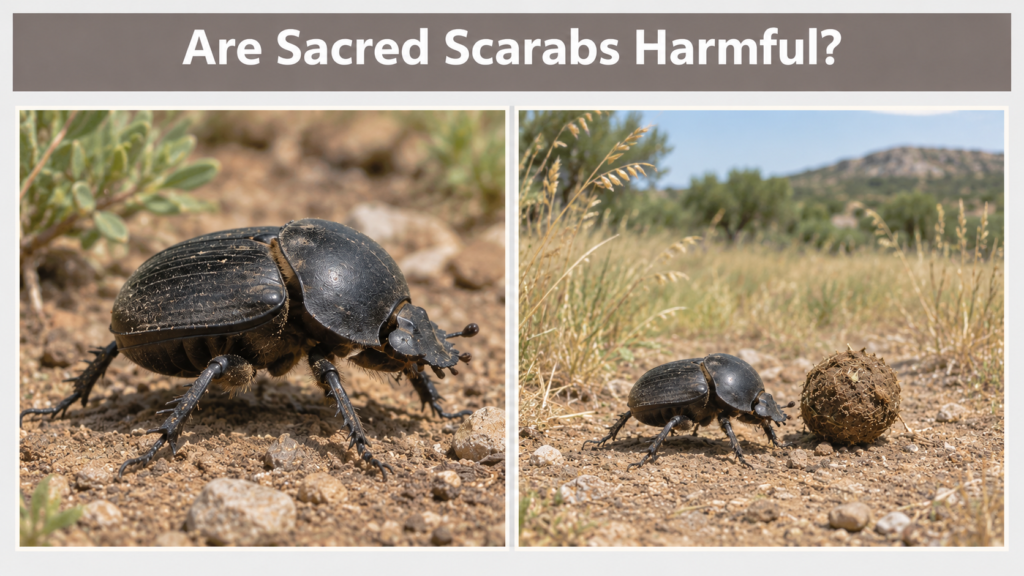
Sacred scarabs are dung-feeding beetles, not pests that attack people or damage household materials. They do not hunt humans, and their characteristic behavior is focused on finding, moving, and burying dung.
As with any wild insect, it is best to observe one without handling it. Picking up or disturbing a beetle can stress it, and its legs are adapted for gripping and digging. If you find one outdoors, leaving it in place allows it to continue its natural behavior.
Why Are Sacred Scarabs Important?
Sacred scarabs are ecologically important because they help process dung. By breaking it up and burying it, they contribute to the movement of nutrients through the soil. Their feeding and nesting behaviors also create activity beneath the ground that affects how organic material is distributed.
They are also important in the study of animal behavior. Their ability to steer while pushing a ball has helped researchers investigate how insects use light and other environmental signals to navigate. At the same time, the beetle’s place in ancient Egyptian art and religion shows how close observation of an animal can shape a culture’s symbols and stories.
FAQs
What is the scientific name of the sacred scarab?
The sacred scarab’s scientific name is Scarabaeus sacer. It is a dung beetle in the family Scarabaeidae and is known for rolling dung balls.
What does a sacred scarab eat?
The sacred scarab feeds on dung, including the softer material in fresh animal waste. Dung can also be collected and buried as food for a developing larva.
Where do sacred scarabs live?
Sacred scarabs occur around the Mediterranean region, including parts of southern Europe, North Africa, and western Asia. They live where they can find dung and suitable ground for digging and burying food.
Why do sacred scarabs roll dung balls?
A dung ball can carry food away from a crowded deposit. Once buried, it may be eaten by an adult or used to feed a developing larva, depending on how it is prepared.
Why did ancient Egyptians associate scarabs with the sun?
The beetle’s rolling behavior was compared with the sun’s movement across the sky. Ancient Egyptians associated scarabs with Khepri, a god connected with the rising sun, renewal, and coming into being.