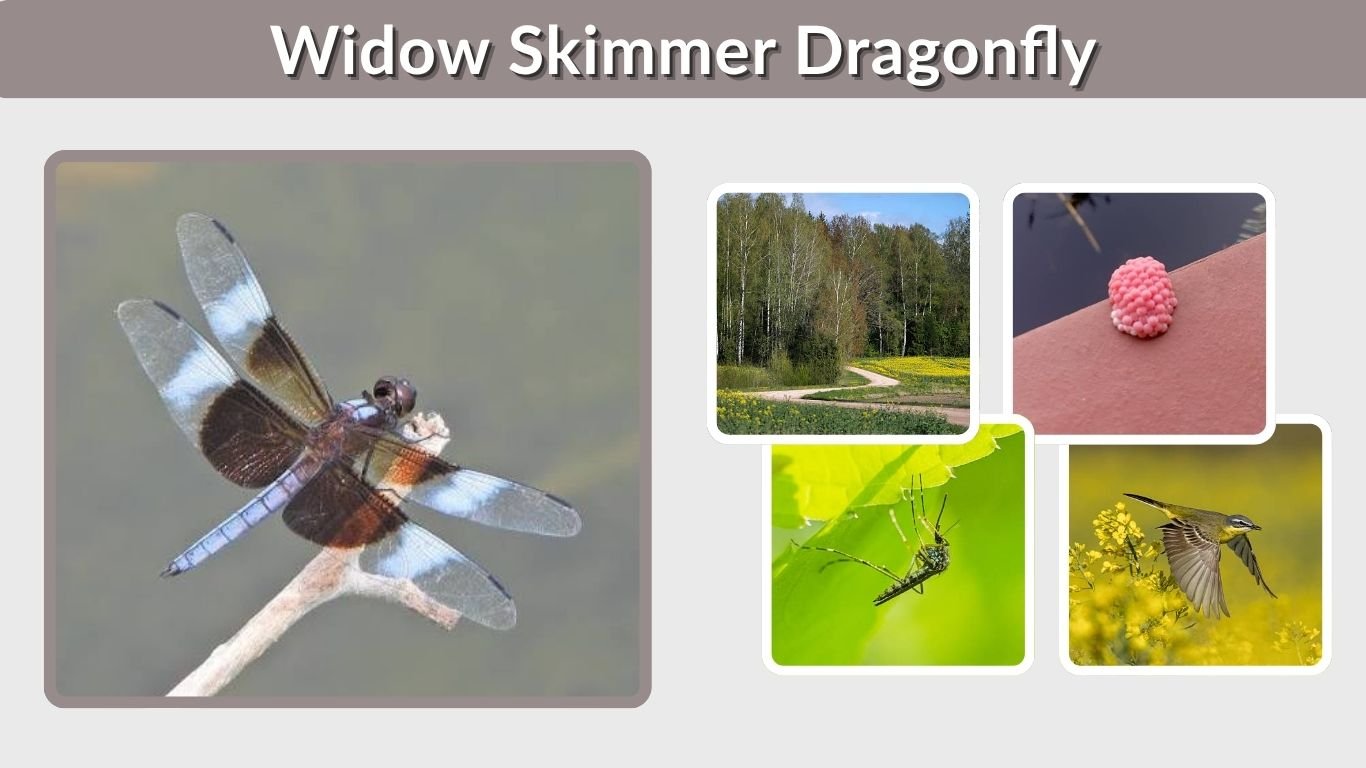
The widow skimmer (Libellula luctuosa) is a striking North American dragonfly known for broad dark patches across the bases of all four wings. Mature males become especially distinctive, developing powdery blue-white bodies and white patches on their wings, while females retain brown, black, and yellow markings. Widow skimmers are commonly seen around ponds, lakes, marshes, and slow-moving streams, although adults may wander far from water. These aerial predators spend warm days catching mosquitoes, flies, and other flying insects.
What Is a Widow Skimmer?
The widow skimmer is a true dragonfly in the family Libellulidae, commonly called the skimmers. Its scientific name is Libellula luctuosa. Adults are medium-to-large dragonflies, typically measuring about 42–50 mm (1.7–2 inches) from head to abdomen. The species occurs across much of North America, extending south into Mexico.
Quick Facts
- Scientific name: Libellula luctuosa
- Family: Libellulidae
- Length: About 42–50 mm
- Hindwing length: About 38–40 mm
- Diet: Flying insects
- Habitat: Ponds, lakes, marshes, and slow streams
- Young stage: Aquatic nymph or naiad
- Main season: Mostly late spring through summer
- Range: Much of the United States, parts of Canada, and Mexico
Ohio wildlife guidance describes the species as a large skimmer associated with ponds and wetlands and identifies its broad dark basal wing band as a particularly useful field mark.
Widow Skimmer Identification
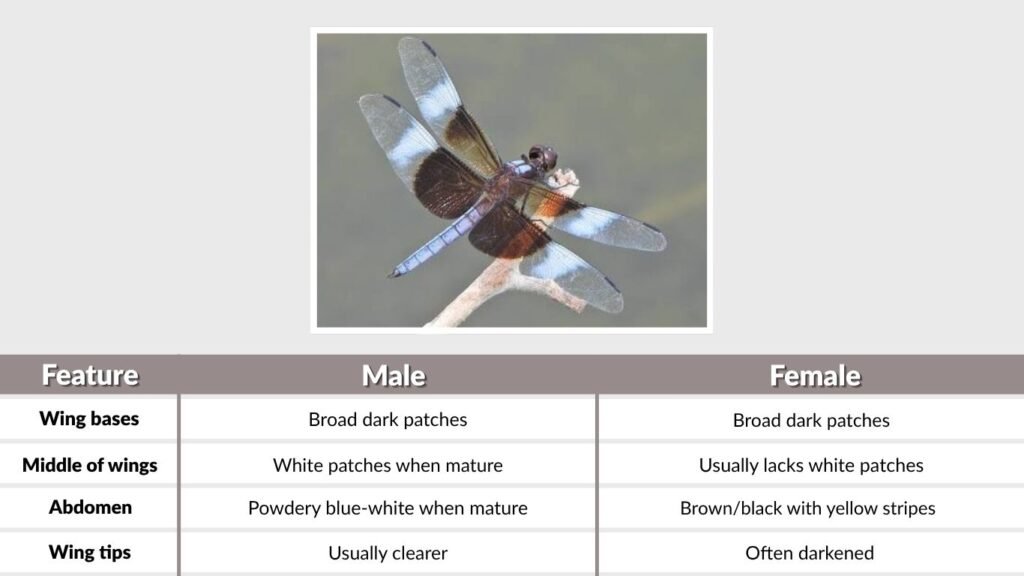
The easiest way to recognize a widow skimmer is by examining its wings. Both sexes have large dark brown or blackish patches covering the basal portions of the forewings and hindwings. Mature males add conspicuous white patches beyond the dark sections, producing a dramatic black-and-white wing pattern.
Male Widow Skimmer
A mature male widow skimmer is usually the most colorful form. His abdomen develops a powdery pale blue or whitish coating known as pruinosity. The front of the thorax can also appear frosted.
The wings have dark basal patches followed by broad whitish areas farther outward. Younger males are more difficult to recognize because they initially resemble females, with yellow markings still visible on the abdomen. The blue-white coating becomes stronger as males mature.
Female Widow Skimmer
Female widow skimmers do not develop the large white wing patches characteristic of mature males. Their wings still have the broad brown patches at the bases and often have brown or darkened tips.
Viewed from above, the female abdomen typically has a dark central stripe bordered by yellow or golden stripes. The combination of yellow abdominal markings and dark patterned wings distinguishes females from mature powdery-blue males.
Male vs. Female Widow Skimmer
| Feature | Male | Female |
| Wing bases | Broad dark patches | Broad dark patches |
| Middle of wings | White patches when mature | Usually lacks white patches |
| Abdomen | Powdery blue-white when mature | Brown/black with yellow stripes |
| Wing tips | Usually clearer | Often darkened |
| Immature appearance | Initially female-like | Keeps yellow/brown pattern |
The difference becomes easiest to see once a male has fully matured. Immature males may retain yellow abdominal stripes even after white areas begin appearing on their wings.
Why Is It Called a Widow Skimmer?
The name sounds ominous, but it does not mean that the female routinely kills her mate.
The scientific name luctuosa relates to mourning or sorrow. The broad dark patches at the bases of the wings have traditionally been compared to dark mourning cloth or mourning garments, which helps explain the name “widow skimmer.”
There has also been an alternative explanation involving females laying eggs without males remaining closely attached to them, but the mourning-cloth explanation is the more straightforward interpretation of the species and common names.
Widow Skimmer Habitat and Range
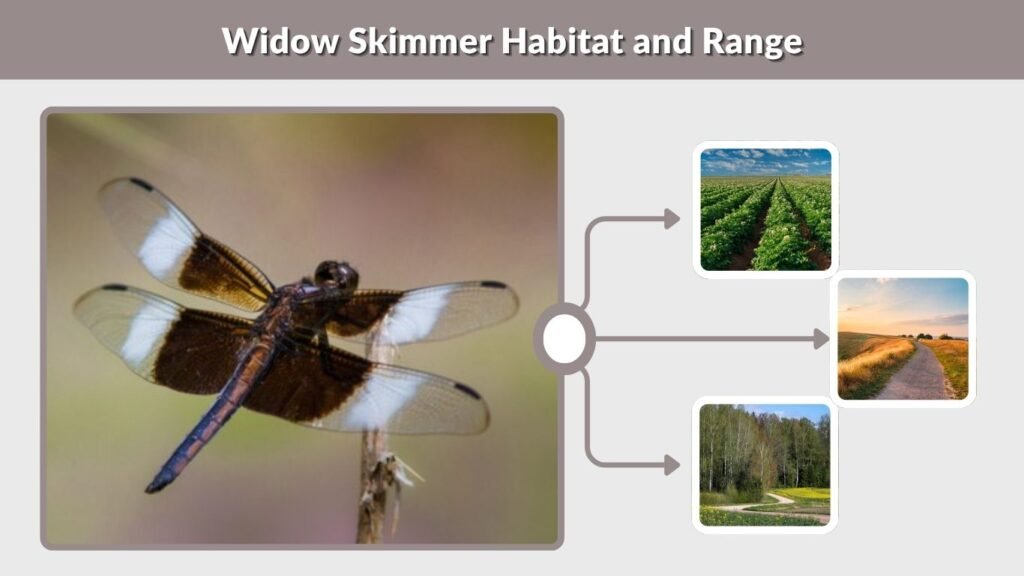
Widow skimmers are strongly associated with freshwater environments but are not restricted to the immediate shoreline. Adults can travel into fields, woodland edges, roadsides, and other open habitats while feeding.
Where Do Widow Skimmers Live?
Breeding habitat includes ponds, lakes, marshes, slow streams, and quiet portions of rivers and creeks. Aquatic vegetation and shallow water provide important habitat for developing nymphs. Adults frequently perch on grass stems, reeds, twigs, and other exposed vegetation near these areas.
Widow Skimmer Range
The species occurs across most of the United States but is less widespread through the Rocky Mountain region. Its distribution reaches south into Mexico and north into parts of Canada, including Manitoba, Ontario, Quebec, and Nova Scotia.
This broad distribution explains sightings from places such as Wisconsin, Texas, Missouri, Ohio, and many other states.
What Do Widow Skimmers Eat?

Adult widow skimmers are aerial predators. They use their excellent eyesight and maneuverability to detect and capture insects while flying.
Their prey consists primarily of small flying insects, including mosquitoes, flies, gnats, small moths, and other insects they can overpower in flight. BugGuide lists flying insects as their primary food.
Widow skimmers often hunt from a perch. An adult may sit on a grass stem, suddenly launch after passing prey, capture it, and then return to a perch. Observers also frequently see males flying patrols while defending breeding areas.
Widow Skimmer Life Cycle

Like all dragonflies, the widow skimmer undergoes incomplete metamorphosis. There is no caterpillar-like larval stage or pupa. Instead, the young develop underwater as predatory nymphs before emerging as winged adults.
Eggs and Reproduction
During breeding, males patrol areas around suitable water and interact with females entering their territories. After mating, females deposit eggs directly into the water.
A female commonly flies low over the surface and repeatedly dips or strikes the tip of her abdomen against the water, releasing eggs. Males may hover nearby while this happens, although females are not always closely guarded.
Widow Skimmer Nymph
After hatching, young widow skimmers live underwater as nymphs, also traditionally called naiads. They inhabit ponds, lakes, and slower sections of streams.
Dragonfly nymphs are predators themselves. They remain underwater, feed, molt, and gradually become larger. When development is complete, a nymph leaves the water and climbs onto vegetation or another surface.
Its outer skin splits, and the adult dragonfly emerges. The new adult expands and hardens its wings before flying away.
Young Adults
Newly emerged widow skimmers may leave the water and spend time feeding in fields and woodland edges while their bodies mature. Missouri conservation information notes that newly emerged adults can spend roughly two weeks feeding and maturing before returning to aquatic breeding areas.
Young males initially resemble females but eventually develop their characteristic pale blue-white coating and white wing markings.
Widow Skimmer Behavior
Widow skimmers are strong, agile flyers but are also well known for perching. They frequently rest on upright grasses or exposed stems, which can make them easier to photograph than constantly flying dragonflies.
Males may defend territories around breeding water and chase competing dragonflies away. When prey flies nearby, a perched widow skimmer can rapidly launch, capture the insect, and return to vegetation.
Their four powerful wings can move independently enough to provide impressive control during hovering, turning, pursuing prey, and avoiding predators.
Predators and Ecological Role

Widow skimmers occupy both predator and prey roles in wetland food webs. Adults reduce populations of numerous flying insects, while their aquatic nymphs consume small aquatic animals.
Adult dragonflies can themselves become food for birds, frogs, larger dragonflies, spiders, and other predators. Aquatic nymphs may be eaten by fish, amphibians, and larger aquatic predators.
Because both life stages are predatory, widow skimmers help transfer energy between aquatic and terrestrial ecosystems.
Widow Skimmer Spiritual Meaning
There is no scientifically established spiritual meaning specific to the widow skimmer. Symbolic interpretations belong to personal or cultural traditions rather than biology.
Dragonflies more generally are sometimes associated with change, transformation, adaptability, and renewal because of their dramatic transition from aquatic nymphs to aerial adults. Seeing a widow skimmer can therefore be given a symbolic meaning by an individual, but such interpretations should be distinguished from scientific facts about the species.
FAQs
Is a widow skimmer a dragonfly?
Yes. The widow skimmer (Libellula luctuosa) is a dragonfly belonging to the skimmer family Libellulidae.
How big is a widow skimmer?
Adults generally measure about 42–50 mm, or 1.7–2 inches, in body length.
How can you tell a male widow skimmer from a female?
Mature males develop pale blue-white abdomens and white patches on their wings. Females lack the large white wing patches and usually have a dark abdomen bordered by yellow or golden stripes.
What does a widow skimmer eat?
Adults mainly eat flying insects, including flies, mosquitoes, gnats, and other small insects. Their aquatic nymphs are also predators.
How did the widow skimmer get its name?
The dark patches on its wings have been compared with dark mourning clothing or draped mourning cloth. The scientific name luctuosa also carries the sense of mourning or sorrow.