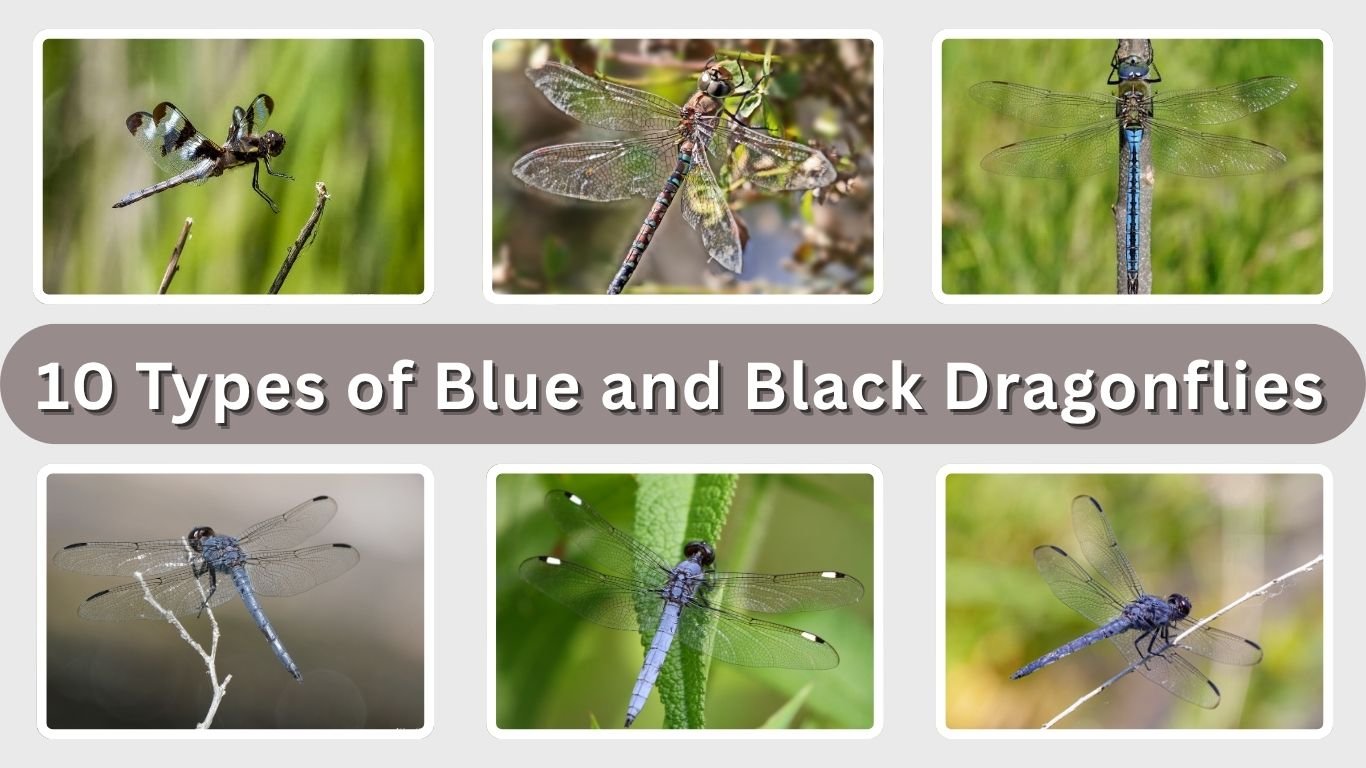
Blue and black dragonflies stand out around ponds, lakes, and wetlands, but their colors do not identify a single species. Some have powder-blue bodies and dark tails, while others display bold wing patches or blue spots along the abdomen. Males, females, and immature individuals can also look surprisingly different. This guide introduces ten blue-and-black dragonflies, explaining their identifying features, habitats, behavior, and life cycles. Learn which details separate similar species and why location matters when identifying the dragonfly you have spotted.
1. Widow Skimmer
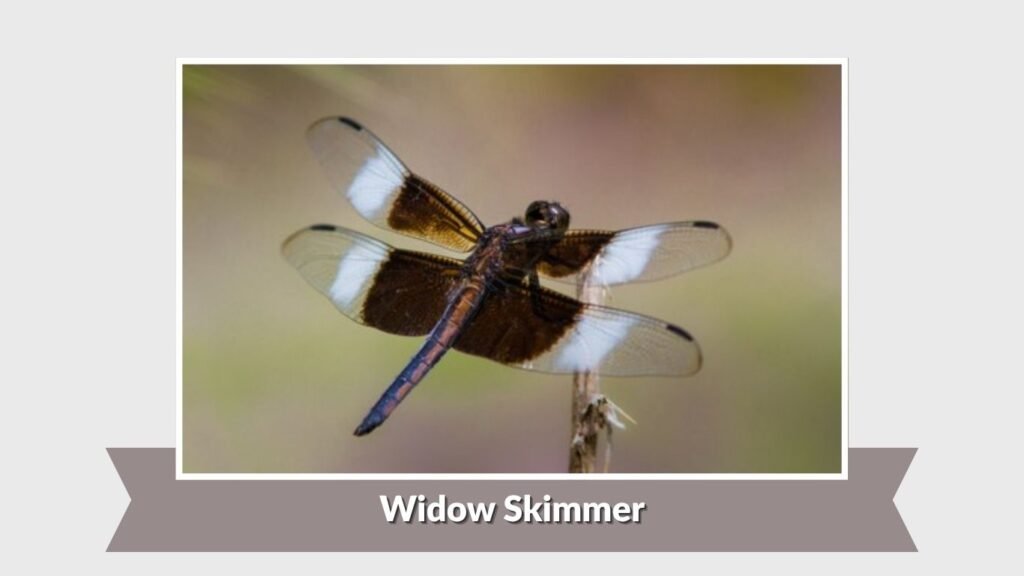
The widow skimmer is a striking blue-and-black dragonfly recognized by its boldly patterned wings. Mature males combine a pale blue abdomen with broad dark wing patches and contrasting white areas. If you notice a light blue dragonfly with black-and-white wings near a North American pond, this species is worth considering.
Identification
- Scientific name: Libellula luctuosa
- Family: Libellulidae
- Body length: Approximately 1.7–2 inches
- Male coloration: Pale blue abdomen with a powdery whitish coating
- Wing pattern: Broad dark patches near the body; mature males also develop white patches
- Female coloration: Brownish body with yellow abdominal stripes and dark wing markings
The dark areas cover only part of each wing, rather than making the wings entirely black. Females and immature males lack the mature male’s conspicuous white wing patches.
Habitat and Distribution
Widow skimmers occur across much of the United States and parts of southern Canada. They inhabit ponds, lakes, marshes, and some slow-moving streams. Adults also visit nearby grasslands and open areas, so sightings away from water are possible.
Behavior and Diet
Males defend waterside territories and chase competing dragonflies. They hunt flying insects, capturing prey during short flights or longer patrols. Their menu includes small flies and other appropriately sized insects.
Females approach breeding sites to mate and lay eggs. A male may remain nearby while a female deposits her eggs into the water.
Life Cycle and Seasonal Activity
The larvae develop underwater, feeding and molting before emerging as winged adults. Newly emerged males do not immediately display the full blue-and-white appearance.
Flight seasons vary geographically. In Wisconsin, adults are generally recorded from early June through late August; warmer regions can have longer seasons. These dates describe population activity, not the lifespan of one individual.
2. Blue Dasher
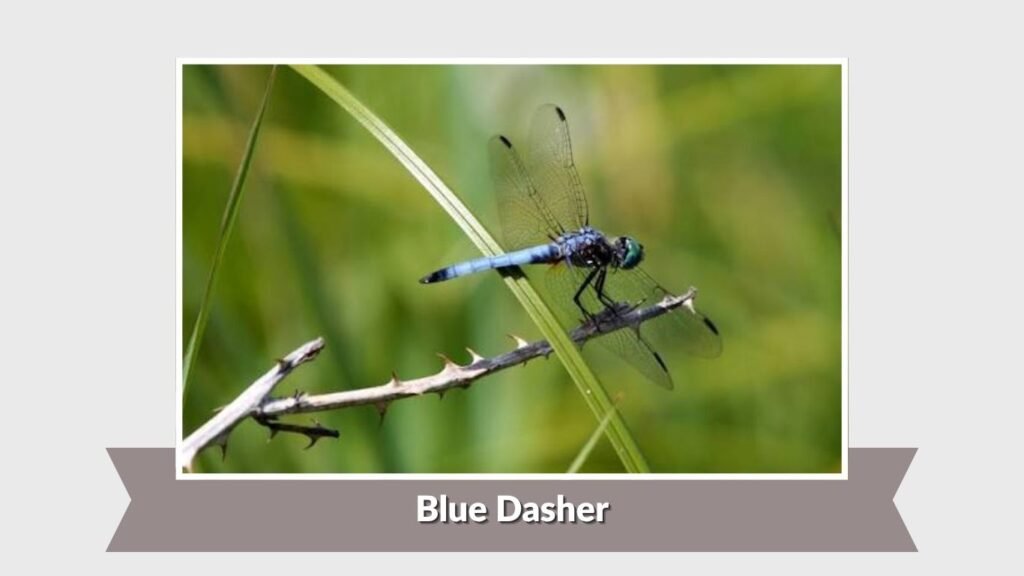
The blue dasher is a small dragonfly with a powder-blue abdomen, contrasting dark tip, and brightly colored eyes. Its black-and-yellow thorax adds another useful identification feature. Although mature males appear predominantly blue, females and young individuals look different enough to confuse beginning dragonfly watchers.
Identification
- Scientific name: Pachydiplax longipennis
- Family: Libellulidae
- Body length: Approximately 1–1.8 inches
- Male abdomen: Powder blue with a dark tip
- Face and eyes: White face with turquoise or greenish eyes
- Thorax: Slanted black-and-yellow stripes
- Female abdomen: Dark with paired yellow markings
The wings are mostly transparent, sometimes with amber coloring near their bases. A blue dragonfly with completely black wings is therefore unlikely to be a typical blue dasher.
Habitat and Distribution
Blue dashers are widespread in North America. They favor ponds, marshes, lake margins, and other calm waters with vegetation.
Emergent stems provide convenient lookout points. A sunny pond with abundant shoreline plants is a useful place to search, especially when small insects are active.
Behavior and Diet
Males defend perches and nearby breeding areas, making quick flights to investigate intruders or capture prey. They eat small flying insects rather than feeding on flowers.
On hot days, a perched individual may raise its abdomen toward the sun. This “obelisk posture” can reduce the body surface exposed to direct sunlight.
Life Cycle and Seasonal Activity
Females release eggs into water, where the larvae become aquatic predators. After repeated molts, mature larvae leave the water for their final transformation.
The blue coloration develops as males mature. Consequently, a brown-and-yellow individual near a blue male may be a female or an immature male rather than a different species.
3. Black-tailed Skimmer
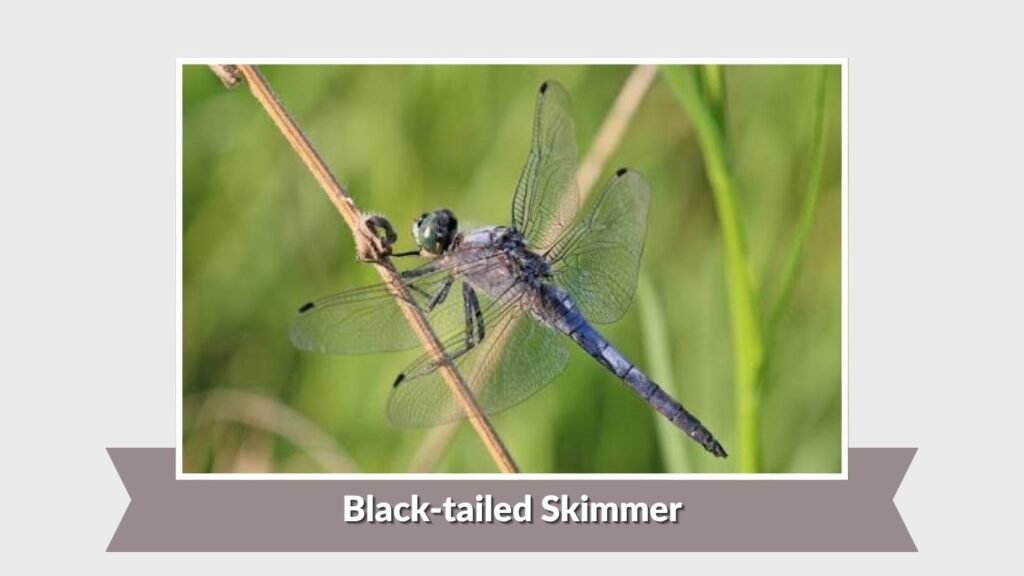
The black-tailed skimmer is a recognizable blue-and-black dragonfly in the UK and elsewhere in its range. Mature males have a powder-blue abdomen that becomes black toward the rear. Unlike widow skimmers, they have largely clear wings, making the position of the dark markings especially important.
Identification
- Scientific name: Orthetrum cancellatum
- Family: Libellulidae
- Body length: Approximately 44–49 millimeters
- Male abdomen: Blue with black terminal segments
- Eyes: Green in mature males
- Wings: Mostly clear, with dark pterostigmata near the tips
- Females and young males: Yellowish abdomen with a dark ladder-like pattern
The abdomen narrows toward its tip. Its dark rear section helps distinguish mature males from similar blue skimmers.
Habitat and Distribution
This species is a familiar sight in parts of Britain and continental Europe. It favors lakes, ponds, slow rivers, and open waters with bare shoreline patches.
Exposed mud, gravel, and sunlit banks are particularly useful observation spots because males often settle directly on the ground.
Behavior and Diet
Black-tailed skimmers fly rapidly and low over the water. Males patrol breeding areas and return to sunny resting places between flights.
Adults capture small insects in flight. Their hunting and territorial behavior make them active around pond margins, but they are not aggressive toward people watching from a distance.
Life Cycle and Seasonal Activity
Eggs develop into aquatic larvae that hunt below the surface. When ready to emerge, larvae climb onto a suitable support and shed their final larval skin.
The newly emerged adult is initially soft and pale. Its wings harden before sustained flight, and males acquire their mature blue appearance later. There is no pupal stage between larva and adult.
4. Slaty Skimmer
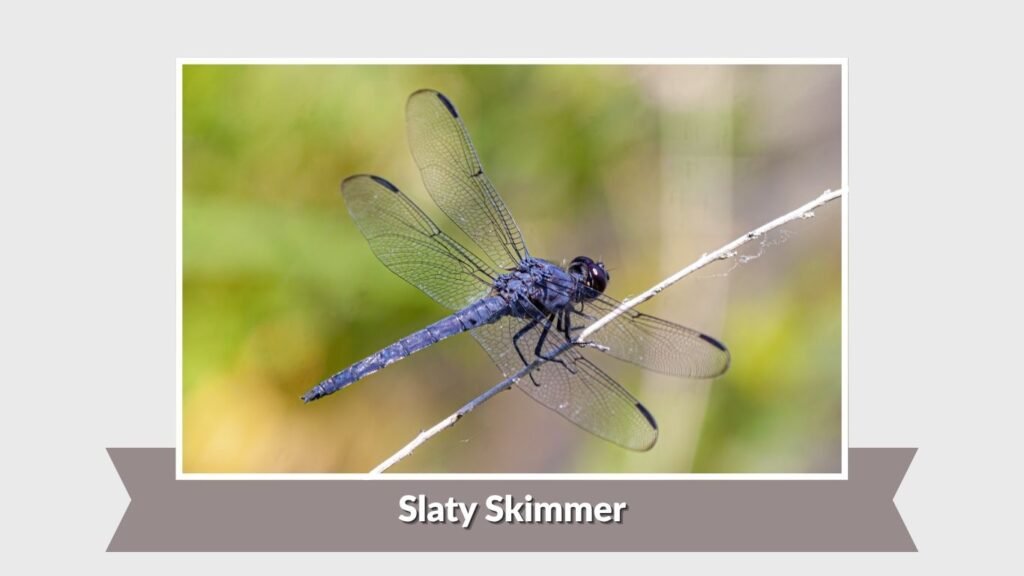
The slaty skimmer is a dark blue dragonfly with a black head and mostly clear wings. Mature males have a relatively uniform slate-blue appearance, without the bright white face of a blue dasher. In dim light, their deep coloration can make them look almost entirely black.
Identification
- Scientific name: Libellula incesta
- Family: Libellulidae
- Body length: Approximately 2 inches
- Male coloration: Dark slate-blue body with a black face
- Eyes: Dark brown
- Wings: Mostly transparent, with dark pterostigmata
- Females and young males: Brown or yellowish bodies with dark abdominal markings
The combination of a dark face and dark blue body is useful, but photographs should still be checked against similar local skimmers.
Habitat and Distribution
Slaty skimmers inhabit the eastern United States and southeastern Canada. They favor quiet waters with muddy or organic bottoms, often near woodland.
Suitable habitats include ponds, lakes, marshy margins, and slow-moving waterways. In northern areas, they may also occur around bog lakes.
Behavior and Diet
Males perch near shore and defend small territories. From these positions, they launch flights to pursue prey, challenge rivals, or investigate females.
Slaty skimmers are capable predators of other insects, including smaller dragonflies. Their presence is therefore part of a broader wetland food web rather than evidence that they feed exclusively on mosquitoes.
Life Cycle and Seasonal Activity
Females deposit eggs at aquatic breeding sites, sometimes while males guard nearby. Larvae live and feed underwater before emerging.
In the northern part of their range, adults generally fly from early June into early September. Southern populations can have a longer season. Mature males gradually develop their characteristic dark coloration.
5. Blue Corporal
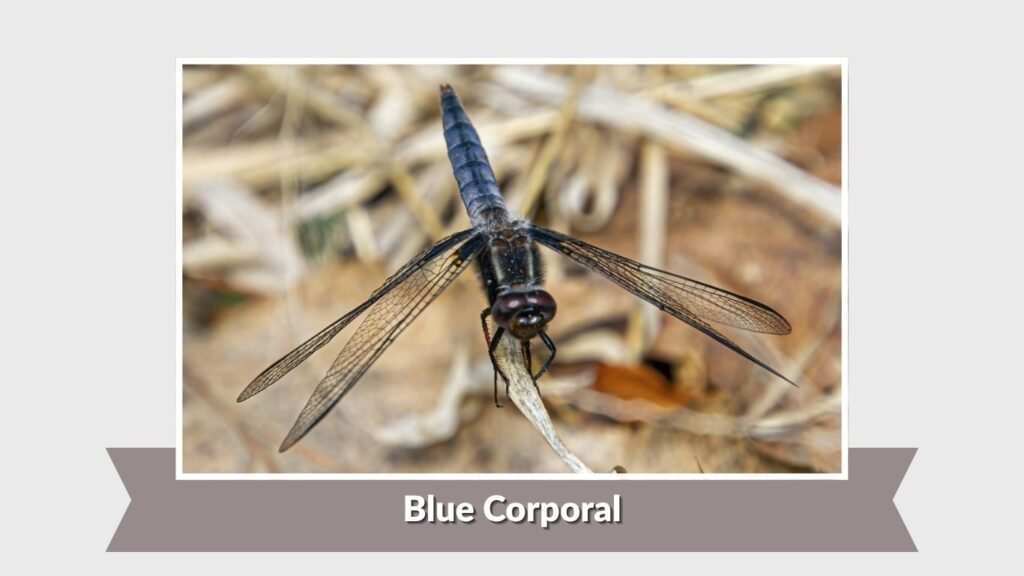
The blue corporal is a compact blue-and-black dragonfly often seen resting close to the ground. Mature males have dusty blue coloration, dark faces, and small dark streaks at the wing bases. These markings distinguish it from dragonflies with broad black wing bands or entirely dark wings.
Identification
- Scientific name: Ladona deplanata
- Family: Libellulidae
- Build: Small, relatively broad-bodied skimmer
- Male coloration: Dusty blue abdomen and parts of the thorax
- Head: Black face with dark brown eyes
- Wings: Mostly clear with dark basal streaks
- Female coloration: Brown with pale thoracic stripes and dark abdominal markings
The contrasting thoracic stripes visible in females and immature individuals are associated with its “corporal” name.
Habitat and Distribution
Blue corporals occur in the eastern United States, with their range extending westward into Texas. They use ponds, lakes, slow streams, and some open ditches.
Sunny shoreline areas, clearings, and waters near woodland provide opportunities to observe them. Local abundance varies considerably.
Behavior and Diet
Unlike dragonflies that usually perch high on vegetation, blue corporals frequently rest on bare ground, logs, paths, or low surfaces. Males patrol close to the water with fluttering flights and occasional hovering.
They capture small insects and chase rival males. Females lay eggs by tapping the water with the abdomen, sometimes with a male guarding nearby.
Life Cycle and Seasonal Activity
The immature stages develop underwater before adults emerge. Blue corporals are notable early-season dragonflies in many areas.
In Missouri, adults are associated mainly with March through May. Their timing changes with latitude and local conditions, so this spring window should not be applied to their entire range.
6. Spangled Skimmer
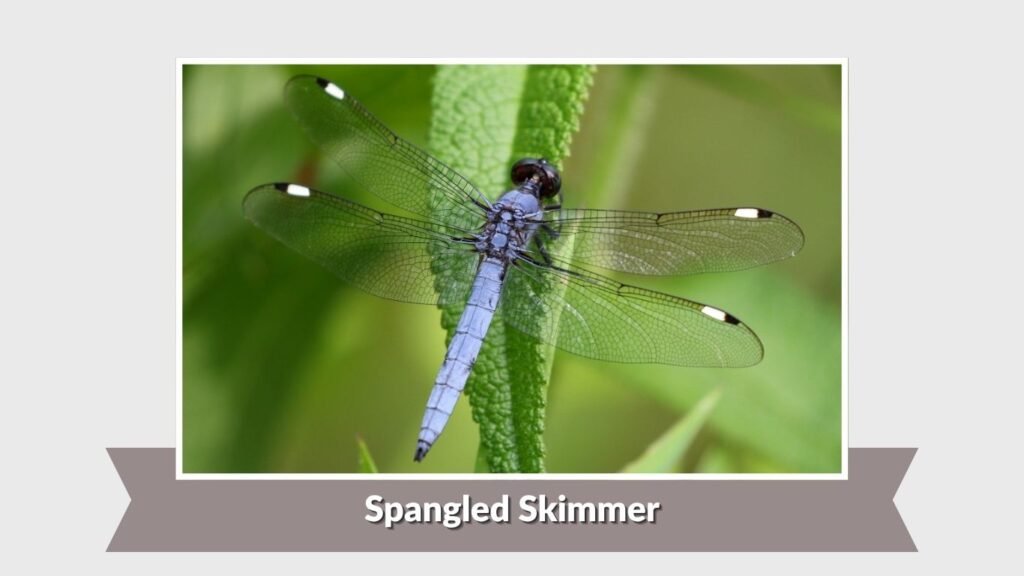
The spangled skimmer is a blue-and-black dragonfly with small but distinctive wing markings. Mature males have blue bodies and dark heads, while each wing carries neighboring white and dark marks near its outer leading edge. These tiny “spangles” help distinguish it from similar blue skimmers.
Identification
- Scientific name: Libellula cyanea
- Family: Libellulidae
- Body length: Approximately 2 inches
- Male coloration: Blue thorax and abdomen with a dark head
- Wing markings: Adjacent white and dark marks near the outer leading edge
- Female coloration: Brown with yellow abdominal stripes and darker wingtips
Unlike a widow skimmer, this species does not have broad black-and-white bands across its wings. Examine the small outer wing markings instead.
Habitat and Distribution
Spangled skimmers occur in the eastern United States. They inhabit ponds, lakes, marshy pools, and slow streams, often where cattails, water lilies, or other aquatic plants grow.
Adults also visit nearby woodland openings and meadows. Their distribution is uneven, so a species common in one region may be uncommon elsewhere.
Behavior and Diet
Males alternate between patrolling the shoreline and resting on vegetation. These perches provide lookout points for finding females, detecting rivals, and spotting prey.
Adults capture small flying insects. Like other dragonflies, they are predators rather than nectar feeders.
Life Cycle and Seasonal Activity
Females release eggs at aquatic breeding sites. The larvae feed underwater and grow through repeated molts before emerging as adults.
Flight seasons vary geographically. Illinois records emphasize June and July, but this should not be treated as the species’ complete flight period everywhere.
7. Twelve-spotted Skimmer
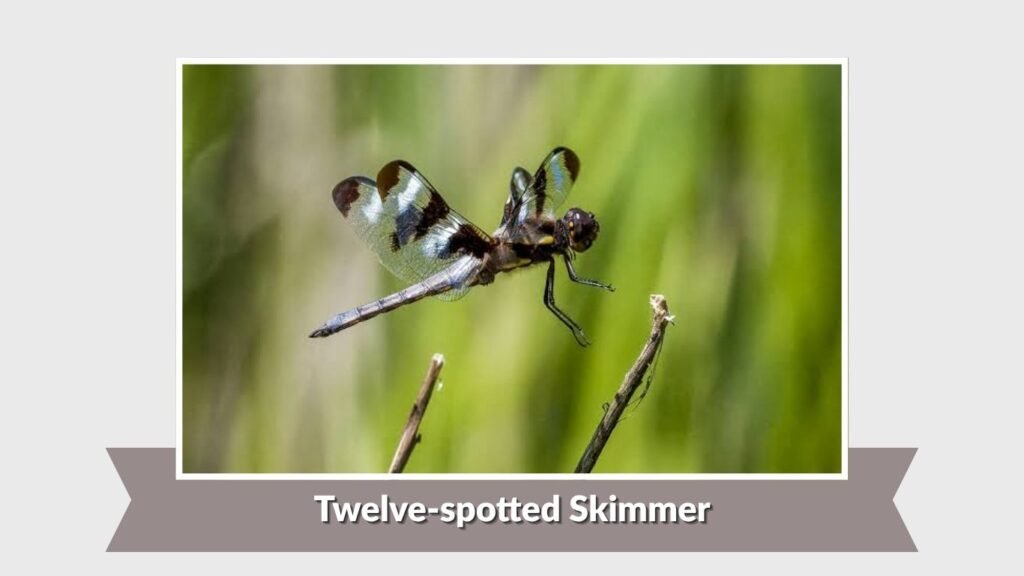
The twelve-spotted skimmer combines patterned wings with a body that can become pale blue-gray in mature males. Its alternating dark and white wing patches create a striking appearance in flight. For a large black, white, and blue dragonfly, the arrangement of these spots is especially useful.
Identification
- Scientific name: Libellula pulchella
- Family: Libellulidae
- Body length: Approximately 2 inches
- Dark wing spots: Three on each wing, totaling twelve
- Mature male wings: Usually eight additional white patches
- Male body: Whitish to pale blue-gray as the surface coating develops
- Females: Brownish bodies with yellow side stripes, generally lacking white wing patches
The species name counts the dark spots, not every visible marking.
Habitat and Distribution
This species is widespread across the United States and southern Canada. It occurs around ponds, marshy lakes, bogs, and slow streams.
Adults also hunt in fields and prairies away from breeding water. A sighting over a lawn or meadow does not necessarily mean a pond is immediately nearby.
Behavior and Diet
Males defend waterside territories and frequently perch on twigs or shrubs. They pursue flying insects and may chase other male dragonflies approaching their territory.
Their patterned wings remain visible when resting, making perched individuals easier to identify than fast-moving ones.
Life Cycle and Seasonal Activity
Aquatic larvae eventually climb out of the water and emerge as adults. Young males initially resemble females before developing the pale body coating and mature wing coloration.
In Wisconsin, the recorded flight season extends from late May to early September. An individual adult lives for only part of that period.
8. Great Blue Skimmer
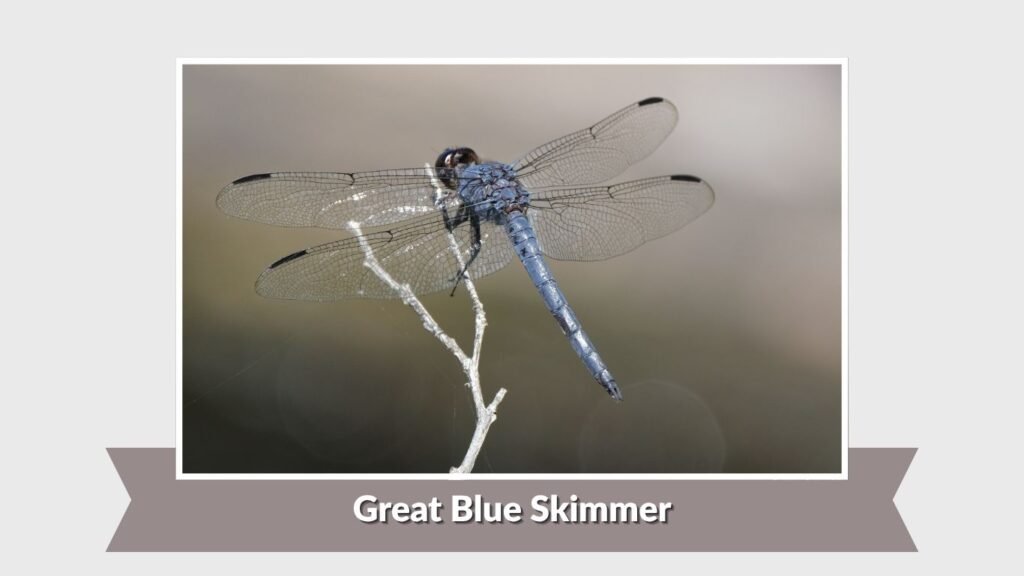
The great blue skimmer is a substantial dragonfly with a powder-blue body and conspicuously pale face. Dark wing markings provide additional contrast, although the wings are not entirely black. Its size and facial coloration help separate it from smaller blue dashers and darker-faced slaty skimmers.
Identification
- Scientific name: Libellula vibrans
- Family: Libellulidae
- Body length: Up to approximately 2.5 inches
- Mature male coloration: Powder-blue thorax and abdomen
- Face: Whitish
- Wings: Mostly clear, with dark markings near the tips and nodes
- Young individuals: Yellowish or brownish with dark abdominal markings
The nodes are small bends along the leading wing edges. Look at the face, body size, and wing pattern together rather than relying on blue coloration alone.
Habitat and Distribution
Great blue skimmers inhabit the eastern United States, especially southeastern regions. They favor swamp pools, woodland ponds, and slow forest streams.
Individuals sometimes wander north beyond their usual breeding areas. Such sightings do not automatically establish a permanent local population.
Behavior and Diet
Adults perch around wetland edges and make flights to capture passing insects. Males defend breeding areas, while females visit suitable water to lay eggs.
These are capable insect predators, but their presence should not be interpreted as a guarantee of mosquito control.
Life Cycle and Seasonal Activity
The larvae develop underwater before climbing onto vegetation or another support to emerge. Newly emerged males do not immediately display their mature powder-blue appearance.
In northern parts of the range, adults are generally recorded from early June through early September. Local weather influences activity.
9. Blue-eyed Darner
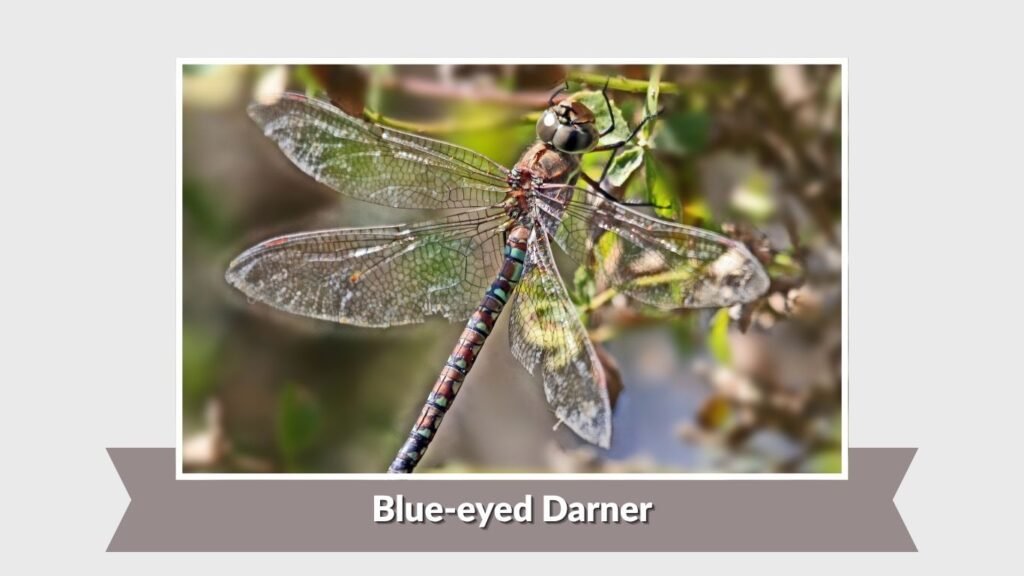
The blue-eyed darner is a large, patterned blue-and-black dragonfly rather than an evenly powder-blue skimmer. Mature males have vivid blue eyes and faces, with blue markings along the abdomen. Similar-looking darners exist, so the eye color is an important clue but not a complete identification.
Identification
- Scientific name: Rhionaeschna multicolor
- Family: Aeshnidae
- Build: Large, long-bodied darner
- Male eyes and face: Bright blue
- Abdomen: Dark background with blue spots
- Thorax: Pale blue side stripes
- Female coloration: Blue and green forms occur
The closely related spatterdock darner can look very similar. Reliable separation may require expert examination of abdominal appendages and other small features.
Habitat and Distribution
This is primarily a western North American species, making it relevant to blue-and-black dragonfly sightings in California. It also occurs farther east in parts of the continent.
Breeding habitats include ponds, lakes, and slow streams with emergent or floating vegetation.
Behavior and Diet
Adults patrol over open water and fields, often following irregular flight paths. They capture flying insects rather than waiting exclusively on a fixed perch.
Their speed can make identification difficult. A sharp photograph of a resting individual is more useful than a brief glimpse of blue eyes.
Life Cycle and Seasonal Activity
The larval stage is aquatic. After emergence, adults mature before returning to breeding habitats.
The Wisconsin Odonata Survey reports peak activity from early June through mid-August, with some later individuals continuing into autumn. Timing differs elsewhere in the range.
10. Emperor Dragonfly
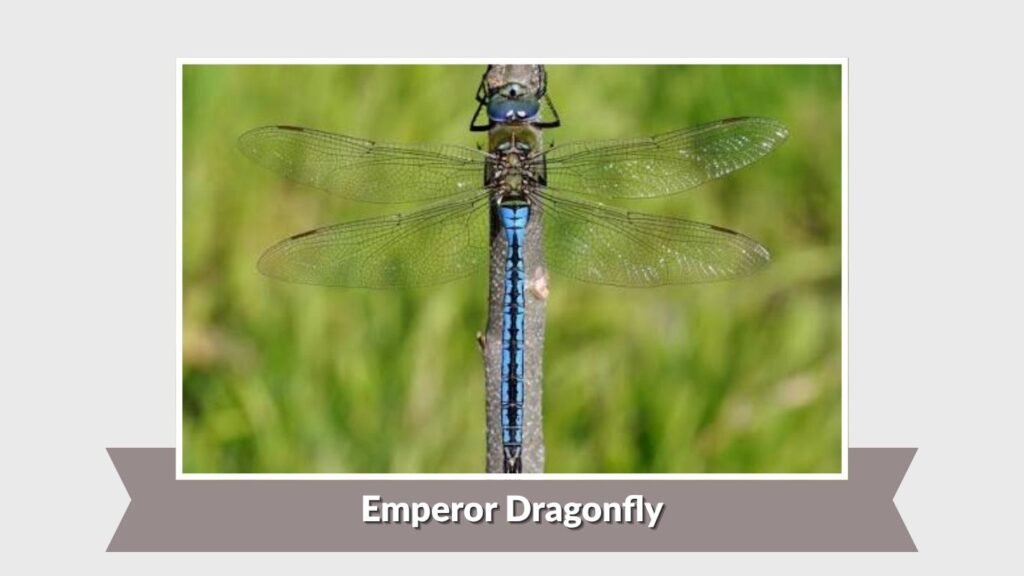
The emperor dragonfly combines a green thorax with a bright blue abdomen and dark central stripe in mature males. Also called the blue emperor, it is a prominent large blue-and-black dragonfly in the UK. Its powerful flight and tendency to hold the abdomen slightly downward provide useful behavioral clues.
Identification
- Scientific name: Anax imperator
- Family: Aeshnidae
- Body length: Approximately 78 millimeters
- Male abdomen: Sky blue with a dark central line
- Thorax: Apple green
- Eyes: Green or blue
- Female abdomen: Usually green, occasionally blue
Its wings are largely transparent. An insect with entirely black wings is therefore unlikely to be an emperor.
Habitat and Distribution
Emperors occur across much of Europe, Africa, and parts of Asia. In Britain, they inhabit suitable areas of England, Wales, and parts of Scotland.
They favor well-vegetated ponds and lakes but also use canals and slow rivers.
Behavior and Diet
Males patrol territories and challenge intruders. They spend considerable time airborne, sometimes eating captured insects without landing.
A large blue-green dragonfly repeatedly circling a pond may be an emperor, but markings and location should confirm the identification.
Life Cycle and Seasonal Activity
Females insert eggs into aquatic vegetation, commonly while alone. The larvae grow underwater before emerging as winged adults.
Unlike butterflies, emperors do not pass through a pupal stage. Their adult lives represent only the final portion of a much longer developmental cycle.
FAQs
Blue-and-black coloration appears in several dragonflies and some damselflies. These answers explain the most useful distinctions.
What is a blue-and-black dragonfly called?
Possible species include the blue dasher, widow skimmer, black-tailed skimmer, and blue-eyed darner. There is no single name for every dragonfly with these colors.
Is a blue insect with black wings always a dragonfly?
No. A slender insect with a metallic blue body and dark wings may be a damselfly. Check body shape, eye spacing, wing position, and location.
Which blue-and-black dragonflies occur in the UK?
The black-tailed skimmer and emperor are two examples. Neither normally has completely black wings, so dark-winged sightings may involve a damselfly.
Can blue-and-black dragonflies sting or bite?
They cannot sting. A restrained dragonfly may bite defensively, especially a large individual. Observe them without grabbing their bodies or wings.
What does a blue-and-black dragonfly symbolize?
Someone may associate it with change, calm, or remembrance. These are personal interpretations, not scientifically established messages or predictions.