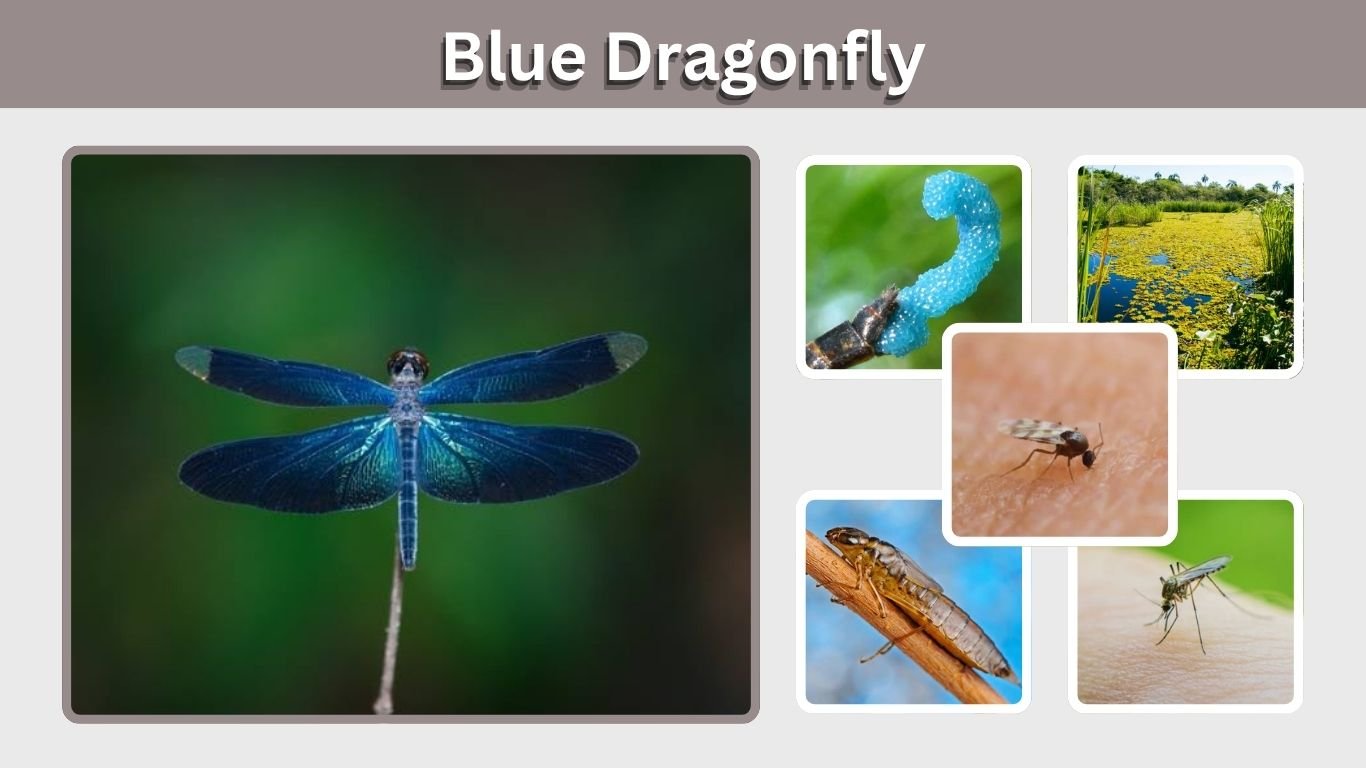
A blue dragonfly can be a small powder-blue insect perched beside a pond or a large, fast-flying hunter with blue-and-black markings. However, “blue dragonfly” is not the name of one species. Several dragonflies develop blue bodies, eyes, or markings, and their appearance can change with age and sex. Identifying one requires more than noticing its color. This guide explains common blue dragonfly species, their habitats and behavior, how to distinguish them from damselflies, and the difference between biological facts and personal symbolism.
What Is a Blue Dragonfly?
The term describes a dragonfly with noticeable blue coloration rather than a single scientific group. Blue species occur in several families, including skimmers and darners. Some are mostly blue, while others combine blue with green, black, yellow, or white.
Identification Features
When examining a blue dragonfly, look for:
- Body pattern: Solid blue, powdery blue, or separate blue spots.
- Face and eyes: White, green, blue, or dark coloration.
- Wing markings: Clear wings, dark patches, or colored tips.
- Size and shape: A compact skimmer or a long-bodied darner.
- Location and season: Species differ between regions and times of year.
Photographing the insect from above and from the side is more useful than relying on a distant view. Wing patterns and body markings are important identification clues.
Male and Female Differences
A blue male and a yellowish female may belong to the same species. Young males can also resemble females before developing their mature coloration.
Consequently, blue color alone cannot reliably establish either species or sex.
Common Blue Dragonfly Species
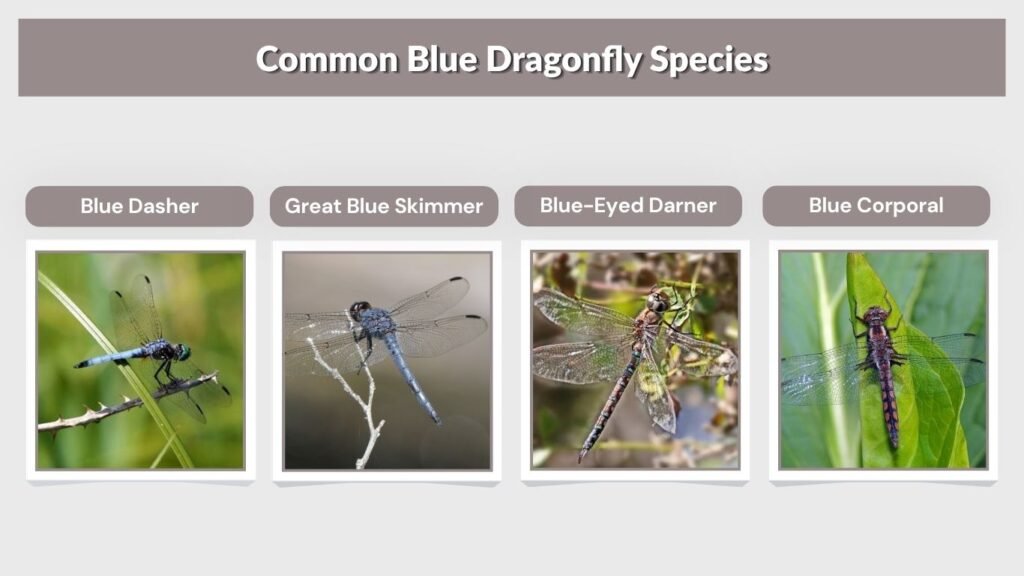
Several familiar dragonflies match descriptions such as “small blue dragonfly,” “blue-and-black dragonfly,” or “blue-and-green dragonfly.” The examples below provide starting points for identification, but your location remains essential.
Blue Dasher
The blue dasher’s scientific name is Pachydiplax longipennis. Mature males have a powder-blue abdomen, dark abdominal tip, white face, and turquoise eyes. Their thorax carries slanted black-and-yellow stripes.
Females look quite different, with dark abdomens marked by paired yellow stripes. These contrasting patterns make the species a good example of why photographs of males and females should be compared.
Great Blue Skimmer
The great blue skimmer, Libellula vibrans, is a large dragonfly whose mature males have powdery blue bodies and conspicuously pale faces.
Dark markings near the wing tips and nodes—the small bends along the leading wing edges—provide additional clues. It is a North American species associated especially with eastern and southern regions, although individuals can wander farther north.
Blue-Eyed Darner
The blue-eyed darner, Rhionaeschna multicolor, has striking blue eyes, a blue face, and blue abdominal spots in mature males. Unlike an evenly powder-blue skimmer, its body has a patterned appearance.
Other darners can also have blue eyes, so this feature is not conclusive. Similar species may require close examination of markings and abdominal appendages.
Blue Corporal
The blue corporal, Ladona deplanata, develops a dark blue body in mature males, contrasting with a black head and dark wing-base markings.
Females and young males are browner. Their short thoracic stripes help explain the “corporal” name. In Missouri, adults are particularly associated with spring rather than the entire summer season.
Blue Emperor Dragonfly
The emperor dragonfly, Anax imperator, is also called the blue emperor. Mature males combine an apple-green thorax with a blue abdomen and a dark central abdominal stripe.
At approximately 78 millimeters long, it is a substantial dragonfly. Females usually have greener abdomens, although blue females occur. Males patrol territories and often remain airborne for extended periods.
Why Are Some Dragonflies Blue?
Dragonfly coloration can involve pigments and microscopic structures that affect reflected light. Different species do not necessarily produce blue coloration in the same way, and a powdery surface should not be confused with blue wing pigment.
Powdery Blue Coatings
Some dragonflies develop a waxy coating called pruinescence as they mature. Microscopic wax structures scatter light, contributing to their pale, powdery appearance.
Research on certain dragonflies has demonstrated that these wax structures also reflect ultraviolet light. This helps explain why mature insects can look very different from younger individuals.
Blue, Green, and Purple Appearances
Lighting, viewing angle, and camera processing can influence the color visible in a photograph. A metallic insect may appear greener in one image and bluer in another.
Descriptions such as “electric blue” or “neon blue” are therefore descriptive labels, not reliable species names.
Blue Dragonfly or Blue Damselfly?
A tiny, slender blue insect beside water may be a damselfly. Both groups belong to Odonata, but they differ in several useful features. Color alone does not separate them.
Main Differences
Most dragonflies have relatively robust bodies and rest with their wings extended sideways. Their eyes are often close together or touching, although exceptions exist.
Most damselflies have slimmer bodies, widely separated eyes, and wings held together above the abdomen when resting. Spreadwing damselflies are an important exception.
An insect with a metallic blue-green body and dark wings may therefore be a damselfly rather than a blue dragonfly.
Blue Dragonfly Habitat, Diet, and Life Cycle
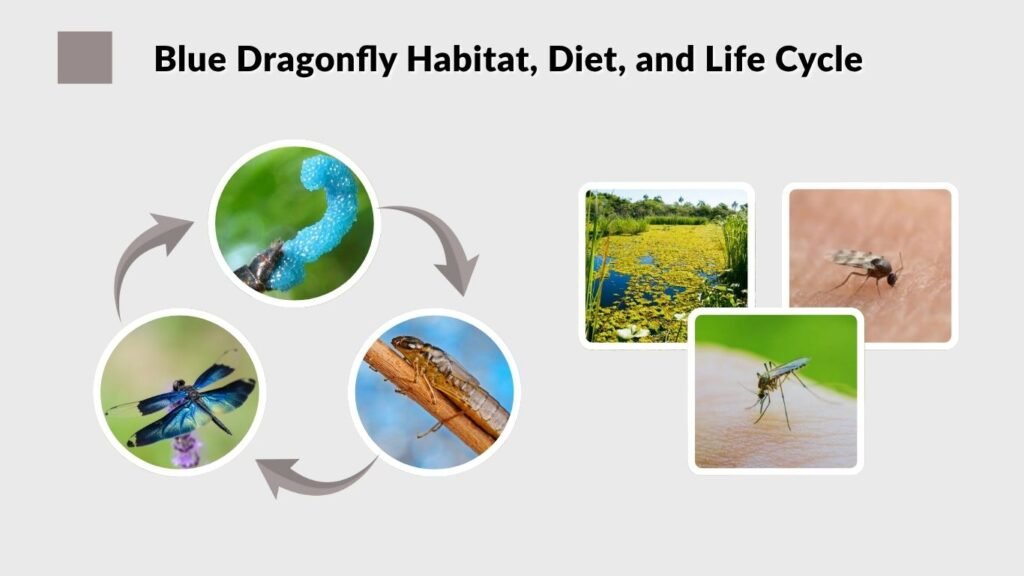
Blue coloration does not create a separate set of habitat requirements. Each species has its own preferences, but dragonflies depend on aquatic habitats during their immature stages. Adults may travel away from water while hunting or dispersing.
Where They Live and What They Eat
Look around ponds, marshes, lakes, and suitable streams. Vegetation provides places to perch, shelter, and emerge from the water.
Adults hunt insects such as mosquitoes, midges, and flies. Their aquatic larvae capture small animals underwater. Dragonflies are predators, not nectar-feeding pollinators, and their presence does not guarantee complete mosquito control.
From Underwater Larva to Flying Adult
Dragonflies pass through three main stages: egg, aquatic larva, and adult. There is no pupal stage.
Larvae grow through repeated molts before climbing out of the water and emerging as winged adults. Depending on species and conditions, the underwater stage can last months or years. The adult stage is generally much shorter, commonly lasting weeks.
Blue Dragonfly Meaning and Symbolism
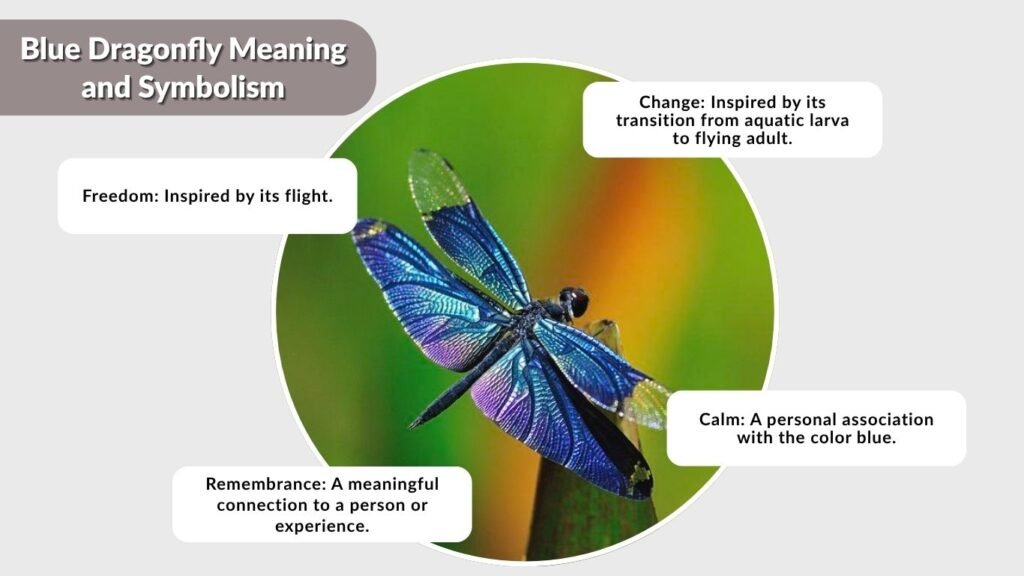
A blue dragonfly can hold personal significance without having one universal spiritual meaning. Symbolic interpretations should be distinguished from biological explanations and should not automatically be attributed to an entire culture or religion.
Personal and Spiritual Interpretations
Someone might choose a blue dragonfly to represent:
- Change: Inspired by its transition from aquatic larva to flying adult.
- Calm: A personal association with the color blue.
- Freedom: Inspired by its flight.
- Remembrance: A meaningful connection to a person or experience.
These are interpretations, not scientifically established messages. A blue dragonfly sighting is not evidence of an approaching death or another predicted event.
Landing on You and Tattoo Meanings
If a dragonfly lands on you, it may simply be using you as a perch. You can appreciate the encounter without assuming supernatural intent.
Likewise, a blue dragonfly tattoo can symbolize whatever its wearer intends; it has no compulsory meaning.
FAQs
Are blue dragonflies rare?
Not necessarily. Some blue species are locally common, while others are uncommon or restricted to particular habitats. Identification and location matter more than color.
Do blue dragonflies bite or sting?
They cannot sting. A restrained dragonfly may bite defensively, so observe it without grabbing its body or wings.
Are all blue dragonflies male?
No. Males are blue in many species, but females can also show blue coloration. Sex must be assessed using species-specific features.
What is a small blue dragonfly called?
It could be a blue dasher or another small dragonfly. A very slender specimen may instead be a blue damselfly.
What does seeing a blue dragonfly mean?
Biologically, it means an insect is present in suitable conditions. Any association with peace, transformation, or remembrance is personal symbolism rather than a confirmed message.