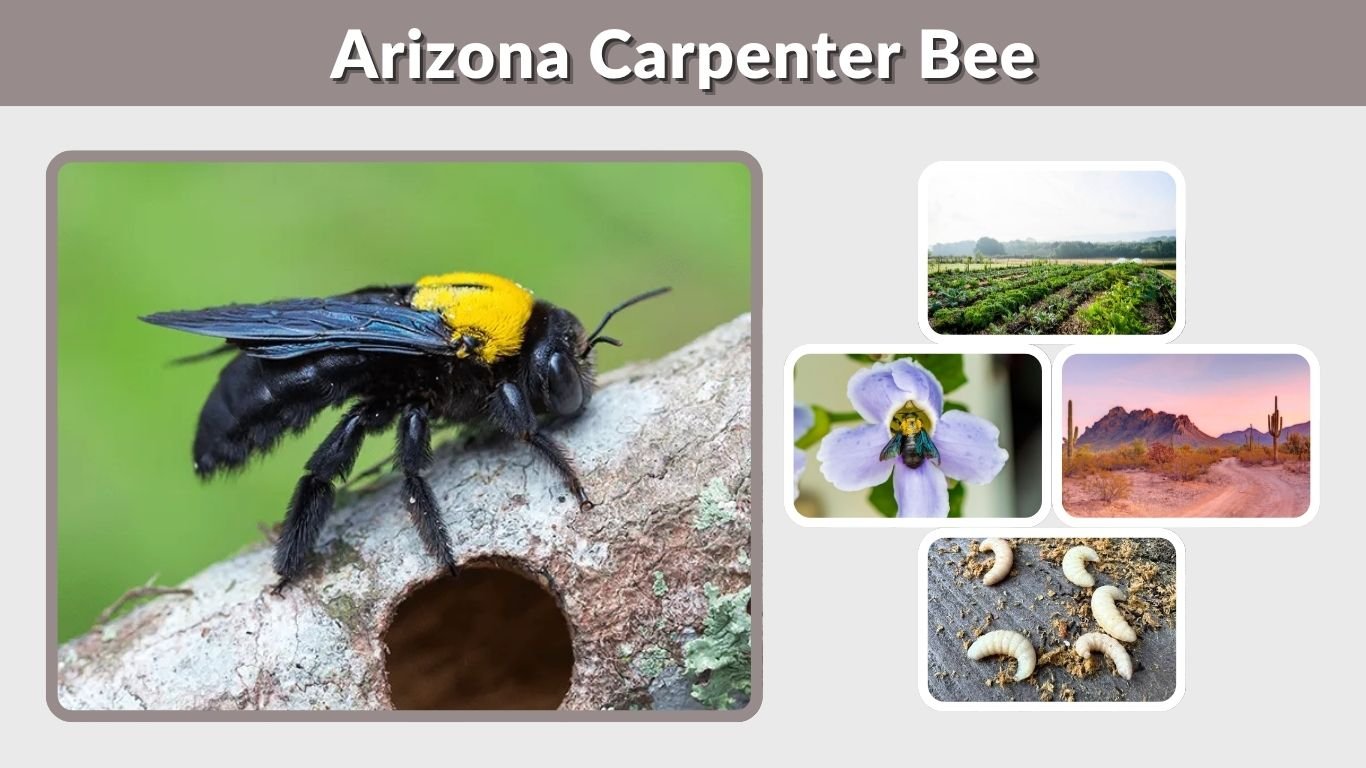
The Arizona carpenter bee is one of the largest and most noticeable native bees found across the state. These powerful pollinators are often seen around desert flowers, gardens, wooden structures, and dried plant stalks. Arizona is home to more than one carpenter bee species, including the Valley carpenter bee and the Arizona form of the California carpenter bee. Although their large size and loud buzzing can look intimidating, carpenter bees are generally solitary and rarely aggressive toward people.
Arizona Carpenter Bee Identification
Arizona carpenter bees are large members of the genus Xylocopa. Two large species commonly encountered around southern Arizona are the Valley carpenter bee (Xylocopa sonorina) and Xylocopa californica arizonensis. Their appearance can vary greatly between species and sexes, so not every large carpenter bee in Arizona will look exactly alike.
What Does an Arizona Carpenter Bee Look Like?
- Size: Large species may reach around 1 inch in length.
- Body: Broad, heavy, and robust.
- Female Valley carpenter bee: Usually almost entirely glossy black.
- Male Valley carpenter bee: Golden, yellowish, or blond and dramatically different from the female.
- X. californica arizonensis: Both sexes are predominantly shiny black.
- Wings: Usually dark, smoky, or slightly iridescent.
- Abdomen: Smooth and shiny rather than densely fuzzy.
- Flight: Strong, fast, and accompanied by noticeable buzzing.
Arizona Cooperative Extension describes the Valley carpenter bee as a gentle giant that can grow slightly longer than an inch.
Arizona Carpenter Bee vs Bumblebee
Carpenter bees and bumblebees can look similar because both are large and robust. The easiest difference is often the abdomen. Bumblebees generally have visibly fuzzy abdomens, while large carpenter bees tend to have smoother, shinier abdominal surfaces.
Carpenter bees are also primarily solitary nesters. Bumblebees typically establish social colonies containing a queen and workers, while carpenter bee females construct or reuse individual nesting tunnels.
Habitat and Distribution in Arizona
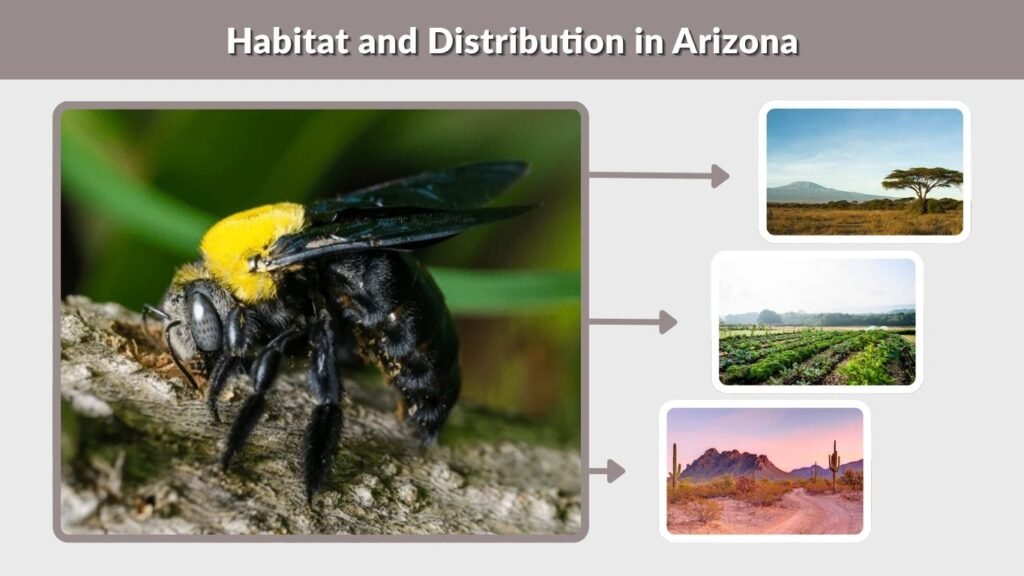
Carpenter bees are well adapted to Arizona’s diverse landscapes. They can occur in deserts, foothills, grasslands, gardens, suburban neighborhoods, and areas containing flowering native plants. Southern Arizona is particularly rich in native bee diversity, and large carpenter bees can be seen around Tucson, Phoenix-area landscapes, and southeastern Arizona.
Where Are Carpenter Bees Found in Arizona?
- Sonoran Desert habitats
- Southern Arizona
- Tucson and surrounding areas
- Phoenix-area gardens and suburbs
- Southeastern Arizona
- Desert grasslands
- Foothills and woodland edges
- Residential gardens
- Areas with agave and yucca
- Places containing dead or weathered wood
The Arizona-Sonora Desert Museum notes that X. californica arizonensis can nest in dried flower stalks of plants such as agave, soaptree yucca, and desert spoon.
Southern Arizona Carpenter Bees
Southern Arizona provides particularly favorable conditions because it combines abundant native flowers with natural nesting materials. Valley carpenter bees have been documented around Tucson, Green Valley, Sierra Vista, and other southern Arizona locations.
They may appear frequently in flower-rich yards, especially when desert plants are blooming.
Arizona Carpenter Bees Behavior and Diet
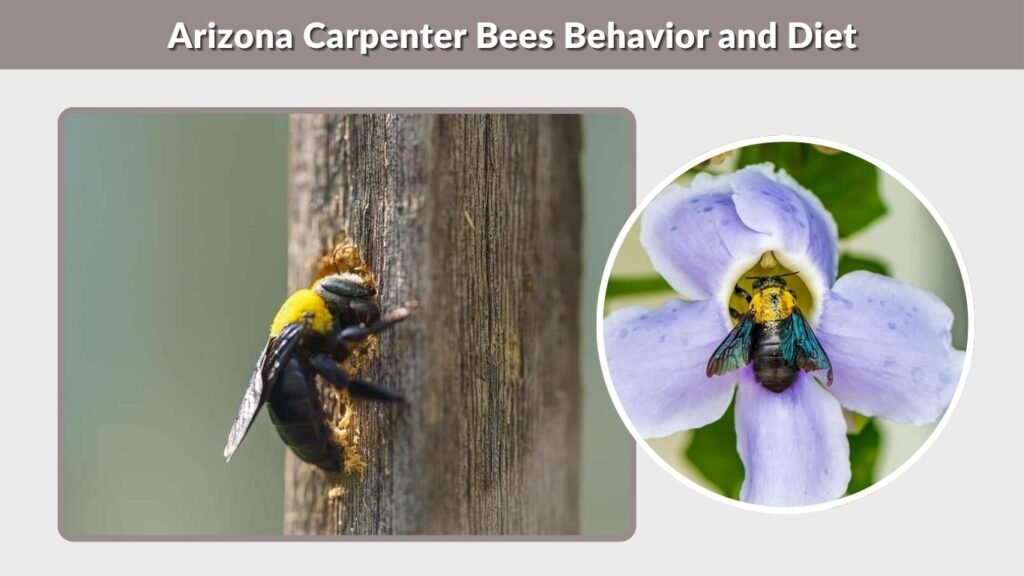
Arizona carpenter bees spend much of their active season searching for flowers, mates, and nesting sites. Despite their intimidating size, they are not usually interested in attacking people. Females focus heavily on nesting and collecting food, while males may patrol flower patches or nesting territories.
Carpenter Bee Behavior
Carpenter bees are generally solitary, although several nests can sometimes occur close together when suitable nesting material is limited.
Males may hover around people who approach their territory. This behavior sometimes gives homeowners the impression that the bee is preparing to attack. However, male carpenter bees cannot sting.
Females spend considerable time visiting flowers and transporting pollen back to their nests. They are strong fliers and may travel repeatedly between flowering plants and nesting sites throughout the day.
What Do Arizona Carpenter Bees Eat?
Adults primarily consume flower nectar for energy. Females also collect pollen and nectar to create food masses for their developing larvae.
Because carpenter bees are large, they sometimes have difficulty entering narrow or deep flowers. They may reach nectar through openings near the base of a flower, a behavior sometimes called nectar robbing. Arizona educational material specifically notes this behavior in Valley carpenter bees.
They can nevertheless be valuable native pollinators while visiting many other flowers normally.
Arizona Carpenter Bee Nest
Unlike honey bees, carpenter bees do not construct large wax colonies. Females create nesting galleries by chewing into suitable plant material or wood. They do not consume the wood as food. Instead, the excavated space becomes a protected nursery for their offspring.
Signs of a Carpenter Bee Nest
- Round entrance holes in wood or dried stalks
- Bees repeatedly entering the same opening
- Small amounts of wood debris around an entrance
- Tunnels inside weathered or softer wood
- Activity around dead branches or plant stalks
- Multiple holes in wood that has been reused for several seasons
For X. californica arizonensis, natural nesting sites can include relatively soft material such as dried agave, yucca, and desert spoon flower stalks.
Do Carpenter Bees Damage Houses?
They can, but the severity varies considerably. A single nest usually does not mean major structural damage. Problems are more likely when bees repeatedly reuse and extend tunnels in the same exposed wood over multiple years.
Unpainted or weathered outdoor wood can be more attractive than well-maintained surfaces. Eaves, beams, fences, patio structures, and other exposed wooden components may occasionally become nesting locations.
Do Arizona Carpenter Bees Sting?
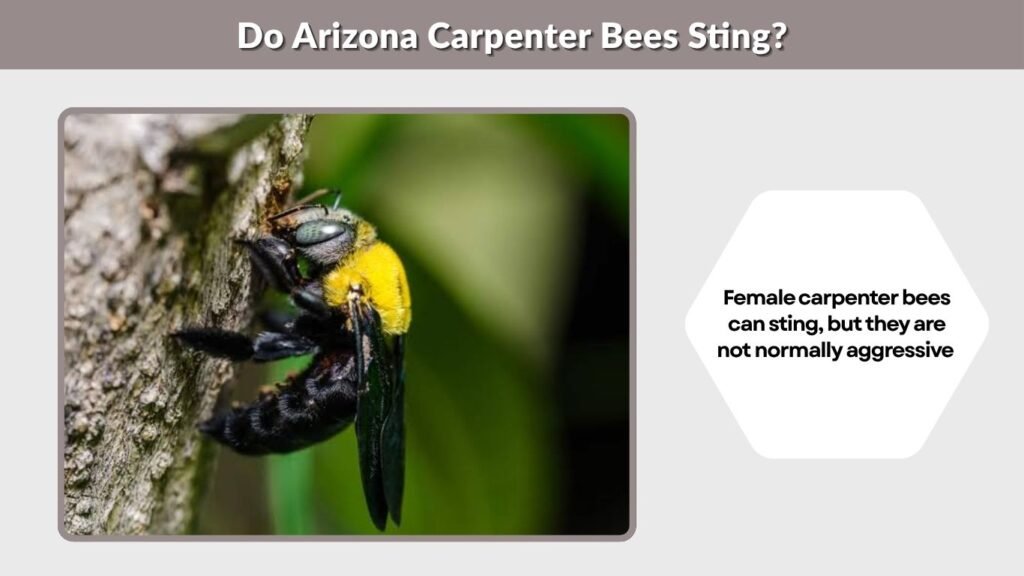
The large size of a carpenter bee often causes unnecessary concern. Carpenter bees can fly close to people, particularly when males are defending territories. However, their behavior is generally much less dangerous than their appearance suggests.
Are Arizona Carpenter Bees Dangerous?
Female carpenter bees can sting, but they are not normally aggressive and generally sting when handled, squeezed, trapped, or strongly threatened.
Male carpenter bees cannot sting at all. Therefore, a bee repeatedly hovering in front of you may actually pose no sting risk if it is a male.
Arizona educational resources advise against handling these large bees because females are capable of stinging.
What Is an Arizona Carpenter Bee Sting Like?
A female carpenter bee sting can cause immediate pain followed by localized redness, itching, or swelling, similar to other bee stings.
Most reactions remain limited to the area around the sting. However, anyone who develops breathing difficulty, extensive swelling, dizziness, widespread hives, or other signs of a severe allergic reaction needs urgent medical attention.
Arizona Carpenter Bees Life Cycle and Lifespan
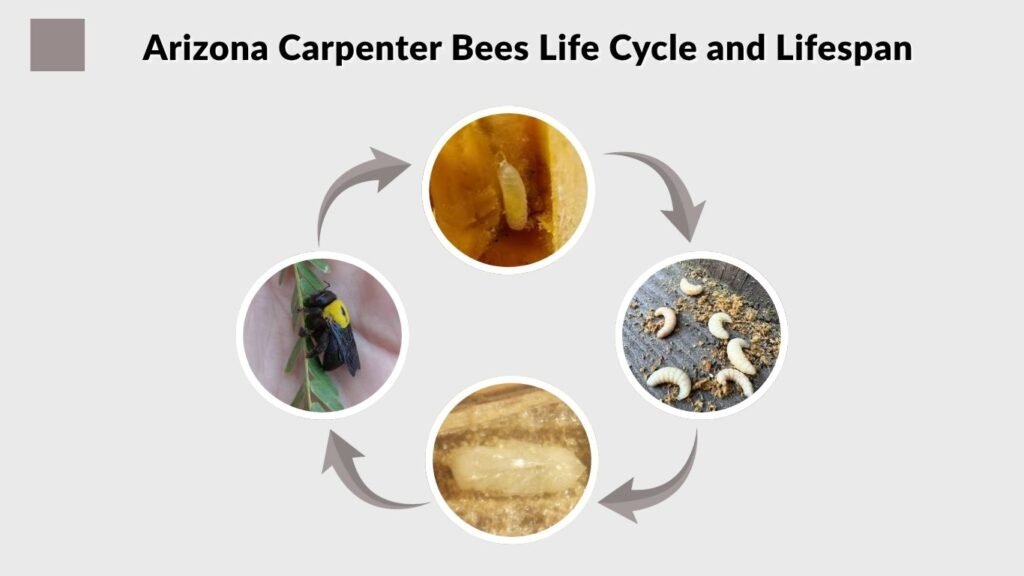
Arizona carpenter bees undergo complete metamorphosis, passing through egg, larva, pupa, and adult stages. Their reproductive strategy differs significantly from that of social honey bees. Instead of maintaining a large colony, a female prepares individual brood chambers inside a wooden or plant-stem tunnel.
Arizona Carpenter Bee Life Cycle
- Egg: A female places an egg inside a prepared brood chamber.
- Larva: The egg hatches and the larva consumes stored pollen and nectar.
- Pupa: The mature larva enters the pupal stage inside the protected nest.
- Adult: The fully developed carpenter bee eventually emerges from the gallery.
Females separate their offspring into individual cells and provide each developing larva with enough stored food to complete its early development.
How Long Do Arizona Carpenter Bees Live?
The exact lifespan varies with species, sex, weather, food availability, and seasonal conditions. Unlike adult insects that survive for only a few days, some carpenter bees can persist across seasons.
Adults may use protected nesting tunnels for shelter, and seasonal activity increases when temperatures and flowering conditions are favorable. Their full life cycle therefore extends considerably longer than the highly visible period when adults are actively visiting flowers.
Should You Get Rid of Carpenter Bees?
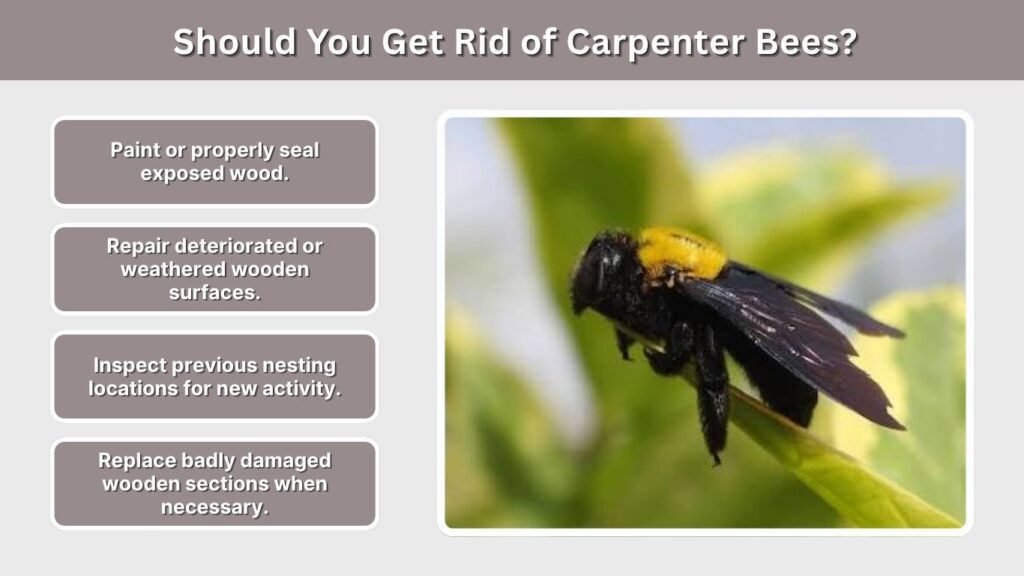
Carpenter bees are native pollinators, so their presence in a garden usually does not require control. The situation is different when repeated nesting begins affecting structural wood. In that case, preventing future nesting is generally more useful than removing every bee in the area.
How to Reduce Carpenter Bee Nesting
- Paint or properly seal exposed wood.
- Repair deteriorated or weathered wooden surfaces.
- Inspect previous nesting locations for new activity.
- Replace badly damaged wooden sections when necessary.
- Provide flowering plants away from important wooden structures.
- Leave natural nesting material undisturbed when it poses no structural problem.
Avoid disturbing active nests unnecessarily. Carpenter bees provide useful pollination services, and natural nests in dead wood or dried plant stalks usually do not need to be removed.
FAQs
1. Are there carpenter bees in Arizona?
Yes. Arizona has multiple carpenter bee species. Two large forms encountered in southern Arizona include the Valley carpenter bee and Xylocopa californica arizonensis.
2. What is the big black carpenter bee in Arizona?
A large black carpenter bee may be a female Valley carpenter bee or another large Xylocopa species. X. californica arizonensis is also shiny black and occurs in Arizona, so close identification may be necessary.
3. Do Arizona carpenter bees sting?
Females can sting when threatened or handled, but they are generally not aggressive. Male carpenter bees do not have functional stingers.
4. Is the Valley carpenter bee found in Arizona?
Yes. Valley carpenter bees occur in Arizona and have been recorded in locations including Tucson, Green Valley, Phoenix-area communities, and southeastern Arizona.
5. Are Arizona carpenter bees beneficial?
Yes. Carpenter bees visit many flowers for nectar and pollen and contribute to the pollination of native and garden plants. Their nesting becomes a concern primarily when repeated tunneling occurs in important structural wood.