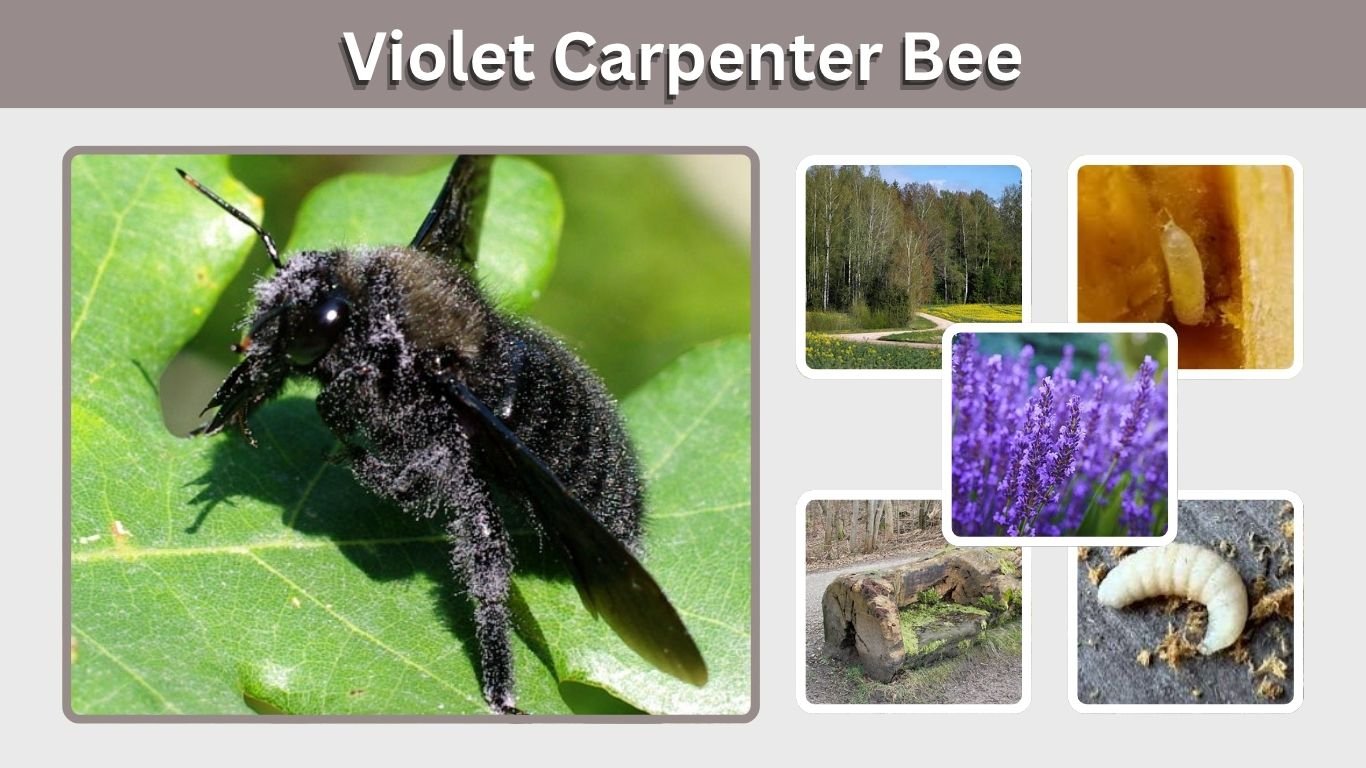
The violet carpenter bee (Xylocopa violacea) is a large, striking bee recognized by its glossy black body and beautiful violet-blue wings. Native to much of Europe and parts of Asia, this solitary bee is an important pollinator of wildflowers, garden plants, and crops. Despite its intimidating size and loud buzzing flight, it is generally calm around people. Below, you’ll learn how to identify the violet carpenter bee, where it lives, whether it stings, how it nests, what it eats, and how its life cycle works.
Violet Carpenter Bee Identification
Violet carpenter bees are among the largest bees found in Europe. Their dark bodies and shimmering wings can make them appear almost entirely black from a distance. In direct sunlight, however, the wings reveal a beautiful violet, blue, or purple sheen. Their smooth, shiny abdomen also helps distinguish them from the much fuzzier appearance of most bumblebees.
What Does a Violet Carpenter Bee Look Like?
- Scientific name: Xylocopa violacea
- Family: Apidae
- Body length: Commonly around 20–25 mm
- Color: Predominantly glossy black
- Wings: Dark with metallic violet-blue reflections
- Body shape: Large, broad, and robust
- Abdomen: Smooth and shiny with relatively little hair
- Thorax: Dark with short black hairs
- Flight: Powerful with a noticeable deep buzzing sound
Black Violet Carpenter Bee
The name “black violet carpenter bee” usually refers to the same distinctive appearance of Xylocopa violacea. The bee’s body itself is predominantly black, while its wings create the violet coloration.
Lighting can dramatically change its appearance. In shade, the bee may look almost completely black. Under bright sunlight, the wings can reflect deep purple, indigo, or metallic blue.
Violet Carpenter Bee Habitat and Distribution
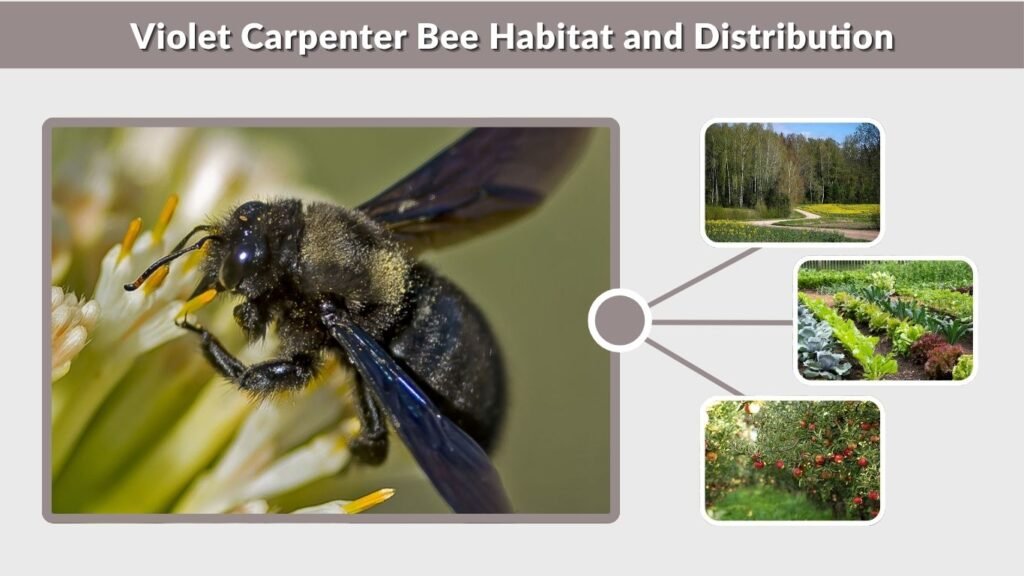
Violet carpenter bees prefer warm environments with abundant flowering plants and suitable dead wood for nesting. They occur across much of southern and central Europe and extend into portions of Asia. Gardens can provide particularly good habitat when they contain nectar-rich flowers along with old trees, logs, or untreated wood suitable for nests.
Where Are Violet Carpenter Bees Found?
- Southern and central Europe
- Mediterranean regions
- Italy
- Croatia and surrounding countries
- Parts of southeastern Europe
- Western and central Asia
- Gardens and orchards
- Woodland edges
- Meadows and flower-rich countryside
- Areas containing dead or decaying wood
Violet Carpenter Bee in the UK
Violet carpenter bees are occasionally recorded in the United Kingdom, particularly in warmer southern areas. Their appearance can attract considerable attention because they are much larger and darker than most familiar British bees.
Warmer conditions may allow individuals to appear farther north than their traditional range. However, sightings should not automatically be interpreted as evidence of a large local population.
Are Violet Carpenter Bees Found in California or Texas?
The true violet carpenter bee, Xylocopa violacea, is primarily an Old World species and is not one of the typical native carpenter bees of California or Texas.
Large black or blue carpenter bees seen in those states are more likely to belong to other Xylocopa species. Several North American carpenter bees can show blue, purple, or metallic reflections and may therefore be mistaken for the European violet carpenter bee.
Male vs Female Violet Carpenter Bee
Male and female violet carpenter bees look similar because both have large black bodies and violet-colored wings. However, there are useful differences when they can be observed closely. Their behavior also differs considerably during the breeding season, with females concentrating on nesting while males spend more time searching for potential mates.
Violet Carpenter Bee Male vs Female
- Female: Usually slightly larger and more robust.
- Female antennae: Normally completely dark.
- Male antennae: Characteristically show reddish or orange coloration near the tips.
- Female behavior: Excavates nests and gathers pollen.
- Male behavior: Patrols flowering areas while searching for females.
- Female sting: Females possess a functional stinger.
- Male sting: Males cannot sting.
The colored sections of the male’s antennae are particularly useful when distinguishing the sexes at close range.
Violet Carpenter Bee Behavior and Diet
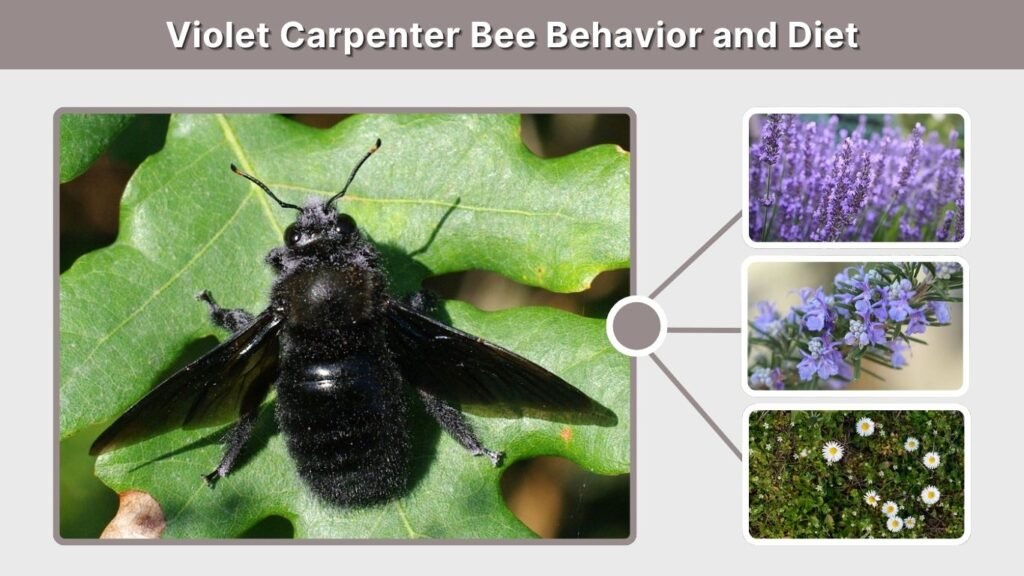
Violet carpenter bees are primarily solitary. A female normally establishes her own nest rather than participating in a large social colony with workers and a queen. Nevertheless, several females can sometimes nest close together when an especially suitable piece of dead wood is available.
What Do Violet Carpenter Bees Eat?
Adult violet carpenter bees obtain most of their energy from flower nectar. Females also collect pollen, which provides protein and other nutrients for their developing larvae.
Common food sources include flowering:
- Lavender
- Wisteria
- Rosemary
- Sage
- Fruit trees
- Legumes
- Wildflowers
- Garden ornamentals
Their large bodies allow them to carry considerable quantities of pollen between plants, making them useful pollinators.
Some carpenter bees also practice nectar robbing. If a flower is too deep for the bee to reach nectar normally, it may make or use an opening near the flower’s base to access the nectar.
Does the Violet Carpenter Bee Make Honey?
No. Violet carpenter bees do not produce stores of honey like honey bees. They are solitary bees and do not maintain large colonies requiring stored honey reserves.
Females instead collect pollen and nectar and combine them into food provisions inside individual nest cells. Each developing larva receives enough stored food to grow without being continuously fed by its mother.
Violet Carpenter Bee Nest
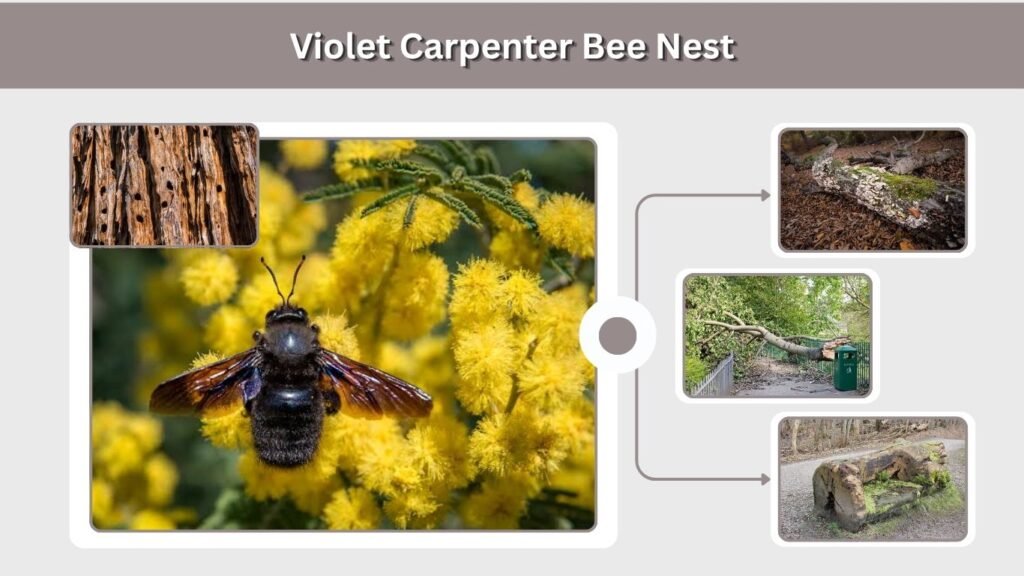
The term “carpenter bee” comes from the female’s remarkable ability to excavate tunnels in wood. She uses powerful mandibles to chew through suitable material. The wood itself is not eaten as food; it is removed to create a protected nesting gallery.
Where Do Violet Carpenter Bees Nest?
- Dead tree trunks
- Fallen branches
- Old logs
- Weathered timber
- Decaying wood
- Fence posts
- Wooden beams
- Untreated outdoor wood
A female usually chooses wood that is relatively soft, dead, or weathered rather than sound hardwood.
Inside the tunnel, she creates several individual brood chambers. Each chamber receives a supply of pollen and nectar followed by a single egg. The chambers are separated from one another with partitions made from chewed wood material.
Do Violet Carpenter Bees Damage Wood?
A single nest generally causes limited damage, particularly when it is located in a dead tree or old log. Problems can develop when carpenter bees repeatedly nest in structural timber.
Older tunnels may be reused and expanded over time. Maintaining painted, sealed, or otherwise protected outdoor wood can help make important structures less attractive as nesting sites.
Are Violet Carpenter Bees Dangerous?
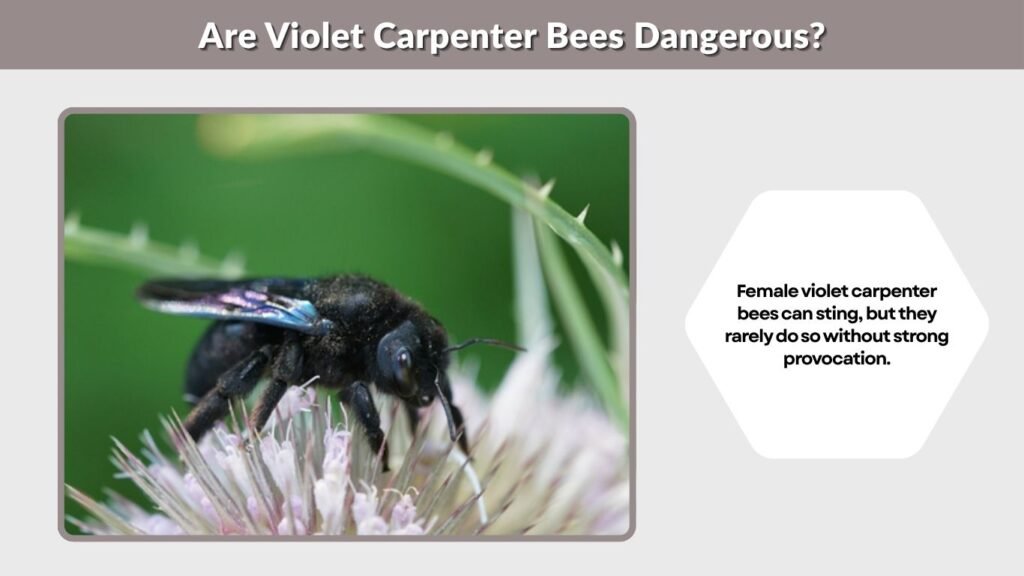
Their large size, glossy black appearance, and loud buzzing can make violet carpenter bees seem threatening. In reality, they are generally peaceful insects that spend most of their time searching for flowers or nesting sites.
Do Violet Carpenter Bees Sting?
Female violet carpenter bees can sting, but they rarely do so without strong provocation. A female is most likely to defend herself if she is grabbed, squeezed, stepped on, or trapped.
Male violet carpenter bees cannot sting because they lack a functional stinger.
A female sting can produce:
- Immediate pain
- Redness
- Local swelling
- Itching or tenderness
Severe allergic reactions to bee venom are possible. Difficulty breathing, extensive swelling, dizziness, or widespread hives after any bee sting requires urgent medical attention.
Violet carpenter bees do not normally bite humans as a defensive behavior. Their powerful jaws are primarily designed for excavating wood and manipulating nesting materials.
Violet Carpenter Bee Life Cycle
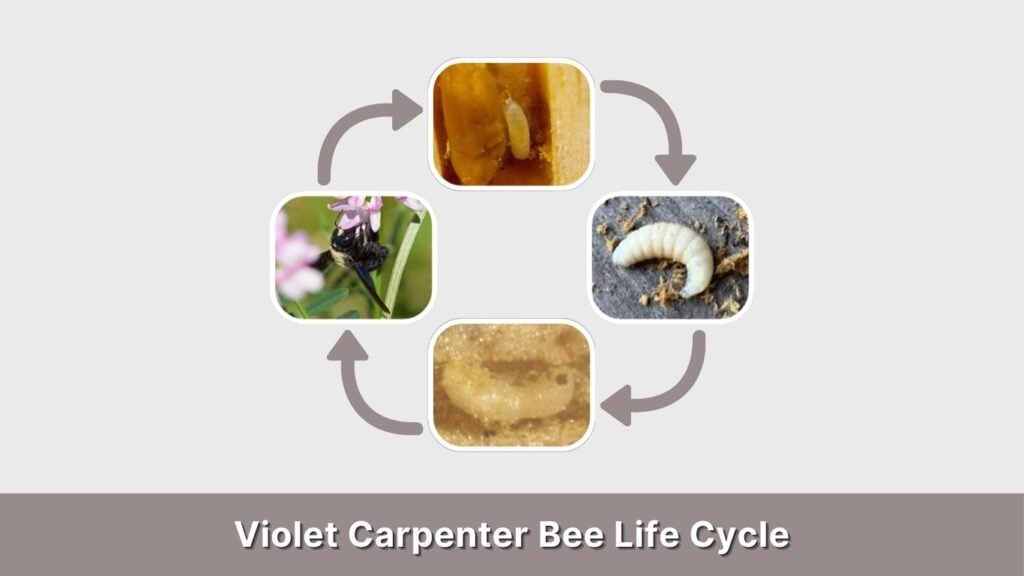
Violet carpenter bees undergo complete metamorphosis, developing through egg, larva, pupa, and adult stages. The female performs nearly all of the nesting work. She excavates the tunnel, prepares food for her offspring, creates individual chambers, and lays eggs.
Four Stages of the Life Cycle
- Egg: The female places one egg in a provisioned nest chamber.
- Larva: The larva hatches and consumes stored pollen and nectar.
- Pupa: The fully grown larva transforms into a pupa inside the nest.
- Adult: The mature bee emerges after completing metamorphosis.
New adults generally emerge after developing inside the wooden gallery. Adults can later use protected cavities for shelter, including during colder periods.
Violet Carpenter Bee Lifespan
The violet carpenter bee can live longer as an adult than many people expect from a bee. Adults that emerge later in the season may overwinter in protected locations and become active again when warmer weather returns.
How Long Do Violet Carpenter Bees Live?
An individual’s exact lifespan varies according to temperature, food availability, predators, sex, and seasonal conditions. Because adults may survive through winter, their adult lives can extend for several months.
Following winter, activity increases as flowers become available. Mating occurs, females establish nests, and another generation begins developing inside wooden galleries.
FAQs
1. Is the violet carpenter bee rare?
Its abundance depends heavily on location. Violet carpenter bees are relatively familiar in parts of southern Europe but can be much less commonly encountered toward the northern limits of their range.
2. Are violet carpenter bees dangerous?
No. They are generally calm solitary bees. Females can sting if seriously threatened, while males are unable to sting.
3. How big is a violet carpenter bee?
Adults commonly reach around 20–25 mm long, making them noticeably larger than many familiar bee species.
4. Why are violet carpenter bees blue or purple?
Their wings contain structures that reflect light, producing a metallic violet, blue, or purple appearance. The body itself is predominantly glossy black.
5. Are violet carpenter bees beneficial?
Yes. Violet carpenter bees visit many flowering plants for pollen and nectar, transferring pollen as they move between flowers. This makes them valuable pollinators in gardens, agricultural landscapes, and natural ecosystems.