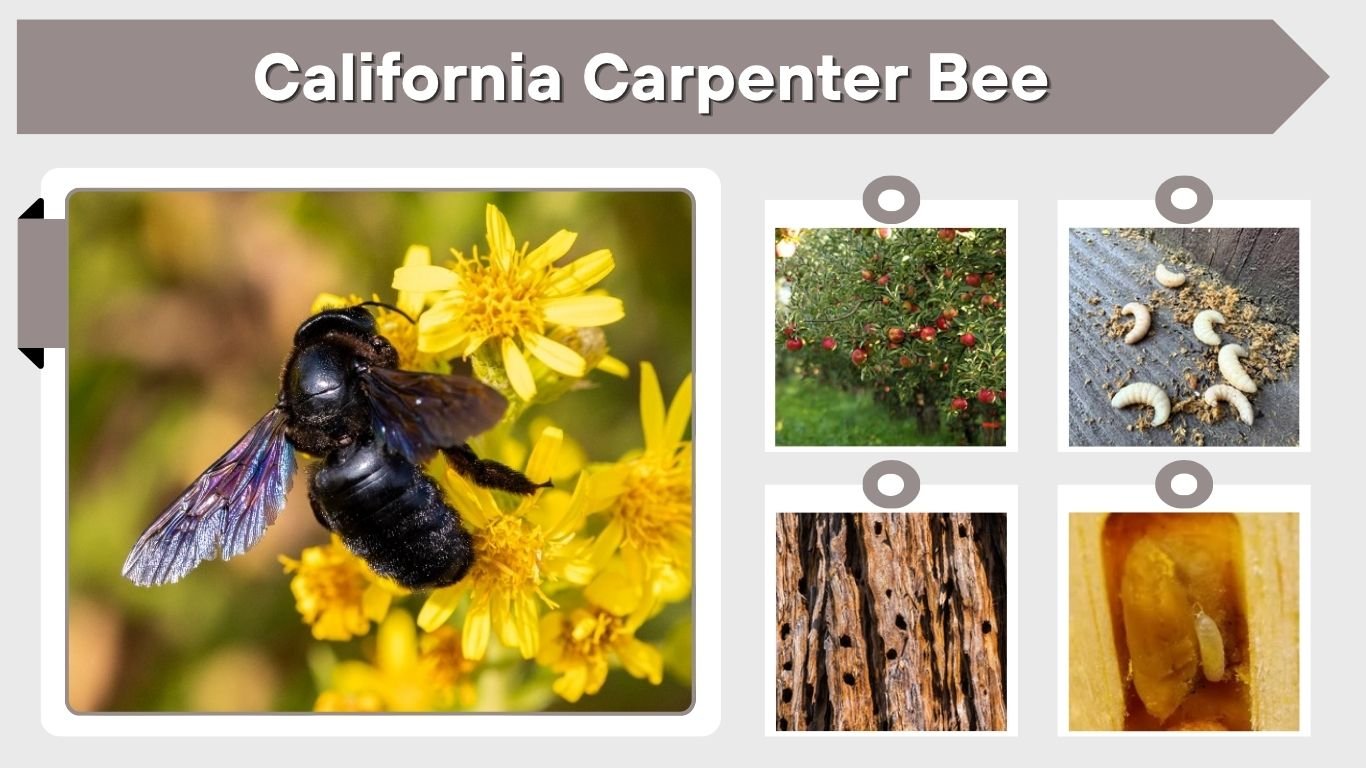
The California carpenter bee (Xylocopa californica), also called the Western carpenter bee, is one of the largest and most noticeable native bees in western North America. Its glossy black body, metallic blue or green reflections, loud flight, and habit of nesting in wood can make it seem intimidating. However, California carpenter bees are valuable native pollinators and are normally not aggressive toward people. Understanding their appearance, nesting behavior, diet, sting risk, and life cycle makes it much easier to distinguish them from bumblebees and other carpenter bee species.
California Carpenter Bee Identification
California carpenter bees are large, robust insects in the family Apidae. Their shiny abdomen is one of the easiest ways to separate them from many bumblebees, which generally have much hairier abdomens. Depending on the individual and subspecies, the body may show striking metallic blue or green reflections. The typical California subspecies can reach roughly 20–24 mm in length.
What Does a California Carpenter Bee Look Like?
- Scientific name: Xylocopa californica
- Common names: California carpenter bee, Western carpenter bee
- Size: Large; commonly around 20–24 mm in the typical California form
- Body: Thick, robust, and mostly black
- Color: Black with noticeable metallic blue or green reflections
- Wings: Dark or smoky in appearance
- Abdomen: Smooth and much shinier than a typical bumblebee abdomen
- Female: Usually dark, glossy, and strongly metallic
- Male: Also dark and metallic but may have pale white, yellowish, or orange hairs around portions of the thorax and abdomen
Their size and deep buzzing sound often attract attention long before people notice the metallic coloration.
California Carpenter Bee Male vs Female
Male and female California carpenter bees may look similar from a distance, but their behavior is different. Females perform the demanding work of creating and provisioning nests. They use powerful mandibles to excavate wood and collect pollen and nectar for their developing offspring.
Males spend more time patrolling territories, hovering near flowers, nest areas, or potential mates. A hovering male can appear aggressive because it may approach people or other insects, but this behavior is primarily territorial.
Do Male California Carpenter Bees Have Stingers?
No. Male carpenter bees cannot sting. Females possess a stinger, but they are normally reluctant to use it unless grabbed, trapped, or seriously disturbed. UC IPM notes that males cannot sting and females generally sting only when provoked or handled roughly.
California Carpenter Bee Habitat and Distribution
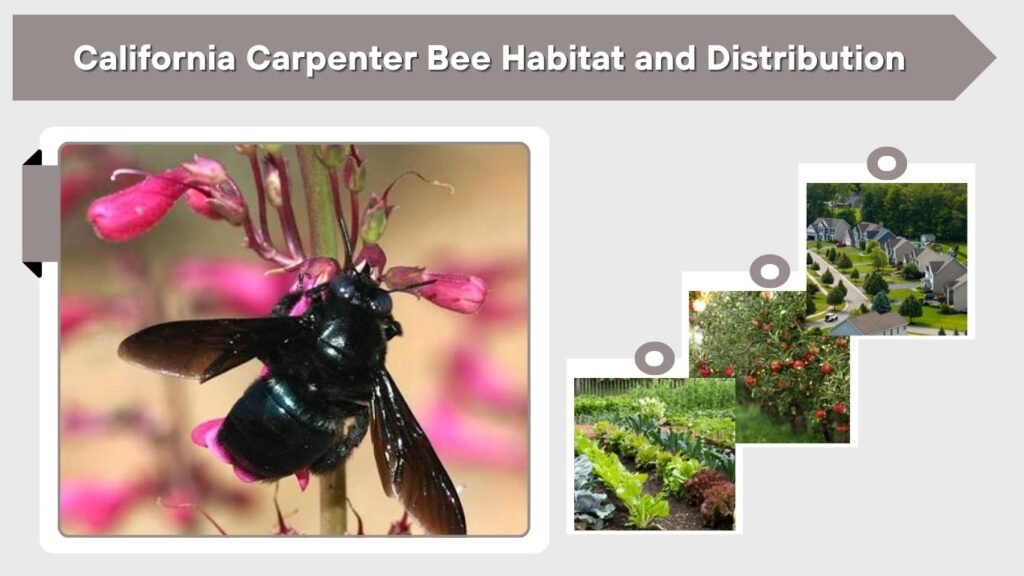
The California carpenter bee is native to western North America and occurs throughout California as well as several surrounding western states. It can live in woodland, chaparral, foothills, suburban areas, gardens, orchards, and some desert environments. Records occur from both northern and southern portions of California.
Where Are California Carpenter Bees Found?
In California, these bees can be associated with the foothills around the Central Valley, coastal and inland mountain ranges, woodland, and southern California landscapes. They can also occur around homes if exposed wood offers an appropriate nesting location.
In natural environments, nesting material may include dead branches, logs, redwood, cedar, and dried plant stalks. The availability of flowers nearby is also important because adults need reliable supplies of nectar and pollen.
California Carpenter Bee Behavior and Diet
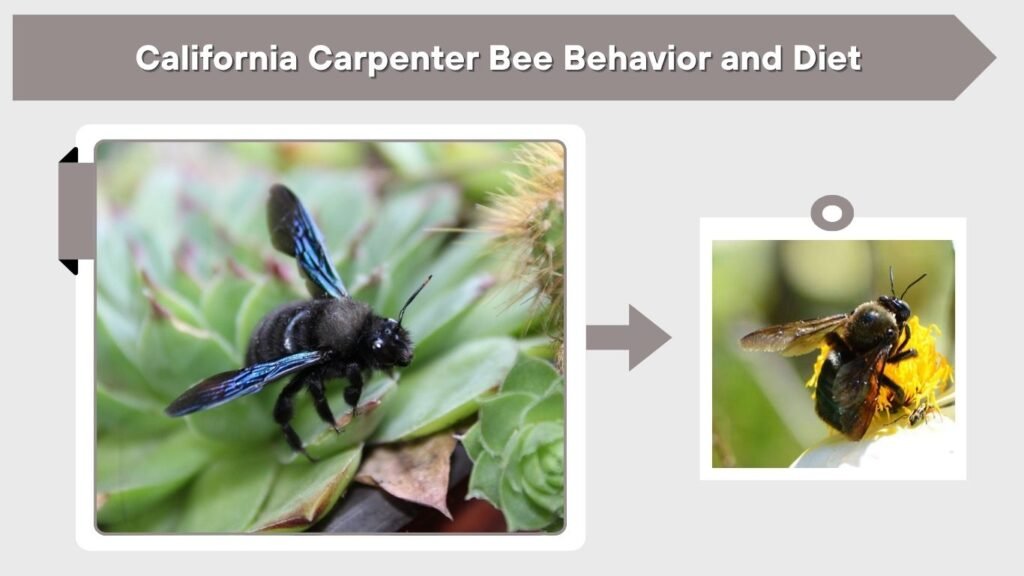
Despite their size, California carpenter bees are generally solitary rather than living in huge colonies like honey bees. Females construct individual nesting galleries, although multiple bees can sometimes use the same piece of wood or even share a general entrance area.
Adults spend much of their active time visiting flowers. Their large bodies allow them to transport substantial amounts of pollen, making them useful pollinators of native and cultivated plants.
What Do California Carpenter Bees Eat?
Adult California carpenter bees primarily consume nectar for energy and collect pollen as a protein-rich food for their offspring. They visit a wide variety of native and introduced flowers.
Females carry pollen and nectar back to their nests and form food provisions inside individual brood chambers. Each developing larva receives its own supply of food.
Carpenter bees occasionally obtain nectar by cutting or using openings near the base of deep flowers rather than entering through the normal flower opening. However, they also provide important pollination while visiting many other flowers normally.
California Carpenter Bee Nest
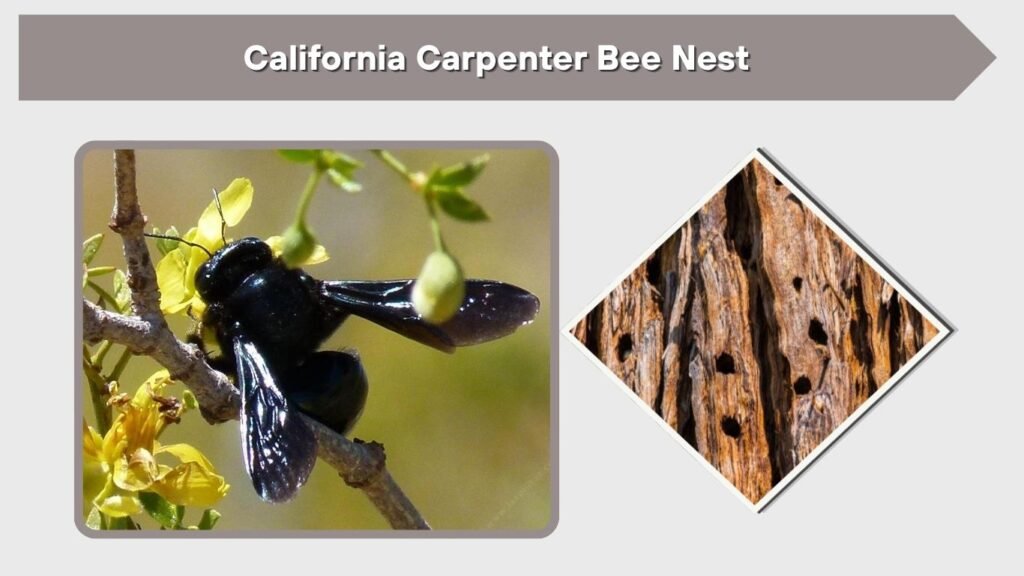
California carpenter bees receive their name from their ability to excavate wood. They do not eat the wood. Instead, females use their strong mandibles to remove wood fibers and create tunnels where eggs can safely develop.
Natural nest locations may include dead trees, logs, branches, redwood, cedar, and dried stalks of plants such as yucca or related vegetation.
California Carpenter Bee Hole Size
Carpenter bee nest entrances are typically round. For carpenter bees generally, tunnels are often about 1/2 inch in diameter and may initially extend approximately 6–10 inches into wood. Inside, females divide the gallery into individual chambers containing an egg and stored pollen food. Older nests may be reused and expanded over time.
Around houses, possible nesting areas include:
- Unpainted wooden beams
- Eaves and fascia boards
- Deck or patio wood
- Fence posts
- Outdoor wooden furniture
- Weathered lumber
- Exposed timber ends
A single nest usually causes limited damage. Repeated nesting in the same wood over many years, however, can enlarge gallery systems and create more significant deterioration.
Are California Carpenter Bees Dangerous?
California carpenter bees may appear dangerous because of their large size and loud buzzing, but they generally pose little risk to people. Males sometimes hover directly in front of humans while defending a territory, yet they have no stinger.
Females can sting, but they typically avoid confrontation. A sting is most likely if a female is squeezed, handled, trapped in clothing, or directly threatened.
Is a California Carpenter Bee Sting Toxic?
A California carpenter bee sting is venomous in the normal bee-sting sense, but the bee is not considered unusually toxic. For most people, a sting causes localized pain, redness, and swelling.
Anyone experiencing trouble breathing, facial or throat swelling, dizziness, widespread hives, or another severe reaction after a bee sting should seek urgent medical attention because serious allergic reactions can occur with bee venom.
California Carpenter Bee Life Cycle
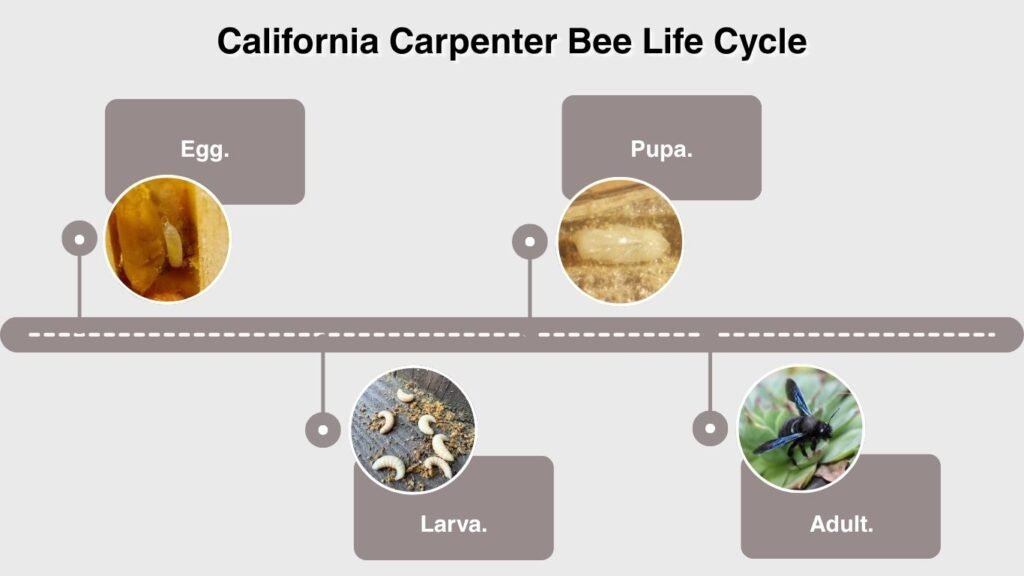
California carpenter bees develop through four main stages: egg, larva, pupa, and adult. The female begins the process by excavating or reusing a wooden tunnel. She creates a series of brood chambers and places a pollen-and-nectar food supply in each chamber before laying an egg.
From Egg to Adult
After an egg hatches, the larva consumes the stored food without needing parental feeding. It grows, molts, and eventually becomes a pupa inside its protected chamber. The adult later emerges from the wooden gallery.
For carpenter bees generally in California, development from egg to adult can take about three months. New adults may emerge in late summer, feed, then overwinter in protected tunnels before becoming active again in spring. UC IPM describes a typical cycle of one generation per year.
California Carpenter Bee Lifespan
There is no single exact lifespan that applies to every California carpenter bee because survival depends on climate, predators, food, nesting conditions, and time of emergence. Their life cycle can nevertheless extend across seasons.
Adults emerging later in the year may survive through winter inside protected nesting tunnels and become active again when temperatures rise. This means an adult can live considerably longer than many short-lived summer insects.
Females that survive winter emerge to establish or reuse nests, while males search for mating opportunities.
California Carpenter Bee vs Valley Carpenter Bee
The California carpenter bee and Valley carpenter bee are not the same species. California has several large carpenter bees, which is why identification can sometimes be confusing.
The California carpenter bee, Xylocopa californica, is especially recognizable by its metallic blue or green reflections. The Valley carpenter bee, currently generally called Xylocopa sonorina, is also widespread in parts of California. The familiar male Valley carpenter bee is often golden or buff colored, while the female is large and black.
Therefore, a large golden “teddy bear” carpenter bee in California is more likely to be a male Valley carpenter bee, not a male California carpenter bee.
Are California Carpenter Bees Beneficial?
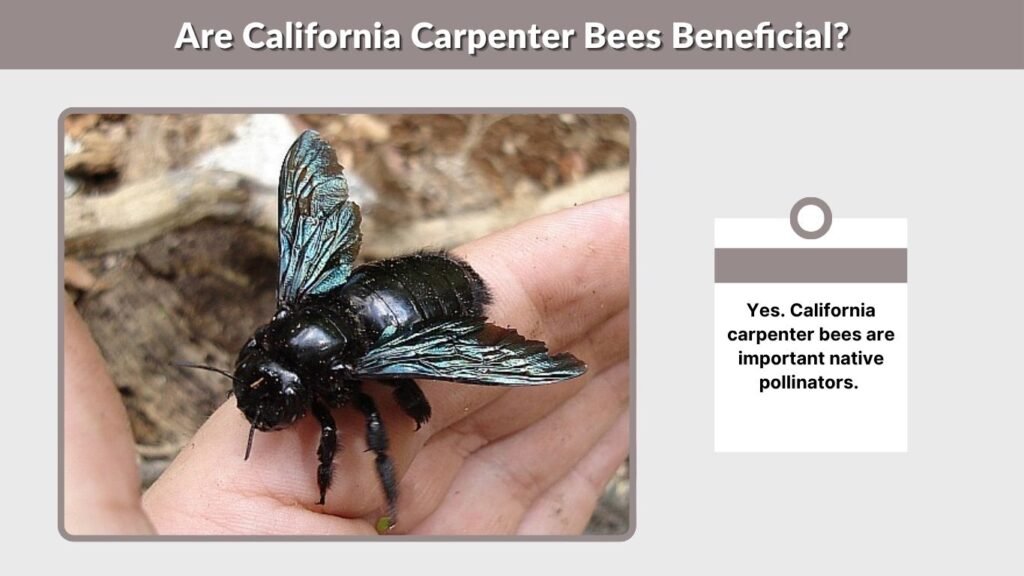
Yes. California carpenter bees are important native pollinators. Their large bodies allow them to carry pollen efficiently between flowers, and they visit many native and introduced plant species.
Problems usually arise only when females repeatedly excavate structural wood around homes. In natural settings, their nesting behavior is simply part of their normal ecology.
When nests are not threatening a building, leaving carpenter bees undisturbed can support local pollinator diversity. For structures, maintaining painted or sealed exposed wood can make surfaces less attractive for future nesting while allowing these impressive native bees to continue pollinating nearby gardens and natural habitats.
FAQs
Are carpenter bees native to California?
Yes. Xylocopa californica is native to western North America and naturally occurs in California.
Do California carpenter bees sting?
Females can sting, but they usually do so only when strongly provoked or handled. Males cannot sting.
Why are California carpenter bees black?
Their bodies are primarily dark, but close inspection often reveals metallic blue or green reflections, particularly on the abdomen.
Do California carpenter bees damage houses?
They can excavate galleries in exposed wooden structures. A small amount of nesting usually causes limited damage, but repeated use and expansion of tunnels over years can become more significant.
What attracts California carpenter bees?
Flower-rich gardens provide nectar and pollen, while suitable weathered or exposed wood can provide nesting habitat. Their presence around flowers is generally beneficial because they are effective native pollinators.