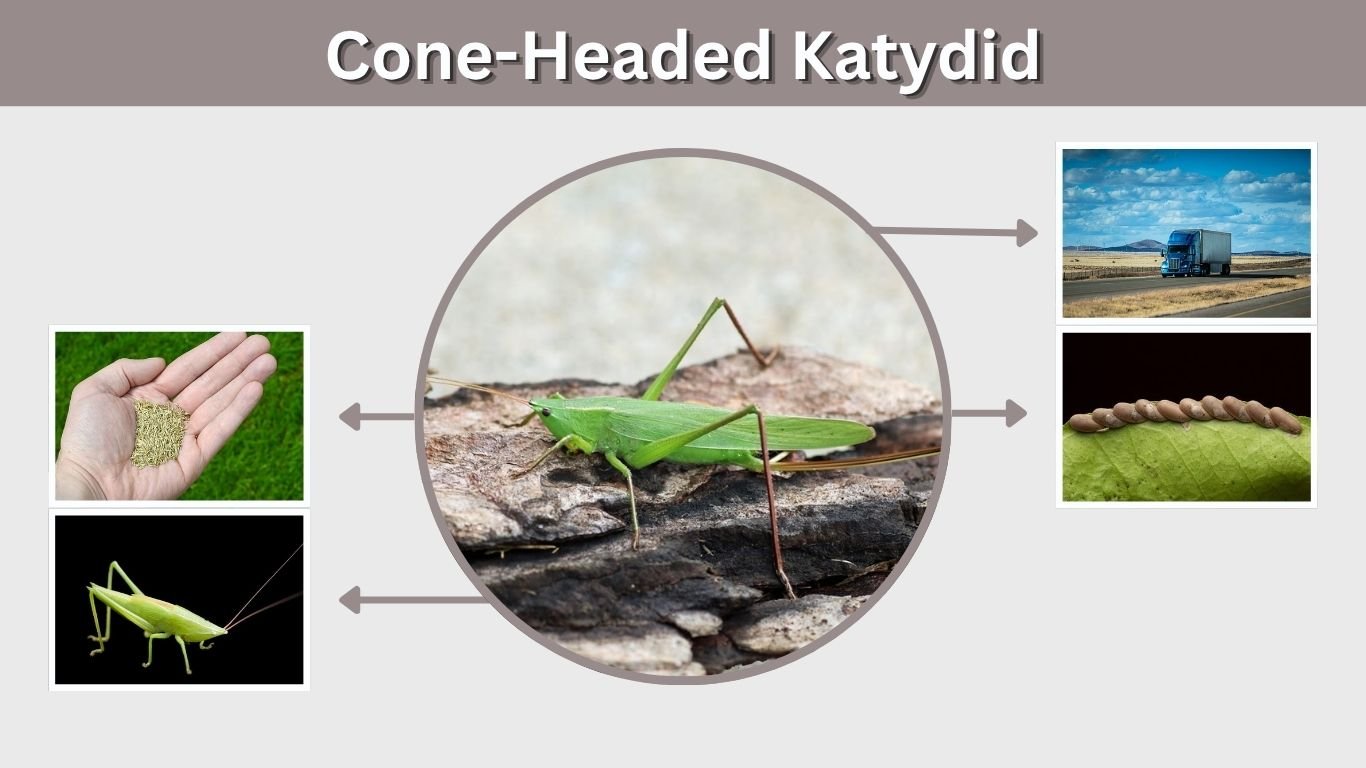
Cone-headed katydids are distinctive insects recognized by the pointed or rounded cone projecting from the front of their heads. Most are green or brown, have extremely long antennae, and produce loud buzzing or rattling songs during warm evenings. The name covers several species rather than one single katydid, including common coneheads in the genus Neoconocephalus and short-winged coneheads in Belocephalus. These insects typically inhabit grasses, wetlands, fields, and other dense vegetation where their colors provide excellent camouflage.
What Is a Cone-Headed Katydid?
Cone-headed katydids belong to the katydid family Tettigoniidae. Their defining characteristic is an extension of the head, called a fastigium, that projects between and beyond the bases of the antennae. North American coneheads include multiple genera and species, so size, cone shape, wings, habitat, and songs vary considerably among different members of the group.
Cone-Headed Katydid Identification
Common identifying characteristics include:
- Pointed or rounded cone-shaped head
- Very long, threadlike antennae
- Green or brown body coloration
- Strong hind legs adapted for jumping
- Long, narrow wings in many species
- Short wings in some specialized species
- Large chewing mouthparts
- Body length of roughly 24–74 mm across North American coneheads
- Excellent camouflage among grasses and leaves
Both green and brown color forms occur among U.S. coneheads. Most species have long wings and can fly well, although some short-winged species are flightless.
Why Do They Have Cone-Shaped Heads?
The projection above the mouthparts gives these insects their common name. Its precise shape is also extremely useful for species identification.
Entomologists often examine the cone from underneath because differences in width, length, shape, and dark markings can separate otherwise similar species. Songs are another important identification tool because several coneheads look nearly identical externally.
Cone-Headed Katydid Sound
Cone-headed katydids are often heard before they are seen. Males create mating calls by rubbing specialized portions of their forewings together, a process called stridulation. Rather than producing the familiar syllabic “katy-did” call of some katydids, many coneheads produce continuous buzzes, repeated pulses, rattles, or other mechanical-sounding songs.
What Does a Cone-Headed Katydid Sound Like?
There is no single conehead song because each species has a characteristic pattern.
For example, the robust conehead (Neoconocephalus robustus) produces an exceptionally loud continuous buzz that can carry hundreds of meters under favorable conditions. The round-tipped conehead (N. retusus) produces a weaker, beady continuous buzz. Caudell’s conehead produces powerful half-second buzzes repeated about once every second.
When Do Coneheads Sing?
Most common coneheads call primarily at night. Males often climb through grasses or other vegetation before singing, although some remain within dense tangles close to the ground.
The round-tipped conehead is unusual because it commonly calls during the afternoon as well as at night. Warm summer and early autumn evenings are especially associated with conehead choruses.
Common Types of Cone-Headed Katydids
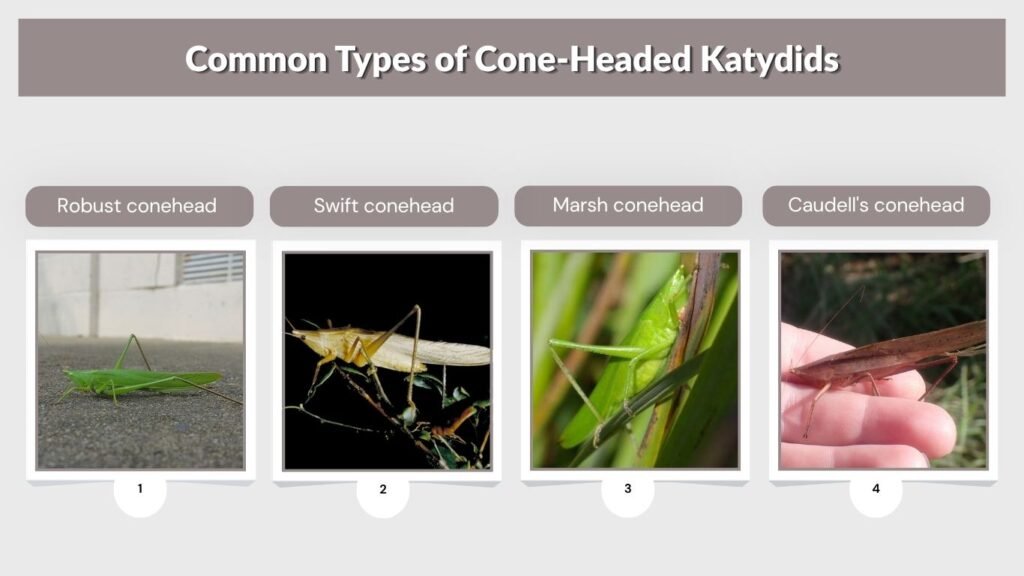
Cone-headed katydids include several genera rather than a single species. In North America, Neoconocephalus contains the insects usually called common coneheads, while Belocephalus contains short-winged coneheads. Other conehead genera are also present. Differences in cone shape and especially male calling songs are useful for separating similar species.
Common Conehead Species
Examples include:
- Robust conehead – Neoconocephalus robustus
- Broad-tipped conehead – Neoconocephalus triops
- Sword-bearing conehead – Neoconocephalus ensiger
- Round-tipped conehead – Neoconocephalus retusus
- Swift conehead – Neoconocephalus velox
- Marsh conehead – Neoconocephalus palustris
- Caudell’s conehead – Neoconocephalus caudellianus
- Palmetto conehead – Belocephalus sabalis
- Half-winged conehead – Belocephalus subapterus
These species occupy different habitats and can have dramatically different songs despite their generally similar appearance.
Palmetto Conehead Katydid
The Palmetto conehead is Belocephalus sabalis. Unlike the typical long-winged common coneheads, it belongs to a group known as the short-winged coneheads.
It occurs in Florida and is associated with palmetto vegetation. Historical records specifically document it on cabbage palmetto and saw palmetto. Its distinctive male calling song also helps distinguish it from related Belocephalus species.
Short-Winged Conehead Katydids
“Short-winged conehead” commonly refers to members of the genus Belocephalus. The group includes Palmetto, Davis’s, and half-winged coneheads in the United States.
Their reduced wings distinguish them from many Neoconocephalus species, which usually possess long wings and are capable flyers. Wing length should nevertheless be considered together with head shape, location, and other identifying features.
What Do Cone-Headed Katydids Eat?
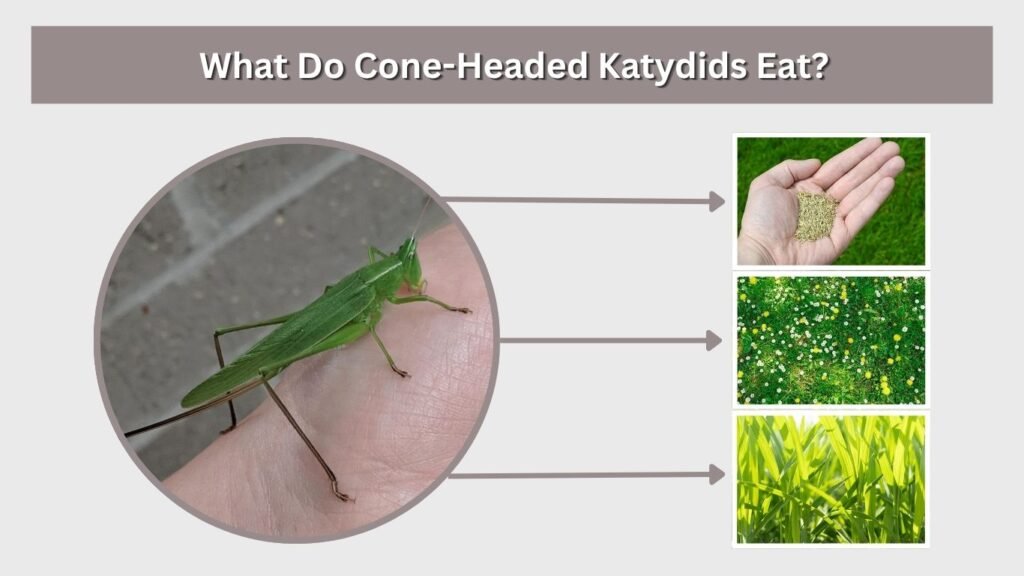
Diet varies among conehead groups, but common coneheads of the genus Neoconocephalus are strongly associated with grasses. Adults feed almost entirely on grass seeds, whereas juveniles mainly consume grass flowers and developing seeds. Other plant material and occasional animal prey may supplement this diet.
Cone-Headed Katydid Diet
Foods recorded for common coneheads include:
- Mature grass seeds
- Developing grass seeds
- Grass flowers
- Sedge fruits
- Grass leaves
- Other suitable plant material
- Occasional living insects
Their powerful jaws allow them to process tough seeds efficiently. This also explains why handling a large conehead directly is unnecessary even though these katydids do not normally seek out people to bite.
Cone-Headed Katydid Habitat
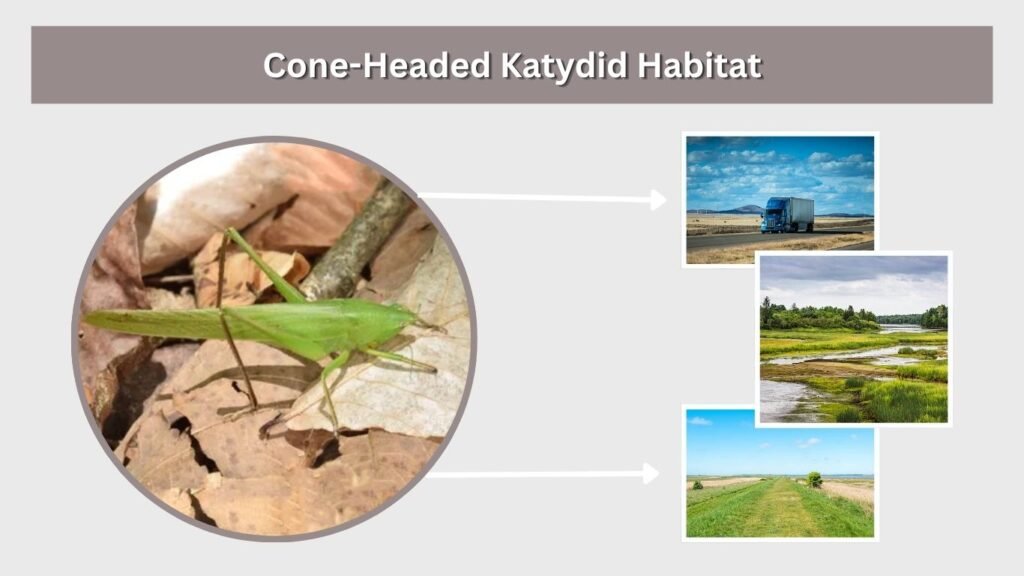
Most coneheads inhabit environments dominated by grasses or dense herbaceous plants. Different species specialize in different conditions, from dry roadside vegetation to wetlands and marshes. Their elongated bodies and green or brown coloration make them difficult to detect while resting vertically among grass stems.
Where Do Coneheads Live?
The round-tipped conehead occurs in grassy or weedy open habitats ranging from relatively dry sites to wet areas, including roadsides, old fields, and marsh edges. Robust coneheads favor tall vegetation in places such as moist prairies and marsh borders. Marsh coneheads occupy dense vegetation in wet habitats.
Many North American species occur in the eastern United States. Some have broad ranges, while others occupy much smaller geographic areas.
Cone-Headed Katydid Life Cycle
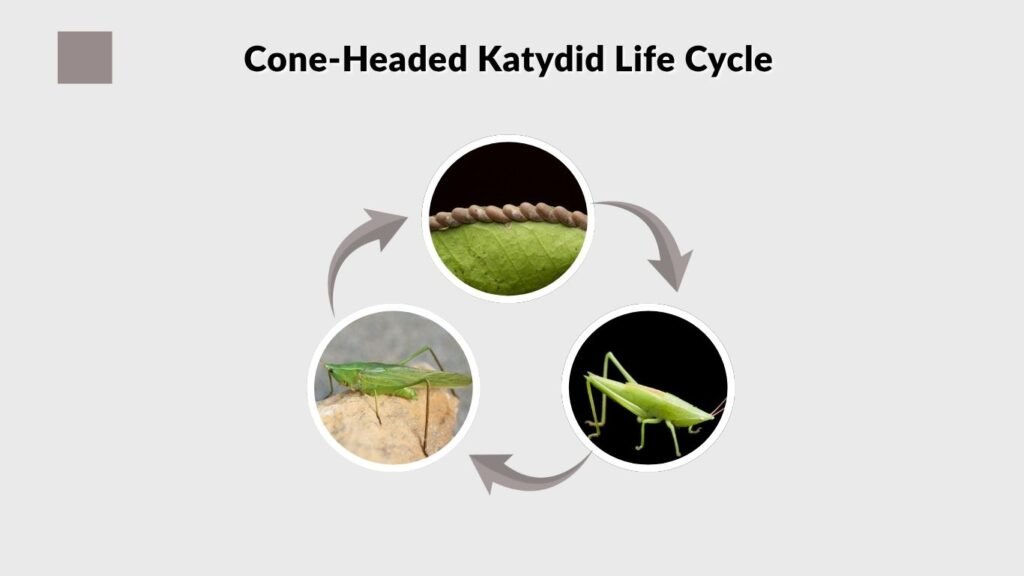
Like other katydids, coneheads undergo incomplete metamorphosis. They develop from eggs into nymphs and finally adults without passing through a pupal stage. Young coneheads resemble small adults but lack fully developed wings and reproductive structures. Seasonal timing differs between species, particularly in warmer southern climates.
Life Cycle Stages
The basic stages include:
- Egg: Females deposit eggs in suitable plant material or other protected sites.
- Nymph: Young katydids hatch looking like miniature wingless adults.
- Growth: Nymphs feed and repeatedly molt.
- Wing development: Wing pads gradually enlarge with each molt.
- Adult: The final molt produces a reproductively mature katydid.
- Mating: Males sing to attract females and begin another generation.
Most Neoconocephalus species in the referenced North American group produce one generation annually and overwinter as eggs. The broad-tipped conehead (N. triops) is unusual because it can overwinter as an adult and produce multiple generations farther south.
Are Cone-Headed Katydids Dangerous?
Their pointed heads, large jaws, and substantial size can make coneheads look intimidating, but they are not venomous or equipped with a stinger. They are primarily plant-associated insects concerned with feeding, mating, and avoiding predators rather than attacking humans.
Can a Cone-Headed Katydid Bite?
Coneheads have strong chewing mandibles, so a large individual could potentially pinch skin if it were restrained or handled roughly. However, biting people is not their normal behavior.
The safest practice is simply to observe them without gripping them. If one enters a building, it can be guided into a container and released into suitable vegetation outdoors.
FAQs
1. What is a cone-headed katydid?
A cone-headed katydid is a katydid characterized by a pointed or rounded projection extending forward from its head. The term covers multiple species and genera, including Neoconocephalus common coneheads and Belocephalus short-winged coneheads.
2. What sound does a cone-headed katydid make?
Sounds vary by species. Many produce prolonged buzzing, rattling, or pulsing calls rather than the classic “katy-did” rhythm. Robust coneheads produce especially loud continuous buzzes, while other species have weaker or regularly repeated calls.
3. What do cone-headed katydids eat?
Common coneheads in the genus Neoconocephalus primarily eat grass seeds. Juveniles commonly feed on flowers and developing grass seeds, while adults rely heavily on mature seeds. Grass leaves, sedge fruits, and occasional insects may also be eaten.
4. What is a Palmetto conehead katydid?
The Palmetto conehead (Belocephalus sabalis) is a short-winged conehead associated with Florida. It has been recorded around cabbage and saw palmettos and belongs to a different genus from the familiar long-winged common coneheads.
5. Can cone-headed katydids fly?
Many cone-headed katydids are strong flyers and have long forewings with functional hindwings. However, some species have reduced wings and cannot fly effectively. Short-winged Belocephalus species are examples of coneheads with abbreviated wings.