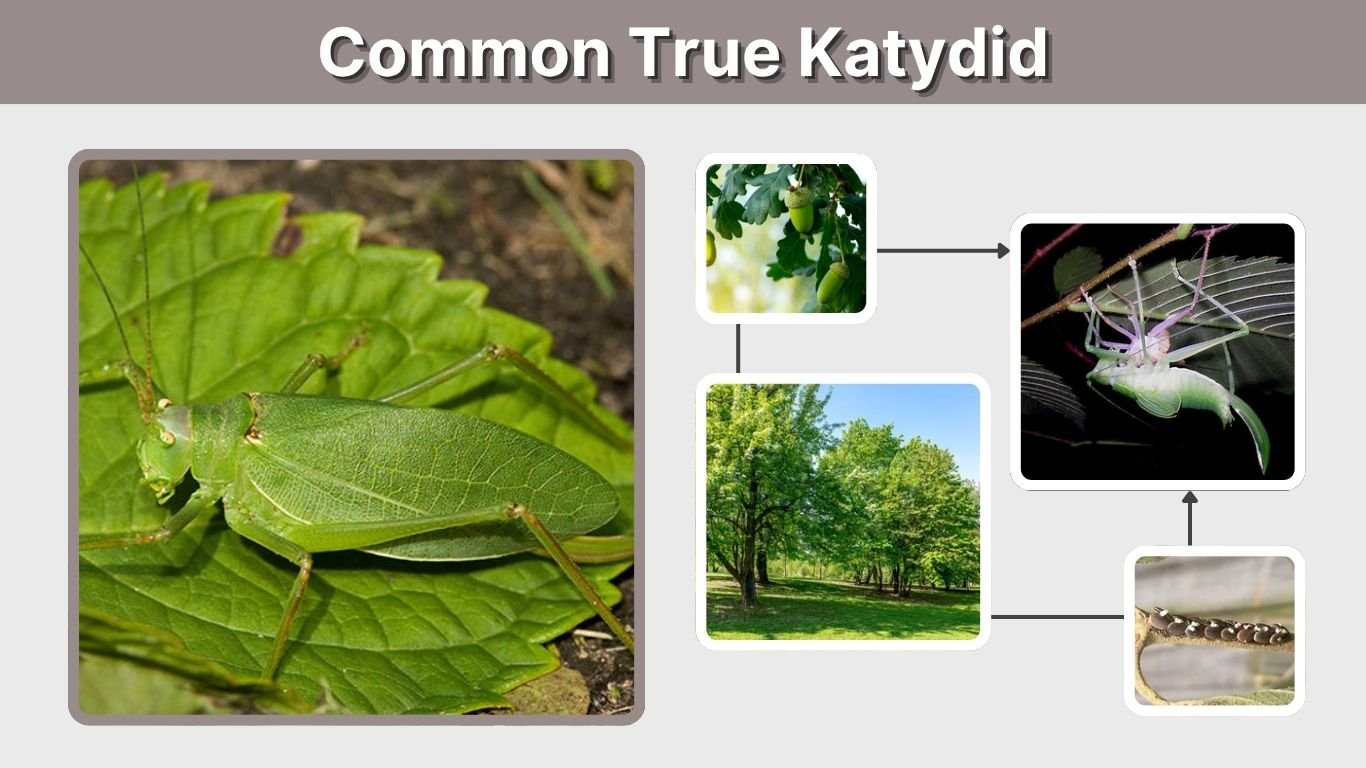
The common true katydid (Pterophylla camellifolia) is a large, leaf-like insect best known for its loud nighttime song that sounds like “katy-did, katy-didn’t.” It lives mainly in deciduous forest canopies across the eastern United States, where its green wings provide excellent camouflage among leaves. Adults are relatively large but are often heard more easily than seen. This guide covers common true katydid identification, size, sound, diet, nymphs, habitat, range, life cycle, and other interesting facts about this remarkable singing insect.
What Is a Common True Katydid?
The common true katydid is a member of the family Tettigoniidae and subfamily Pseudophyllinae. Its scientific name is Pterophylla camellifolia, and it is also called the northern katydid, northern true katydid, or rough-winged katydid. Its broad, strongly veined wings resemble leaves and help conceal it high in deciduous trees.
Common True Katydid Identification
Important identification characteristics include:
- Bright to medium green coloration
- Broad, rounded, leaf-like forewings
- Strong veins across the wings
- Wings forming a cup-like shape over the abdomen
- Extremely long, thin antennae
- Long jumping legs
- Robust, somewhat hump-backed body
- Two shallow grooves on the pronotum
- Adult size of roughly 45–55 mm
The leaf-shaped wings are particularly effective camouflage when the katydid rests among tree foliage.
Why Is It Called a “True” Katydid?
The common name comes from its famous rhythmic call. To human ears, the repeated notes can resemble the words “katy-did” or “katy-didn’t.”
This familiar sound helped give katydids their English name. The common true katydid is one of the classic eastern species associated with loud summer insect choruses.
Common True Katydid Sound and Song
Sound is one of the most noticeable characteristics of Pterophylla camellifolia. Adults usually remain hidden high among foliage, but their calls can carry through forests during warm evenings. Both males and females are capable of stridulation, although males are generally louder. The song can also vary among geographic populations.
What Does a Common True Katydid Sound Like?
Its call is usually described as a harsh, rhythmic series resembling “katy-did” or “katy-didn’t.” Several individuals calling together can create an intense chorus.
The sound is produced through stridulation, in which specialized structures on the wings are rubbed together. Calling generally begins around dusk and continues into the night.
Why Do Common True Katydids Sing?
The primary function of the song is communication associated with reproduction. Males call to advertise their presence and help attract females.
Warm summer nights can support particularly strong choruses because many adults may call simultaneously from the forest canopy. Research on the species has also documented nightly and seasonal patterns in its calling activity.
What Do Common True Katydids Eat?
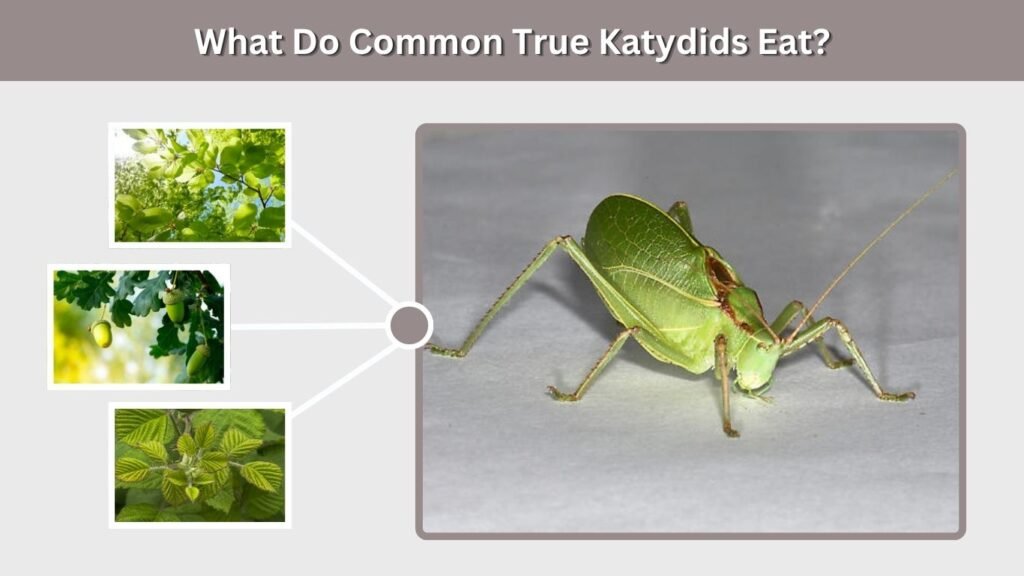
Common true katydids are primarily foliage feeders. Because they spend much of their lives in trees and shrubs, they have easy access to leaves. Their chewing mouthparts allow them to remove sections of plant tissue, although they are usually encountered as part of natural forest ecosystems rather than as major household pests.
Common True Katydid Diet
Foods can include:
- Leaves of deciduous trees
- Shrub foliage
- Oak leaves
- Bramble leaves
- Viburnum foliage
- Other suitable broadleaf vegetation
Captive individuals have been recorded eating oak, bramble, and leatherleaf viburnum. In nature, their diet includes foliage from deciduous trees and shrubs.
Do Common True Katydids Damage Trees?
Individual katydids generally remove relatively small amounts of foliage. They may leave irregular chewing marks or missing sections along leaves.
Because they spend much of their time high in tree canopies, their feeding is often unnoticed. They are usually more famous for their nighttime calls than for causing significant visible plant damage.
Common True Katydid Nymph
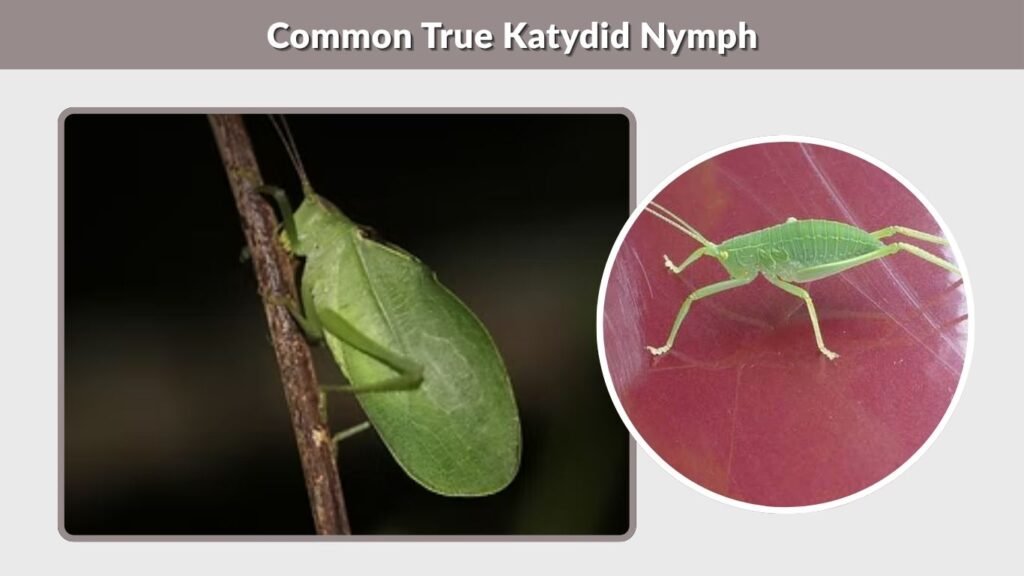
Young common true katydids are called nymphs. Unlike butterflies and moths, katydids do not pass through a caterpillar or pupal stage. Nymphs resemble smaller, wingless versions of adults and gradually develop their characteristic wings and reproductive structures through repeated molts.
What Does a Nymph Look Like?
A common true katydid nymph typically has:
- Bright green coloration
- Long antennae
- Long hind legs
- A relatively slender body
- No fully developed wings
- Small developing wing pads in older nymphs
- Leaf-like camouflage
A documented juvenile photographed in Alachua County, Florida, shows the characteristic green coloration and long-legged appearance of the immature stage.
How Does the Nymph Become an Adult?
The nymph grows by periodically shedding its exoskeleton. After each molt, its body becomes larger and its wing pads develop further.
Eventually, the final molt produces a fully winged adult capable of reproduction and singing. This developmental process is known as incomplete metamorphosis because there is no pupal stage.
Common True Katydid Life Cycle
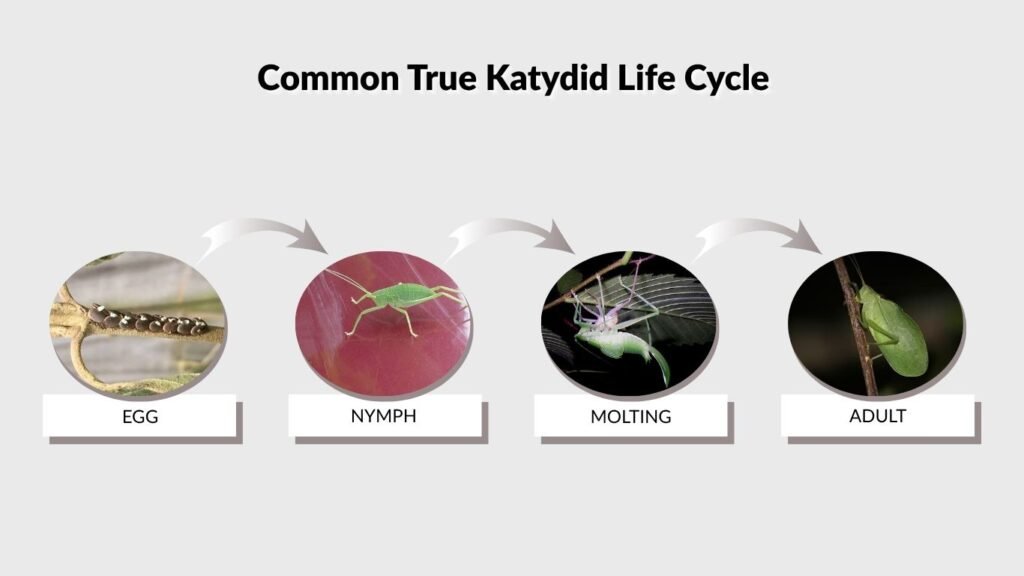
The common true katydid generally produces one generation each year. Eggs survive through the colder season and hatch when conditions become favorable in spring. Nymphs then feed and grow during the warmer months, with adults becoming common later in summer and surviving until frost in many parts of their range.
Life Cycle Stages
The life cycle includes:
- Egg: Females insert eggs into loose bark or young tree stems.
- Spring hatching: Eggs hatch as temperatures warm.
- Nymph: Young katydids begin feeding on vegetation.
- Molting: Nymphs pass through several progressively larger stages.
- Adult: Fully developed katydids appear during summer.
- Mating and egg laying: Adults reproduce before cold weather returns.
There is generally one brood each year.
Common True Katydid Eggs
Instead of laying exposed clusters on leaves, females place their eggs into suitable plant material. Loose bark and young tree stems provide protected locations.
The eggs remain through the colder season before hatching in spring, allowing the next generation to appear when fresh vegetation and warmer temperatures return.
Common True Katydid Range and Habitat
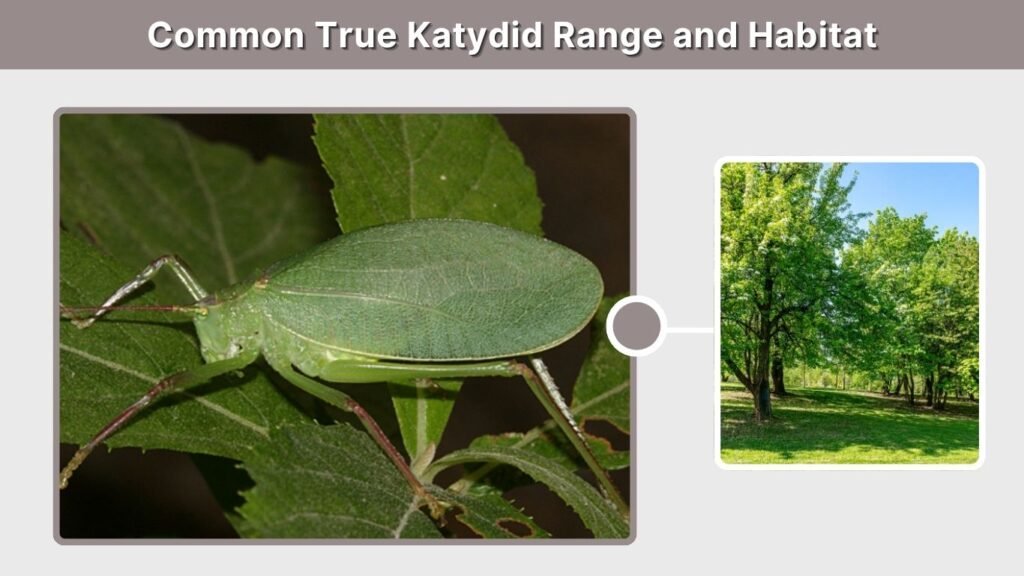
The common true katydid is primarily an eastern U.S. species associated with deciduous woodland. It spends much of its time high in the forest canopy, which explains why people frequently hear the species without actually seeing it. Adults are typically active from midsummer until frost, with exact timing varying by latitude and climate.
Where Are Common True Katydids Found?
Their range includes much of the eastern United States, particularly areas roughly extending through:
- Texas
- Florida
- The southeastern states
- The Mid-Atlantic
- Parts of the Northeast
- Massachusetts
- Parts of the Midwest
- Iowa and surrounding areas
Local distribution varies, but mature deciduous woodland provides particularly suitable habitat.
Why Are They Hard to Find?
Common true katydids usually remain high in trees rather than sitting openly near the ground. Their green color and heavily veined wings closely resemble leaves.
They are also effectively flightless, although they may glide toward lower branches. As a result, listening for their loud calls at dusk is often easier than searching visually for them.
Common True Katydid Size and Flight
Adult common true katydids are fairly large insects, reaching approximately 45–55 mm in length. Their broad wings make them look even larger and more leaf-like. Despite possessing wings, they are not strong flyers like many other katydid species. Their body design favors camouflage and life among tree branches.
Can Common True Katydids Fly?
Common true katydids are generally regarded as flightless. Their large, rounded wings are better suited to camouflage than sustained flight.
When disturbed high in a tree, an individual may glide downward to another branch rather than fly actively for a long distance. It may also crawl or hop to escape danger.
FAQs
1. What is the scientific name of the common true katydid?
The scientific name is Pterophylla camellifolia. It belongs to the family Tettigoniidae and subfamily Pseudophyllinae. Other common names include northern true katydid, northern katydid, and rough-winged katydid.
2. What does a common true katydid sound like?
Its rhythmic call is commonly interpreted as “katy-did” or “katy-didn’t.” Adults typically begin singing around dusk and continue into the night. Both sexes can stridulate, although males usually produce louder calls.
3. What do common true katydids eat?
They primarily eat the foliage of deciduous trees and shrubs. Oak, bramble, and leatherleaf viburnum have been eaten by captive individuals, while wild katydids feed on various suitable leaves in forest canopies.
4. How big is a common true katydid?
Adult common true katydids are approximately 45–55 mm long, or about 1.8–2.2 inches. Their broad leaf-shaped wings and long legs can make them appear larger than their body length suggests.
5. Where do common true katydids live?
They primarily inhabit deciduous forests across the eastern United States. They spend much of their time high in tree canopies and are therefore commonly heard rather than seen, especially from midsummer through early fall.