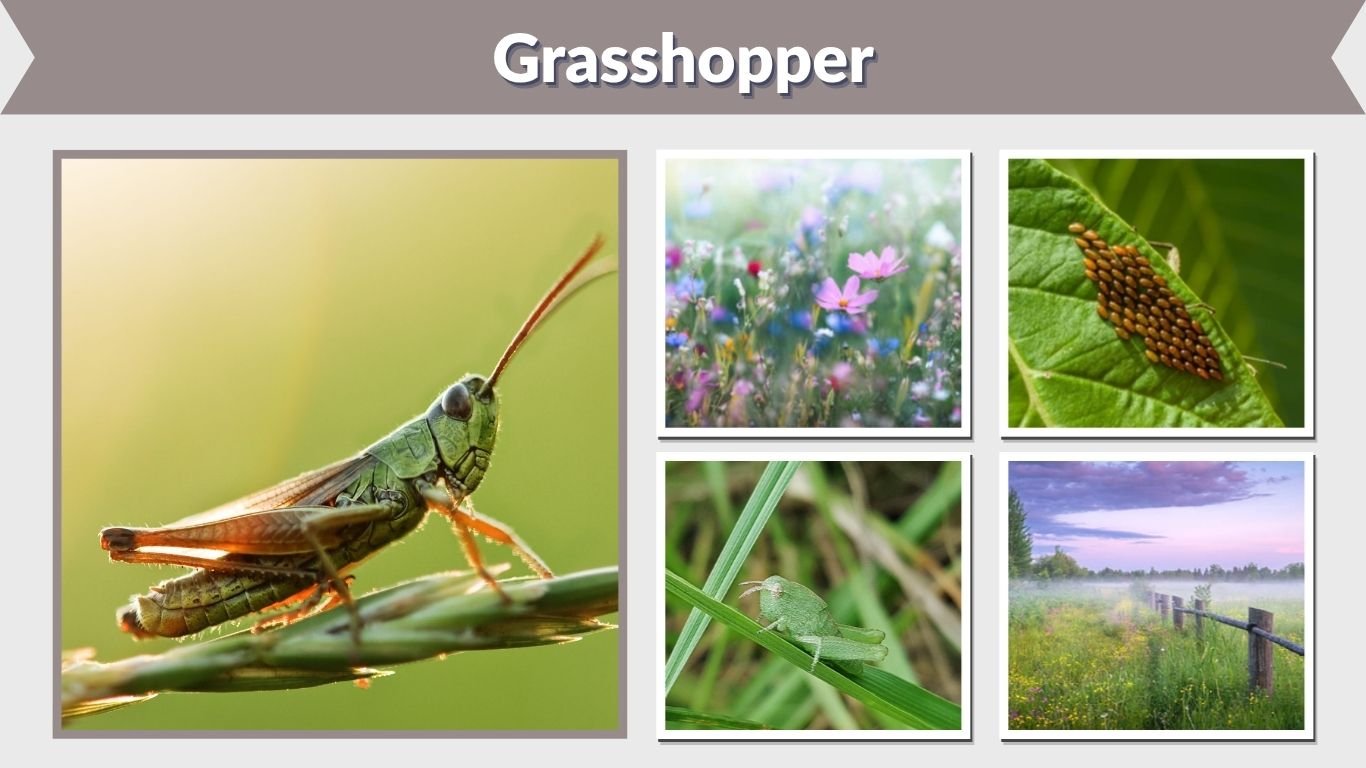
Grasshoppers are familiar jumping insects found in grasslands, gardens, farms, forests, and many other habitats around the world. Known for their powerful hind legs and ability to leap impressive distances, these insects also have wings, strong chewing mouthparts, and an interesting life cycle. Some species are small and green, while others are large, brown, black, or even unusually pink. This guide explains what grasshoppers eat, whether they bite, how they fly, their life cycle, identification features, and how they differ from locusts and crickets.
What Is a Grasshopper?
A grasshopper is an insect belonging to the order Orthoptera, which also includes crickets and katydids. Most grasshoppers are active during warm weather and spend much of their time among grasses and other vegetation. They are especially recognizable because their enlarged hind legs allow them to escape predators quickly by making powerful jumps.
Grasshopper Identification
Common features that help identify a grasshopper include:
- Three distinct body regions: head, thorax, and abdomen
- Six legs, with greatly enlarged hind legs
- Two relatively short antennae
- Large compound eyes
- Strong chewing mouthparts
- Two pairs of wings in most adults
- Green, brown, gray, yellow, or patterned coloration
- A body usually adapted for blending into vegetation
Grasshopper Size and Appearance
Grasshopper size varies considerably between species. Small species may measure less than an inch long, while some giant grasshoppers grow several inches in length.
Green grasshoppers often disappear almost completely among leaves and grasses. Brown grasshoppers are better camouflaged against soil, bark, and dry vegetation. Black grasshoppers also occur, while rare genetic color variations can produce striking pink grasshoppers.
What Do Grasshoppers Eat?
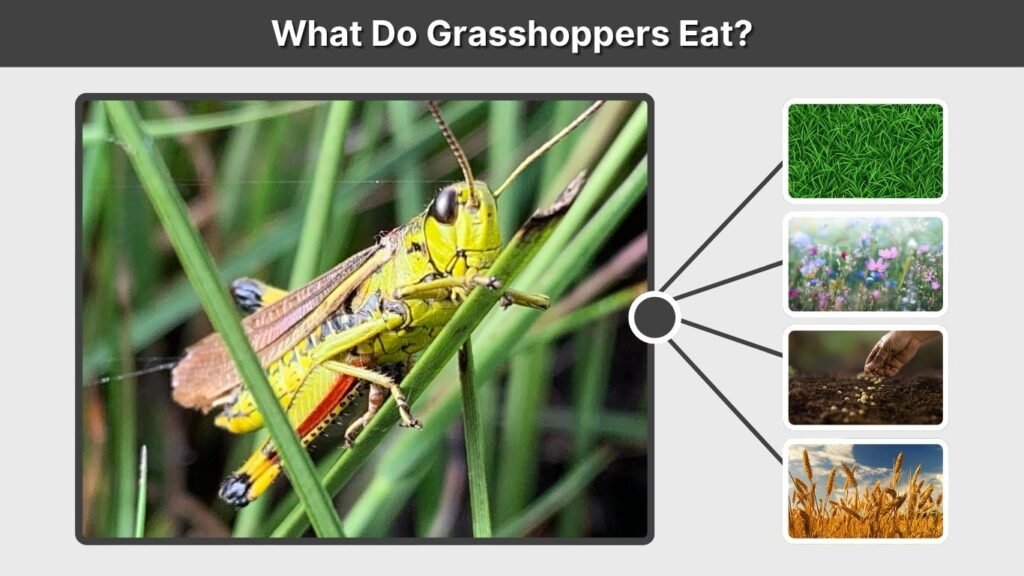
Grasshoppers are primarily plant-eating insects, although diets differ somewhat between species. Their powerful mandibles can cut through leaves, stems, flowers, and other plant material. Because large populations can consume considerable amounts of vegetation, certain grasshopper species can become important agricultural pests when environmental conditions favor rapid population growth.
Common Grasshopper Foods
Grasshoppers may feed on:
- Grass
- Leaves
- Plant stems
- Flowers
- Seeds
- Grains
- Agricultural crops
- Shrubs and weeds
- Decaying plant material
Some species occasionally consume other materials, but vegetation forms the main part of the diet for most grasshoppers.
Do Grasshoppers Eat Grass?
Yes. Grass is one of the most common foods eaten by grasshoppers. Their chewing mouthparts are designed for cutting and grinding tough plant material.
Grasshoppers living in meadows and lawns may spend much of the day moving between grass stems while feeding. However, they are not limited to grass and may switch to broadleaf plants, crops, flowers, or weeds depending on the species and available food.
Can Grasshoppers Fly?
Many adult grasshoppers can fly, although their flying ability varies greatly between species. Jumping is normally their most noticeable form of movement because their muscular hind legs can propel them away from danger instantly. Wings allow adults to travel farther, locate food, find mates, and move away from unsuitable environmental conditions.
Grasshopper Wings
Most winged grasshoppers have two pairs of wings. The front pair is relatively firm and protects the more delicate hind wings underneath. When the insect takes flight, the hind wings unfold and provide much of the lifting surface.
Their wings can serve several purposes:
- Traveling between feeding areas
- Escaping predators
- Finding mates
- Moving to new habitats
- Dispersing when food becomes scarce
Young grasshoppers cannot fly because their wings are not fully developed.
Jumping vs Flying
Grasshoppers often jump before taking flight. Their large hind legs contain powerful muscles capable of generating rapid acceleration. A threatened grasshopper may leap suddenly and then spread its wings to extend the distance it travels.
Some short-winged species rely primarily on jumping instead of sustained flight.
Grasshopper Life Cycle
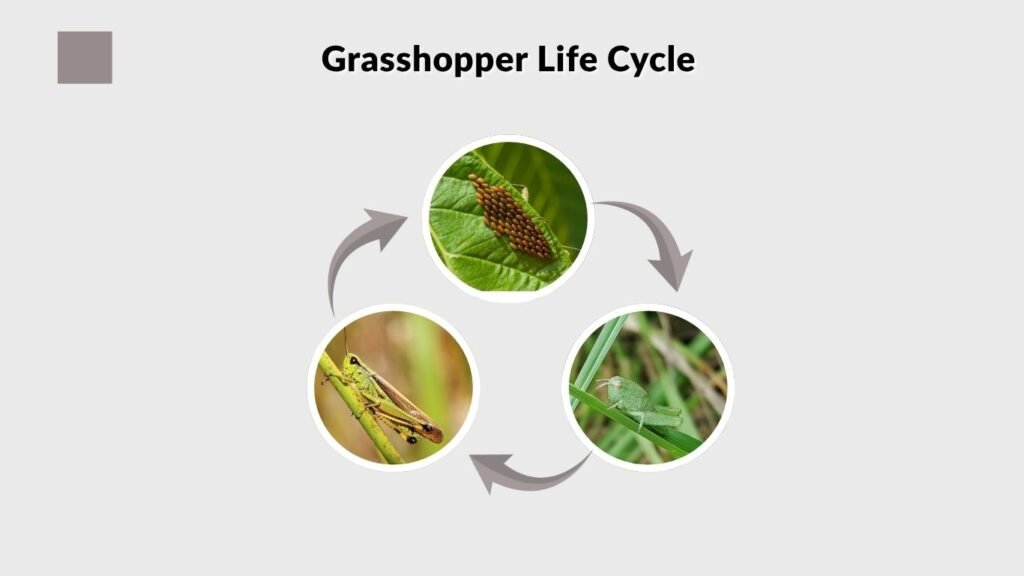
The grasshopper life cycle is an example of incomplete metamorphosis. Unlike butterflies and beetles, grasshoppers do not have a caterpillar-like larval stage or a pupal stage. Instead, young grasshoppers resemble miniature adults and gradually develop larger bodies and functional wings through several molts.
Three Grasshopper Life Stages
The basic life cycle consists of:
- Egg: Females typically deposit groups of eggs in soil or another protected location.
- Nymph: Young grasshoppers hatch without fully developed wings and pass through several molts.
- Adult: After the final molt, the grasshopper develops mature wings and reproductive organs.
The amount of time needed to complete the cycle varies by species, climate, temperature, and food availability.
What Is a Baby Grasshopper Called?
A baby grasshopper is called a nymph. Nymphs look similar to adults but are smaller and lack fully developed wings.
As a young grasshopper grows, its external skeleton becomes too small. It sheds this covering through molting and produces a larger one. Wing structures become progressively more noticeable until the insect reaches adulthood.
Do Grasshoppers Bite?
Grasshoppers have chewing mouthparts capable of cutting vegetation, so technically they can bite. However, grasshoppers do not normally seek out humans as food and generally prefer escaping when disturbed. A defensive nip may occur if a grasshopper is trapped, squeezed, or handled roughly, but ordinary encounters rarely result in a bite.
Can a Grasshopper Bite Humans?
A grasshopper may pinch human skin with its mandibles when it feels threatened. For most people, such contact causes little more than temporary discomfort.
Grasshoppers do not have venomous fangs or stingers. Their primary defenses are camouflage, jumping, flying, and sometimes producing defensive secretions.
Avoiding Defensive Bites
When observing grasshoppers:
- Avoid squeezing or tightly gripping them.
- Allow the insect to walk onto your hand naturally.
- Keep fingers away from its mouthparts.
- Release it if it begins struggling.
- Wash your hands after handling wild insects.
Simply leaving a grasshopper alone is usually enough to avoid any problem.
Grasshopper vs Locust vs Cricket
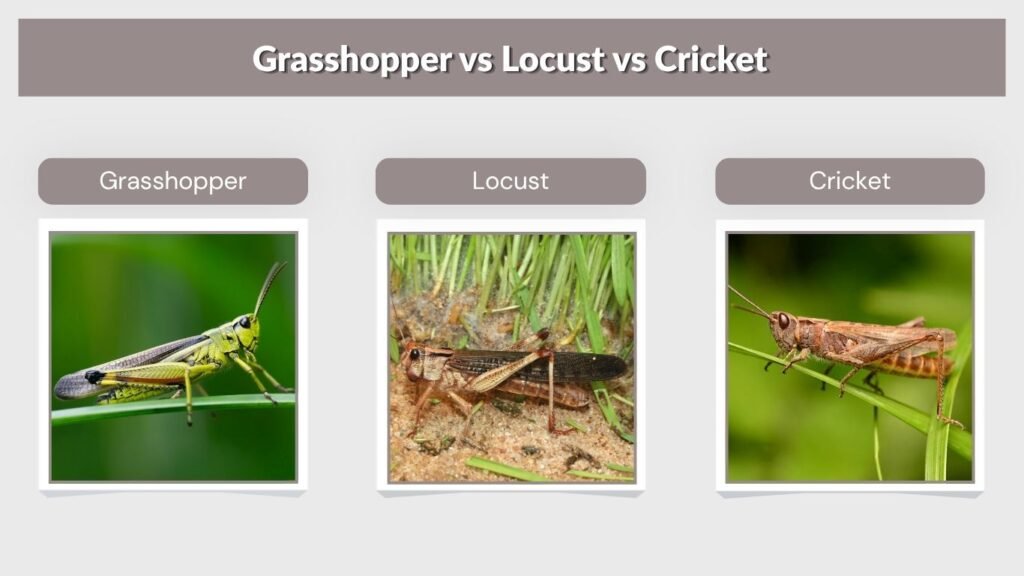
Grasshoppers, locusts, and crickets belong to the order Orthoptera, so they share features such as strong hind legs and chewing mouthparts. However, these names describe insects with different appearances, behaviors, and lifestyles. One particularly important point is that locusts are not a completely separate type of insect from grasshoppers.
Grasshopper vs Locust
Locusts are certain grasshopper species capable of changing their behavior and appearance when population conditions trigger a gregarious phase. During this phase, enormous numbers can form coordinated groups or swarms and travel long distances.
Ordinary grasshoppers usually live more independently and do not produce the same large migratory swarms.
Grasshopper vs Cricket
Crickets generally have much longer antennae than grasshoppers. Many crickets are also most active during the evening or nighttime, whereas numerous grasshopper species are more noticeable during daylight.
Both groups produce sounds, but they use different structures and behaviors to create their characteristic calls.
Where Do Grasshoppers Live?
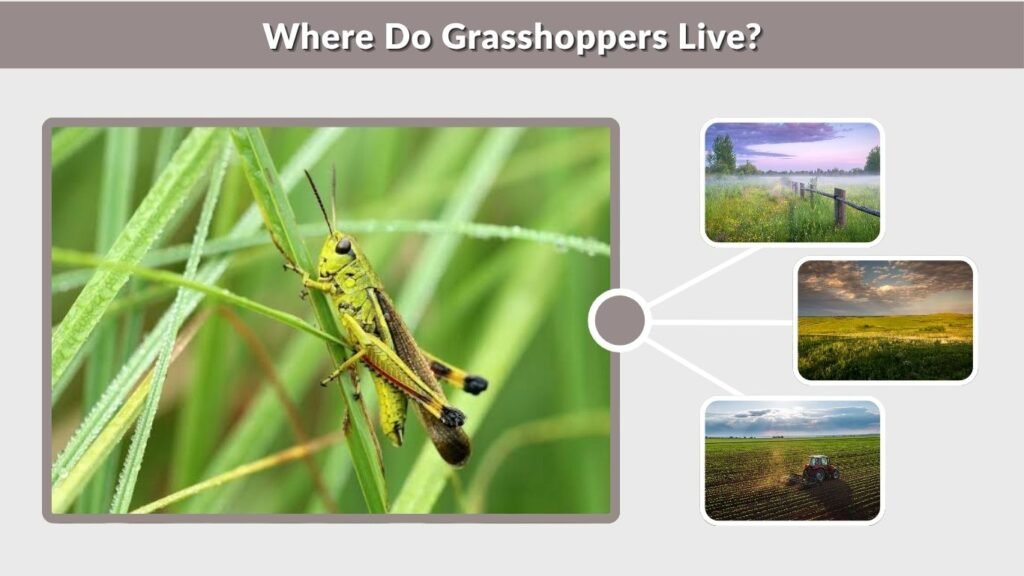
Grasshoppers occur in many environments wherever temperatures and vegetation provide suitable conditions. They are particularly abundant in open habitats where grasses and low-growing plants provide both food and cover.
Common Grasshopper Habitats
Grasshoppers can commonly be found in:
- Meadows
- Grasslands
- Agricultural fields
- Gardens
- Roadside vegetation
- Woodland edges
- Shrublands
- Semi-arid areas
Their exact distribution depends on the species. Some thrive in moist vegetation, while others are specifically adapted to hot, dry habitats.
FAQs
1. What do grasshoppers eat?
Most grasshoppers eat vegetation, including grass, leaves, stems, flowers, seeds, grains, and agricultural crops.
2. Can grasshoppers fly?
Yes. Many adult grasshoppers have functional wings and can fly, although flight ability varies among species.
3. Do grasshoppers bite people?
Grasshoppers can occasionally pinch the skin when handled or threatened, but they do not normally attack humans.
4. What is a young grasshopper called?
A young grasshopper is called a nymph. It resembles a small adult but does not yet have fully developed wings.
5. Are locusts and grasshoppers the same?
Locusts are specialized grasshoppers that can enter a swarming phase under certain environmental and population conditions. Therefore, all locusts are grasshoppers, but not all grasshoppers are locusts.