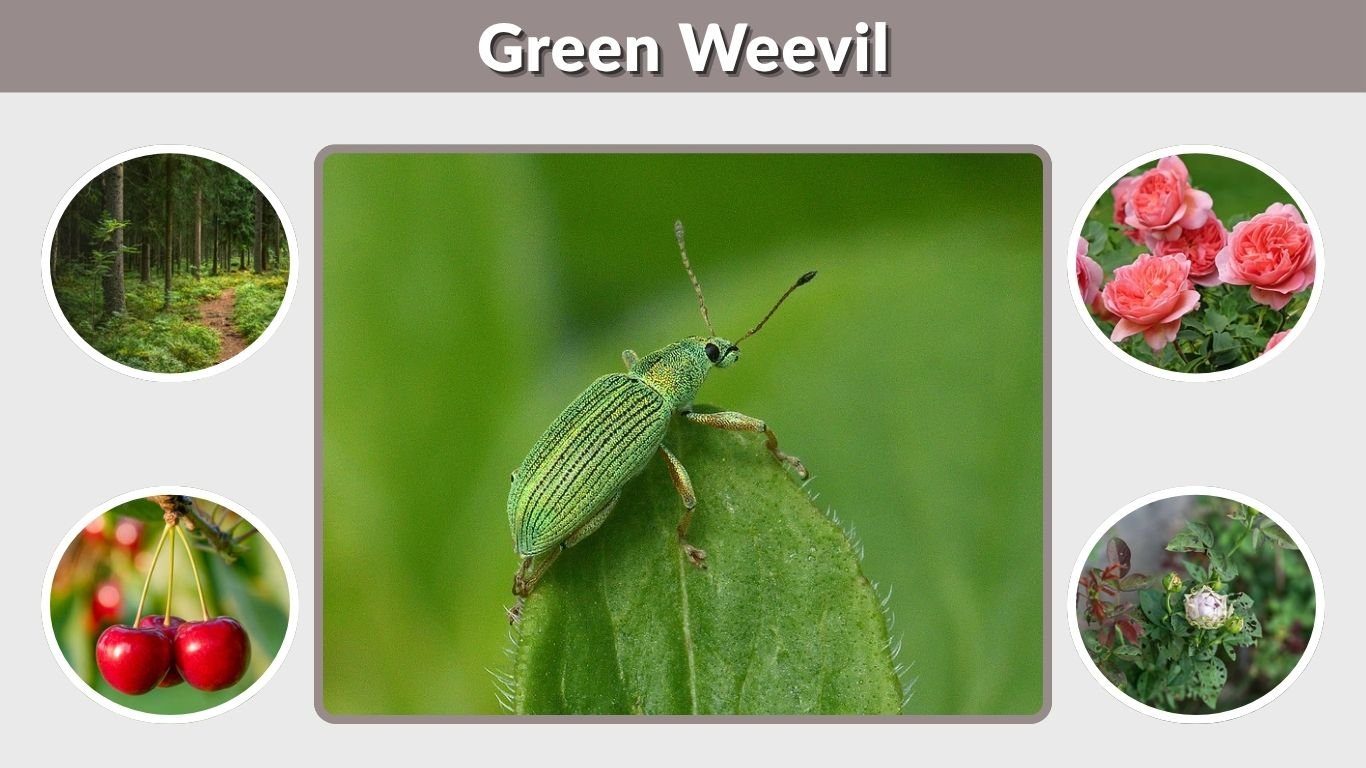
The green weevil is a small beetle recognized by its distinctive snout and green, blue-green, or metallic coloration. Several different weevil species can appear green, including the green immigrant leaf weevil, pale green weevil, green nettle weevil, and blue-green citrus root weevil. Most feed on leaves as adults, while their larvae may develop in soil and feed on plant roots. Although green weevils are generally harmless to people, some species can damage ornamental plants, fruit trees, shrubs, and crops when populations become large. Correct identification is therefore important before deciding whether control is necessary.
What Is a Green Weevil?
The term green weevil does not refer to just one species. It is commonly used for several members of the weevil family that have green scales or metallic coloration.
Weevils belong to the beetle order Coleoptera and are usually recognized by their characteristic snout, technically called a rostrum.
Some green weevils have long, obvious snouts, while broad-nosed species have shorter and wider snouts.
Green Weevil Identification
Typical green weevil characteristics include:
- Small to medium-sized beetle
- Green, pale green, turquoise, or blue-green body
- Short or elongated snout
- Elbowed antennae
- Hard wing covers
- Oval or pear-shaped body
- Six legs
- Scaly or metallic-looking surface
- Slow crawling behavior
- Ability to drop from plants when disturbed
The green appearance often comes from tiny colored scales covering the body rather than from the insect’s underlying exoskeleton.
As these scales wear away, older individuals may look duller, grayish, brownish, or patchy.
What Does a Green Weevil Look Like?
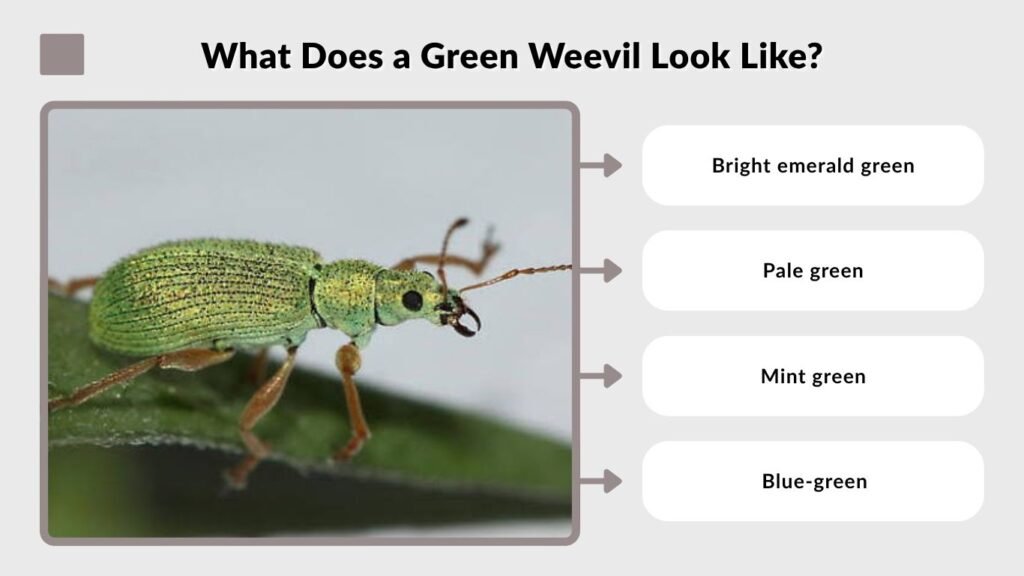
Most green weevils have compact bodies and noticeably narrower heads.
Their most recognizable feature is the projection extending from the front of the head. Depending on species, this snout may be short and broad or relatively long.
Colors vary considerably.
A green weevil may appear:
- Bright emerald green
- Pale green
- Mint green
- Blue-green
- Silvery green
- Metallic turquoise
- Green with brown patches
Lighting can also affect how shiny or iridescent species appear.
How Big Are Green Weevils?
Many commonly encountered green weevils are only around 1/4 inch long, although exact size depends on species.
Their small size sometimes makes identification difficult without magnification.
A small green insect with a broad body, elbowed antennae, and a short snout is often a broad-nosed weevil.
Green Immigrant Leaf Weevil
The green immigrant leaf weevil is one of the most frequently encountered insects described simply as a green weevil.
It belongs to the genus Polydrusus and has spread well beyond its original European range.
Adults are usually covered with green or bluish-green scales.
Green Immigrant Leaf Weevil Identification
Look for:
- Green to blue-green coloration
- Oval body
- Broad, relatively short snout
- Elbowed antennae
- Approximately 5–7 mm body length
- Light-colored legs
- Small patches where green scales may be missing
Adults commonly occur on trees, shrubs, and other vegetation.
They may drop suddenly when approached, which is a common defensive behavior among weevils.
Pale Green Weevil
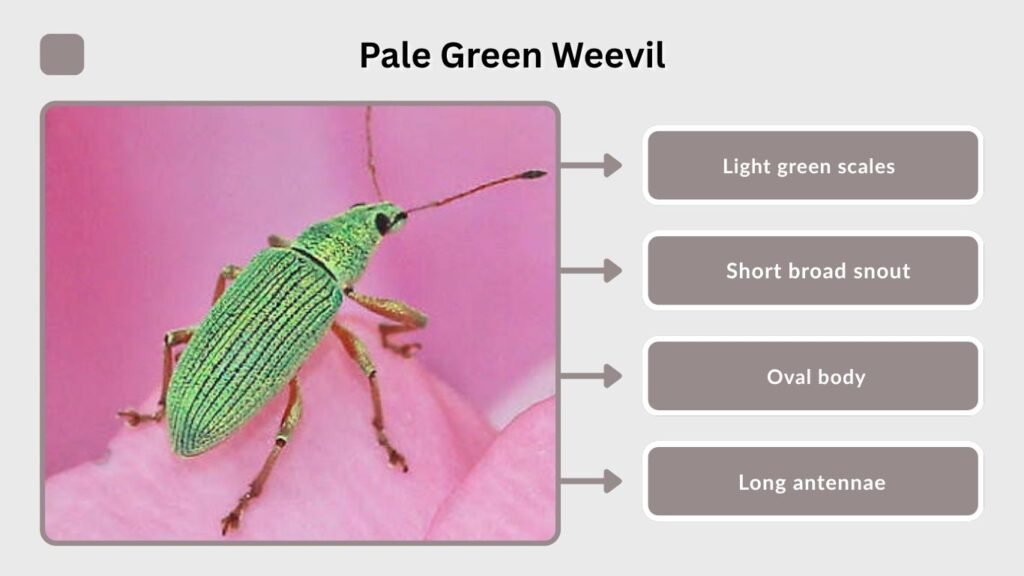
The term pale green weevil is often applied to broad-nosed weevils with lighter green coloration.
One species associated with this name is Polydrusus impressifrons.
Its scales may make the beetle look soft green, gray-green, or slightly silvery.
Pale Green Weevil Characteristics
Pale green weevils generally have:
- Light green scales
- Short broad snout
- Oval body
- Long antennae
- Relatively small size
Because coloration can vary and scales can wear away, identifying a species based entirely on green color is unreliable.
Body shape, antennae, snout structure, host plant, and location provide better clues.
Green Nettle Weevil
Another striking species is the green nettle weevil.
As its common name suggests, it is frequently associated with nettles, although adults may occur on other plants as well.
Green nettle weevils have bright metallic or scaly green bodies and the distinctive form expected from broad-nosed weevils.
They are especially familiar in parts of Europe, including the UK.
Blue-Green Citrus Root Weevil
The blue-green citrus root weevil is an important plant-feeding weevil in areas where citrus is grown.
Adults feed on foliage, while developing larvae live below ground.
Why Citrus Root Weevils Can Be Problematic
Adult feeding may leave characteristic notches around leaf margins.
The underground larvae can be more serious because they feed on roots.
Heavy infestations may reduce tree vigor and make affected citrus plants more vulnerable to additional stress.
When a shiny blue-green weevil is repeatedly found around citrus, proper species identification becomes especially important.
Green Weevil Habitat
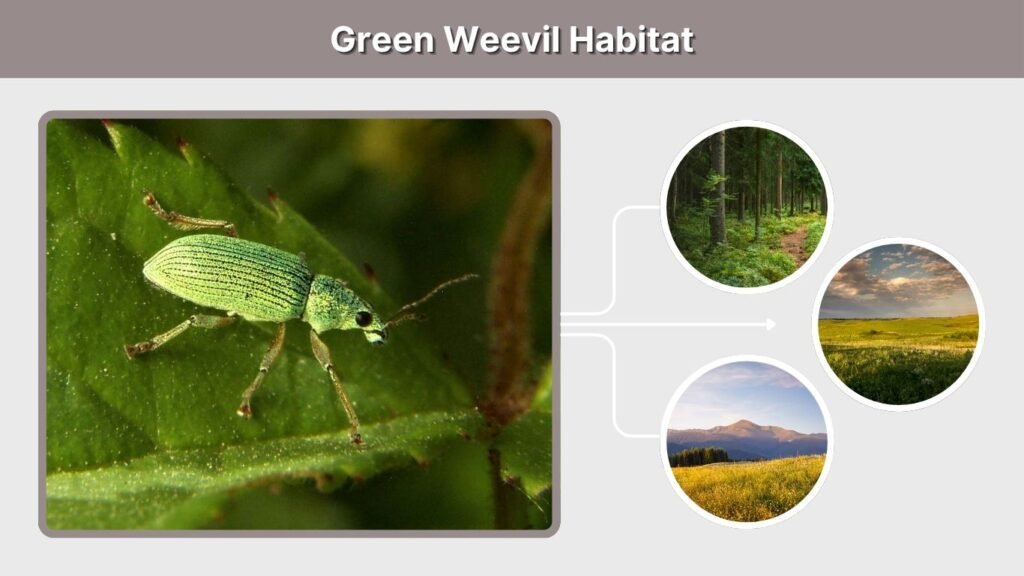
Green weevils occur in a wide variety of environments because different species rely on different host plants.
They can be found in:
- Gardens
- Woodlands
- Orchards
- Agricultural fields
- Shrub borders
- Meadows
- Parks
- Fruit plantations
- Residential landscapes
Adult weevils usually remain on vegetation where they feed.
Larvae of many broad-nosed species develop underground.
Where Are Green Weevils Found?
Different species occur across Europe and North America.
Green immigrant leaf weevils can be encountered in parts of the United States and Canada, including areas of Michigan, Minnesota, Wisconsin, Washington, Ontario, and other northern regions.
Green-colored weevils can also occur in Texas, Florida, California, and other states, although they may represent entirely different species.
This is why location should always be considered during green weevil identification.
What Do Green Weevils Eat?
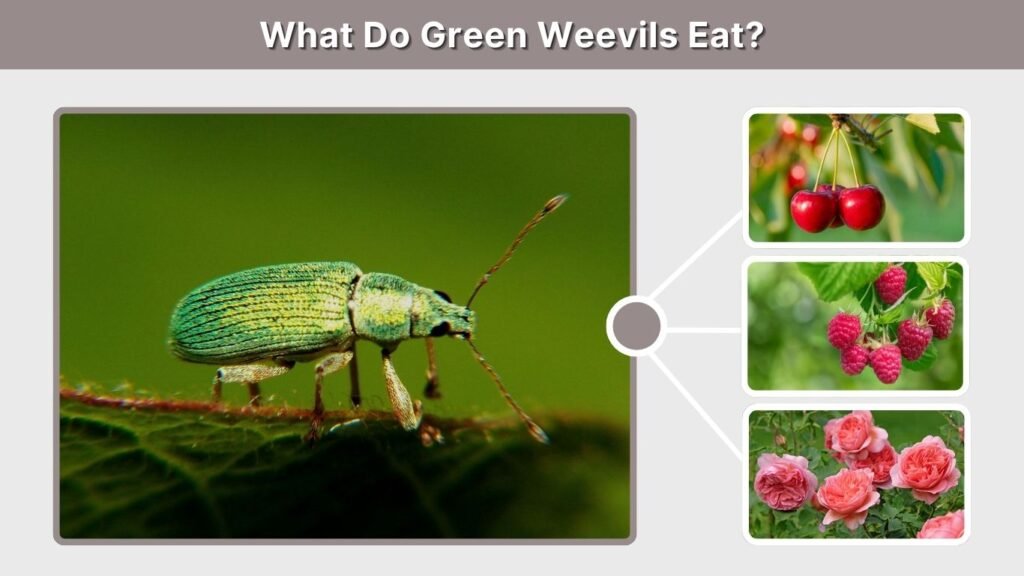
Most green weevils are herbivorous.
Adults usually feed on leaves, buds, flowers, or tender plant tissue.
Their exact diet depends on species.
Adult Green Weevil Diet
Adults may feed on plants such as:
- Birch
- Oak
- Maple
- Willow
- Apple
- Cherry
- Raspberry
- Rose
- Nettle
- Citrus
- Various shrubs
Many broad-nosed weevils create small semicircular notches along leaf margins.
Minor feeding rarely causes serious injury to healthy mature plants.
What Do Green Weevil Larvae Eat?
Larvae of many species live underground and feed on:
- Fine roots
- Plant rootlets
- Decaying vegetation
- Underground plant tissues
Because the larvae are hidden, root damage can occur long before the insects themselves are noticed.
Green Weevil Life Cycle
Like other beetles, green weevils undergo complete metamorphosis.
Their life cycle includes four stages:
- Egg
- Larva
- Pupa
- Adult
Egg Stage
Females deposit eggs in protected locations, which may include soil, plant debris, or areas near suitable host plants.
The exact egg-laying behavior varies among species.
Larval Stage
After hatching, the larvae are typically pale, legless grubs with darker head capsules.
Many develop underground and feed on roots.
Unlike the colorful adult beetles, green weevil larvae usually do not appear green.
Pupal Stage
Once development is complete, the larva creates a protected chamber and transforms into a pupa.
During this stage, the adult body develops.
Adult Stage
Adults eventually emerge and move onto vegetation to feed and reproduce.
Depending on species and climate, the full life cycle may take several months or approximately a year.
Green Weevil Damage
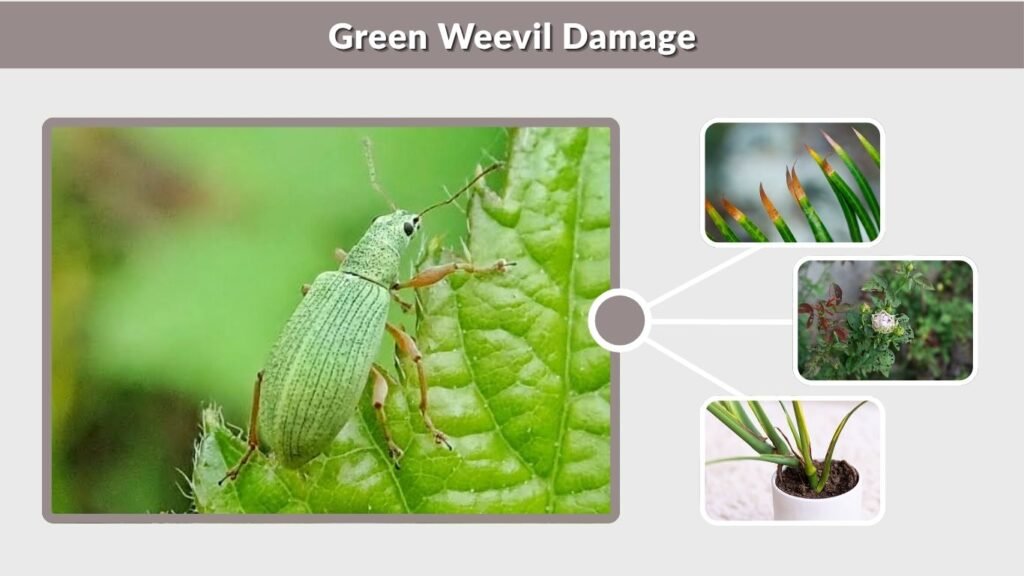
Not every green weevil should be considered a pest.
Small populations usually cause limited damage.
Problems become more noticeable when many adults or larvae feed on the same plants.
Signs of Green Weevil Damage
Look for:
- Notched leaf edges
- Ragged foliage
- Small feeding holes
- Reduced plant vigor
- Wilting despite adequate water
- Root damage
- Slow growth
- Premature leaf loss in severe infestations
Leaf-edge notching is particularly common among broad-nosed weevils.
Are Green Weevils Harmful to Plants?
They can be, but severity varies greatly.
A mature tree can usually tolerate modest adult feeding without serious consequences.
Young plants, seedlings, container plants, and heavily infested crops may be more vulnerable.
Root-feeding larvae can sometimes cause greater problems than adults because damage occurs underground and can interfere with water and nutrient uptake.
Do Green Weevils Bite?
Green weevils are not considered biting insects.
Their mouthparts are designed for chewing plant material.
They do not feed on blood and do not actively attack humans.
A weevil may crawl across skin if it accidentally lands on someone, but this is harmless.
Is a Green Weevil Dangerous?
Green weevils are generally:
- Not venomous
- Not poisonous
- Not aggressive
- Not blood feeders
- Not medically significant
Terms such as “green immigrant leaf weevil bite” and “pale green weevil bite” are often searched because people notice these unfamiliar beetles indoors or on their clothing.
In normal circumstances, they pose essentially no threat to humans or pets.
Why Are Green Weevils in My House?
An occasional green weevil indoors usually wandered inside accidentally.
Adults may enter through:
- Open windows
- Doors
- Damaged screens
- Gaps around frames
- Plants brought indoors
These leaf-feeding species generally cannot establish household infestations because they need appropriate outdoor plants and soil conditions.
Simply remove the beetle and release it outdoors.
How to Get Rid of Green Weevils
Control should depend on the species and level of damage.
A few adults on outdoor plants rarely require aggressive treatment.
Hand-Pick Adult Weevils
Inspect affected plants and remove adults manually.
Because weevils often drop when disturbed, placing a sheet underneath the plant and gently shaking branches can make collection easier.
Remove Heavily Damaged Plant Material
Prune badly damaged foliage when appropriate and remove dead plant debris that may provide shelter.
Avoid unnecessarily removing healthy leaves from already stressed plants.
Keep Plants Healthy
Healthy plants tolerate minor feeding much better than stressed ones.
Maintain appropriate:
- Watering
- Drainage
- Soil fertility
- Mulching
- Pruning
Avoid excessive irrigation because continuously wet soil can sometimes favor root-feeding pests.
Inspect Roots When Damage Is Severe
If a plant is declining while adult weevils are present, inspect the root zone when practical.
Finding pale legless larvae around damaged roots may indicate a developing root weevil problem.
Biological Control
Beneficial nematodes can be used against larvae of certain root-feeding weevils under suitable conditions.
Their effectiveness depends on soil temperature, moisture, timing, and the particular pest species.
Insecticides
Chemical treatment is usually unnecessary for a few adult weevils.
Where severe infestations threaten valuable ornamental plants or crops, a product specifically labeled for the identified weevil and host plant may be appropriate.
Identification should come first because control methods can differ substantially among species.
Green Weevil vs Other Green Beetles
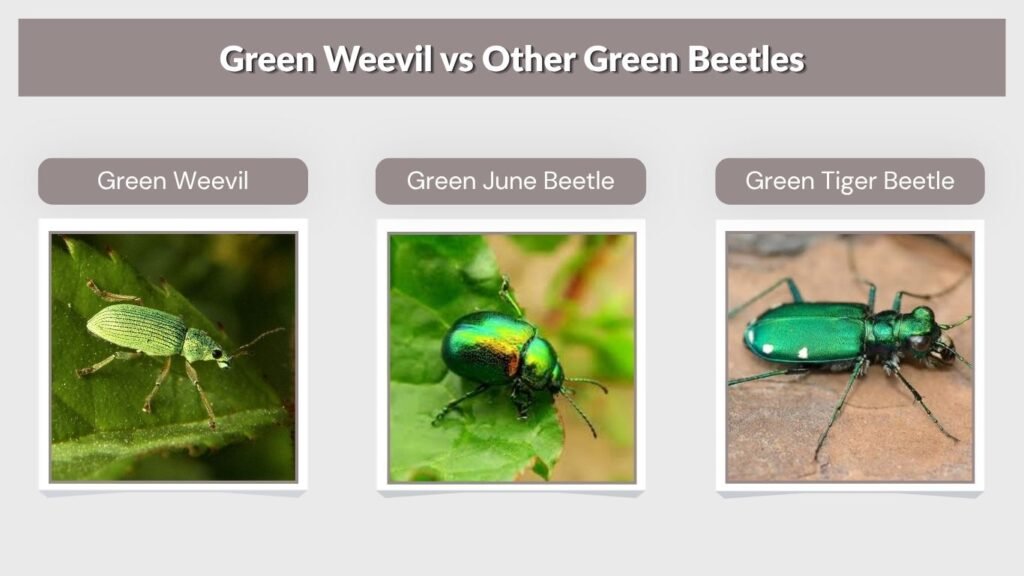
People frequently confuse green weevils with other shiny beetles.
| Feature | Green Weevil | Green June Beetle | Green Tiger Beetle |
|---|---|---|---|
| Typical size | Small | Large | Small to medium |
| Snout | Usually visible | No | No |
| Body | Compact, oval | Broad and heavy | Narrow, athletic |
| Diet | Mostly plants | Fruit/organic matter | Predatory |
| Movement | Usually slow | Strong flyer | Extremely fast runner |
| Main clue | Distinctive snout | Large scarab body | Large jaws and long legs |
The easiest clue is usually the weevil’s characteristic snout and elbowed antennae.
Interesting Green Weevil Facts
- Green weevils are beetles.
- There is no single species called simply the green weevil.
- Many get their coloration from microscopic body scales.
- Their green scales can wear off as they age.
- Most species feed on plants.
- Adult and larval diets can be very different.
- Many larvae live underground.
- Broad-nosed weevils have shorter snouts than classic long-snouted weevils.
- Green immigrant leaf weevils have spread outside their original European range.
- Most green weevils are completely harmless to humans.
FAQs
Are green weevils harmful?
Green weevils are harmless to people but some species can damage plants. Adults usually chew leaves, while larvae of certain species feed on roots. A few beetles normally cause little concern, whereas large populations may affect young plants, ornamentals, citrus trees, or other susceptible vegetation.
Do green weevils bite humans?
Green weevils do not normally bite humans. Their mouthparts are adapted for chewing plant tissues rather than skin. They are not venomous, poisonous, or blood-feeding, so an adult green weevil crawling on someone should not be considered dangerous.
What is the green immigrant leaf weevil?
The green immigrant leaf weevil is a small broad-nosed weevil associated with the genus Polydrusus. Adults are usually covered in green or blue-green scales and feed on foliage from various trees and shrubs. Small populations typically cause only minor cosmetic leaf damage.
Why is there a green weevil on my plant?
The beetle is probably feeding on the plant’s foliage or searching for a suitable host. Check leaves for small notches along their edges. Occasional feeding is usually minor, but repeated damage combined with large numbers of beetles may justify closer inspection and control.
How can I identify a green weevil?
Look for a small oval beetle with green or blue-green scales, a noticeable snout, and elbowed antennae. Color alone is not enough for exact species identification because many unrelated weevils can appear green. Body shape, host plant, markings, size, and geographic location provide additional clues.