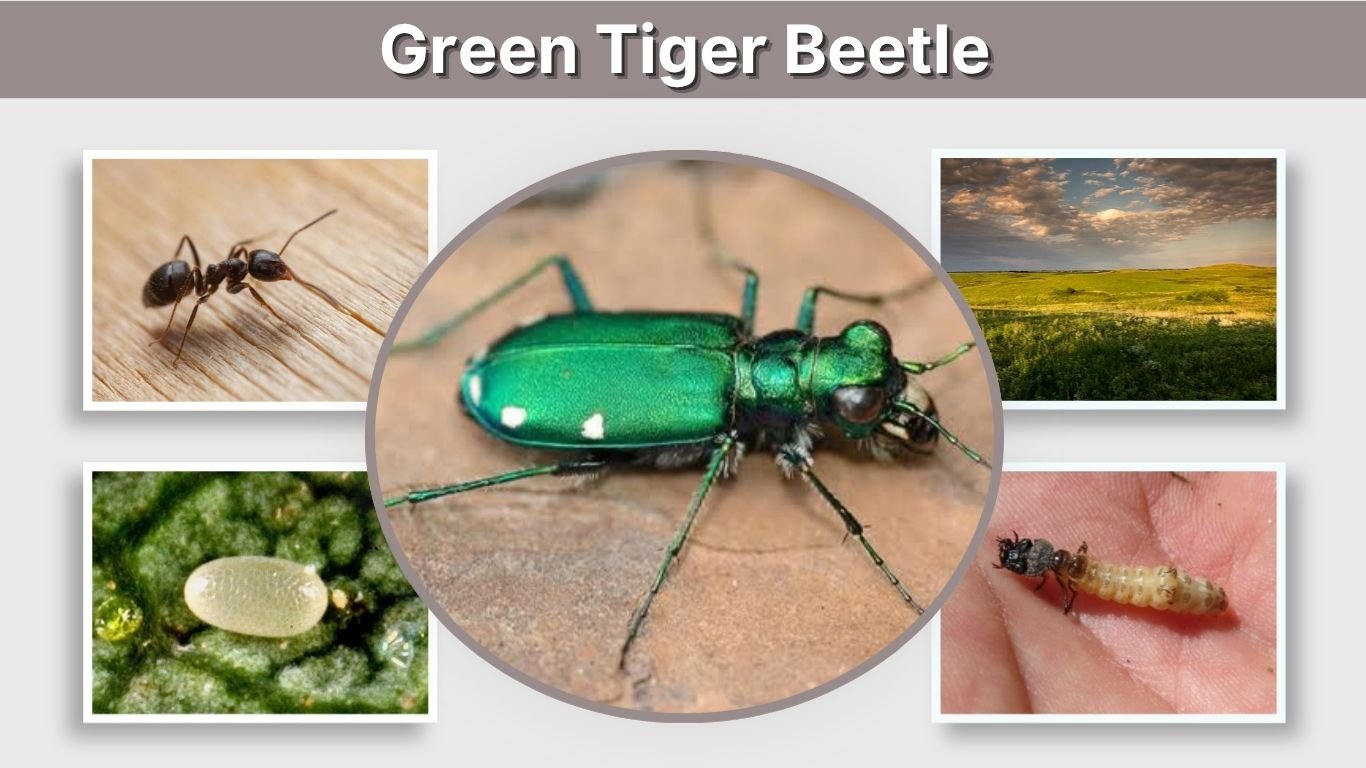
The green tiger beetle is a fast-moving predatory beetle known for its brilliant metallic green color, long legs, and powerful jaws. Depending on location, the name may refer to different green-colored tiger beetle species, including the European green tiger beetle (Cicindela campestris) and North America’s six-spotted tiger beetle (Cicindela sexguttata). These energetic beetles spend much of their time running across sunny ground hunting small insects. Although their large mandibles can look intimidating, green tiger beetles are beneficial predators and are generally harmless to people.
What Is a Green Tiger Beetle?
Green tiger beetles belong to the ground beetle family Carabidae and the tiger beetle group Cicindelinae. They are predatory insects famous for their speed, excellent eyesight, metallic coloration, and active hunting behavior.
The term “green tiger beetle” can cause some confusion because it does not always describe the same species.
In Britain and much of Europe, the green tiger beetle usually refers to Cicindela campestris. In North America, someone describing an emerald or metallic green tiger beetle may instead be looking at the six-spotted tiger beetle, Cicindela sexguttata.
Green Tiger Beetle Identification
Typical characteristics include:
- Bright metallic green or emerald body
- Approximately 0.4–0.7 inch long, depending on species
- Large bulging compound eyes
- Long, slender legs
- Large curved mandibles
- Hard metallic wing covers
- Cream, yellow, or white spots on some species
- Extremely quick running behavior
- Short bursts of flight when disturbed
The combination of brilliant coloration, large eyes, long legs, and prominent jaws makes tiger beetles relatively distinctive.
What Does a Green Tiger Beetle Look Like?
An adult green tiger beetle usually has a narrow, athletic body rather than the heavy rounded shape seen in June beetles and many other scarabs.
Its upper surface may appear emerald green, blue-green, bronze-green, or almost turquoise depending on the species and lighting.
One of the most noticeable features is its pair of large eyes. Tiger beetles rely heavily on vision while hunting.
Their long legs keep the body above the ground and allow the insect to move at impressive speeds.
The jaws, or mandibles, project forward from the head and are used to capture prey.
Metallic Green Color
The green coloration can appear exceptionally bright in direct sunlight.
Rather than coming entirely from ordinary pigments, much of the metallic appearance results from microscopic structures that reflect light.
Changing the viewing angle can therefore make the same beetle appear green, blue, bronze, or even purple.
Green Tiger Beetle Size
Most commonly encountered green tiger beetles are relatively small despite their fierce appearance.
Depending on the species, adults are commonly around 10–18 mm long, or roughly 0.4–0.7 inch.
The six-spotted tiger beetle is generally within this range.
Their long legs and oversized jaws can make the beetles appear larger when viewed closely.
Green Tiger Beetle Habitat
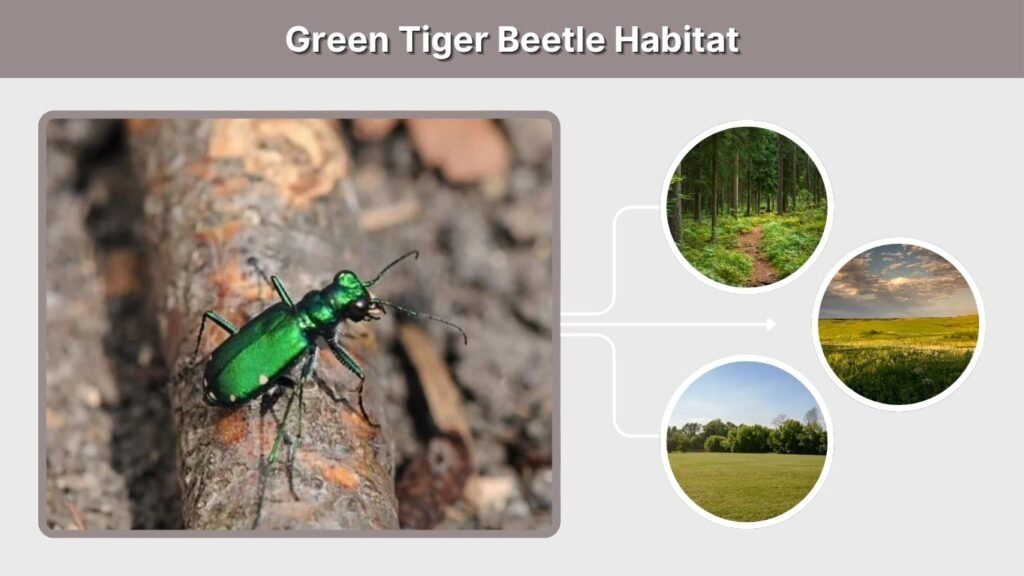
Green tiger beetles usually prefer places where they can run easily and locate prey visually.
Suitable habitats may include:
- Woodland paths
- Forest edges
- Sandy trails
- Heathland
- Grasslands
- Bare soil
- Riverbanks
- Open fields
- Gardens near wooded areas
They generally favor sunny locations containing exposed or lightly vegetated ground.
Dense vegetation is less suitable because tiger beetles depend on rapid running to chase prey.
Where Does the Green Tiger Beetle Live?
Distribution depends on the species.
Cicindela campestris, commonly called the green tiger beetle in the UK, occurs across Britain, Ireland, and other parts of Europe.
The six-spotted green tiger beetle is native to North America and occurs through much of the eastern United States and southern Canada.
It can be encountered in places such as Illinois, Indiana, Connecticut, New York, and Ontario.
Six-Spotted Green Tiger Beetle
One of the best-known metallic green tiger beetles in North America is the six-spotted tiger beetle, Cicindela sexguttata.
Despite its common name, the beetle does not always have exactly six spots.
Six-Spotted Green Tiger Beetle Identification
Look for:
- Brilliant emerald-green body
- Long legs
- Large dark eyes
- Strong white or cream mandibles
- Small pale spots along the edges of the wing covers
- Fast running behavior
Some individuals have six clearly visible pale spots, while others may have fewer or additional markings.
Coloration may also vary from vivid green to blue-green.
Where Are Six-Spotted Tiger Beetles Found?
Six-spotted tiger beetles are strongly associated with deciduous woodlands.
They are particularly noticeable along sunny forest paths where patches of exposed soil give them room to run.
Adults are commonly seen during spring and early summer.
What Do Green Tiger Beetles Eat?
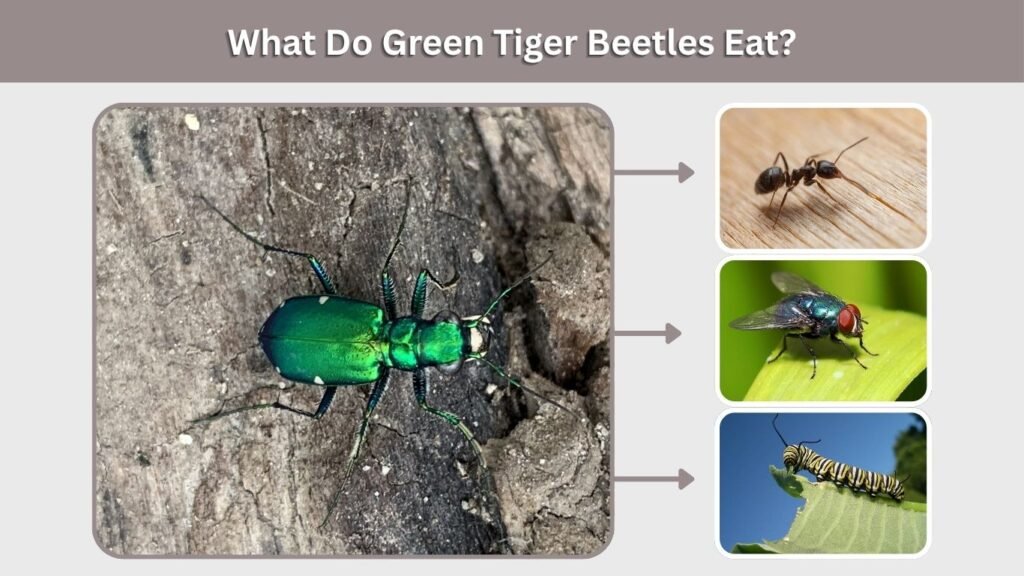
Green tiger beetles are carnivorous predators.
Unlike many beetles that feed primarily on leaves, wood, or fruit, tiger beetles actively chase other animals.
Their diet may include:
- Ants
- Small flies
- Caterpillars
- Spiders
- Small beetles
- Aphids
- Other small insects and arthropods
Their powerful mandibles grab and crush prey.
How Do Green Tiger Beetles Hunt?
An adult usually waits on open ground until movement catches its attention.
It then runs rapidly toward its target.
Interestingly, tiger beetles can run so quickly that maintaining a clear view of their prey becomes difficult. They frequently stop for extremely short periods, visually relocate the prey, and then accelerate again.
The result is a distinctive run-stop-run hunting pattern.
Green Tiger Beetle Speed
Tiger beetles are among the fastest-running insects relative to body size.
Their speed helps them catch prey and escape predators.
Their long legs also keep their bodies elevated above hot ground surfaces.
When approached, a green tiger beetle often runs away first. If the disturbance continues, it may fly several feet before landing and immediately beginning to run again.
This habit can make photographing a tiger beetle surprisingly difficult.
Green Tiger Beetle Larvae
The larval stage looks dramatically different from the colorful adult.
Tiger beetle larvae are pale or brownish, elongated predators that spend most of their lives inside vertical burrows in the ground.
How Green Tiger Beetle Larvae Hunt
A larva normally sits near the entrance of its burrow with its head positioned close to the surface.
When an ant, small beetle, or other arthropod approaches, the larva rapidly lunges forward and grabs it with its powerful jaws.
Hooks on the larva’s body help prevent struggling prey from pulling it out of the burrow.
After capturing its meal, the larva retreats underground.
Green Tiger Beetle Life Cycle
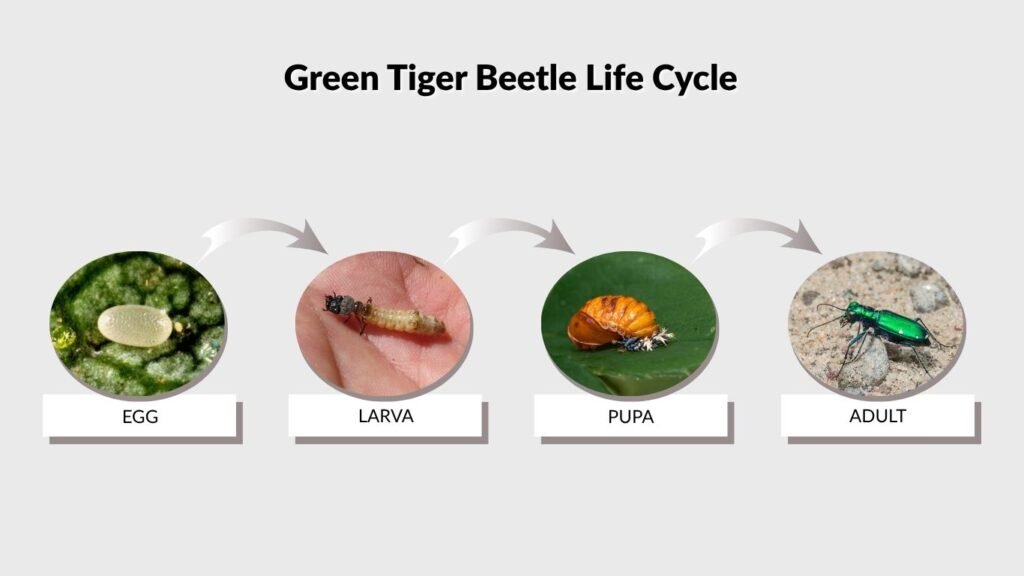
Green tiger beetles undergo complete metamorphosis with four main stages:
- Egg
- Larva
- Pupa
- Adult
Females lay eggs in suitable soil.
After hatching, each larva creates or occupies a burrow and remains a ground-dwelling predator throughout its development.
Larvae grow through several stages before pupating underground.
Eventually, the adult emerges and begins hunting above ground.
Depending on species and environmental conditions, completion of the life cycle may take one or more years.
Do Green Tiger Beetles Bite?
Green tiger beetles have large mandibles capable of capturing and cutting small prey, so people naturally wonder whether they bite.
They are not aggressive toward humans.
A beetle trapped against the skin or handled roughly might use its jaws defensively and produce a small pinch. However, serious bites are uncommon.
Green tiger beetles are:
- Not venomous
- Not poisonous
- Not blood-feeding
- Not aggressive toward humans
Simply seeing one in a garden or woodland presents no danger.
It is better to observe the beetle rather than attempt to hold it.
Are Green Tiger Beetles Beneficial?
Green tiger beetles can be considered beneficial predators.
Both adults and larvae consume other insects and help form part of the natural predator-prey system.
They generally do not damage garden plants, trees, lawns, furniture, or houses.
Unlike Japanese beetles, green tiger beetles are not normally significant leaf-feeding pests.
Finding them can also indicate that an area contains suitable open soil and a diverse community of small insects.
Green Tiger Beetle vs Emerald Ash Borer
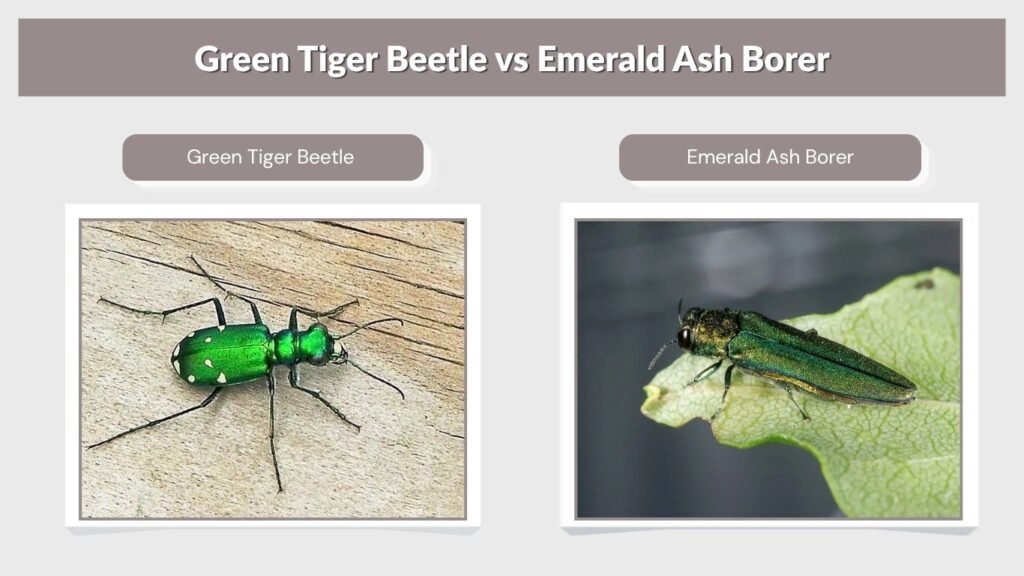
A bright green beetle is sometimes immediately identified as an emerald ash borer, but these two insects look quite different.
| Feature | Green Tiger Beetle | Emerald Ash Borer |
|---|---|---|
| Body | Athletic with long legs | Narrow and elongated |
| Eyes | Large and prominent | Less prominent |
| Mandibles | Large and obvious | Much less noticeable |
| Behavior | Runs rapidly on ground | Commonly associated with ash trees |
| Feeding | Predator | Larvae feed beneath ash bark |
| Plant damage | Generally none | Can kill ash trees |
A beetle racing along a woodland path is far more likely to be a tiger beetle than an emerald ash borer.
Green Tiger Beetle UK
In the United Kingdom, the name green tiger beetle usually refers specifically to Cicindela campestris.
Adults are brilliant metallic green with pale markings on their wing covers.
They are commonly found on sunny ground in places such as heathland, woodland tracks, sandy areas, and open grassland.
They may be particularly noticeable on warm spring and summer days.
Their speed and tendency to fly a short distance when approached are typical tiger beetle behaviors.
Green Tiger Beetle Facts
- Green tiger beetles are predators rather than plant feeders.
- Many have beautiful emerald metallic coloration.
- They possess exceptionally large eyes for their body size.
- Adults hunt mainly by sight.
- They can run remarkably fast.
- Larvae are also predators.
- Tiger beetle larvae live inside underground burrows.
- Six-spotted tiger beetles may have more or fewer than six spots.
- Green tiger beetles are generally beneficial to gardens and ecosystems.
- They are harmless to people unless handled roughly.
- Some species appear blue-green or bronze depending on lighting.
- Their fast running behavior gives them their fierce “tiger” reputation.
FAQs
Is a green tiger beetle dangerous?
No. Green tiger beetles are not dangerous to humans. They are predators of small insects and other arthropods. Although their large jaws may produce a slight defensive pinch if the beetle is handled, they are not venomous and do not deliberately attack people.
What does a green tiger beetle eat?
Green tiger beetles eat ants, flies, small beetles, caterpillars, spiders, and other small arthropods. Adults actively chase prey across open ground, while larvae remain near underground burrows and ambush insects passing close to the entrance.
Why is the green tiger beetle so fast?
Speed helps tiger beetles capture prey and avoid predators. Their long legs allow them to sprint rapidly across exposed soil. During a chase, they often alternate between very fast running and brief stops that allow them to visually relocate their target.
Is the six-spotted tiger beetle always green?
Most six-spotted tiger beetles have brilliant metallic green coloration, but individuals can vary. Some appear blue-green, turquoise, or occasionally more bluish. Their appearance can also change depending on sunlight and the angle from which the beetle is viewed.
Are green tiger beetles good for gardens?
Yes, they are generally beneficial. Green tiger beetles do not normally feed on healthy garden plants. Instead, both adults and larvae prey on small insects and other arthropods, making them useful natural predators within gardens, forests, grasslands, and other habitats.