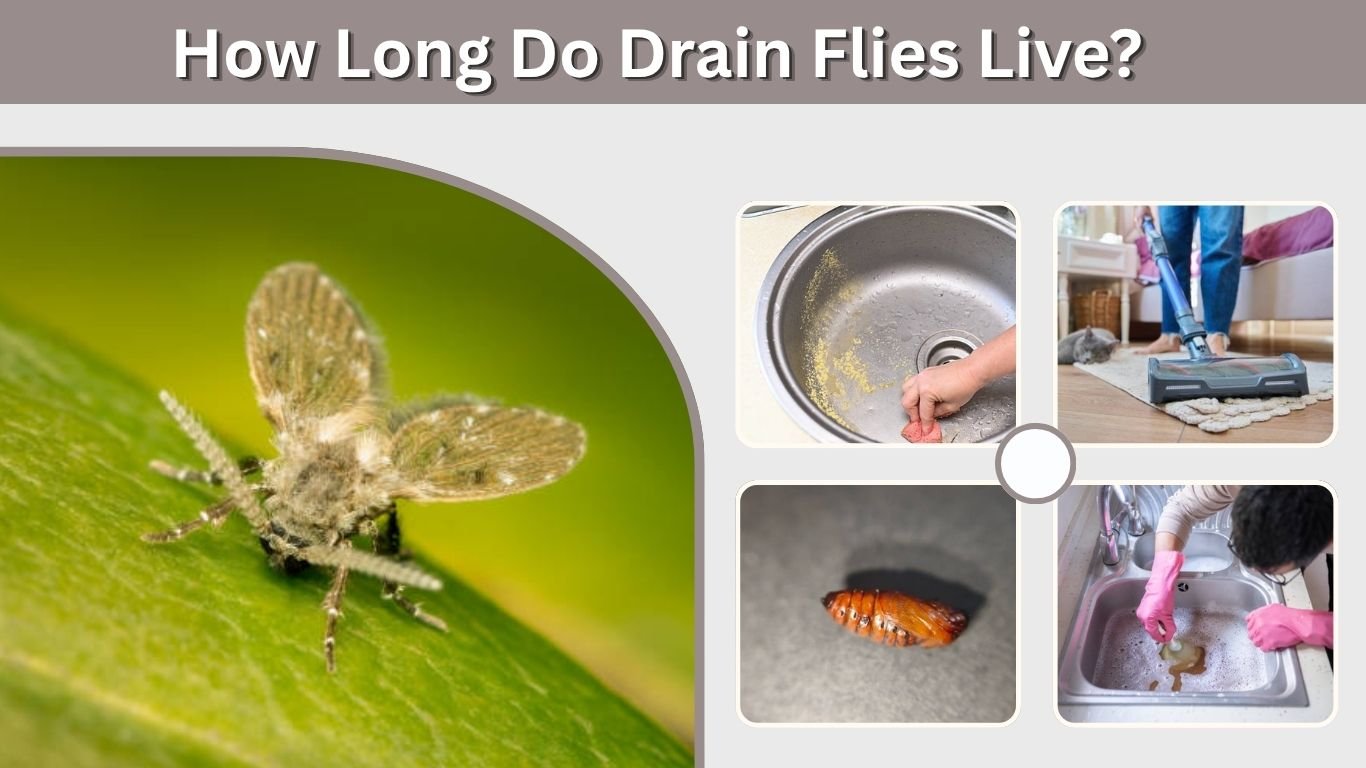
Drain flies usually live for about two weeks as adults, although temperature, moisture, species, and access to food can affect survival. Their complete development from egg to adult commonly takes one to four weeks. Therefore, a drain fly may exist for roughly three to six weeks when its immature and adult stages are considered together. These small, fuzzy flies reproduce quickly in the organic slime lining drains, sewage systems, and other wet areas. Understanding each stage of their life cycle explains why adult flies may continue appearing for several days after a drain has been cleaned.
How Long Do Drain Flies Live?
An adult drain fly generally lives for approximately two weeks after emerging from its pupal case. Some may die sooner when conditions are dry or food is unavailable, while favorable indoor conditions may allow them to survive somewhat longer.
The adult lifespan is only part of the story. Before becoming a winged fly, the insect develops through egg, larval, and pupal stages inside wet organic material.
| Life stage | Approximate duration |
| Egg | Less than 48 hours |
| Larva | About 9–15 days |
| Pupa | About 20–40 hours |
| Adult | About two weeks |
| Egg-to-adult development | Roughly 1–4 weeks |
Development times are not identical for every species. The University of Florida reports a typical egg-to-adult life cycle of around 21–27 days, while other extension sources note that some moth flies can complete development in one to three weeks under favorable conditions.
Drain Fly Life Cycle
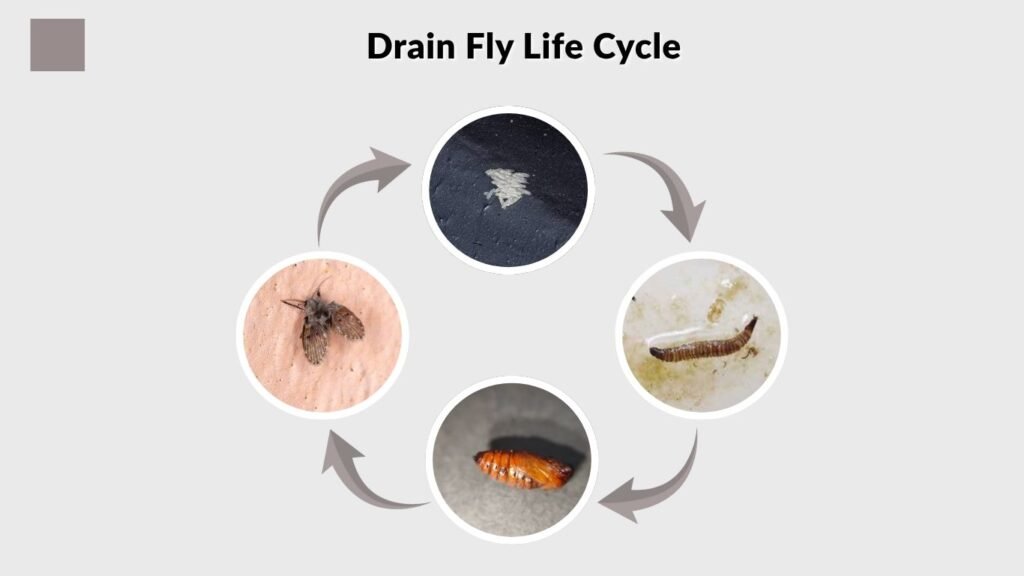
Drain flies undergo complete metamorphosis. This means that their immature form looks completely different from the winged adult.
The four stages are:
- Egg
- Larva
- Pupa
- Adult
Their eggs, larvae, and pupae remain close to the wet breeding material. Only the adults leave the drain and fly around bathrooms, kitchens, basements, and other rooms.
Stage 1: Eggs
Female drain flies deposit eggs in moist, decomposing organic material. Inside a home, this material is commonly the gelatinous film coating the walls of a sink, shower, bathtub, floor drain, garbage disposal, or sewage pipe.
Egg masses may contain approximately 30–100 eggs, and the eggs can hatch in less than 48 hours. The newly hatched larvae immediately have access to bacteria, fungi, algae, and decaying matter in the surrounding slime.
Common egg-laying locations include:
- Bathroom and kitchen drains
- Sink overflow channels
- Shower and bathtub traps
- Floor drains
- Sewage systems
- Sump pits
- Septic systems
- Wet mop buckets
- Appliance drain pans
- Areas around leaking pipes
The short egg stage allows a small drain fly problem to grow quickly when the breeding material is not removed.
Stage 2: Larvae
Drain fly larvae are narrow, legless, wormlike organisms. They generally live within the thin film of water and organic debris lining the breeding site.
The larval stage commonly lasts around 9–15 days, although development can vary with temperature, food availability, species, and environmental conditions.
Larvae feed on:
- Bacteria
- Fungi
- Algae
- Microscopic organisms
- Decaying plant material
- Sewage residue
- Other organic matter
This stage is the main reason that simply killing adult drain flies does not end an infestation. Dozens of larvae may remain hidden inside a drain and continue developing after the visible adults are removed.
Stage 3: Pupae
After completing their growth, the larvae transform into pupae. During this nonfeeding stage, the insect changes into its adult form.
The pupal period may last approximately 20–40 hours under suitable conditions. The pupa remains close to the wet surface and breathes through specialized structures until the adult is ready to emerge.
Because the pupal stage is brief, new adult flies may appear shortly after the larvae finish developing.
Stage 4: Adults
Adult drain flies emerge from the breeding material and rest on nearby walls, ceilings, cabinets, sinks, or plumbing fixtures. Their hairy bodies and broad wings give them a tiny mothlike appearance.
Adults are weak fliers and normally travel only short distances. They are often most noticeable during the evening, although they may rest visibly near plumbing throughout the day.
During their approximately two-week adult lives, they mate and lay eggs in suitable wet organic matter. If that material remains available, the next generation begins before the previous adults disappear.
How Fast Do Drain Flies Reproduce?
Drain flies can reproduce rapidly because several parts of their life cycle are short. Eggs hatch in less than two days, larvae may mature within roughly two weeks, and the pupal stage may last less than two days.
Under typical conditions, the entire egg-to-adult cycle may take about 21–27 days. Warm conditions can accelerate development, while cooler temperatures or limited food may slow it.
This rapid development means that multiple stages may exist simultaneously inside the same drain:
- Adults may be resting on the walls.
- Newly laid eggs may be hidden in slime.
- Larvae may be actively feeding.
- Pupae may be close to producing new adults.
Killing only the visible flies leaves the remaining stages untouched.
Does Temperature Affect Their Lifespan?
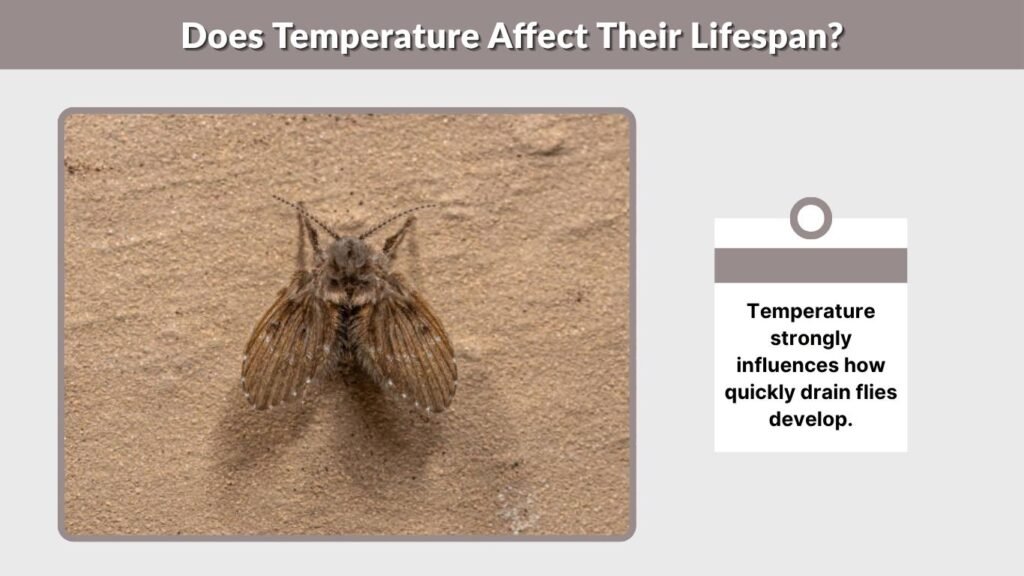
Temperature strongly influences how quickly drain flies develop. Warm, humid environments generally accelerate the immature stages, allowing adults to emerge sooner. Cooler conditions slow their development.
However, faster development does not necessarily mean that each adult lives longer. Warm conditions mainly shorten the time required to move from egg through larva and pupa to the adult stage. The availability of moisture and breeding material is also essential because the immature stages cannot develop successfully in a clean, dry drain.
This is why infestations are often persistent in humid bathrooms, commercial kitchens, basements, sewage facilities, and buildings with plumbing leaks.
How Long Can Drain Flies Live Without Food?
Adult drain flies feed on liquids such as nectar, polluted water, and dissolved organic material. They may survive for a limited period without an obvious food source, but dry indoor conditions and lack of moisture can shorten their lives.
Larvae are much more dependent on their breeding material. Removing the drain slime eliminates their food and shelter, interrupting the next generation.
Waiting for adult flies to die naturally is not an effective control method. Even though each adult lives only about two weeks, females can lay new eggs before dying.
Why Do Drain Flies Keep Appearing?
Drain flies may continue appearing because immature insects remain inside the drain. Even after adult flies are vacuumed or sprayed, existing larvae and pupae can mature and emerge.
New adults may also indicate that:
- The drain was flushed but not scrubbed.
- Organic film remains on the pipe walls.
- The sink overflow channel was overlooked.
- Another drain is infested.
- A toilet seal or sewage pipe is leaking.
- Standing water exists beneath an appliance.
- A floor drain or sump pit is providing a breeding site.
Because the immature stages can take several weeks to finish developing, monitoring should continue after cleaning.
How to Break the Drain Fly Life Cycle
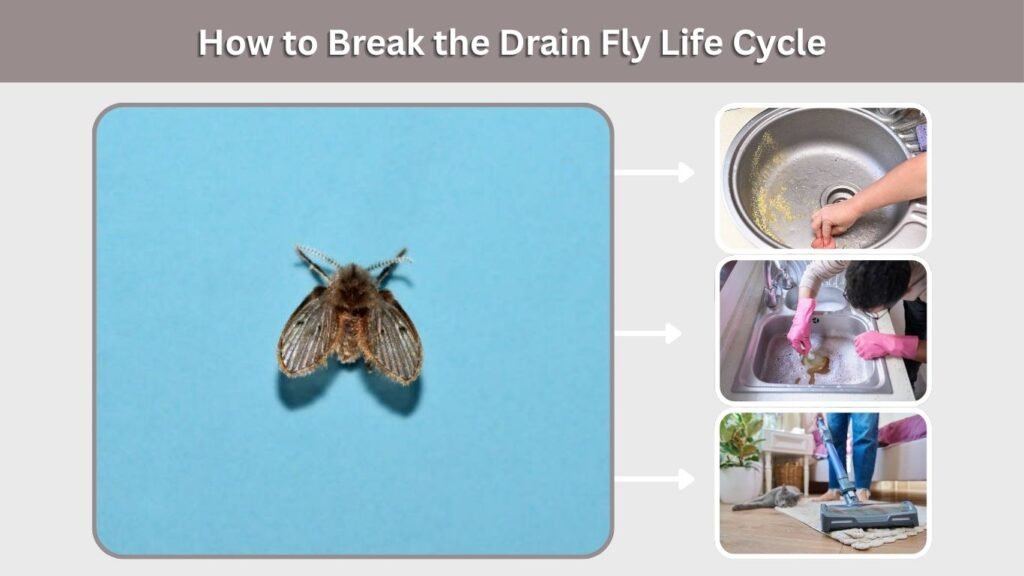
Effective control targets the eggs and larvae rather than focusing only on the short-lived adults.
Identify the Breeding Site
Place transparent tape loosely over part of a suspected drain overnight with the sticky side facing downward. Adult flies trapped beneath it may indicate that they are emerging from that drain.
Test sinks, showers, tubs, floor drains, utility drains, and other damp areas.
Scrub the Drain
Remove the stopper or drain cover and clear away visible hair and debris. Use a long, stiff brush to scrub the entire inner surface of the drain.
Physical scrubbing removes the organic film containing food, eggs, and larvae. Pouring liquid through the center of the pipe may not remove buildup attached to the walls.
Clean Hidden Areas
Clean the underside of drain covers, garbage-disposal guards, sink overflow passages, and other areas that remain wet. These hidden surfaces can allow the infestation to survive.
Use an Appropriate Drain Treatment
An enzyme-based or biological drain cleaner can help digest remaining organic material after brushing. Follow the label instructions and confirm compatibility with your plumbing or septic system.
Never mix bleach with vinegar, ammonia, acids, or commercial drain-opening chemicals.
Remove Adult Flies
Vacuum adults from walls and ceilings or use sticky cards to monitor their numbers. This provides immediate relief but must be combined with breeding-site removal.
When Should the Flies Disappear?
Adult numbers should begin decreasing after the breeding material is thoroughly removed. However, some adults may continue emerging for several days because pupae already present can survive long enough to finish development.
Continue cleaning and monitoring for at least one to two weeks. If adults are still appearing after that period, another breeding source may remain.
Persistent infestations accompanied by sewage odors, wet flooring, recurring backups, or flies emerging from walls may require a plumber or pest-management professional.
FAQs
Do drain flies live for only 24 hours?
No. Adult drain flies commonly live for about two weeks. Their complete existence from egg through adulthood is considerably longer and may span several weeks, depending on species, temperature, moisture, and food availability.
How long does the complete drain fly life cycle take?
Egg-to-adult development commonly takes around one to four weeks. The University of Florida gives a typical range of approximately 21–27 days, though warmer conditions can accelerate development.
How many eggs does a drain fly lay?
An egg mass may contain approximately 30–100 eggs. The eggs are placed in moist organic material and can hatch in less than 48 hours, allowing an untreated infestation to increase rapidly.
Will drain flies eventually disappear on their own?
They may disappear if the breeding material dries completely or is removed. However, waiting for the adults to die usually fails because females can lay another generation of eggs during their short adult lives.
Why are drain flies still present after cleaning?
Larvae or pupae may remain in parts of the drain that were not fully scrubbed. Another nearby breeding site, such as an overflow channel, floor drain, leaking pipe, sump pit, or damaged toilet seal, may also be producing adults.