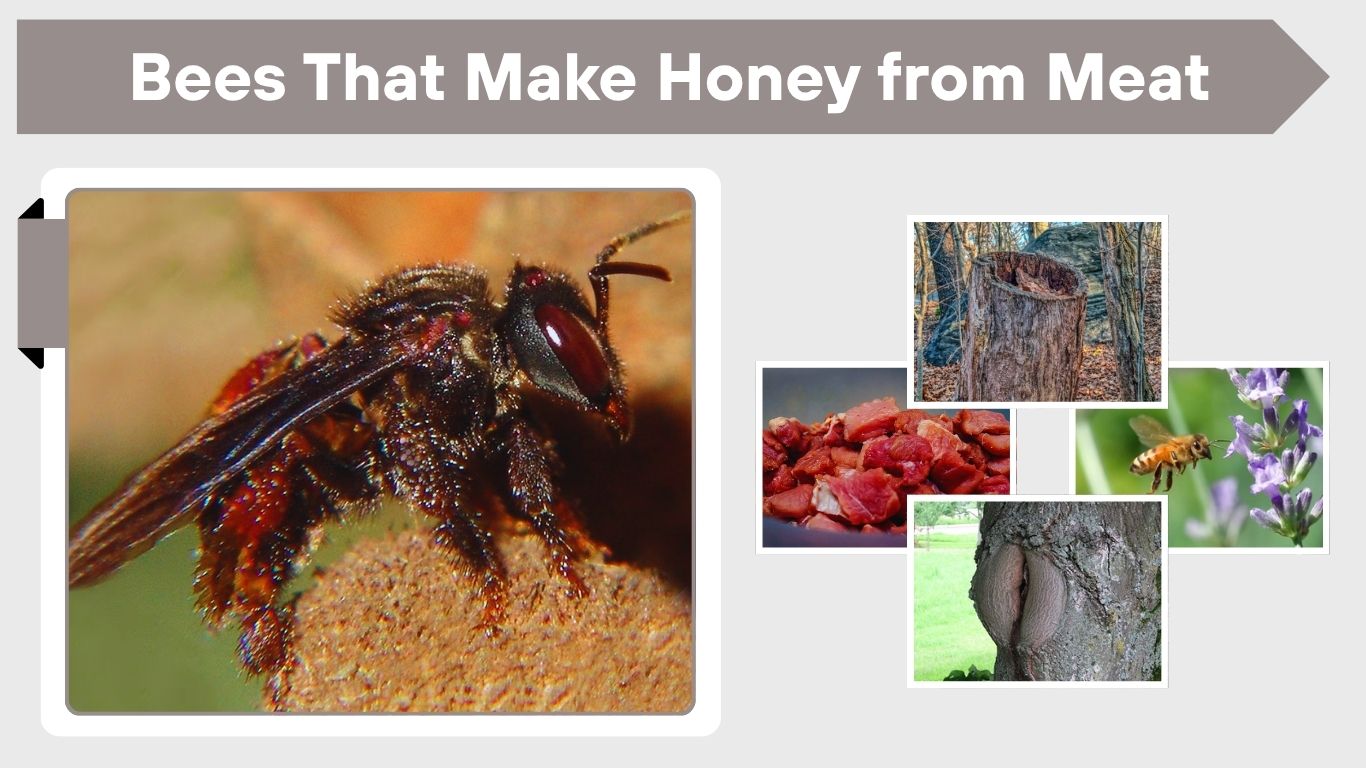
When most people think of bees, they imagine insects collecting nectar from flowers and producing sweet golden honey. However, not all bees follow this familiar pattern. A rare and fascinating group known as vulture bees has developed a completely different lifestyle. Instead of relying on flowers, these bees feed on decaying animal matter and produce a unique substance often referred to as “meat honey.” Their unusual behavior challenges what we know about bees and highlights the incredible adaptability of nature.
What Are Meat-Eating Bees?
Meat-eating bees, commonly called vulture bees, belong to the Trigona genus. These bees are part of the stingless bee family, meaning they do not have a functional sting. What makes them truly unique is their diet. Unlike typical bees that depend on nectar and pollen, vulture bees collect protein from carrion—dead animals such as small mammals, birds, or reptiles.
This adaptation allows them to survive in environments where floral resources may be limited. Despite their unusual feeding habits, they still live in highly organized colonies similar to other social bees.
Key Characteristics of Vulture Bees

- Stingless bees with reduced stingers
- Strong mandibles for cutting flesh
- Dark-colored bodies with minimal hair
- Feed primarily on decaying animal tissue
- Produce a honey-like substance from protein
Where Do These Bees Live?

Vulture bees are mainly found in tropical regions of Central and South America. Countries like Brazil, Costa Rica, and Mexico provide the warm, humid conditions these bees need to thrive.
They typically live in forests where both nesting sites and food sources are available. These bees build their nests in tree cavities, hollow logs, or sometimes underground. Their ability to adapt to different nesting environments helps them survive in dense tropical ecosystems.
How Do Vulture Bees Make Honey from Meat?
The process of making “meat honey” is very different from traditional honey production. Instead of collecting nectar, worker bees gather small pieces of flesh from decaying animals.
Once back in the hive, the material is processed through enzymes in their bodies. This breaks down the protein and transforms it into a usable food source. The final product is stored in special containers made from wax and plant resins.
Unlike regular honey, this substance has a strong smell and a very different chemical composition. It is not sweet in the traditional sense and is primarily used to feed the colony rather than for human consumption.
What Does Meat Honey Taste Like?
The taste of meat honey is very different from floral honey. It is often described as pungent, sour, or even slightly bitter. The smell can also be quite strong, which makes it unappealing to most people.
Because of its unusual origin and flavor, meat honey is rarely consumed by humans. It mainly serves as an energy source for the bees themselves.
Are Vulture Bees Dangerous?
Vulture bees are not considered dangerous to humans. Since they are stingless, they cannot inject venom like honey bees or wasps. However, they can bite if they feel threatened.
Their bites are generally mild and not harmful. These bees are more focused on scavenging for food than interacting with humans, so encounters are uncommon unless their nest is disturbed.
Identification Guide

- Small to medium-sized dark-colored bees
- Lack of a functional sting
- Strong jaws visible at the front of the head
- Less hairy compared to pollen-collecting bees
- Often found around decaying organic matter
Vulture Bees vs Honey Bees

Understanding how vulture bees differ from common honey bees helps highlight their uniqueness.
| Feature | Vulture Bees | Honey Bees |
| Diet | Carrion (meat) | Nectar and pollen |
| Sting | No functional sting | Functional sting |
| Honey Type | Protein-based “meat honey” | Sweet floral honey |
| Habitat | Tropical regions | Worldwide |
| Role | Decomposers | Pollinators |
Why Do Vulture Bees Eat Meat?

Vulture bees evolved to use a food source that most other bees ignore. In tropical environments, competition for nectar can be high. By feeding on carrion, these bees avoid competition and gain access to a rich protein source.
This adaptation also allows them to survive in areas where flowers are not always available. Their behavior is similar to scavenger animals like vultures, which is how they got their name.
Ecological Importance
Vulture bees play an important role in maintaining ecosystem balance. By feeding on dead animals, they help break down organic matter and recycle nutrients back into the environment.
Although they are not primary pollinators, they may still contribute to pollination when visiting flowers occasionally. Their dual role as scavengers and occasional pollinators makes them a unique and valuable part of tropical ecosystems.
FAQs
What are bees that make honey from meat called?
They are called vulture bees. These stingless bees belong to the Trigona genus and are known for feeding on carrion and producing a honey-like substance from animal protein.
Do vulture bees really make honey?
Yes, they produce a honey-like substance, but it is very different from regular honey. It is made from processed meat rather than nectar and has a different taste, smell, and composition.
Is meat honey safe to eat?
Meat honey is generally not consumed by humans due to its unusual composition and strong odor. It is mainly produced as a food source for the bee colony rather than for human use.
Where can vulture bees be found?
Vulture bees are mostly found in tropical regions of Central and South America. They prefer warm, humid environments such as rainforests.
Do vulture bees sting?
No, vulture bees do not have a functional sting. However, they can bite if disturbed, though their bites are usually mild and not harmful.