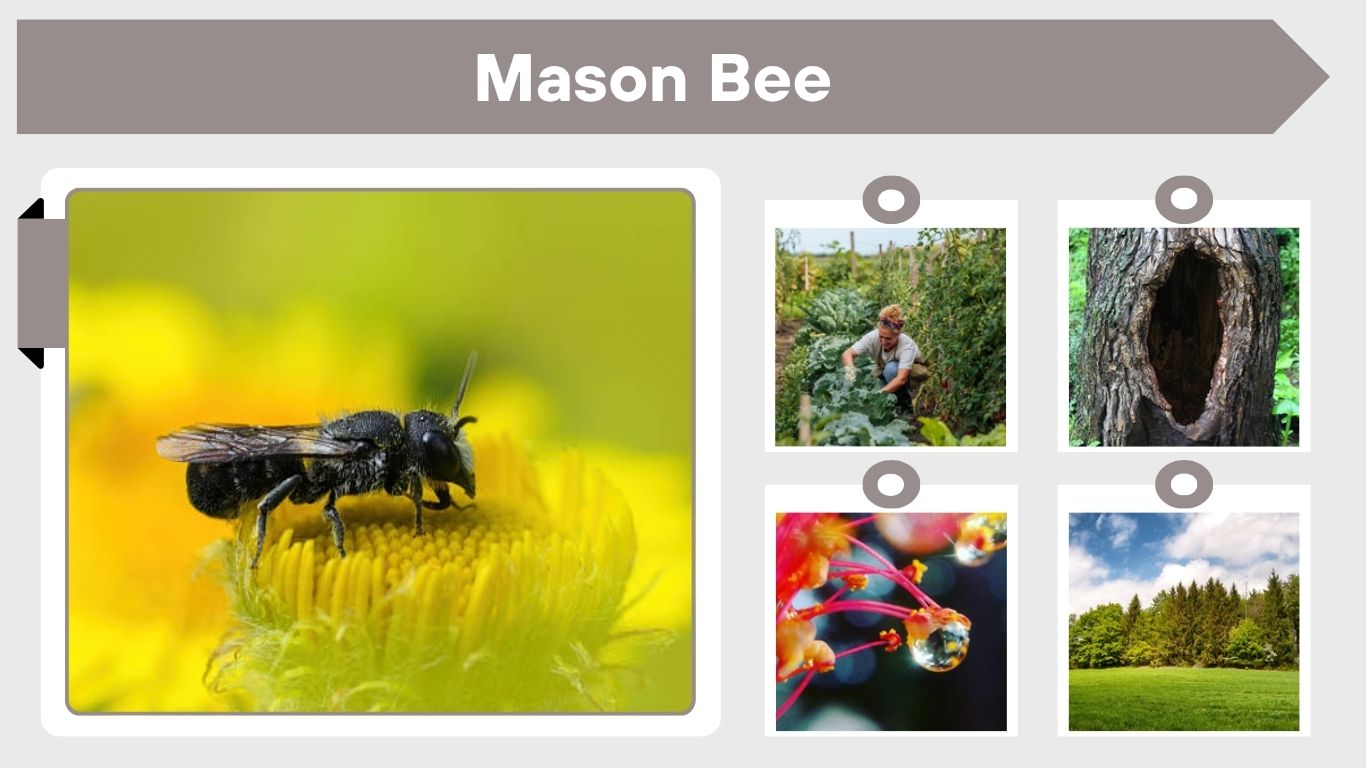
Mason bees are among the most efficient and gentle pollinators found in nature. Unlike honeybees, they do not live in large colonies or produce honey, yet they play a crucial role in pollinating crops and wild plants. Their calm behavior, simple nesting habits, and high productivity make them especially valuable for gardeners and farmers alike.
What Is a Mason Bee?
Mason bees belong to the genus Osmia, a group of solitary bees known for their unique nesting behavior. Instead of forming hives like honeybees, each female mason bee builds and manages her own nest.
They get their name from their use of mud or clay to construct and seal their nests, much like a mason working with mortar. These bees are active mainly in spring and are especially important for pollinating early-blooming plants.
Physical Description of Mason Bees

Mason bees are small to medium-sized insects, usually measuring between 8 and 20 millimeters in length. Their appearance can vary depending on the species, but most share a few common features.
- They often have metallic blue, green, or black bodies
- Their bodies are covered in fine hairs that help collect pollen
- Females are typically larger and more robust than males
- Males may have lighter facial markings or longer antennae
Unlike honeybees, mason bees carry pollen on the underside of their abdomen rather than on their legs. This makes them messier pollinators, which actually increases their effectiveness.
Types of Mason Bees

There are many species of mason bees worldwide, but a few are especially well known due to their role in agriculture and gardening.
- Blue Orchard Mason Bee (Osmia lignaria) – common in North America and widely used for orchard pollination
- Red Mason Bee (Osmia bicornis) – found across Europe and easily recognized by its reddish hair
- Hornfaced Bee (Osmia cornifrons) – native to Asia and introduced to other regions for crop pollination
- Other regional species adapted to local climates and plants
Each species may differ slightly in size, color, and behavior, but they all share similar nesting and life cycle patterns.
Life Cycle of a Mason Bee
The life cycle of a mason bee is closely tied to the seasons, with most activity occurring in spring.
Egg Stage
After mating, the female begins building her nest inside a hollow cavity. She creates small chambers using mud walls and lays a single egg in each one. Along with the egg, she deposits a mixture of pollen and nectar as food for the future larva.
Larval Stage
Once the egg hatches, the larva feeds on the stored pollen and nectar. This stage is entirely contained within the sealed chamber, where the larva grows safely without outside interference.
Pupal Stage
After feeding and growing, the larva spins a cocoon and enters the pupal stage. During this phase, it undergoes transformation into an adult bee. This process continues through the warmer months.
Adult Stage
Adult bees typically emerge in early spring. Males come out first, followed by females. Their lifespan is relatively short, usually around 4 to 6 weeks, during which they focus on mating and building nests for the next generation.
Mason Bee Nesting Behavior

Mason bees are known for their simple yet effective nesting habits. They do not dig their own nests but instead rely on existing holes and cavities.
Common nesting sites include hollow plant stems, cracks in wood, and holes in tree trunks. They also readily use artificial bee houses provided by humans.
Nest Structure
Inside the cavity, the female constructs a series of chambers arranged in a straight line. Each chamber contains:
- One egg
- A supply of pollen and nectar
- A mud wall separating it from the next chamber
After filling the entire space, she seals the entrance with a thick mud plug to protect the developing bees from predators and environmental conditions.
Habitat and Distribution

Mason bees are found across many parts of the world, including North America, Europe, and Asia. They thrive in temperate climates where seasonal changes support their life cycle.
These bees are commonly seen in:
- Gardens and backyards
- Orchards and farms
- Forest edges and meadows
They prefer environments where flowers are abundant and suitable nesting sites are available. Because they do not travel far from their nests, having nearby food sources is essential for their survival.
Diet and Pollination Role

Mason bees feed primarily on nectar and pollen, which they collect from flowering plants. While nectar provides energy, pollen supplies the protein needed for larval development.
Their role as pollinators is extremely important. In fact, mason bees are often considered more efficient than honeybees for certain crops. This is because they transfer pollen more effectively between flowers.
A single mason bee can visit hundreds of flowers in a day, making them especially valuable for pollinating fruit trees such as apples, cherries, and almonds. Their ability to work in cooler and wetter conditions also gives them an advantage over other pollinators.
Do Mason Bees Sting?
Mason bees are known for their calm and non-aggressive nature, which makes them very different from many other stinging insects. Female mason bees do have the ability to sting, but they rarely use it. In most cases, they will only sting if they are directly handled or feel seriously threatened.
Male mason bees, on the other hand, cannot sting at all. Even though they may appear curious and fly close to people, they are completely harmless. Because of this gentle behavior, mason bees are considered safe for home gardens, even in areas with children and pets.
Benefits of Mason Bees
Mason bees offer several advantages, especially for gardeners and farmers looking to improve plant productivity. Their efficiency and low-maintenance nature make them highly desirable pollinators.
- They are extremely effective pollinators, often outperforming honeybees
- They are non-aggressive and safe to keep near homes
- They require no hive management or complex care
- They help support biodiversity and ecosystem health
Because of these benefits, many people actively encourage mason bees to live in their gardens and orchards.
How to Attract Mason Bees
Creating a welcoming environment for mason bees is simple and rewarding. With the right conditions, these bees will naturally settle and begin pollinating nearby plants.
- Install bee houses or nesting tubes in a sunny location
- Provide a nearby source of moist soil or mud for nest building
- Plant early-blooming flowers to provide food in spring
- Avoid using chemical pesticides that can harm bees
By following these steps, you can significantly increase the chances of attracting mason bees to your space.
Mason Bee Houses and Care
Mason bee houses are artificial nesting structures designed to mimic natural cavities. They are widely used to support bee populations and improve pollination in gardens.
- Bee houses can be made from wood blocks or paper tubes
- Place them facing morning sunlight for warmth
- Keep them elevated and protected from rain
- Clean or replace nesting materials annually to prevent disease
Proper care ensures that mason bees remain healthy and continue returning each year.
Common Threats to Mason Bees
Despite their resilience, mason bees face several environmental challenges that can impact their populations.
- Loss of natural habitat due to urbanization
- Exposure to pesticides and harmful chemicals
- Parasites and predators that invade nests
- Climate changes affecting seasonal timing
Addressing these threats is important for maintaining healthy pollinator communities.
Interesting Facts About Mason Bees
Mason bees have several unique traits that make them fascinating insects to observe and study.
- They carry pollen on their abdomen instead of their legs
- They can pollinate up to 95% of the flowers they visit
- They do not produce honey or live in colonies
- They can fly and work in cooler temperatures than many other bees
These characteristics highlight why mason bees are so efficient and valuable in nature.
Mason Bees vs Honeybees

Mason bees differ significantly from honeybees in both behavior and lifestyle. While honeybees are social insects living in large colonies, mason bees are solitary and independent.
Mason bees do not produce honey or build large hives. Instead, each female creates her own nest and works alone. They are also more efficient pollinators because they spread pollen more freely between flowers.
Another key difference is temperament. Mason bees are far less aggressive, making them easier and safer to manage in residential areas.
FAQs
What is a mason bee?
A mason bee is a solitary bee from the genus Osmia that builds its nest using mud. Unlike social bees, it lives alone and is known for its excellent pollination ability, especially in gardens and orchards.
Are mason bees aggressive?
Mason bees are very gentle and rarely sting. Females may sting only if handled roughly, while males cannot sting at all. This makes them one of the safest bee species to have around homes and gardens.
How long do mason bees live?
Adult mason bees live for about 4 to 6 weeks during spring. However, their full life cycle lasts nearly a year, as they spend most of their time developing inside sealed nest chambers.
Where do mason bees build their nests?
Mason bees use pre-existing holes such as hollow stems, wood cavities, or artificial bee houses. They divide these spaces into small chambers using mud, where each egg develops safely.
Do mason bees produce honey?
No, mason bees do not produce honey. They collect nectar and pollen only to feed their offspring. Their focus is on reproduction and pollination rather than storing food like honeybees.