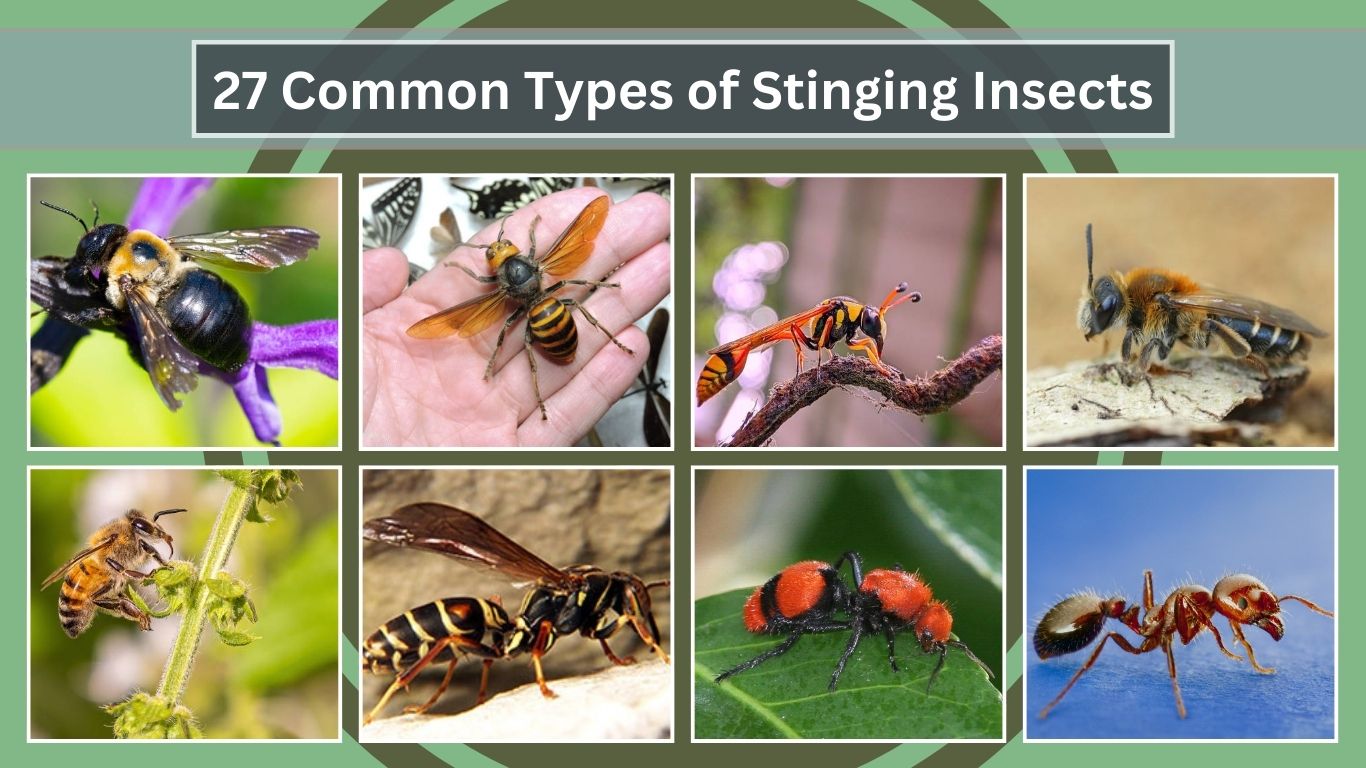
Stinging insects are a diverse group that includes bees, wasps, hornets, and ants, each with unique behaviors, habitats, and levels of danger. While many play vital roles in ecosystems—such as pollination or natural pest control—others are feared for their painful stings and aggressive defenses. Understanding these insects helps us identify them, appreciate their ecological importance, and take precautions to avoid harmful encounters. Here are 27 common stinging insects and their key traits.
1. Honey Bee

Honey bees are among the most recognized stinging insects, valued for their vital role in pollination and honey production. They live in highly organized colonies and are generally non-aggressive unless provoked or defending their hive.
Identification
- Medium-sized insect (about 1.2–1.5 cm long)
- Golden-yellow body with brown bands
- Covered in fine hairs for pollen collection
- Slender legs with pollen baskets on hind legs
Habitat & Behavior
Honey bees build wax hives in hollow trees, beekeeping boxes, or cavities. Colonies consist of a queen, worker bees, and drones. They are social insects, working collectively to forage nectar, pollinate flowers, and produce honey. Their communication relies on the “waggle dance” to share foraging locations.
Sting & Danger
Honey bees sting in defense. Their barbed stinger remains lodged in the skin, causing the bee to die afterward. Stings are painful, causing swelling and redness. While usually mild, multiple stings or allergic reactions can be dangerous, leading to severe symptoms like anaphylaxis.
Common Regions
Honey bees are found worldwide, especially in North America, Europe, Asia, Africa, and Australia. They thrive in temperate to tropical climates wherever flowering plants are abundant.
2. Bumblebee

Bumblebees are large, fuzzy insects easily recognized by their buzzing sound and bright coloration. They are excellent pollinators and are generally non-aggressive, stinging only when threatened.
Identification
- Size: 1.5–2.5 cm long, larger than honey bees
- Color: Black body with yellow or orange bands
- Features: Dense body hairs give them a fuzzy look
- Wings: Small and beat rapidly, producing a loud buzz
Habitat & Behavior
Bumblebees often nest underground in abandoned rodent burrows, thick grass, or compost piles. Some may also use birdhouses. Their colonies are smaller than honey bee colonies, usually consisting of a few hundred individuals. They specialize in “buzz pollination,” a vibration technique that helps release pollen from certain flowers, making them valuable for crops like tomatoes.
Sting & Danger
Unlike honey bees, bumblebees have smooth stingers and can sting multiple times without dying. Their sting is painful but rarely life-threatening, except in cases of allergic reactions. They are less aggressive and usually sting only when their nest is disturbed.
Common Regions
Bumblebees are found in North America, Europe, Asia, and temperate parts of South America. They prefer gardens, meadows, and farmland areas rich in flowering plants.
3. Africanized Honey Bee

Africanized honey bees, often called “killer bees,” are a hybrid between African and European honey bees. They are nearly identical in appearance to regular honey bees but are infamous for their aggressive defensive behavior when disturbed.
Identification
- Size: Similar to honey bees, about 1.2–1.5 cm
- Color: Golden-yellow with brown bands
- Features: Very hard to distinguish visually from European honey bees
- Behavior trait: More aggressive and quicker to swarm
Habitat & Behavior
Africanized honey bees nest in smaller cavities than European honey bees, such as holes in trees, sheds, or utility boxes. Their colonies reproduce and swarm more frequently, making them harder to control. They are highly defensive and may chase perceived threats for long distances compared to standard honey bees.
Sting & Danger
Although each sting is no more toxic than that of a European honey bee, the danger lies in their tendency to attack in large numbers. Multiple stings can cause severe reactions, and in extreme cases, fatalities have occurred. People with allergies to bee venom are at particularly high risk.
Common Regions
Originally introduced to South America, Africanized honey bees spread through Brazil and gradually moved northward. Today, they are found in South and Central America, Mexico, and parts of the southern United States, especially Texas, Arizona, New Mexico, Nevada, and California.
4. Carpenter Bee

Carpenter bees are large, solitary bees often mistaken for bumblebees. Unlike bumblebees, they do not live in large colonies and are best known for drilling into wood to create nesting tunnels.
Identification
- Size: Large, about 1.5–2.5 cm long
- Color: Shiny black abdomen, unlike the hairy abdomen of bumblebees
- Features: Males often have a yellow or white face; females are solid black
- Wings: Transparent with a bluish or purplish sheen
Habitat & Behavior
Carpenter bees prefer to nest in untreated, unpainted, or weathered wood. They bore round holes into wood surfaces, creating tunnels where females lay eggs. They are mostly solitary, though several bees may nest in the same wooden area. Despite their intimidating size, males cannot sting, but they may hover aggressively to protect territory.
Sting & Danger
Female carpenter bees can sting, but they are not aggressive and usually sting only if handled or provoked. Male carpenter bees, though defensive, lack a stinger entirely. The main concern with carpenter bees is the structural damage they can cause to wood over time, not their sting.
Common Regions
Carpenter bees are found worldwide, especially in North America, Asia, Europe, and Australia. They thrive in temperate climates and are common around wooden structures, fences, decks, and garden sheds.
5. Yellowjacket Wasp

Yellowjackets are aggressive stinging insects often mistaken for bees but are actually a type of wasp. They are known for their bright coloration, fast flight, and defensive nature, especially around their nests.
Identification
- Size: About 1–1.5 cm long
- Color: Black and yellow bands on the abdomen
- Features: Shiny body with little hair compared to bees
- Wings: Transparent and fold lengthwise when at rest
Habitat & Behavior
Yellowjackets build paper-like nests made from chewed wood fibers, often located underground, in tree cavities, or in wall voids. They are social wasps, living in colonies with thousands of individuals. They aggressively defend their nests and are also attracted to sugary foods, garbage, and outdoor picnics.
Sting & Danger
Yellowjackets can sting repeatedly since their stingers are smooth and do not remain lodged in the skin. Their sting is painful and injects venom that causes burning pain, swelling, and redness. In some cases, multiple stings or allergic reactions can lead to severe medical emergencies.
Common Regions
Yellowjackets are widespread across North America, Europe, and parts of Asia. They thrive in urban, suburban, and rural environments, particularly in late summer and early fall when their colonies are at peak size.
6. Bald-faced Hornet

The bald-faced hornet is actually a type of yellowjacket wasp, known for its striking black-and-white coloration and highly defensive nature. It is larger than most yellowjackets and notorious for aggressively protecting its nest.
Identification
- Size: 1.2–2 cm long, larger than common yellowjackets
- Color: Black body with distinctive white markings on the face and abdomen
- Features: Smooth, shiny body with long legs
- Wings: Dark and folded lengthwise when at rest
Habitat & Behavior
Bald-faced hornets build large, paper-like nests shaped like footballs, often suspended from tree branches, shrubs, utility poles, or building overhangs. These nests can house hundreds of individuals. They are social wasps that feed on nectar, fruit, and other insects, playing an important role in pest control. However, they are highly territorial and will chase intruders far from the nest if threatened.
Sting & Danger
Bald-faced hornets have smooth stingers that allow them to sting repeatedly. Their sting is more painful than that of many other wasps and injects venom that causes intense burning, swelling, and redness. Multiple stings or allergic reactions can result in serious medical issues, making encounters particularly dangerous.
Common Regions
Bald-faced hornets are commonly found in North America, particularly in the United States and southern Canada. They thrive in wooded areas, gardens, parks, and suburban neighborhoods where trees and shrubs are available for nesting.
7. European Hornet

The European hornet is one of the largest wasps found in Europe and North America. Despite its intimidating size and loud buzzing, it is less aggressive than many other stinging wasps, though it fiercely defends its nest when disturbed.
Identification
- Size: 2–3.5 cm long, significantly larger than yellowjackets
- Color: Brownish body with yellow abdominal bands
- Features: Large reddish-brown head and thorax
- Wings: Reddish-brown and fold lengthwise at rest
Habitat & Behavior
European hornets build large paper nests in hollow trees, wall voids, attics, and abandoned barns. Their nests can contain hundreds of hornets. They are active during the day and at night, unlike most other wasps. They feed on sap, fruit, and insects, often hunting other wasps, bees, and grasshoppers. While they avoid unnecessary conflict, they become highly defensive near their nest.
Sting & Danger
European hornets can sting multiple times since their stinger is smooth. Their sting is painful, with venom causing swelling, redness, and a burning sensation. Though not usually fatal, multiple stings or allergic reactions can be dangerous. They may also spray venom when defending their nest, which can irritate skin and eyes.
Common Regions
European hornets are native to Europe but were introduced to North America in the 1800s. Today, they are widespread across Europe, Asia, and parts of the eastern United States, thriving in forests, rural areas, and human settlements.
8. Asian Giant Hornet

The Asian giant hornet, often called the “murder hornet,” is the world’s largest hornet. Its size, powerful sting, and aggressive defense of its nest make it one of the most feared stinging insects.
Identification
- Size: 3.5–5 cm long, wingspan up to 7.5 cm
- Color: Large orange-yellow head with prominent black eyes
- Body: Dark brown or black thorax with yellow-orange bands on the abdomen
- Features: Strong mandibles used to kill prey, especially bees
Habitat & Behavior
Asian giant hornets typically nest underground in abandoned rodent burrows or hidden forested areas. They are social insects with colonies that can include hundreds of members. They are predators of other insects, particularly honey bees, which they can devastate in large numbers. Despite their fearsome reputation, they avoid humans unless threatened or their nest is disturbed.
Sting & Danger
Their sting is extremely painful and injects a large amount of potent venom. Unlike bees, they can sting multiple times. The venom can damage tissue, cause intense swelling, and in some cases, trigger organ failure or anaphylactic shock. Multiple stings may be fatal without immediate medical treatment.
Common Regions
Asian giant hornets are native to East Asia, especially Japan, China, and Korea. They are also found in parts of Southeast Asia. Recently, they have been detected in small numbers in North America, particularly in the Pacific Northwest of the United States and Canada.
9. Paper Wasp

Paper wasps are slender-bodied wasps named for the papery nests they construct from chewed wood fibers mixed with saliva. They are less aggressive than yellowjackets and hornets but will sting if their nests are threatened.
Identification
- Size: 1.5–2.5 cm long
- Color: Brown or reddish body with yellow markings (varies by species)
- Body: Slender with a narrow “waist”
- Wings: Long and folded lengthwise when resting
Habitat & Behavior
Paper wasps build umbrella-shaped nests that hang from branches, eaves, or other sheltered surfaces. Their colonies are relatively small, often numbering fewer than 200 individuals. They are beneficial insects, feeding on caterpillars and other garden pests, while also visiting flowers for nectar. Paper wasps are social but less aggressive than hornets, usually ignoring humans unless provoked.
Sting & Danger
Paper wasps can sting multiple times and inject venom that causes sharp pain, swelling, and burning sensations. Their sting is usually not life-threatening but can be dangerous to people with bee or wasp venom allergies. Disturbing their nests increases the likelihood of multiple stings.
Common Regions
Paper wasps are found in temperate and tropical regions worldwide, including North America, South America, Europe, Asia, and Australia. They commonly nest in gardens, orchards, and near human structures such as sheds and porches.
10. Red Wasp

Red wasps are a type of paper wasp known for their reddish-brown coloration and painful sting. They are common in warmer regions and often build nests close to human structures, which can lead to frequent encounters.
Identification
- Size: 2–2.5 cm long
- Color: Predominantly reddish-brown body with some dark wings
- Body: Slender with a narrow waist
- Wings: Long, translucent, and folded when resting
Habitat & Behavior
Red wasps build open, umbrella-shaped nests made of chewed wood fibers. These nests are commonly attached to tree branches, under eaves, porches, and in sheds. Colonies are moderate in size, usually containing several dozen individuals. They feed on nectar and hunt caterpillars and other insects, making them beneficial for natural pest control. However, they become defensive if humans come near their nest.
Sting & Danger
Red wasps can sting multiple times and deliver a painful venom that causes burning, swelling, and redness. They are more aggressive than many paper wasp species and will attack in defense of their colony. While usually not life-threatening, stings can be dangerous for individuals with allergies to wasp venom.
Common Regions
Red wasps are primarily found in the southern United States, particularly in Texas, Louisiana, Alabama, and surrounding states. They thrive in warm, humid climates and are often seen around homes, gardens, and wooded areas.
11. Cicada Killer Wasp

The cicada killer wasp is a giant, solitary wasp known for hunting cicadas to feed its young. Despite its large and intimidating size, it is generally non-aggressive toward humans and rarely stings unless handled.
Identification
- Size: 3–4 cm long, one of the largest wasp species in North America
- Color: Black or dark brown body with yellow bands on the abdomen
- Features: Large reddish-brown head and thorax
- Wings: Reddish-brown and transparent
Habitat & Behavior
Cicada killer wasps are solitary ground-nesters, digging tunnels in sandy or loose soil. Females hunt cicadas, sting them to paralyze, and drag them into the burrow as food for their larvae. They are active during midsummer when cicadas emerge. Despite their fearsome appearance, males are territorial but harmless (they cannot sting), while females are docile unless provoked.
Sting & Danger
Female cicada killers can sting, but they rarely do. Their sting is painful but not as dangerous as hornet or yellowjacket stings. They pose little threat to humans, though their large size often causes unnecessary fear. The main nuisance is their burrowing habit, which can disturb lawns and gardens.
Common Regions
Cicada killer wasps are common in North America, particularly in the United States and parts of Mexico. They thrive in sandy soils, open fields, garden edges, and sunny areas where cicadas are abundant.
12. Mud Dauber Wasp

Mud dauber wasps are solitary wasps recognized for their unique nesting habit of building mud tubes. They are non-aggressive and rarely sting, making them among the least threatening stinging insects to humans.
Identification
- Size: 2–2.5 cm long
- Color: Black or metallic blue, sometimes with yellow markings
- Body: Very slender “thread-waisted” appearance
- Wings: Dark or clear, folding lengthwise when at rest
Habitat & Behavior
Mud daubers construct small mud tube nests on walls, under eaves, or inside barns and sheds. Females hunt spiders, paralyze them with a sting, and place them inside the mud nest as food for their larvae. They are solitary, with each female building and provisioning her own nest. They do not defend their nests aggressively like social wasps.
Sting & Danger
Mud daubers can sting but are extremely unlikely to do so. Their sting is mild compared to hornets or yellowjackets. They are considered beneficial insects because they help control spider populations. The greatest nuisance is their mud nests on buildings, not their sting.
Common Regions
Mud dauber wasps are found worldwide, especially in North and South America, Europe, Asia, and Australia. They prefer warm climates and are commonly seen near human structures and places with abundant spiders.
13. Velvet Ant (Cow Killer Ant)

Velvet ants, often called “cow killer ants,” are actually a type of wasp, not true ants. The females are wingless and covered in dense, colorful hairs, making them resemble large ants. They are famous for their extremely painful sting.
Identification
- Size: 1.5–2.5 cm long
- Color: Bright red, orange, or yellow hairs with black body parts
- Features: Females are wingless and ant-like; males have wings and can fly
- Body: Dense velvet-like hair gives them their name
Habitat & Behavior
Velvet ants are solitary wasps that do not form colonies. Females roam on the ground searching for nests of ground-nesting bees and wasps, where they lay their eggs. The larvae develop by feeding on the host’s larvae. They are most often seen in sandy or open areas during summer. Despite their name, they do not kill cows—the nickname comes from the intensity of their sting.
Sting & Danger
The sting of a velvet ant is considered one of the most painful among insects. While extremely painful, it is not typically life-threatening unless someone is allergic to wasp venom. They are not aggressive but will sting if stepped on or handled. Their bright coloration is a warning to predators of their potent sting.
Common Regions
Velvet ants are widely found in North and South America, especially in the southern United States. They thrive in dry, sandy habitats, fields, open woodlands, and gardens.
14. Bullet Ant

The bullet ant is infamous for delivering the most painful sting of any insect in the world. Its sting has been compared to being shot, which is how it earned its dramatic name. Despite this, bullet ants are not aggressive unless their nest is threatened.
Identification
- Size: 1.8–3 cm long, one of the largest ants in the world
- Color: Dark reddish-brown to black body
- Features: Large, strong mandibles and long legs
- Body: Smooth and shiny with a narrow waist
Habitat & Behavior
Bullet ants live in humid rainforests, nesting at the bases of trees. They are social insects, forming colonies with several hundred individuals. Workers forage for nectar, small insects, and plant matter. In South America, some indigenous tribes use bullet ants in initiation rituals, where young men must endure multiple stings as a test of courage.
Sting & Danger
The sting of a bullet ant is considered the most painful of any insect, ranking highest on the Schmidt Pain Index. It causes excruciating pain lasting up to 24 hours, accompanied by swelling, nausea, and temporary paralysis in severe cases. Despite the pain, the venom is not usually fatal unless the person is allergic or stung many times.
Common Regions
Bullet ants are native to Central and South America, especially in rainforests from Nicaragua to Paraguay. They are most commonly encountered in lowland tropical forests.
15. Fire Ant

Fire ants are small but aggressive ants known for their painful stings and tendency to swarm when disturbed. They are considered invasive in many parts of the world and can pose risks to both humans and animals.
Identification
- Size: 2–6 mm long (workers vary in size within a colony)
- Color: Reddish-brown body with darker abdomen
- Features: Segmented body with strong mandibles
- Colonies: Large mounds with thousands of workers and multiple queens in some species
Habitat & Behavior
Fire ants build dome-shaped soil mounds, often in open sunny areas such as lawns, fields, and roadsides. They are highly social, with colonies containing tens of thousands of ants. When their nest is disturbed, they swarm aggressively, climbing onto intruders and delivering painful stings. They feed on plants, seeds, insects, and even small animals.
Sting & Danger
Fire ants sting by first biting to grip the skin, then injecting venom through their stinger. The sting causes intense burning pain, followed by itchy pustules or blisters. Multiple stings are common since many ants attack at once. While usually not life-threatening, stings can cause severe allergic reactions or even anaphylaxis in sensitive individuals.
Common Regions
Fire ants are native to South America but have spread to the southern United States, Australia, China, and other regions. They thrive in warm, sunny environments and are particularly problematic in agricultural and urban areas.
16. Red Imported Fire Ant

The red imported fire ant (RIFA) is one of the most notorious invasive ants, known for its aggressive swarming behavior and painful stings. It is a serious pest in many regions, causing ecological, agricultural, and health problems.
Identification
- Size: 2–6 mm long, with workers varying in size (polymorphic)
- Color: Dark reddish-brown body with a darker abdomen
- Features: Antennae with 10 segments and a two-segmented “waist”
- Colonies: May contain multiple queens, making them harder to control
Habitat & Behavior
Red imported fire ants build large soil mounds, often reaching up to 45 cm in height. These nests are found in open, sunny areas such as pastures, lawns, parks, and fields. Colonies are massive, sometimes containing hundreds of thousands of ants. They are opportunistic feeders, consuming plants, seeds, insects, and small vertebrates. Disturbing a mound triggers an aggressive swarm attack.
Sting & Danger
Their sting is painful, producing a burning sensation followed by itchy pustules or blisters. Multiple stings are common since many ants attack simultaneously. The venom contains alkaloids that can cause severe allergic reactions, and in rare cases, anaphylaxis. These ants are particularly dangerous to pets, livestock, and humans with venom allergies.
Common Regions
Red imported fire ants are native to South America but have spread widely, especially in the southern United States, Australia, China, and parts of Asia. They thrive in warm, humid climates and are a major invasive species in agricultural and urban environments.
17. Harvester Ant

Harvester ants are ground-dwelling ants best known for collecting seeds and storing them in their nests. While they are important ecologically, some species deliver a painful and medically significant sting.
Identification
- Size: 4–7 mm long, larger than many common ants
- Color: Reddish-brown to black, depending on species
- Features: Large heads with strong mandibles for carrying seeds
- Body: Long legs and a distinctly segmented waist
Habitat & Behavior
Harvester ants build large underground nests with wide, flat mounds that may reach several feet across. They prefer dry, open habitats such as grasslands, deserts, and prairies. Colonies can be very large, containing thousands of ants. They forage for seeds and store them in granaries underground, playing a major role in seed dispersal. Some species clear all vegetation around their nests, creating bare soil patches.
Sting & Danger
The sting of harvester ants, particularly species like the red harvester ant and the Maricopa harvester ant, is extremely painful and long-lasting. Their venom is highly toxic and can cause swelling, redness, and systemic reactions in sensitive individuals. In rare cases, stings may trigger life-threatening allergic responses.
Common Regions
Harvester ants are found mainly in North America, especially in the southwestern United States. They also occur in Central and South America, Africa, and parts of Asia. They thrive in arid and semi-arid environments where seeds are abundant.
18. Jack Jumper Ant

The jack jumper ant, also called the hopper ant, is a highly aggressive ant species known for its powerful sting and remarkable jumping ability. It is one of the few ants capable of causing fatal allergic reactions in humans.
Identification
- Size: 1–1.5 cm long
- Color: Black body with orange or yellow legs and jaws
- Features: Strong mandibles and long legs adapted for jumping
- Behavior trait: Notable for its ability to leap several inches when threatened
Habitat & Behavior
Jack jumper ants are solitary foragers that prefer open, dry habitats such as woodlands, grasslands, and scrublands. They nest in soil, under rocks, or in decaying wood. Unlike many ants, they do not form massive colonies; instead, their nests contain hundreds rather than thousands of individuals. They actively hunt insects and spiders, relying on speed and agility rather than scavenging.
Sting & Danger
Their sting is extremely painful and injects potent venom. Jack jumper ants are especially dangerous because their venom is one of the leading causes of insect-sting anaphylaxis in Australia. Victims may experience swelling, difficulty breathing, dizziness, and, in severe cases, life-threatening shock. Immediate medical treatment is required for allergic individuals.
Common Regions
Jack jumper ants are found mainly in Australia, particularly in Tasmania, Victoria, and southern New South Wales. They prefer open, sunlit environments and are less common in dense forests.
19. Army Ant

Army ants are nomadic, highly aggressive ants that live in enormous colonies. They are best known for their coordinated group hunting, where thousands of ants swarm prey with overwhelming force.
Identification
- Size: Workers range from 3–15 mm depending on species
- Color: Usually dark brown to black
- Features: Strong mandibles used for cutting prey
- Colonies: Huge colonies with hundreds of thousands to millions of individuals
Habitat & Behavior
Army ants do not build permanent nests. Instead, they form temporary living nests called “bivouacs,” made of the interlocked bodies of worker ants. Colonies are constantly on the move in search of food. They hunt in massive raiding columns, attacking insects, spiders, and even small vertebrates. Their social organization and coordination make them one of the most formidable insect predators in the world.
Sting & Danger
Army ants have powerful mandibles and, in some species, venomous stings. While most species’ stings are not life-threatening, the sheer number of ants in a raid can inflict hundreds of painful bites and stings at once. In rare cases, large swarms can be dangerous to livestock or humans unable to escape.
Common Regions
Army ants are primarily found in Central and South America, especially in tropical rainforests. Some species also live in Africa and Asia. They thrive in warm, humid environments where food sources are abundant.
20. Sweat Bee

Sweat bees are small bees named for their attraction to human sweat, which they use as a source of salt and moisture. While most species are gentle, some may sting if brushed away or provoked.
Identification
- Size: 4–10 mm long, among the smallest bees
- Color: Varies from metallic green, blue, or bronze to plain black or brown
- Features: Slender body, often with a metallic sheen
- Wings: Clear, delicate, and proportionate to their small size
Habitat & Behavior
Sweat bees live in a wide range of habitats, from forests and grasslands to urban gardens. Many species nest in the ground, while others use rotting wood or plant stems. They are important pollinators, visiting a variety of flowers. Social structures vary—some are solitary, while others form small colonies. Their attraction to perspiration often brings them into contact with humans during hot weather.
Sting & Danger
Sweat bee stings are mild compared to wasps or hornets. They generally sting only when pressed against the skin or swatted. The sting causes minor pain, redness, and irritation but is rarely serious unless the person is allergic to bee venom.
Common Regions
Sweat bees are distributed worldwide, especially in North and South America, Europe, and Asia. They are very common in gardens, fields, and any area with flowering plants.
21. Mining Bee

Mining bees are solitary ground-nesting bees that play an important role in pollination. They are gentle and rarely sting, making them harmless to humans despite their abundance during spring.
Identification
- Size: 8–15 mm long, depending on the species
- Color: Usually brown to black with pale hairs on the body
- Features: Fuzzy thorax, striped abdomen, and long antennae
- Wings: Transparent with a slight brownish tint
Habitat & Behavior
Mining bees dig tunnels in sandy or loose soil, creating small volcano-like mounds at the entrance of their nests. Each female builds her own nest, unlike honey bees that live in colonies. They are active primarily in early spring, coinciding with the blooming of fruit trees and other plants. Mining bees are highly beneficial pollinators and are non-aggressive, even when nesting in large groups.
Sting & Danger
Mining bees are very unlikely to sting. Females are equipped with stingers but use them only if severely threatened or handled. Their sting is mild compared to that of wasps or hornets. Since they are non-aggressive, they pose virtually no danger to humans or pets.
Common Regions
Mining bees are widely distributed across North America, Europe, and parts of Asia. They prefer open sunny areas with sandy or loose soils, such as gardens, orchards, meadows, and grassy fields.
22. Leafcutter Bee

Leafcutter bees are solitary bees recognized for cutting neat, circular pieces from leaves and petals to construct their nests. They are excellent pollinators and are valued in agriculture, particularly for crops like alfalfa.
Identification
- Size: 6–18 mm long, depending on the species
- Color: Usually black or dark brown with pale hairs on the thorax
- Features: Females carry pollen on the underside of their abdomen rather than on their legs
- Wings: Clear and proportionate to body size
Habitat & Behavior
Leafcutter bees typically nest in pre-existing cavities such as hollow stems, rotting wood, and artificial bee houses. Females cut small circular or oval leaf pieces to line their nest cells. Each cell contains a pollen-nectar mixture and a single egg. They are solitary but may nest in clusters when suitable sites are abundant. Leafcutter bees are active during summer and are crucial pollinators of wildflowers and crops.
Sting & Danger
Leafcutter bees are non-aggressive and sting only when handled or trapped. Their sting is mild and far less painful than that of honey bees or wasps. Since they are solitary and do not defend their nests collectively, encounters with stings are very rare.
Common Regions
Leafcutter bees are found throughout North America, Europe, Asia, and Africa. They thrive in gardens, farmlands, and forest edges where flowering plants and nesting cavities are available.
23. Mason Bee

Mason bees are solitary bees known for their nesting behavior of using mud or clay to seal their brood cells. They are gentle, non-aggressive, and considered some of the most efficient pollinators, especially for fruit trees.
Identification
- Size: 6–12 mm long, similar in size to honey bees
- Color: Usually dark metallic blue, green, or black
- Features: Robust body covered in short hairs
- Pollen trait: Carry pollen on abdominal hairs rather than on their legs
Habitat & Behavior
Mason bees do not build hives. Instead, they nest in existing cavities such as hollow stems, wood crevices, or artificial bee houses. Females gather pollen and nectar to create food stores, lay an egg, and then seal the cell with mud. Each female works independently, and they do not form colonies. Their activity peaks in early spring, making them important pollinators of apples, cherries, and other fruit crops.
Sting & Danger
Mason bees are extremely docile and rarely sting. Even if they do, their sting is mild and far less painful than that of honey bees or wasps. They do not defend their nests aggressively, so the risk of being stung is minimal.
Common Regions
Mason bees are found across North America, Europe, and Asia. They thrive in temperate climates with flowering plants and nesting sites available, particularly in orchards, gardens, and wooded areas.
24. Orchid Bee

Orchid bees are brightly colored tropical bees named for their close relationship with orchids. Males are famous for collecting floral fragrances, which they store and use during courtship displays.
Identification
- Size: 8–15 mm long, depending on species
- Color: Metallic green, blue, gold, or purple with a shiny body
- Features: Long tongues adapted for deep flowers
- Wings: Transparent and proportionate to body size
Habitat & Behavior
Orchid bees are mostly solitary, with females nesting in cavities such as hollow wood or soil crevices. They forage widely, visiting orchids and other flowers for nectar and pollen. Males gather aromatic compounds from orchids and store them in special hind-leg pouches. These fragrances are later released in flight displays to attract females, playing a key role in their mating ritual.
Sting & Danger
Female orchid bees can sting, but they are not aggressive and generally avoid humans. Their sting is painful but no more dangerous than that of a honey bee. Since they are solitary and non-defensive, stings are rare.
Common Regions
Orchid bees are native to Central and South America, ranging from Mexico to Brazil. They thrive in tropical and subtropical forests, especially in areas rich in orchids and other flowering plants.
25. Hoverfly

Hoverflies, also called flower flies or syrphid flies, are harmless insects that mimic the appearance of bees and wasps. Despite their look, they cannot sting and are important pollinators in many ecosystems.
Identification
- Size: 6–20 mm long, depending on the species
- Color: Often black and yellow striped, resembling bees or wasps
- Features: Large compound eyes and short antennae
- Wings: Only one pair (as flies), transparent and fast-beating
Habitat & Behavior
Hoverflies are common around flowers, where adults feed on nectar and pollen. Their hovering ability allows them to remain suspended in the air like tiny helicopters. They are solitary insects and do not build nests. Larvae vary by species: some feed on aphids and garden pests, while others live in decaying plant matter or water.
Sting & Danger
Hoverflies do not have stingers and are completely harmless. Their wasp-like coloration is protective mimicry, deterring predators by making them look dangerous. Since they cannot sting or bite, they pose no risk to humans.
Common Regions
Hoverflies are found worldwide, including North and South America, Europe, Asia, Africa, and Australia. They thrive in gardens, meadows, forests, and agricultural fields with abundant flowers.
26. Tarantula Hawk Wasp

The tarantula hawk wasp is a massive, solitary wasp famous for hunting tarantulas as food for its larvae. It delivers one of the most painful stings of any insect, though it is not aggressive toward humans unless provoked.
Identification
- Size: 4–5 cm long, among the largest wasps in the world
- Color: Shiny black body with bright orange or rust-colored wings
- Features: Long legs with hooked claws for grappling tarantulas
- Wings: Large and strong, giving it powerful flight
Habitat & Behavior
Tarantula hawks are solitary and do not form colonies. Females hunt tarantulas, paralyzing them with a sting and dragging them into a burrow. An egg is laid on the immobilized spider, and the larva feeds on the still-living host. Adults primarily feed on nectar and are often seen visiting flowering plants. Despite their size and frightening reputation, they usually avoid humans.
Sting & Danger
Their sting is considered one of the most painful in the insect world, described as excruciating but short-lived, lasting only a few minutes. They rarely sting unless directly handled or threatened. Although the sting is intensely painful, it is not typically dangerous unless the victim is allergic to wasp venom.
Common Regions
Tarantula hawk wasps are found in deserts, grasslands, and open habitats. They are widespread in the southwestern United States, Central America, and South America. Some species also occur in Asia and Africa.
27. Warrior Wasp

The warrior wasp is a large, aggressive wasp species feared for its painful sting and intimidating appearance. It is one of the few insects whose sting is ranked at the highest level on the Schmidt Pain Index, comparable to the bullet ant.
Identification
- Size: 2.5–3.5 cm long
- Color: Dark metallic blue or black body with purple or green sheen
- Features: Long legs and narrow waist typical of wasps
- Wings: Dark or translucent with a purplish tint
Habitat & Behavior
Warrior wasps build large paper nests, often suspended from tree branches in tropical forests. Colonies can contain hundreds of individuals. They are social and extremely defensive of their nests, responding aggressively when disturbed. Adults feed on nectar, while larvae are provisioned with chewed insects. Their coordinated defense makes them especially dangerous if a nest is threatened.
Sting & Danger
The sting of a warrior wasp is excruciatingly painful, ranked alongside the bullet ant on the pain scale. Victims report burning, throbbing pain lasting several hours. While the venom is rarely fatal, multiple stings or allergic reactions can lead to serious medical emergencies. Their aggressive swarming behavior greatly increases the danger.
Common Regions
Warrior wasps are native to Central and South America, particularly in tropical rainforests. They are most often encountered in Mexico, Nicaragua, Costa Rica, and parts of the Amazon Basin.