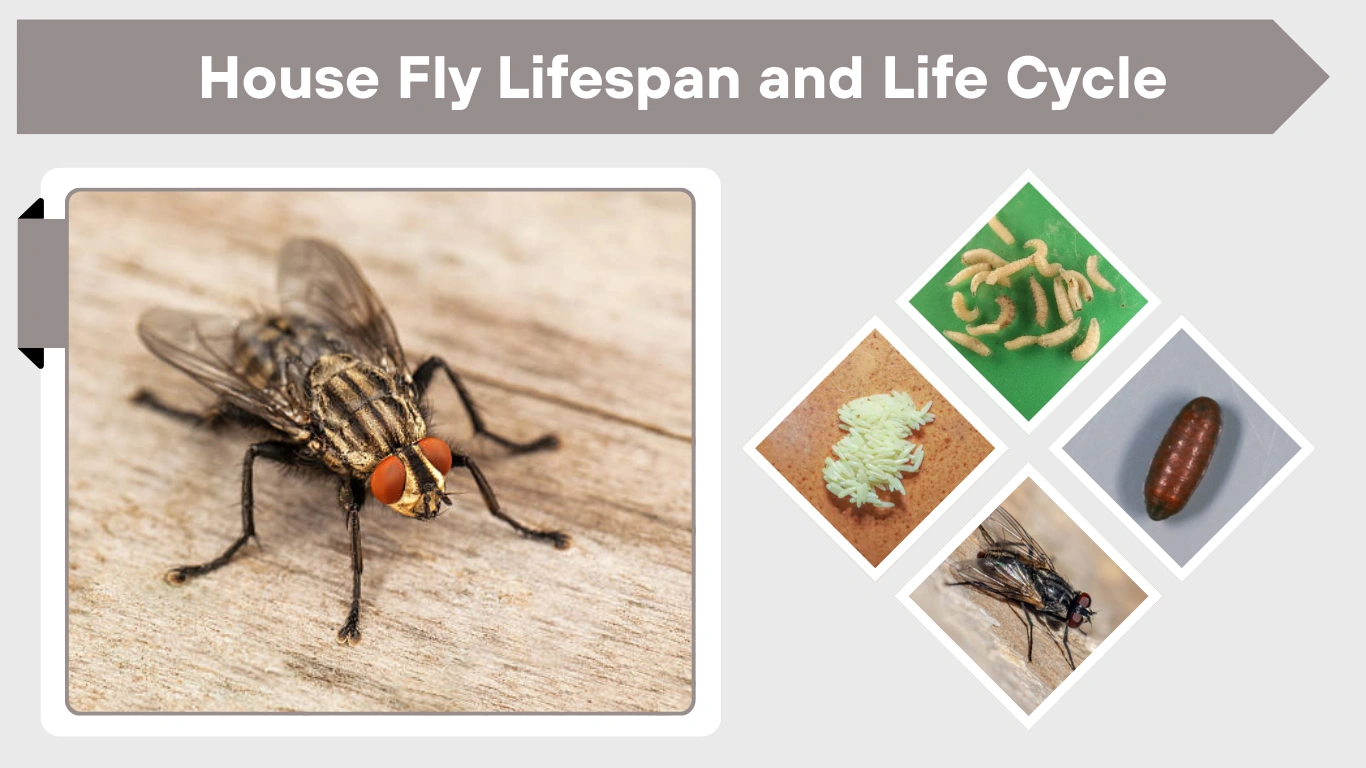
House flies are among the most common household pests worldwide. Although they may seem harmless, their short lifespan combined with rapid reproduction makes them a serious nuisance. A single fly can multiply into hundreds within weeks under ideal conditions. Understanding the house fly lifespan and life cycle helps explain how infestations grow so quickly. In this guide, you’ll learn how long house flies live, the four stages of their development, and why their fast life cycle makes prevention essential.
How Long Do House Flies Live?
The average house fly lifespan is surprisingly short, but that doesn’t mean they aren’t a problem. In fact, their brief life is one reason they reproduce so aggressively.
Average Lifespan of a House Fly
A typical adult house fly lives between 15 and 30 days. In ideal indoor conditions with steady warmth and plenty of food, some may survive slightly longer. Female house flies often live a bit longer than males because they need time to lay multiple batches of eggs during their lifetime.
While a month may not sound long, it is more than enough time for a single female to lay hundreds of eggs and start a new generation.
Lifespan Indoors vs Outdoors
House flies generally live longer indoors than outdoors. Inside homes, temperatures are stable and food sources are readily available. Outdoors, flies face predators, wind, rain, and temperature changes that can shorten their lives.
During warm seasons, especially summer, flies thrive and reproduce quickly. In colder weather, their lifespan shortens significantly unless they find shelter indoors.
Factors That Affect House Fly Lifespan
Several environmental factors influence how long a house fly survives:
- Temperature: Warm temperatures speed up development and increase activity.
- Food availability: Access to organic waste or food scraps supports longer survival.
- Humidity: Moderate humidity levels help them thrive.
- Predators and control measures: Spiders, birds, and human pest control reduce lifespan.
In warm environments, their entire life cycle can move at an accelerated pace.
Overview of the House Fly Life Cycle

The house fly undergoes complete metamorphosis, meaning it develops through four distinct stages: egg, larva, pupa, and adult. Each stage serves a specific purpose in growth and reproduction.
Under ideal warm conditions, the entire house fly life cycle can be completed in as little as 7 to 10 days. In cooler conditions, it may take up to three weeks. This rapid development is the main reason fly infestations grow so quickly.
Because multiple generations can develop in a single season, even a small fly problem can become overwhelming within weeks.
Stage 1 – Egg Stage

The life of a house fly begins as a tiny white egg, usually laid in clusters in moist organic material.
Where Do House Flies Lay Eggs?
Female house flies prefer to lay eggs in places that provide immediate food for emerging larvae. Common breeding sites include:
- Garbage bins
- Animal manure
- Rotting food
- Compost piles
- Decaying organic matter
These environments supply nutrients that allow larvae to grow rapidly after hatching.
How Many Eggs Do House Flies Lay?
A single female house fly can lay 75 to 150 eggs at one time. Over her lifetime, she may produce up to 500 eggs in several batches.
This high reproductive capacity explains why infestations can escalate so quickly. Even if only a fraction of the eggs survive, the population can multiply dramatically within weeks.
How Long Do Eggs Take to Hatch?
House fly eggs hatch very quickly—usually within 8 to 24 hours. In warm weather, hatching may occur in less than a day. This short incubation period means that new larvae begin feeding almost immediately after being laid.
Stage 2 – Larva (Maggot) Stage

Once the eggs hatch, they enter the larval stage, commonly known as the maggot stage.
What Is a Maggot?
Maggots are small, cream-colored, legless larvae with soft bodies. They are typically about 3–9 millimeters long and appear worm-like. Unlike adult flies, maggots do not have wings or visible eyes.
Their sole purpose during this stage is to feed and grow. They consume the surrounding organic material constantly, gaining size rapidly.
How Long Does the Maggot Stage Last?
The larval stage generally lasts 3 to 5 days, depending on temperature and food availability. In warm environments, development happens faster. During this time, maggots molt several times as they grow larger.
By the end of this stage, the larva is fully grown and ready to transform into the next phase of development.
Why This Stage Is Critical for Infestation Growth
The maggot stage is the most important growth period in the house fly life cycle. Because larvae remain hidden inside garbage or waste, infestations often go unnoticed at this point.
Since they feed continuously and develop quickly, eliminating breeding sources during this stage is key to preventing adult fly populations from increasing.
Stage 3 – Pupa Stage

After completing the larval stage, the fully grown maggot moves to a slightly drier area to begin pupation. This marks the transition from feeding and growth to transformation.
What Happens During Pupation?
During the pupal stage, the maggot forms a hard, protective outer casing called a puparium. Inside this casing, the insect undergoes a dramatic transformation. Its body reorganizes completely, developing wings, legs, compound eyes, and other adult features.
Although the pupa appears inactive from the outside, major biological changes are happening internally. This is the stage where the larva turns into a fully formed adult fly.
Duration of the Pupal Stage
The pupal stage typically lasts 3 to 6 days, depending largely on environmental conditions. Warm temperatures accelerate development, while cooler conditions slow it down.
Once development is complete, the adult fly breaks out of the puparium and emerges into the environment. Within a short time, its wings expand and harden, allowing it to fly and begin searching for food.
Stage 4 – Adult House Fly

The adult stage is the final phase of the house fly life cycle. This is the stage most people are familiar with—and the one responsible for spreading contamination.
When Do Adult Flies Start Reproducing?
Adult house flies mature quickly. Within 2 to 3 days of emerging from the pupal case, they are capable of mating. Females typically mate once but can lay multiple batches of fertilized eggs throughout their lifespan.
This short time to reproductive maturity allows fly populations to grow at a rapid pace, especially during warmer months.
Adult Behavior and Feeding Habits
Adult house flies feed on a wide range of organic materials. Because they cannot chew solid food, they regurgitate digestive enzymes onto surfaces to liquefy food before sucking it up.
They are commonly attracted to:
- Food scraps
- Sugary substances
- Animal waste
- Garbage
As they move between waste and human food sources, they can transfer bacteria and pathogens on their legs and mouthparts. This makes them potential carriers of diseases such as food poisoning and other gastrointestinal infections.
Adult Lifespan and Reproduction Rate
An adult house fly typically lives 2 to 4 weeks. During that time, a female can lay several batches of eggs, potentially producing hundreds of offspring.
Because the entire life cycle—from egg to adult—can be completed in as little as a week under ideal conditions, multiple generations can develop in a single summer season. This overlapping of generations leads to rapid population growth.
How Fast Do House Flies Multiply?
House flies are known for their incredible reproductive speed. In warm environments, the full life cycle can take 7 to 10 days, meaning a new generation of adults can appear in just over a week.
Consider this:
- One female lays up to 150 eggs at a time.
- Those eggs hatch within 24 hours.
- Larvae develop in a few days.
- Adults begin reproducing within 2–3 days of emerging.
With favorable conditions, several generations can overlap during the summer. Even if survival rates are moderate, the population can expand exponentially in a short period.
This is why a small number of flies indoors can quickly turn into a noticeable infestation if breeding sources are not eliminated.
House Fly Lifecycle Timeline (Quick Summary)

Here is a simplified timeline of the house fly life cycle:
- Egg stage: 8–24 hours
- Larva (maggot) stage: 3–5 days
- Pupa stage: 3–6 days
- Adult lifespan: 15–30 days
- Total cycle duration: 7–21 days
The exact timing depends heavily on temperature and environmental conditions. Warmer temperatures generally shorten development time, while cooler weather slows it down.
Why Understanding the House Fly Life Cycle Matters
Knowing the house fly lifespan and life cycle is essential for effective prevention and control. Since flies reproduce so quickly, simply killing visible adults is not enough to solve the problem.
The key to breaking the cycle is eliminating breeding sites such as garbage, food waste, and animal manure. By targeting the egg and larval stages, you can stop new generations from developing.
Proper sanitation, sealed trash containers, regular cleaning, and waste management significantly reduce the risk of infestation. Understanding how quickly house flies multiply highlights the importance of early action and consistent prevention.
Conclusion
Although the average house fly lives only a few weeks, its rapid reproductive cycle allows populations to grow quickly. With four distinct stages—egg, larva, pupa, and adult—the entire life cycle can be completed in as little as a week under ideal conditions. Because females lay hundreds of eggs during their lifetime, even a small fly problem can escalate fast. Understanding their lifespan and development stages is the first step toward effective prevention and long-term control.