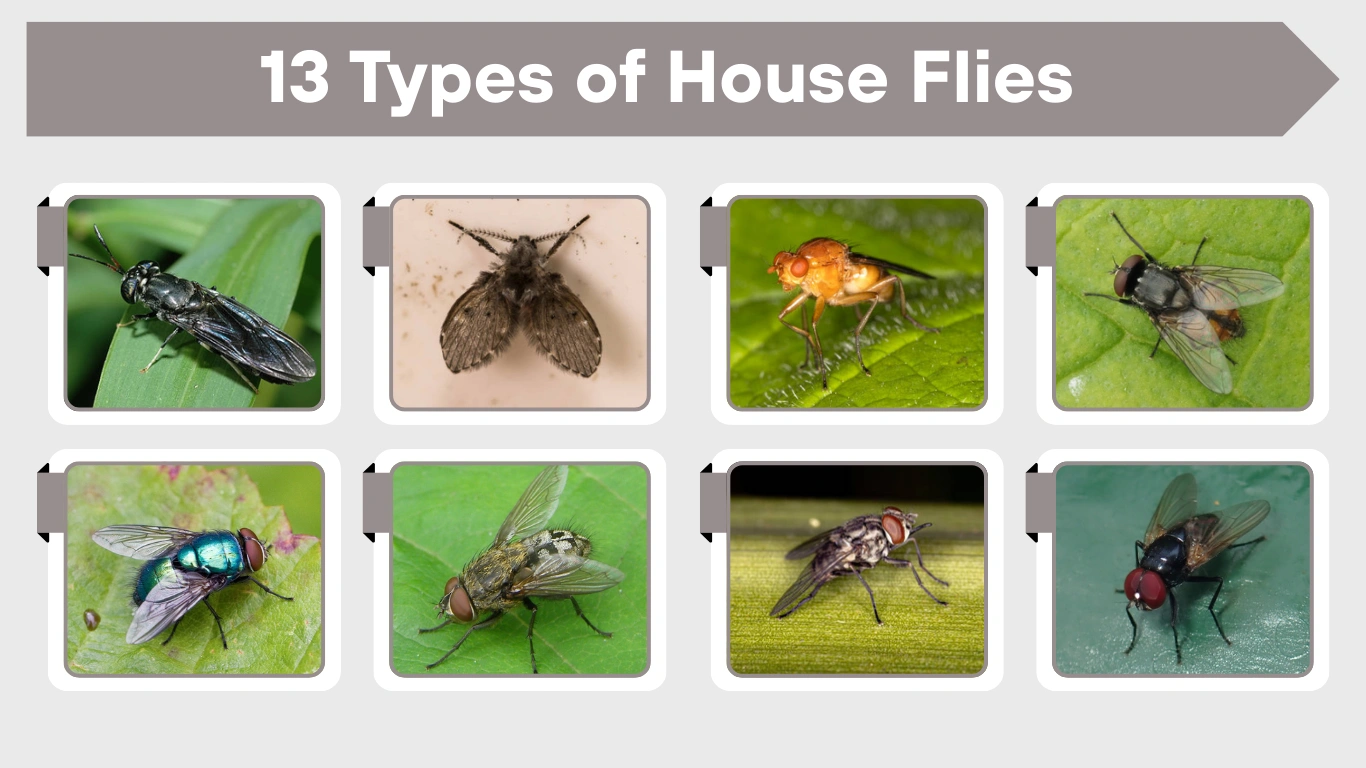
House flies are common insects found in homes, farms, and outdoor spaces around the world. While many people think all flies are the same, there are actually several different types, each with unique behaviors, habitats, and characteristics. Some species are harmless nuisances, while others can bite, spread bacteria, or affect livestock. Understanding the differences between these 13 types of house flies can help you identify them correctly and take proper control measures when necessary. Here’s a closer look at the most common species you may encounter.
1. Common House Fly

The common house fly (Musca domestica) is one of the most widespread and recognizable household pests in the world. It thrives in human environments and is known for its rapid reproduction and ability to spread bacteria. Found in homes, farms, restaurants, and waste areas, this fly is active during warm months and can quickly become a nuisance indoors and outdoors.
Identification
- Gray thorax with four dark longitudinal stripes
- Slightly hairy body
- Large reddish compound eyes
- One pair of clear wings
- Sponging mouthparts (no biting)
- About 6–7 mm in length
Habitat
Common house flies prefer warm environments close to human activity. They are commonly found around garbage bins, animal manure, compost piles, and food preparation areas. Indoors, they are often seen resting on walls, ceilings, and windows.
Behaviors
These flies are active during the daytime and are constantly moving between food sources and breeding sites. They frequently land on surfaces, including food, which increases the risk of contamination. House flies do not bite, but they can mechanically transmit pathogens through their legs and mouthparts.
Diet and Lifecycle
Adult house flies feed on liquid or semi-liquid substances, including decaying organic matter, food scraps, and sugary liquids. They regurgitate digestive enzymes onto solid food to liquefy it before feeding.
The lifecycle includes four stages: egg, larva (maggot), pupa, and adult. Females lay batches of eggs in moist, decaying material. Eggs hatch within 24 hours, and under warm conditions, the entire lifecycle can be completed in as little as 7–10 days.
2. Lesser House Fly

The lesser house fly (Fannia canicularis) is a smaller relative of the common house fly and is frequently found in homes, poultry houses, and animal facilities. Although similar in appearance, it has distinct flight patterns and behavior. It is common in temperate regions and is especially noticeable during warmer months.
Identification
- Smaller than the common house fly (about 4–6 mm long)
- Slender, dark gray to black body
- Three faint dark stripes on the thorax
- Clear wings that overlap when at rest
- Males often seen flying in circular patterns indoors
Habitat
Lesser house flies prefer areas with decaying organic material, manure, compost, and garbage. They are commonly found in poultry farms and livestock facilities but may also enter homes, especially during summer.
Behaviors
Males are known for their distinctive hovering and circular flight patterns inside buildings. Unlike common house flies, they are less likely to land directly on food but can still be a nuisance. They are most active during daylight hours.
Diet and Lifecycle
Adults feed on decaying organic matter and other moist materials. The larvae develop in animal manure, compost, or other decomposing organic waste.
Their lifecycle includes egg, larva, pupa, and adult stages. Under warm conditions, development can be completed in about 2–3 weeks.
3. Stable Fly

The stable fly (Stomoxys calcitrans) resembles the common house fly but is known for its painful biting behavior. Unlike non-biting house flies, stable flies feed on blood and are common around livestock, farms, and sometimes residential areas. They are active during warm seasons and can be a serious nuisance to both animals and humans.
Identification
- Similar in size to the common house fly (6–8 mm long)
- Gray body with dark spots on the abdomen
- Four dark stripes on the thorax
- Long, rigid, forward-pointing proboscis (used for biting)
- Clear wings held slightly apart when at rest
Habitat
Stable flies are commonly found near livestock facilities, barns, stables, and areas with decaying plant material mixed with animal waste. They may also be present near beaches, lawns, or gardens where organic debris accumulates.
Behaviors
Stable flies are aggressive daytime biters and feed primarily on the blood of cattle, horses, and other animals, but they will also bite humans. They typically bite on the legs and lower body. Both males and females feed on blood.
Diet and Lifecycle
Adult stable flies require blood meals for survival and reproduction. The larvae develop in moist, decaying organic matter such as manure, hay, or grass clippings.
Their lifecycle includes egg, larva, pupa, and adult stages, usually completed in about 2–4 weeks depending on temperature and environmental conditions.
4. Cluster Fly

The cluster fly (Pollenia rudis) is often mistaken for the common house fly, especially when it enters homes. Unlike typical house flies, cluster flies develop as parasites of earthworms. They are most noticeable in autumn and winter when they gather in large numbers inside buildings to overwinter.
Identification
- Slightly larger than the common house fly (8–10 mm long)
- Dark gray body with golden or yellowish hairs on the thorax
- Overlapping wings when at rest
- Slower movement compared to house flies
- Distinctive checkered pattern on the abdomen
Habitat
Cluster flies are commonly found in fields, lawns, and grassy areas where earthworms are present. During cooler months, they enter homes, attics, wall voids, and other sheltered spaces to hibernate.
Behaviors
These flies are sluggish and slow-moving. In autumn, they gather in large groups on sunny exterior walls before entering buildings through small cracks and openings. Indoors, they often cluster around windows and light sources during winter warm spells.
Diet and Lifecycle
Adult cluster flies feed on flower nectar and other plant liquids. The larvae develop as internal parasites within earthworms in the soil.
Their lifecycle includes egg, larva, pupa, and adult stages. Development usually takes several weeks, and multiple generations can occur during warmer months.
5. Blue Bottle Fly

The blue bottle fly (Calliphora vomitoria) is a large, metallic-colored fly commonly found around garbage, animal carcasses, and decaying organic matter. It is well known for its shiny blue abdomen and loud buzzing sound. This species plays an important role in decomposition but can also become a household nuisance.
Identification
- Large size (10–14 mm long)
- Metallic blue abdomen
- Black head and thorax
- Reddish-brown compound eyes
- Clear wings with strong buzzing flight
Habitat
Blue bottle flies are commonly found near garbage bins, dead animals, compost piles, and animal waste. They may enter homes in search of food or suitable breeding sites, especially during warm weather.
Behaviors
These flies are strong fliers and are often attracted to odors from decaying meat or organic waste. They are active during the daytime and are usually among the first insects to arrive at carrion.
Diet and Lifecycle
Adults feed on decaying organic matter, carrion, and sugary substances like nectar. Females lay eggs on dead animals or rotting meat.
The lifecycle includes egg, larva (maggot), pupa, and adult stages. Under warm conditions, development can be completed in about 2–3 weeks.
6. Green Bottle Fly

The green bottle fly (Lucilia sericata) is a metallic green blow fly commonly found around decaying organic matter. It is similar to the blue bottle fly but smaller and bright green in color. This species plays a key role in decomposition and is also used in medical settings for maggot therapy.
Identification
- Medium to large size (8–12 mm long)
- Shiny metallic green body
- Reddish compound eyes
- Clear wings
- Black legs
- Loud buzzing flight
Habitat
Green bottle flies are commonly found near garbage, compost piles, animal carcasses, and manure. They are frequently seen in rural and urban areas, especially during warm seasons. They may also enter homes in search of food or breeding sites.
Behaviors
These flies are active during the daytime and are strongly attracted to the smell of decaying meat and waste. They are often among the first insects to locate and colonize carcasses.
Diet and Lifecycle
Adults feed on nectar, garbage, and decaying organic matter. Females lay eggs on carrion or rotting material.
Their lifecycle includes egg, larva (maggot), pupa, and adult stages. In warm conditions, the full development cycle can be completed in approximately 2–3 weeks.
7. Black Dump Fly

The black dump fly (Hydrotaea aenescens) is a dark-colored fly commonly found around garbage, manure, and decaying organic waste. It is sometimes mistaken for the common house fly but has a more metallic sheen and different breeding habits. This species is often associated with waste disposal sites and livestock areas.
Identification
- Medium size (5–7 mm long)
- Dark gray to black body with slight metallic shine
- Clear wings
- Short antennae
- Slender body shape
- Less prominent thoracic stripes than the common house fly
Habitat
Black dump flies are typically found near garbage dumps, compost piles, animal manure, and decaying plant material. They are common in agricultural settings and areas where organic waste accumulates.
Behaviors
These flies are active during warm months and are frequently seen resting on waste materials. They may enter buildings near waste sites but are less likely to invade homes compared to common house flies.
Diet and Lifecycle
Adults feed on decaying organic matter and waste materials. The larvae develop in manure, garbage, and other decomposing substances.
Their lifecycle includes egg, larva, pupa, and adult stages, usually completed within a few weeks under favorable environmental conditions.
8. Flesh Fly

The flesh fly (family Sarcophagidae) is a gray, striped fly commonly found around decaying organic matter and animal carcasses. Unlike many other flies, flesh flies give birth to live larvae instead of laying eggs. They are widespread and often seen in both urban and rural environments.
Identification
- Medium to large size (8–15 mm long)
- Gray thorax with three dark longitudinal stripes
- Checkered black-and-gray pattern on the abdomen
- Red compound eyes
- Clear wings
- Robust, bristly body
Habitat
Flesh flies are commonly found near carrion, garbage, manure, and decaying flesh. They may also be seen around pet waste, open wounds on animals, and outdoor food sources.
Behaviors
These flies are active during the daytime and are strongly attracted to decaying meat and waste odors. Females deposit live larvae directly onto suitable food sources, which allows rapid development.
Diet and Lifecycle
Adult flesh flies feed on liquid from decaying organic matter, nectar, and other sugary substances.
Their lifecycle includes larva, pupa, and adult stages (since larvae are deposited directly). Development is usually rapid, often completed within 2–3 weeks depending on environmental conditions.
9. Face Fly

The face fly (Musca autumnalis) closely resembles the common house fly but is primarily associated with livestock. It is known for feeding on the facial secretions of cattle and horses. This species is common in rural and agricultural areas, especially during warm seasons.
Identification
- Similar in size to the common house fly (6–8 mm long)
- Dark gray body with faint thoracic stripes
- Slightly larger and more robust than the common house fly
- Reddish compound eyes
- Clear wings
Habitat
Face flies are commonly found around cattle farms, pastures, and livestock facilities. They breed in fresh cattle manure and are rarely found breeding indoors. However, they may enter buildings to overwinter in cooler climates.
Behaviors
Adult face flies are active during the daytime and are often seen clustering around the eyes, nose, and mouth of cattle. They feed on tears and other secretions, which can irritate animals and spread eye infections such as pinkeye.
Diet and Lifecycle
Adults feed on facial secretions of livestock, as well as nectar and other liquids. Females lay eggs in fresh cattle manure, where larvae develop.
The lifecycle includes egg, larva, pupa, and adult stages, typically completed within 2–3 weeks under favorable warm conditions.
10. Fruit Fly

The fruit fly (Drosophila melanogaster and related species) is a small fly commonly found around ripened or fermenting fruits and vegetables. It is one of the most familiar household flies and is widely used in scientific research due to its rapid reproduction and simple genetics.
Identification
- Very small size (2–4 mm long)
- Tan to light brown body
- Bright red compound eyes (in most common species)
- Clear wings
- Rounded abdomen
Habitat
Fruit flies are commonly found in kitchens, grocery stores, markets, and anywhere fermenting fruit or sugary liquids are present. They breed in overripe fruits, spilled juices, drains, and garbage containers.
Behaviors
These flies are active throughout the day and are strongly attracted to sweet, fermented odors. They gather quickly around exposed fruit and can multiply rapidly if breeding sources are not removed.
Diet and Lifecycle
Adults feed on fermenting fruits, vegetables, and sugary substances. Females lay eggs on the surface of moist, decaying produce.
Their lifecycle includes egg, larva, pupa, and adult stages. Under warm conditions, development can be completed in as little as 8–10 days.
11. Phorid Fly

The phorid fly (family Phoridae), often called the scuttle fly, is a small hump-backed fly commonly found in homes, restaurants, and drains. It is known for its rapid, jerky running behavior across surfaces rather than sustained flight. These flies are frequently associated with decaying organic matter and hidden moisture sources.
Identification
- Very small size (2–6 mm long)
- Brown to black body
- Distinctive hump-backed appearance
- Short antennae
- Clear wings
- Characteristic fast, erratic running movement
Habitat
Phorid flies are commonly found near garbage, drains, sewage leaks, decaying food, and moist organic material. Indoors, they often breed in clogged drains, wall voids, or under appliances where organic debris accumulates.
Behaviors
Unlike many flies, phorid flies often prefer to run quickly across surfaces instead of flying. They are active year-round indoors and are attracted to moisture and decomposing organic material.
Diet and Lifecycle
Adults feed on decaying organic matter and sugary substances. Females lay eggs in moist, decomposing material, including food waste and sewage buildup.
Their lifecycle includes egg, larva, pupa, and adult stages, typically completed within 2–4 weeks depending on environmental conditions.
12. Drain Fly

The drain fly (family Psychodidae), also known as the moth fly or sewer fly, is a tiny, fuzzy fly commonly found around sinks, showers, and drains. It thrives in moist environments where organic sludge builds up. Although harmless, drain flies can become a persistent indoor nuisance.
Identification
- Very small size (1.5–5 mm long)
- Fuzzy, moth-like appearance
- Hairy wings held roof-like over the body
- Gray, tan, or light brown color
- Weak, fluttering flight
Habitat
Drain flies are commonly found in bathrooms, kitchens, basements, and near floor drains. They breed in the slimy organic buildup inside pipes, sewage systems, septic tanks, and other consistently moist areas.
Behaviors
These flies are most active during the evening and are often seen resting on walls near drains. They are weak fliers and tend to make short, hopping flights when disturbed.
Diet and Lifecycle
Adults feed on organic matter and microorganisms found in drain sludge. Females lay eggs in the gelatinous film inside drains and pipes.
Their lifecycle includes egg, larva, pupa, and adult stages, usually completed in about 1–3 weeks under suitable moist conditions.
13. Soldier Fly

The soldier fly (family Stratiomyidae), particularly the black soldier fly (Hermetia illucens), is a large, wasp-like fly commonly found around compost, manure, and decaying organic waste. Unlike many other flies, adult soldier flies are not considered pests and do not spread disease.
Identification
- Medium to large size (15–20 mm long)
- Black body with a slender, wasp-like appearance
- Transparent patches on the abdomen
- Long antennae
- Dark wings folded flat over the body
- Slow, non-aggressive movement
Habitat
Soldier flies are commonly found near compost piles, manure, garbage, and agricultural waste. They are especially abundant in warm climates and are often seen around organic recycling facilities or farms.
Behaviors
Adult soldier flies are not attracted to human food and rarely enter homes. They do not bite or sting. Their larvae are highly efficient decomposers and are often used in waste management and animal feed production.
Diet and Lifecycle
Adult soldier flies primarily feed on nectar or may not feed much at all during their short lifespan. Females lay eggs near decaying organic matter.
The lifecycle includes egg, larva, pupa, and adult stages. The larval stage is the longest and can last several weeks, during which larvae consume large amounts of organic waste before pupating.
FAQs
What is the most common type of house fly?
The common house fly (Musca domestica) is the most widespread species worldwide. It is frequently found in homes, restaurants, farms, and garbage areas. This fly is known for its rapid reproduction and ability to spread bacteria by landing on food and surfaces.
Which house flies bite humans?
Most house flies do not bite. However, the stable fly is an exception. It feeds on blood and can bite both humans and animals, causing painful skin irritation. Its long, pointed mouthpart makes it easy to distinguish from non-biting species.
Why are house flies attracted to homes?
House flies are attracted to food, moisture, and warmth. Open garbage, overripe fruits, pet waste, drains, and leftover food provide ideal feeding and breeding conditions. Even small amounts of organic waste can attract flies indoors.
How can I prevent house fly infestations?
Keeping your home clean is the best prevention method. Dispose of garbage properly, clean drains regularly, store food in sealed containers, and fix moisture problems. Sealing cracks and installing window screens also help prevent flies from entering.
How fast do house flies reproduce?
House flies reproduce very quickly. Under warm conditions, some species can complete their lifecycle in as little as 7–10 days. A single female can lay hundreds of eggs, which is why infestations can grow rapidly if breeding sources are not removed.