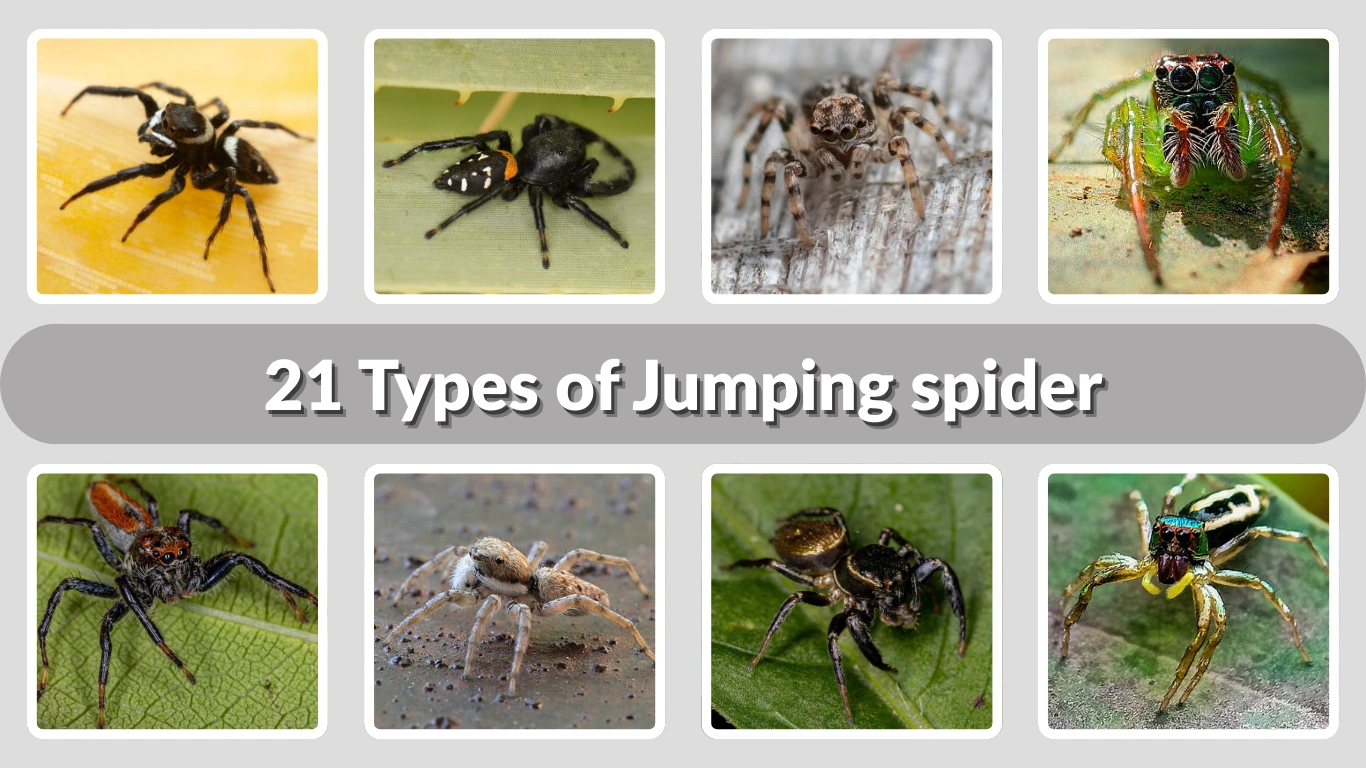
Jumping spiders are among the most fascinating arachnids, known for their incredible vision, bold personalities, and acrobatic leaps. Found in gardens, forests, homes, and even tropical islands, these small predators rely on precision hunting rather than webs. Their bright colors, curious behavior, and unique adaptations make them a favorite among nature enthusiasts. This guide introduces 21 different jumping spider types and highlights what makes each one so distinctive.
1. Bold Jumping Spider

The bold jumping spider is one of the most recognizable jumping spiders in North America, known for its striking black body, iridescent green chelicerae, and bold white or orange markings. It is an active daytime hunter with excellent vision and agile movements.
Identification
- Black, fuzzy body
- Iridescent green or blue mouthparts
- White or orange spots on abdomen
- Large forward-facing eyes
- Compact, sturdy jumping-spider shape
Habitat
Bold jumping spiders live in a wide range of environments, including gardens, forests, grasslands, and building exteriors. They prefer sunny, open areas where they can actively hunt. They may also be found on fences, tree trunks, windowsills, and outdoor walls.
Behaviors
These spiders are active hunters and do not build webs to catch prey. Instead, they stalk and leap onto insects with precision. Curious by nature, they often turn to look at movement, including humans. They use silk only as a safety line and to create small shelters.
Diet and Lifecycle
Their diet includes flies, moths, beetles, and small insects. They pounce on prey using their jumping ability and strong vision. Females lay eggs inside silk retreats, protecting the sacs until hatching. Spiderlings disperse and undergo several molts before reaching adulthood. Females can live up to a year, while males typically have shorter lifespans.
2. Regal Jumping Spider

The regal jumping spider is one of the largest and most colorful jumping spider species in North America. Known for its striking patterns and bright iridescent chelicerae, it is a confident hunter often seen in warm, sunny habitats. Despite its bold appearance, it is harmless to humans.
Identification
- Large, robust jumping spider
- Black body with white, orange, or gray markings
- Iridescent green or blue chelicerae
- Dense, hairy legs and body
- Females often larger and more colorful than males
Habitat
Regal jumping spiders prefer warm climates and are commonly found in gardens, shrublands, open fields, and building exteriors. They seek sunny surfaces such as fences, tree trunks, and walls where they can observe prey. Indoors, they may appear near windows or warm corners.
Behaviors
These spiders actively stalk prey using superb vision, leaping with precision. They are curious and may turn to face approaching movement. Instead of webs for hunting, they build silk retreats to rest, molt, or guard eggs. They are solitary and active during the day.
Diet and Lifecycle
Their diet includes flies, crickets, moths, and other small arthropods. They capture prey using quick, calculated jumps and powerful mandibles. Females lay eggs in silk chambers and guard them until hatching. Spiderlings disperse and grow through several molts. Females live up to a year; males live shorter lives.
3. Zebra Jumping Spider

The zebra jumping spider is a small, energetic hunter recognized by its striking black-and-white striped pattern. Common across many regions, it thrives in both natural and urban settings. Its excellent vision and agile jumping abilities make it a skilled daytime predator.
Identification
- Black body with white zebra-like stripes
- Small size (typically 5–7 mm)
- Large forward-facing eyes
- Short, sturdy legs
- Fast, jerky movements typical of jumping spiders
Habitat
Zebra jumping spiders live on walls, fences, tree trunks, rocks, and sunny outdoor surfaces. They prefer bright, open areas where they can spot prey easily. They are frequently seen on building exteriors, garden furniture, and windowsills.
Behaviors
These spiders actively hunt rather than build webs. They stalk prey visually, then leap with accuracy using a silk safety line. They may observe humans up close due to their natural curiosity. Zebra jumpers are solitary and spend nights in small silk retreats.
Diet and Lifecycle
Their diet includes flies, small beetles, gnats, and other tiny insects. They strike quickly using their jumping ability and strong jaws. Females lay eggs in silk sacs hidden in cracks or under bark. Spiderlings disperse soon after hatching and molt several times before reaching adulthood. Females live longer than males, often close to a year.
4. Red Jumping Spider

The red jumping spider is a brightly colored species known for its vivid red or reddish-orange body and highly active hunting style. Its compact build, keen eyesight, and bold coloration make it a standout among jumping spiders. It is harmless to humans and beneficial for pest control.
Identification
- Bright red or reddish-orange body
- Compact, sturdy shape typical of jumpers
- Large forward-facing eyes
- Quick, agile movements
- Often found on plants, walls, or outdoor surfaces
Habitat
Red jumping spiders inhabit gardens, forests, grasslands, and building exteriors. They prefer sunny areas where they can hunt during the day. They are commonly spotted on leaves, branches, fences, and windowsills, especially in warm climates.
Behaviors
These spiders are active daytime hunters, stalking and leaping onto insects with precision. Curious and alert, they often turn to observe movement around them. They build small silk retreats for resting, molting, and laying eggs but do not use webs to catch prey.
Diet and Lifecycle
Their diet includes small flies, beetles, gnats, and other tiny insects. They capture prey using calculated jumps supported by a silk safety line. Females lay eggs inside silk pouches attached to leaves or hidden surfaces. Spiderlings hatch, disperse quickly, and grow through several molts to reach maturity.
5. Emerald Jumping Spider

The emerald jumping spider is known for its shimmering green or metallic coloration and agile hunting behavior. This small but striking spider is often found in leafy environments where its iridescent body blends naturally. It is harmless to humans and admired for its beauty and speed.
Identification
- Metallic green or emerald-colored body
- Small, compact shape
- Large, forward-facing eyes for excellent vision
- Quick, alert movements
- Subtle patterning depending on species and sex
Habitat
Emerald jumping spiders live in forests, gardens, shrubs, and areas with abundant vegetation. They prefer leafy plants, tree bark, and shaded outdoor surfaces where insects are plentiful. They are more commonly found in warm or tropical regions.
Behaviors
These spiders actively hunt insects using stealth and precision leaps. They rarely use webs except for silk retreats and egg sacs. Curious by nature, they may turn to watch movement, including humans. They spend most of their time patrolling leaves and branches for prey.
Diet and Lifecycle
Their diet includes tiny flies, ants, gnats, and other small insects. They stalk prey visually and leap using a silk safety line for stability. Females lay eggs inside silk retreats hidden in foliage. Spiderlings disperse soon after hatching and grow through several molts before adulthood.
6. Phidippus audax

Phidippus audax, commonly known as the Bold Jumping Spider, is a widespread and easily recognized species. Although similar to the bold jumping spider already listed, this name refers specifically to the scientific species known for its colorful markings and lively behavior.
Identification
- Black, hairy body
- Iridescent green or blue chelicerae
- Distinct white or orange spots on the abdomen
- Large forward-facing eyes
- Thick, powerful legs for jumping
Habitat
Phidippus audax thrives in gardens, grasslands, forests, and around human structures. They prefer sunny spots where hunting is easiest, such as fences, walls, and tree trunks. They also inhabit fields and meadows rich in insect activity.
Behaviors
These spiders are diurnal hunters, using sharp vision to track and leap on prey. They investigate movement and sometimes appear curious toward humans. Instead of using webs for hunting, they create silk retreats for resting, molting, or protecting eggs.
Diet and Lifecycle
Their diet consists of flies, small beetles, moths, and other tiny arthropods. Females lay eggs inside silk sacs within hidden retreats. Spiderlings emerge, disperse, and molt multiple times before reaching adulthood. Females may live up to a year, while males typically have shorter lifespans.
7. Phidippus regius

Phidippus regius, known as the Regal Jumping Spider, is one of the largest and most visually striking jumping spiders. With bold colors, iridescent mouthparts, and confident movements, it is a favorite among spider enthusiasts and is commonly found in warm climates.
Identification
- Large, robust jumping spider
- Black body with white, orange, or gray markings
- Bright iridescent chelicerae (green, blue, or purple)
- Females often larger and more boldly patterned
- Dense hairs covering legs and body
Habitat
Phidippus regius lives in sunny, warm locations such as gardens, fields, shrubs, and building exteriors. It prefers elevated surfaces like fences, tree trunks, and window frames where it can observe prey. Indoors, it may appear near sunny windows.
Behaviors
These spiders actively stalk and leap on insects during the day. They turn to observe movement and often react with curiosity. Unlike web-building spiders, they use silk only for safety lines, retreats, and egg sacs. They are solitary and territorial.
Diet and Lifecycle
Their diet includes flies, beetles, moths, crickets, and small arthropods. They hunt visually, using precise jumps to capture prey. Females lay eggs in silk retreats and guard them until hatching. Spiderlings disperse and grow through several molts before reaching adulthood. Females can live up to a year; males live shorter lives.
8. Bronze Jumping Spider

The bronze jumping spider is named for its metallic bronze or copper-hued coloration, which gives it a distinctive sheen in sunlight. This small, active hunter can be found on plants, rocks, and walls where it searches for tiny insects. It is harmless and highly agile.
Identification
- Metallic bronze or copper-colored body
- Small, compact shape
- Large, forward-facing eyes
- Quick, darting movements
- Light patterning depending on species and sex
Habitat
Bronze jumping spiders inhabit gardens, forests, grassy fields, and rock surfaces. They prefer sunny spots where prey is easy to spot, often appearing on leaves, stems, fences, and building exteriors. They thrive in warm and temperate regions.
Behaviors
These spiders are visual hunters, stalking prey and leaping with precision. They build silk retreats for resting and laying eggs but rely on active hunting rather than web trapping. Their metallic sheen may help them blend with reflective plant surfaces.
Diet and Lifecycle
Their diet includes tiny flies, gnats, aphids, and other small insects. They ambush prey using fast leaps and secure it with their strong jaws. Females lay eggs in silk retreats hidden on plants. Spiderlings hatch, disperse, and molt several times before reaching adulthood.
9. Golden Jumping Spider

The golden jumping spider is a bright and eye-catching species known for its yellow or golden body tones. Its shimmering coloration helps it blend into flowers and foliage, making it an effective daytime hunter. This species is harmless and admired for its beauty and agility.
Identification
- Yellow, gold, or golden-brown body
- Compact jumping-spider shape
- Large forward-facing eyes
- Fine hairs giving a soft sheen
- Quick, agile movements
Habitat
Golden jumping spiders live in gardens, meadows, flowering plants, and forest edges. They prefer sunny environments where insect activity is high, often hiding among blossoms or leaves. They are frequently found on stems, petals, and shrubs.
Behaviors
These spiders are active daytime hunters, relying on sharp vision to stalk and leap on insects. They may remain on flowers for long periods, waiting for pollinators or other small insects. They build silk retreats for resting, molting, and egg-laying.
Diet and Lifecycle
Their diet includes small flies, gnats, aphids, and pollinating insects. They ambush prey with precise leaps supported by a silk safety line. Females produce egg sacs inside silk retreats, often attached to leaves. Spiderlings hatch, disperse, and molt several times before reaching adulthood.
10. Tan Jumping Spider

The tan jumping spider is a small, sandy-colored species that blends easily with bark, rocks, and dry vegetation. Its subtle coloration and quick, alert movements make it an efficient day-hunting predator. It is harmless to humans and often found in sunny outdoor spots.
Identification
- Light tan or sandy-brown body
- Subtle stripe or spot patterns
- Large, forward-facing jumping-spider eyes
- Small, compact build
- Fast, agile movement across surfaces
Habitat
Tan jumping spiders live in dry, open environments such as fields, forest edges, gardens, and building exteriors. They prefer warm, sunny surfaces like tree trunks, fences, rocks, and walls where insects are active and easily visible.
Behaviors
These spiders stalk prey visually and leap with accuracy, often pausing to observe movement around them. They use silk only for safety lines and small retreats rather than for catching prey. Curious and alert, they frequently explore their surroundings.
Diet and Lifecycle
Their diet includes small flies, beetles, gnats, and aphids. They rely on stealth and sudden leaps to overpower prey. Females lay eggs in silk retreats attached to bark or leaves. Spiderlings hatch and disperse, growing through several molts before reaching adulthood.
11. Twin-Flagged Jumping Spider

The twin-flagged jumping spider is known for the distinctive “flag-like” patches on its abdomen, giving it a bold and recognizable appearance. This agile hunter is commonly found on walls, rocks, and tree trunks, where it actively searches for prey during the day.
Identification
- Dark body with two pale or white “flag” patches on the abdomen
- Large forward-facing eyes
- Slender, agile legs
- Medium-sized for a jumping spider
- Quick, alert movements
Habitat
Twin-flagged jumping spiders live on vertical surfaces such as tree bark, fences, walls, and rock faces. They prefer sunny habitats where prey is abundant and easily spotted. They are commonly found in gardens, forests, and urban outdoor spaces.
Behaviors
These spiders are active hunters that rely on vision and rapid jumping to capture prey. They exhibit typical jumper curiosity, often turning to watch movement. Instead of using webs for hunting, they build small silk retreats for resting and egg-laying.
Diet and Lifecycle
Their diet includes flies, beetles, gnats, and other tiny insects. They stalk prey with slow, deliberate movements before making a sudden leap. Females lay eggs inside silk retreats hidden on bark or sheltered surfaces. Spiderlings emerge, disperse, and molt several times before reaching maturity.
12. Magnolia Green Jumping Spider

The magnolia green jumping spider is a vibrant species known for its bright green coloration and preference for leafy plants, especially magnolia trees. Its vivid body helps it blend with foliage, making it an effective daytime hunter and a striking sight when discovered.
Identification
- Bright green body with subtle white or red markings
- Large forward-facing eyes
- Slender legs with fine hairs
- Small to medium size
- Smooth, glossy appearance
Habitat
These spiders prefer magnolia trees, shrubs, garden plants, and leafy vegetation. They thrive in warm, humid environments where insect activity is high. They spend much of their time on leaves and stems, using their coloration as camouflage.
Behaviors
Magnolia green jumping spiders hunt visually, stalking insects and leaping precisely to capture them. They are active during the day and often remain motionless while observing their surroundings. They build silk retreats on the underside of leaves for rest and egg-laying.
Diet and Lifecycle
Their diet includes small flies, gnats, aphids, and caterpillars. They ambush prey using stealth and quick jumps. Females lay eggs inside silk chambers attached to leaves. Spiderlings hatch, disperse, and grow through several molts to reach adulthood.
13. Apache Jumping Spider

The Apache jumping spider is a striking species recognized for its bold patterns and agile hunting behavior. Common in the southwestern United States, it prefers sunny, arid environments and is known for its lively movements and excellent vision.
Identification
- Black or dark brown body with white or red markings
- Prominent forward-facing eyes
- Medium-sized jumping spider
- Strong, spiny legs for agile movement
- Distinctive contrasting patterns on the abdomen
Habitat
Apache jumping spiders inhabit deserts, scrublands, rocky areas, and dry grasslands. They are often found on rocks, cactus surfaces, walls, and tree trunks. They prefer warm, bright environments where prey is abundant.
Behaviors
These spiders hunt actively during the day, stalking insects visually before leaping to capture them. They are curious and may turn to watch movement nearby. They do not build webs for hunting but create silk retreats for resting and laying eggs.
Diet and Lifecycle
Their diet includes flies, beetles, ants, and other small arthropods. They use precise jumps and strong jaws to subdue prey. Females lay eggs inside silk sacs hidden in sheltered crevices. Spiderlings hatch, disperse, and molt multiple times before reaching adulthood.
14. Caribbean Jumping Spider

The Caribbean jumping spider is a colorful, energetic species found throughout tropical island habitats. Its vivid markings and quick movements make it a standout among jumping spiders. It thrives in warm, humid climates and is harmless to humans.
Identification
- Brightly colored body (often red, orange, green, or black patterns)
- Large, forward-facing eyes typical of jumpers
- Medium-sized and compact
- Slender, agile legs
- Distinctive tropical color patterns
Habitat
Caribbean jumping spiders inhabit tropical forests, gardens, beaches, and shrublands. They live on leaves, branches, walls, and tree trunks. Their preferred environments are warm, moist, and rich in insect life, making them common in island vegetation.
Behaviors
These spiders are visual hunters, actively stalking insects before making calculated leaps. They display curiosity and awareness of movement around them. They build small silk retreats on leaves or bark for resting, molting, and laying eggs.
Diet and Lifecycle
Their diet consists of small flies, beetle larvae, gnats, and other tiny insects. They rely on speed, eyesight, and powerful jumps to capture prey. Females lay eggs inside silk sacs guarded in hidden retreats. Spiderlings emerge, disperse, and grow through several molts into adulthood.
15. Heavy Jumping Spider

The heavy jumping spider is a sturdily built species recognized for its thick legs and robust body. Although not as colorful as some jumpers, its strong frame and precise hunting style make it an impressive predator. It is harmless and commonly found in outdoor environments.
Identification
- Thick, sturdy legs
- Robust, compact body
- Dark or brownish coloration
- Large forward-facing eyes
- Slow, deliberate stalking followed by sudden leaps
Habitat
Heavy jumping spiders inhabit gardens, forests, rocky areas, and building exteriors. They prefer places with stable surfaces such as tree bark, stones, and walls where they can hunt efficiently. They are active in sunny conditions and rest in shaded crevices.
Behaviors
These spiders stalk prey slowly, relying on strength and accuracy rather than speed. When close enough, they leap powerfully to subdue insects. They create silk retreats for resting, egg-laying, and protection from predators. They show mild curiosity when observing nearby motion.
Diet and Lifecycle
Their diet includes beetles, small flies, ants, and other insects. They ambush prey using controlled jumps, often from a hidden position. Females lay eggs in silk sacs concealed in cracks or under bark. Spiderlings hatch, disperse, and molt several times before reaching adulthood.
16. Leafhopper Mimic Jumping Spider

The leafhopper mimic jumping spider is a cleverly disguised species that imitates the appearance and movements of leafhoppers. Its elongated body and jerky hopping behavior help it blend in with its prey, making it an efficient and deceptive hunter.
Identification
- Elongated, insect-like body
- Green, brown, or mottled coloration mimicking leafhoppers
- Jerky, hopping movements
- Large forward-facing jumping-spider eyes
- Slender legs suited for quick jumps
Habitat
These spiders inhabit gardens, grassy areas, shrubs, and forests where leafhoppers are common. They prefer leafy vegetation, stems, and plant surfaces where their mimicry provides camouflage and easy access to prey.
Behaviors
Leafhopper mimic jumpers actively hunt during the day. Their mimicry allows them to approach prey without detection. They leap quickly to capture insects and use silk only as a safety line or for building small retreats. Curious by nature, they may pause to observe movement.
Diet and Lifecycle
Their diet includes leafhoppers, small flies, gnats, and other plant-dwelling insects. They stalk prey visually, moving in quick, erratic motions to maintain their disguise. Females lay eggs inside silk retreats hidden on leaves. Spiderlings hatch, disperse, and molt several times before reaching adulthood.
17. Peppered Jumping Spider

The peppered jumping spider is easily recognized by its speckled or “peppered” appearance, giving it excellent camouflage on bark, rocks, and soil. This small hunter is quick, observant, and completely harmless to humans.
Identification
- Speckled black, gray, or brown body
- Fine mottled pattern resembling pepper grains
- Compact jumping-spider shape
- Large forward-facing eyes
- Quick, darting movements
Habitat
Peppered jumping spiders live in forests, rocky environments, gardens, and building exteriors. They prefer textured surfaces such as bark, stones, and concrete, where their camouflage helps them blend in. They are active in sunny areas where prey is visible.
Behaviors
These spiders hunt using sharp vision, stalking and leaping onto insects with precision. Their mottled pattern allows them to remain unnoticed while observing prey. They build small silk retreats for resting, molting, and laying eggs.
Diet and Lifecycle
Their diet includes tiny flies, beetle larvae, gnats, and other small arthropods. They ambush prey using sudden, controlled jumps. Females lay eggs in silk chambers hidden on bark or under stones. Spiderlings hatch, disperse, and molt several times before reaching adulthood.
18. Vine Jumping Spider

The vine jumping spider is a slender, agile species commonly found on vines, shrubs, and climbing plants. Its elongated body and excellent camouflage allow it to move seamlessly through vegetation while hunting small insects during the day.
Identification
- Slender, elongated body
- Brown, green, or vine-like coloration
- Large forward-facing eyes
- Long, agile legs
- Smooth movement through plant surfaces
Habitat
Vine jumping spiders inhabit gardens, forests, vineyards, and shrub layers. They prefer areas rich in vegetation, especially where vines or climbing plants create vertical pathways for hunting. They thrive in warm, sunny environments.
Behaviors
These spiders actively stalk prey among leaves and stems, using their vision to judge distance before leaping. They move smoothly through vegetation and may pause to observe movement nearby. They build silk retreats on the underside of leaves or in curled foliage.
Diet and Lifecycle
Their diet includes gnats, small flies, aphids, and other plant-dwelling insects. They capture prey with swift, precise jumps supported by a silk safety line. Females lay eggs within silk retreats hidden in dense vegetation. Spiderlings hatch, disperse, and molt several times until reaching maturity.
19. Flea Jumping Spider

The flea jumping spider is a tiny, extremely agile species known for its rapid, flea-like jumps. Its small size and quick movements make it difficult to spot, but it is an effective predator of tiny insects and completely harmless to humans.
Identification
- Very small body size
- Dark brown or black coloration
- Rapid, flea-like jumping behavior
- Large eyes typical of jumpers
- Short, compact legs
Habitat
Flea jumping spiders inhabit leaf litter, grass, low shrubs, and the edges of forests and gardens. They prefer moist, shaded environments where tiny insects thrive. They are also found on the ground or low vegetation where their jumping ability helps them escape predators.
Behaviors
These spiders are extremely active and rely on quick jumps to hunt or evade threats. They stalk prey visually but may leap abruptly when disturbed. They build small silk retreats under leaves or debris but do not use webs for catching prey.
Diet and Lifecycle
Their diet consists of springtails, tiny flies, mites, and other minute arthropods. They capture prey with fast lunges and secure it using their strong jaws. Females lay eggs in small silk sacs hidden under leaves or soil coverings. Spiderlings hatch, disperse, and molt several times before reaching adulthood.
20. Paraphidippus Jumping Spider

The Paraphidippus jumping spider is a striking, medium-to-large species known for its bold markings and energetic hunting style. Found primarily in the Americas, it thrives in warm, sunny environments where insect activity is high.
Identification
- Medium to large jumping spider
- Often brightly patterned with reds, whites, or metallic hues
- Large forward-facing eyes
- Strong, agile legs for powerful leaps
- Hairy body with distinctive patterns
Habitat
Paraphidippus spiders inhabit gardens, forests, open fields, and building exteriors. They prefer sunny surfaces like walls, fences, tree trunks, and shrubs where they can spot prey easily. They are especially common in warm, temperate, and tropical regions.
Behaviors
These spiders rely on excellent vision to stalk prey and make quick, accurate jumps. They display curiosity toward movement and often pause to observe surroundings. They use silk only for safety lines, retreats, and protecting egg sacs—not for hunting.
Diet and Lifecycle
Their diet includes flies, beetles, crickets, and other small arthropods. They capture prey with a calculated pounce. Females lay eggs inside silk retreats hidden on plants or behind bark. Spiderlings disperse after hatching, molting several times before adulthood.
21. Adanson’s Jumping Spider

Adanson’s jumping spider is a widely distributed species known for its dark coloration, iridescent mouthparts, and energetic hunting behavior. It is commonly found in warm regions around the world and is admired for its agility and sharp vision.
Identification
- Dark brown to black body
- Iridescent green or blue chelicerae
- Compact, sturdy jumping-spider shape
- Large forward-facing eyes
- Quick, alert movements
Habitat
Adanson’s jumping spiders inhabit warm regions, including gardens, walls, tree bark, and building exteriors. They prefer sunny locations where prey is abundant and can often be seen patrolling plants, rocks, and human-made structures.
Behaviors
These spiders are active hunters, using keen vision to stalk and leap onto prey. They often turn to observe movement nearby, showing typical jumping-spider curiosity. They build silk retreats for resting, molting, and laying eggs but do not use webs to catch prey.
Diet and Lifecycle
Their diet consists of small flies, beetles, gnats, and various tiny insects. They capture prey using swift, precise jumps supported by a silk safety line. Females lay eggs in silk sacs attached to protected surfaces. Spiderlings hatch, disperse, and molt several times before reaching maturity.
FAQs
1. Are jumping spiders dangerous to humans?
Jumping spiders are generally harmless and rarely bite. Even when they do, the bite is mild and comparable to a small insect sting. They prefer to avoid confrontation and rely on their speed and agility to escape threats rather than defend themselves.
2. Why do jumping spiders seem curious about people?
Jumping spiders have excellent vision thanks to their large forward-facing eyes. They often turn and watch movement, including humans, out of natural curiosity. This behavior helps them understand their surroundings and identify potential prey or threats.
3. Do jumping spiders build webs?
Jumping spiders do not use webs to catch prey. Instead, they actively hunt using keen eyesight and impressive jumping ability. They do produce silk, but mainly for building retreats, laying egg sacs, and creating safety lines when leaping.
4. What do jumping spiders eat?
Jumping spiders primarily eat small insects such as flies, gnats, beetles, ants, and moths. Some species even consume other spiders. Their hunting method involves visually tracking prey, then leaping accurately to capture and subdue it.
5. How long do jumping spiders live?
Most jumping spiders live for about one year. Females generally live longer than males, especially since males often die soon after mating. Spiderlings grow through multiple molts, gradually reaching adulthood within several months.