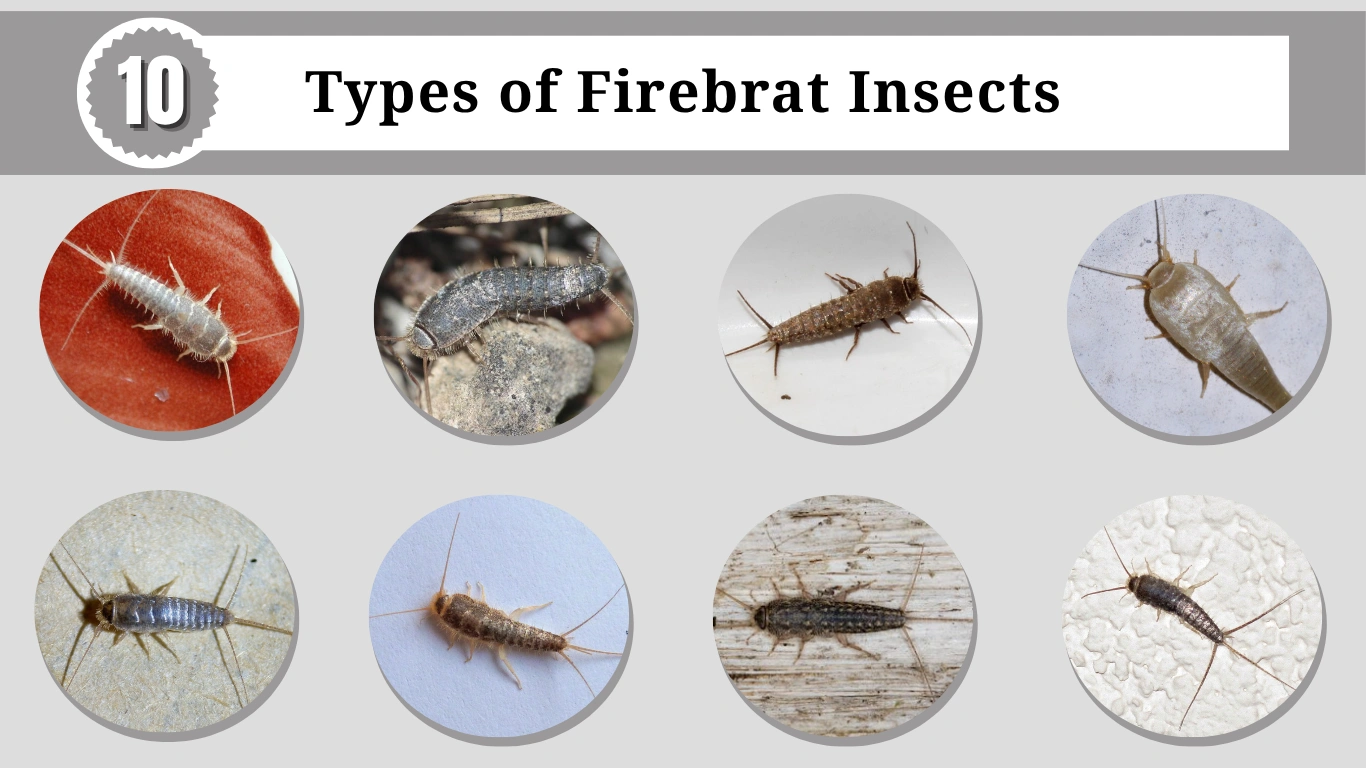
Firebrats are small, wingless insects related to silverfish, known for their heat-loving nature and rapid movements. They thrive in warm, humid places such as kitchens, basements, and near furnaces. Despite their tiny size, these insects exhibit diverse physical traits and habitats across species. This guide explores 10 fascinating types of firebrat insects, detailing their identification, habitats, behaviors, diets, and lifecycles.
1. Thermobia domestica

The Thermobia domestica, commonly known as the firebrat, is a small, heat-loving insect often found near warm, humid environments like furnaces, boilers, and kitchens. Recognized as one of the oldest primitive insects, firebrats are closely related to silverfish but prefer higher temperatures for survival and reproduction.
Identification
- Slender, carrot-shaped body
- Covered in fine, grayish-brown scales with darker mottled patches
- Long antennae and three tail-like appendages (cerci)
- Typically measures around 1 to 1.5 cm in length
- Fast-moving and nocturnal
Habitat
Firebrats thrive in warm, moist areas, often found near heating ducts, ovens, and hot-water pipes. They prefer temperatures above 32°C (90°F) and can survive in attics, basements, and industrial buildings where warmth is consistent.
Behaviors
These insects are nocturnal and avoid light. They move quickly across surfaces and can live in colonies. Firebrats are resilient and can survive for long periods without food, though they rely on humid environments to maintain their body moisture.
Diet
Firebrats feed on carbohydrates and proteins found in paper, book bindings, linen, and starchy materials like cereal and glue. They may also consume dead insects and fungal growth, making them opportunistic feeders within their environment.
Lifecycle
Their lifecycle includes egg, nymph, and adult stages. Eggs hatch in about two weeks under warm conditions. Nymphs resemble smaller adults and molt several times before maturity. Firebrats can live up to three years, reproducing rapidly in warm, undisturbed areas.
2. Ctenolepisma longicaudata

The Ctenolepisma longicaudata, also known as the gray silverfish or long-tailed silverfish, is a common household insect similar to the firebrat. It thrives in cooler environments than Thermobia domestica and is known for its elongated body and silvery scales, which give it a metallic appearance.
Identification
- Elongated, flattened body with fine silver-gray scales
- Distinct long antennae and three rear bristles
- Average length of 1–1.5 cm
- Body tapers toward the tail, giving a fish-like appearance
- Quick and elusive, often seen darting away when disturbed
Habitat
This species prefers dark, humid spaces such as basements, bathrooms, and behind walls or baseboards. Unlike firebrats, they can survive in slightly cooler conditions but still avoid dry areas with low humidity.
Behaviors
Ctenolepisma longicaudata is nocturnal, avoiding daylight and remaining hidden during the day. It’s highly adaptable and can colonize both residential and commercial buildings, especially in old paper archives or storage areas.
Diet
It feeds on starchy and protein-rich materials, including paper, glue, fabric, and food crumbs. This insect’s ability to digest cellulose makes it a persistent pest in libraries and museums.
Lifecycle
Eggs hatch within several weeks, depending on temperature and humidity. The nymphs molt multiple times before reaching adulthood, and adults continue molting throughout life. With optimal conditions, the gray silverfish can live up to 8 years.
3. Ctenolepisma lineata

The Ctenolepisma lineata, also known as the four-lined silverfish or lined silverfish, is a small, wingless insect characterized by its distinct striped body pattern. It is commonly found in warm, dry regions and occasionally invades homes, particularly attics or storage areas with paper or fabric materials.
Identification
- Flattened body with four dark longitudinal stripes on its back
- Covered in fine, shiny scales giving a silvery sheen
- Length ranges between 1–1.3 cm
- Long antennae and three tail filaments
- Quick movements when disturbed
Habitat
Ctenolepisma lineata prefers dry, warm environments, often inhabiting roof voids, under insulation, and within cracks in wooden structures. Unlike other silverfish, it tolerates lower humidity and can thrive in older, dry buildings.
Behaviors
This species is secretive and nocturnal, emerging at night to feed. It avoids light and can live for long periods without food. Their population can go unnoticed for years due to their preference for undisturbed areas.
Diet
They feed primarily on carbohydrates and proteins from paper, textiles, book bindings, and dead insects. They are known to damage stored items like wallpaper, fabrics, and old documents.
Lifecycle
Eggs hatch within several weeks, depending on temperature. Nymphs go through multiple molts before reaching adulthood, continuing to molt even afterward. With favorable conditions, the species can live for up to five years.
4. Ctenolepisma villosa

The Ctenolepisma villosa, or hairy silverfish, is a distinctive member of the Lepismatidae family. Recognized by its dense covering of hair-like scales, this insect is commonly found in warmer climates and is well-adapted to both natural and indoor habitats.
Identification
- Body length of 1–1.5 cm
- Densely covered with long, bristly scales
- Silvery-gray coloration with a slightly brown tint
- Possesses long antennae and three caudal filaments
- Moves rapidly when disturbed
Habitat
Ctenolepisma villosa lives in warm, sheltered places such as beneath bark, in cracks of rocks, and occasionally in homes. Indoors, they inhabit basements, attics, and behind furniture where temperature and humidity remain stable.
Behaviors
They are nocturnal and extremely shy, preferring to stay hidden during the day. Their hairy body helps them detect vibrations and sense danger. They tend to live solitarily but can appear in small clusters when food sources are abundant.
Diet
This species feeds on organic matter, paper, cotton, and stored food products containing starch. They can also consume dead insects, contributing to their survival in nutrient-poor environments.
Lifecycle
Eggs are deposited in secluded areas, and development to adulthood takes several months. The hairy silverfish undergoes continuous molting, allowing it to live several years, especially in warm indoor environments.
5. Ctenolepisma targionii

The Ctenolepisma targionii, also known as the Targioni silverfish, is a small, wingless insect closely related to the common silverfish. It is recognized by its subtle body coloration and adaptability to both indoor and outdoor environments, especially in warmer regions.
Identification
- Body length of 1–1.2 cm
- Light gray or brownish scales covering the body
- Long antennae and three prominent tail filaments
- Slightly tapered body with smooth texture
- Moves swiftly and avoids light
Habitat
Ctenolepisma targionii prefers dry, warm habitats such as under rocks, bark, or in stored paper materials. Indoors, it can be found near baseboards, attics, and wall crevices, thriving in moderately humid spaces.
Behaviors
This species is nocturnal, spending the day hidden in narrow spaces. It’s highly adaptable, often relocating toward warmth or food sources. Its quick movement and camouflage make it difficult to detect.
Diet
Feeds on starchy materials, cellulose, and organic debris. It is known to damage books, wallpapers, and stored grains if infestations occur indoors.
Lifecycle
Eggs hatch within two to three weeks under warm conditions. Nymphs molt several times before reaching adulthood, and adults continue molting throughout their life, which can span up to 4 years.
6. Ctenolepisma urbana

The Ctenolepisma urbana, commonly called the urban silverfish, is a cosmopolitan pest often associated with residential and commercial buildings. This species has adapted perfectly to indoor living, surviving in a range of environmental conditions.
Identification
- Length between 1–1.5 cm
- Covered in silvery-gray scales
- Long antennae and three rear filaments
- Streamlined, flattened body resembling a teardrop shape
- Moves quickly, especially in dark spaces
Habitat
As the name suggests, Ctenolepisma urbana thrives in urban environments. It prefers basements, bathrooms, and kitchens where humidity levels remain moderate. They often hide under flooring, wallpaper, or insulation.
Behaviors
This insect is nocturnal and secretive, emerging at night to forage. It is known for its resilience, surviving months without food and tolerating mild variations in humidity.
Diet
Feeds on starchy and protein-rich materials such as books, cardboard, wallpaper glue, and fabrics. It occasionally consumes food crumbs and dead insects when available.
Lifecycle
The urban silverfish lays eggs in protected areas. Development to maturity takes several months, with continuous molting throughout life. Adults can live for up to 5 years under stable indoor conditions.
7. Ctenolepisma ciliata

The Ctenolepisma ciliata, or fringed silverfish, is a distinctive species identified by its long body and fringe-like setae along the edges. It is often found in natural outdoor habitats but can adapt to indoor spaces, especially in warm and dry environments.
Identification
- Body length around 1–1.3 cm
- Covered with silvery-gray scales and long, fine bristles
- Possesses long antennae and three tail appendages
- Flattened, elongated body with a shiny appearance
- Moves swiftly when disturbed
Habitat
Ctenolepisma ciliata commonly resides under bark, stones, or within leaf litter. Indoors, it may inhabit attics, dry basements, and wall voids. It thrives in low-moisture environments, making it more tolerant of dryness than many related species.
Behaviors
This insect is nocturnal and sensitive to vibrations. It typically remains hidden during daylight hours and becomes active at night, searching for food or mates. Populations are generally small but persistent once established.
Diet
Feeds on starches, sugars, and organic debris. Indoors, it consumes paper, fabrics, and adhesive residues from wallpaper or book bindings. Outdoors, it survives on decaying plant matter and fungi.
Lifecycle
Eggs hatch in a few weeks, and the nymphs molt numerous times before adulthood. Continuous molting allows it to grow slowly but steadily, with adults living several years under optimal conditions.
8. Ctenolepisma michaelseni

The Ctenolepisma michaelseni, also known as Michaelsen’s silverfish, is a lesser-known but widespread species found in both natural and man-made environments. It is recognized for its subtle coloration and adaptability to various temperatures.
Identification
- Measures 1–1.5 cm in length
- Body covered in light silver to brownish scales
- Three long, tail-like appendages and long antennae
- Smooth, tapering body
- Quick and elusive movements
Habitat
This species thrives in semi-humid areas such as basements, storage rooms, and under floorboards. Outdoors, it can be found beneath stones, decaying logs, or in leaf litter. It tolerates moderate humidity and a broad temperature range.
Behaviors
Ctenolepisma michaelseni is nocturnal and cautious, preferring secluded locations. It is not aggressive and often coexists with other silverfish species without competition for food.
Diet
Feeds on starchy materials, old paper, dead insects, and food particles. It can also digest cellulose, making it capable of damaging stored documents and textiles.
Lifecycle
Eggs hatch within two to three weeks, and the young molt multiple times before maturing. Adults continue molting throughout life, with lifespans extending up to 4–6 years in stable indoor environments.
9. Ctenolepisma almeriensis

The Ctenolepisma almeriensis, or Almería silverfish, is a rare species primarily found in southern European regions. It is known for its subtle coloration and adaptability to both outdoor and indoor habitats. This species has gained attention for its preference for drier, warmer climates and its resilience to environmental changes.
Identification
- Length around 1–1.2 cm
- Body covered in fine, pale gray to brown scales
- Long antennae and three distinct tail filaments
- Smooth, elongated body shape
- Moves rapidly when threatened
Habitat
Ctenolepisma almeriensis thrives in warm, arid environments such as attics, storage rooms, and wall voids. Outdoors, it shelters beneath stones or dry vegetation. It tolerates dry heat better than many other silverfish species.
Behaviors
This insect is nocturnal, seeking shelter during the day. It is sensitive to vibrations and light, remaining hidden in cracks and crevices. Populations grow slowly, often unnoticed until infestation signs appear.
Diet
Feeds mainly on starchy materials, paper, cardboard, and dried organic matter. It can survive on minimal food sources, including glue and dead insects.
Lifecycle
Eggs hatch after several weeks depending on temperature and humidity. Nymphs molt multiple times before reaching adulthood. Adults continue to molt throughout their lifespan, living 3–5 years in ideal conditions.
10. Ctenolepisma fumosum

The Ctenolepisma fumosum, commonly known as the smoky silverfish, is a dark-colored species notable for its smoky-gray appearance. It prefers warm, sheltered environments and is often encountered in domestic settings with consistent humidity and warmth.
Identification
- Length between 1–1.4 cm
- Covered in dark gray or smoky-brown scales
- Three rear filaments and long, segmented antennae
- Flattened, oval-shaped body
- Fast-moving and light-averse
Habitat
Ctenolepisma fumosum is found in warm, humid environments such as bathrooms, laundry areas, and basements. Outdoors, it may live under stones, bark, or debris where moisture is retained.
Behaviors
This species is nocturnal, hiding during the day and becoming active at night. It is highly resilient and capable of surviving for months without food. It tends to form small, hidden colonies in quiet, undisturbed areas.
Diet
Feeds on organic matter, including paper, starch, and food residues. It can digest cellulose and glue, leading to potential damage in books and stored materials.
Lifecycle
Eggs hatch in 2–4 weeks under warm, moist conditions. Nymphs undergo several molts before adulthood, and adults continue molting throughout their lifespan, which may reach up to 6 years.