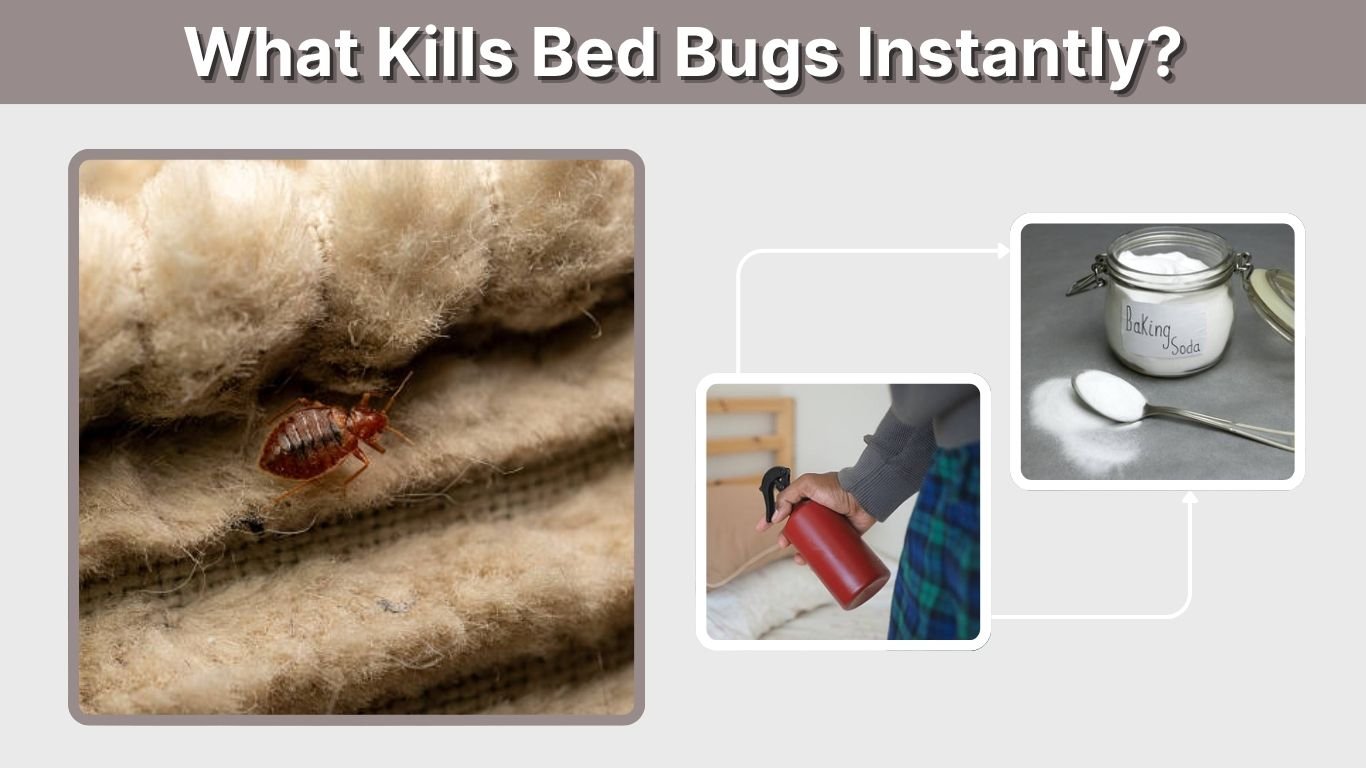
Bed bugs are persistent household pests that hide in mattresses, furniture, and narrow cracks, making them difficult to eliminate. If you discover an infestation, you may wonder what kills bed bugs instantly and whether common home remedies actually work. High heat, direct steam, and certain approved insecticides can kill exposed bed bugs quickly. However, eliminating an entire infestation requires additional treatment. This guide explains seven effective methods, the temperatures needed to kill bed bugs, and how to prevent them from returning.
What Kills Bed Bugs Instantly?
High heat and properly applied steam are among the fastest reliable ways to kill bed bugs. Some registered contact insecticides can also kill exposed insects quickly, although their effectiveness varies. Vacuuming removes visible insects immediately but does not necessarily kill them. No single household remedy can guarantee instant elimination of every bed bug and egg.
| Treatment | How Quickly It Works | Kills Eggs? |
| Hot steam | Seconds with sufficient direct exposure | Yes |
| Clothes dryer | 30 minutes on high heat | Yes |
| Professional heat treatment | Several hours for full treatment | Yes |
| Portable heat chamber | Depends on equipment and load | Yes |
| Bed bug contact spray | Varies by product | Depends on label |
| Vacuuming | Removes visible insects immediately | May remove some |
| Freezing | Several days | Yes, if correctly performed |
7 Effective Methods to Kill Bed Bugs Quickly
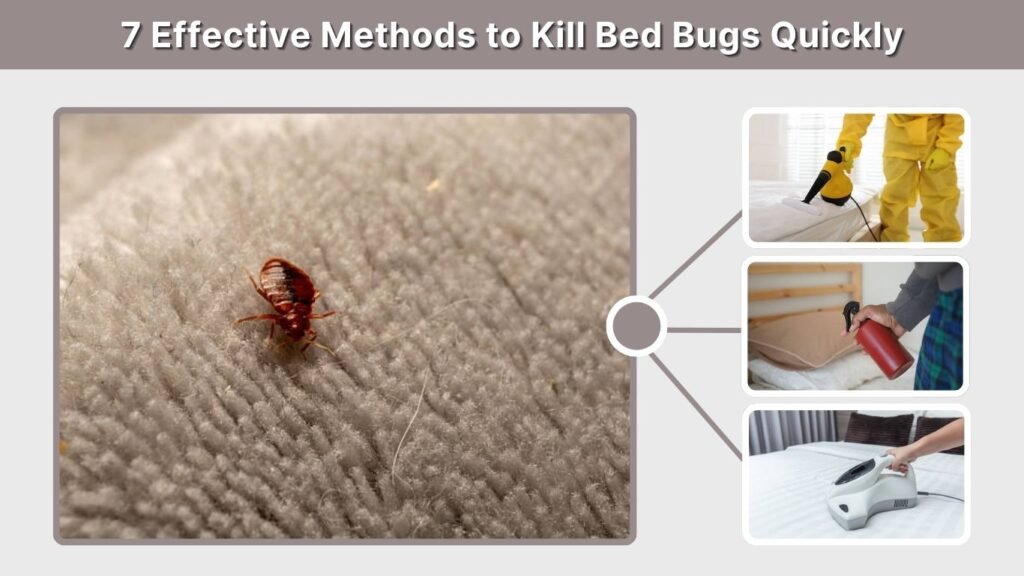
Bed bugs can survive in tiny hiding places, making ordinary household cleaning insufficient. Effective treatment requires reaching the insects directly or exposing them to temperatures they cannot survive. Some techniques work within seconds, while others require sustained exposure. These seven methods can help control bed bugs, although not all provide instantaneous results or complete infestation elimination.
1. Hot Steam Treatment
Steam is one of the fastest nonchemical ways to kill bed bugs and their eggs. When sufficiently hot steam reaches the insects directly, it can kill them within seconds.
Professional guidance recommends steam temperatures of at least 130°F (54°C), with treated surface temperatures around 160–180°F (71–82°C) often recommended.
Steam is particularly useful for mattress seams, upholstered furniture, bed frames, and accessible cracks.
Move the steamer slowly, use a diffuser to avoid scattering insects, and avoid electrical outlets. Steam cannot reliably destroy insects hidden beyond its heat penetration.
2. Clothes Dryer on High Heat
A clothes dryer is an effective solution for bed bugs hiding in washable fabrics, clothing, and bedding.
According to the EPA, placing suitable items in a dryer on high heat for 30 minutes can kill bed bugs and eggs. Washing alone may not eliminate every insect.
Avoid overloading the dryer, and make sure the fabric can tolerate the selected temperature. After drying, store treated clothing in clean, sealed bags to prevent reinfestation.
3. Professional Heat Treatment
Professional heat treatment raises temperatures throughout infested spaces using specialized equipment.
EPA guidance identifies 120°F (49°C) for at least 90 minutes as an effective exposure for killing bed bugs and eggs, once the affected areas reach that temperature.
Actual professional treatments take longer because heat must penetrate furniture, walls, and other hiding places.
This approach is especially useful for substantial infestations. However, increasing your household thermostat or using ordinary space heaters is not a safe substitute.
4. Portable Heat Chambers
Portable heat chambers provide controlled temperatures for treating infested belongings that cannot go into a clothes dryer.
Depending on the equipment, they can treat luggage, shoes, books, and other heat-tolerant objects.
The treatment time depends on the manufacturer’s instructions, the amount of material inside, and how quickly the objects reach the required temperature.
These devices are not instantaneous, but they can kill both adult bed bugs and eggs when operated correctly.
5. EPA-Registered Bed Bug Contact Sprays
Certain registered bed bug sprays can kill insects relatively quickly when applied directly according to their labels.
Products containing pyrethrins or other approved active ingredients may provide rapid knockdown. However, some bed bug populations have developed resistance to common insecticides.
The effectiveness of sprays depends on their ingredients, application method, and the insects’ exposure.
Choose a registered product specifically labeled for bed bugs. Never apply pesticides to your skin, clothing, or bedding unless the label expressly permits that application.
6. Vacuuming Bed Bugs
Vacuuming immediately removes accessible bed bugs from mattresses, carpets, furniture, and bed frames.
A crevice attachment helps reach narrow spaces where insects hide during daylight hours.
Although vacuuming is not an instant killing method, it can quickly reduce the number of visible insects.
Immediately seal the vacuum contents in a plastic bag and dispose of them outdoors. Repeat cleaning and combine vacuuming with other treatments because eggs and hidden insects may remain.
7. Freezing Infested Items
Freezing can kill bed bugs and eggs, but it does not work instantly.
Some guidance recommends maintaining temperatures at 0°F (-18°C) or colder for at least four days, ensuring the entire item reaches the required temperature.
This method may be appropriate for selected small belongings. However, ordinary household freezers can fluctuate, so temperature monitoring is important.
Leaving furniture outside during cold weather is not a reliable substitute for controlled freezing.
What Temperature Kills Bed Bugs Instantly?
Temperature plays an important role in bed bug survival. Extreme heat can destroy insects rapidly, but effectiveness depends on exposure duration and whether heat penetrates their hiding places. Bed bug eggs may require longer exposure than adults at lower temperatures. For reliable results, it is important to distinguish laboratory killing temperatures from practical household treatment recommendations.
What Heat Kills Bed Bugs Instantly?
Temperatures around 122°F (50°C) can kill bed bugs very rapidly under controlled direct exposure, but this does not mean briefly heating room air to that temperature will eliminate an infestation.
For practical whole-area heat treatment, the EPA recommends at least 120°F (49°C) for 90 minutes to ensure eggs are killed. Higher temperatures generally shorten the required exposure.
Does Cold Kill Bed Bugs Instantly?
Cold temperatures can kill bed bugs, but ordinary freezing is significantly slower than direct heat.
Temperatures near 0°F (-18°C) generally require several days of exposure. Bed bugs may also become inactive in cold conditions without immediately dying.
For fast household treatment, high heat is usually more practical than freezing.
What Kills Bed Bugs Instantly? Home Remedies Explained
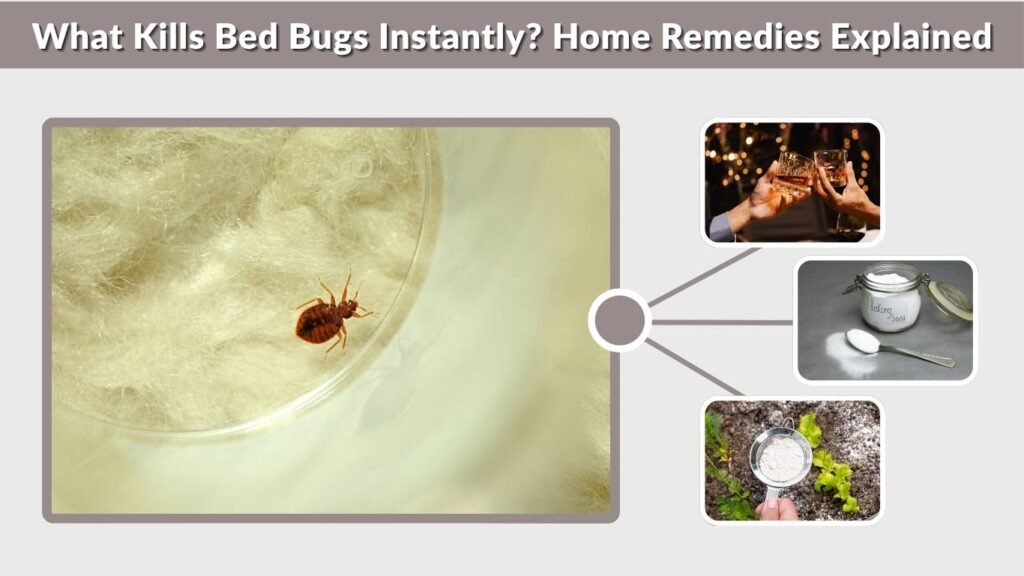
Many homeowners search for natural bed bug treatments because commercial insecticides can be expensive or require professional application. Vinegar, baking soda, essential oils, and rubbing alcohol are frequently recommended online. However, not every substance that affects an exposed insect can eliminate an infestation. Some household chemicals also introduce serious health and fire hazards.
Does Vinegar Kill Bed Bugs Instantly?
Vinegar is not a reliable bed bug treatment. Direct exposure may harm some insects, but there is insufficient evidence that household vinegar consistently kills bed bugs or their eggs.
Its odor does not provide dependable protection, and spraying vinegar around furniture will not eliminate hidden colonies.
Does Baking Soda Kill Bed Bugs?
Baking soda does not have convincing scientific evidence supporting it as an effective bed bug killer.
Claims that baking soda instantly dehydrates bed bugs are unsupported.
Sprinkling it around mattresses or furniture is unlikely to resolve an infestation and may delay more effective treatment.
Does Rubbing Alcohol Kill Bed Bugs?
Rubbing alcohol can kill some bed bugs through direct contact, but it is dangerous to use as a household pesticide.
It evaporates quickly, offers no dependable residual control, and is highly flammable.
The EPA warns that using rubbing alcohol for bed bug control has caused household fires. Avoid this method.
What Smell Kills Bed Bugs Instantly?
No household scent has been reliably demonstrated to kill bed bugs instantly.
Peppermint, lavender, tea tree oil, eucalyptus, and other essential oils are sometimes promoted as natural solutions.
However, their odors do not reliably kill hidden insects or eggs. Essential oils can also irritate skin, harm pets, or damage household materials.
Does Diatomaceous Earth Kill Bed Bugs Instantly?
Diatomaceous earth works by damaging the insect’s protective outer layer, eventually causing dehydration.
It does not kill immediately and may require days or weeks of adequate exposure.
Only EPA-registered pesticide formulations labeled for bed bugs should be used, following their application and inhalation precautions.
What Kills Bed Bugs Instantly and Permanently?
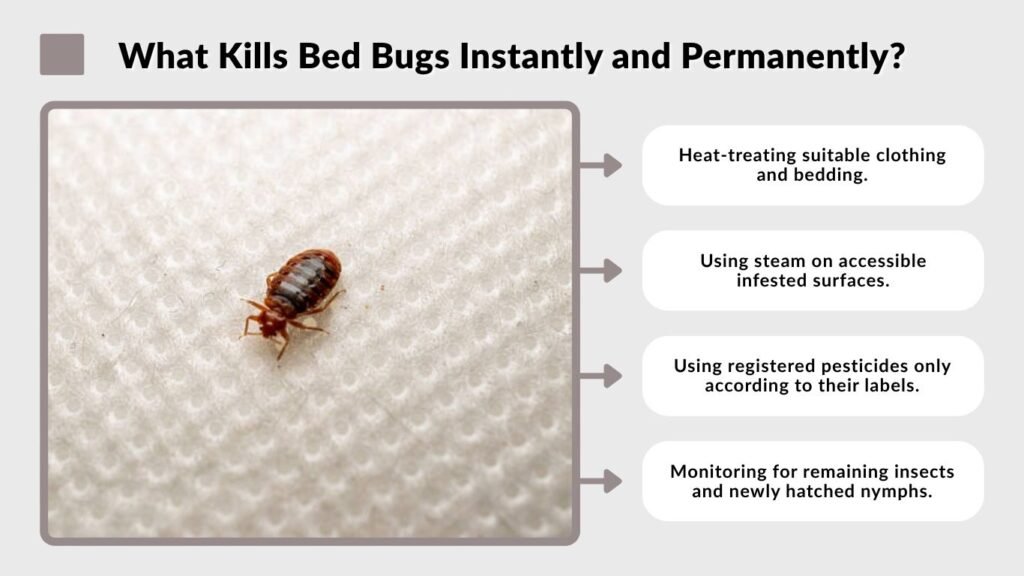
Killing a visible bed bug does not mean the entire infestation has disappeared. Bed bugs often hide behind headboards, within mattress seams, and in furniture joints. Their eggs can survive incomplete treatments and produce new insects later. Long-term elimination therefore requires a combination of methods that target both visible and hidden populations.
Combine Multiple Treatment Methods
An effective bed bug control strategy typically includes:
- Inspecting mattresses, furniture, and surrounding hiding places.
- Heat-treating suitable clothing and bedding.
- Using steam on accessible infested surfaces.
- Vacuuming visible insects and disposing of the contents securely.
- Installing bed bug-proof mattress and box spring encasements.
- Using registered pesticides only according to their labels.
- Monitoring for remaining insects and newly hatched nymphs.
Professional pest-control services may be necessary for extensive or recurring infestations.
Prevent Bed Bugs From Returning
Continue checking bed frames, mattress seams, and surrounding furniture after treatment.
Reduce clutter, seal appropriate cracks, and inspect secondhand furniture before bringing it indoors.
Bed bug interceptors beneath bed legs can help detect ongoing activity.
Successful control requires follow-up because even a small surviving population can establish another infestation.
FAQs
1. What kills bed bugs and their eggs instantly?
Properly applied high-temperature steam can rapidly kill exposed bed bugs and eggs when sufficient heat reaches them. Professional heat treatments and clothes dryers are also effective, although they require sustained exposure. No treatment guarantees instantaneous elimination of insects and eggs hidden throughout an entire home.
2. What is the best homemade bed bug killer?
High heat is generally the most reliable household approach. Drying suitable clothing and bedding on high heat for 30 minutes can kill bed bugs and eggs. A suitable steamer can treat accessible furniture surfaces. Vinegar, baking soda, and essential oil mixtures are not dependable substitutes.
3. Can I get rid of bed bugs overnight?
You may kill many exposed bed bugs overnight using appropriate heat treatment, but complete elimination cannot be guaranteed. Hidden insects and surviving eggs can cause continued activity. Thorough inspection, targeted treatment, and follow-up monitoring are necessary before considering an infestation eradicated.
4. What kills bed bugs instantly on skin?
Do not apply insecticides, rubbing alcohol, bleach, or essential oil mixtures to your skin to kill bed bugs. If you find a bed bug crawling on your body, remove it and wash normally with soap and water. Bed bugs generally do not live on human skin.
5. What spray kills bed bugs instantly?
Some EPA-registered contact sprays provide rapid knockdown when they reach susceptible bed bugs directly. However, no spray guarantees instant death or complete infestation elimination. Product effectiveness varies, and resistance can reduce results. Always choose a bed bug-labeled pesticide and follow all safety and application instructions.