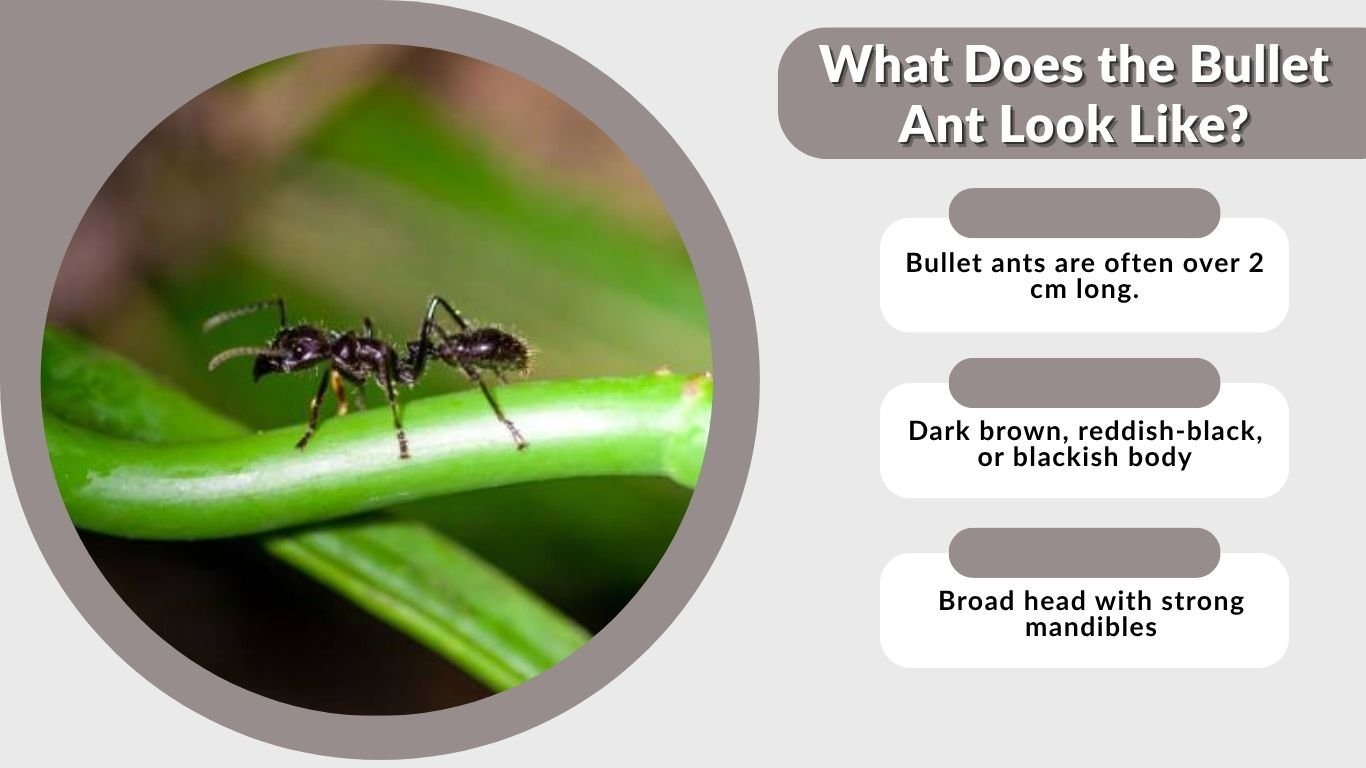
The bullet ant is one of the most recognizable ants in the tropical Americas because of its large size, dark body, long legs, and wasp-like build. Scientifically known as Paraponera clavata, it lives mainly in humid lowland rainforests of Central and South America. Although it is famous for its painful sting, its appearance is just as important for identification: this ant looks heavy, glossy, hairy, and powerful compared with most common household ants.
Quick Bullet Ant Identification
A bullet ant does not look like a small kitchen ant. It is a large tropical ant with a strong body, dark reddish-black coloring, long legs, and a noticeable stinger. Workers are usually about 18–30 mm long, making them far larger than most ants people see around homes or gardens.
| Feature | What to Look For |
| Size | Very large, usually 18–30 mm long |
| Color | Dark brown, reddish-black, or nearly black |
| Body shape | Thick, wasp-like, muscular body |
| Legs | Long, strong, and spiny-looking |
| Head | Large, broad, and powerful |
| Antennae | Long, elbowed, and dark |
| Stinger | Present at the end of the abdomen |
| Habitat clue | Tropical rainforest, often near tree bases |
Bullet Ant Size
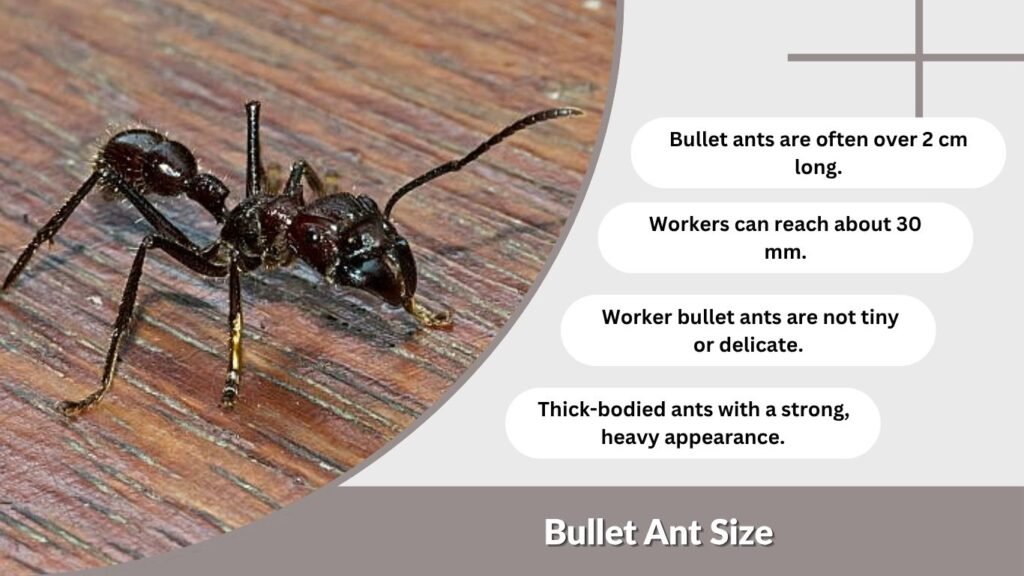
The first thing most people notice is size. Bullet ants are often over 2 cm long, and workers can reach about 30 mm. That makes them look more like a small wasp without wings than a typical ant. AntWiki describes Paraponera clavata as a very large ant of the New World tropics, usually over 2 cm long.
Worker Size
Worker bullet ants are not tiny or delicate. They are long, thick-bodied ants with a strong, heavy appearance. A full-sized worker may be about the length of a large paperclip. Because they are so large, individual body parts—head, thorax, waist, and abdomen—are easy to see without magnification.
Queen Size
Unlike some ant species where the queen is dramatically larger than the workers, bullet ant queens are not much bigger than workers. This makes worker identification especially important because most ants seen outside the nest are workers.
Bullet Ant Color and Body Texture
Bullet ants are usually dark brown to reddish-black. In bright light, some individuals may show a reddish or mahogany tone on the head and thorax, while others look almost black. Their body surface often appears glossy, tough, and slightly armored.
Color Pattern
A bullet ant is not brightly striped like a yellow jacket or patterned like some wasps. Its color is mostly dark and uniform. The head, thorax, legs, and abdomen are usually deep brown, blackish-brown, or reddish-black. Some photos show lighter brown tones on the legs or joints, but the overall appearance remains dark.
Hairy Surface
Look closely and the bullet ant appears covered with fine hairs. These hairs are especially visible on the head, legs, and abdomen. The body is not smooth like polished plastic; it has a rugged, textured surface that gives the ant a fierce, bristly look.
Head, Eyes, and Mandibles
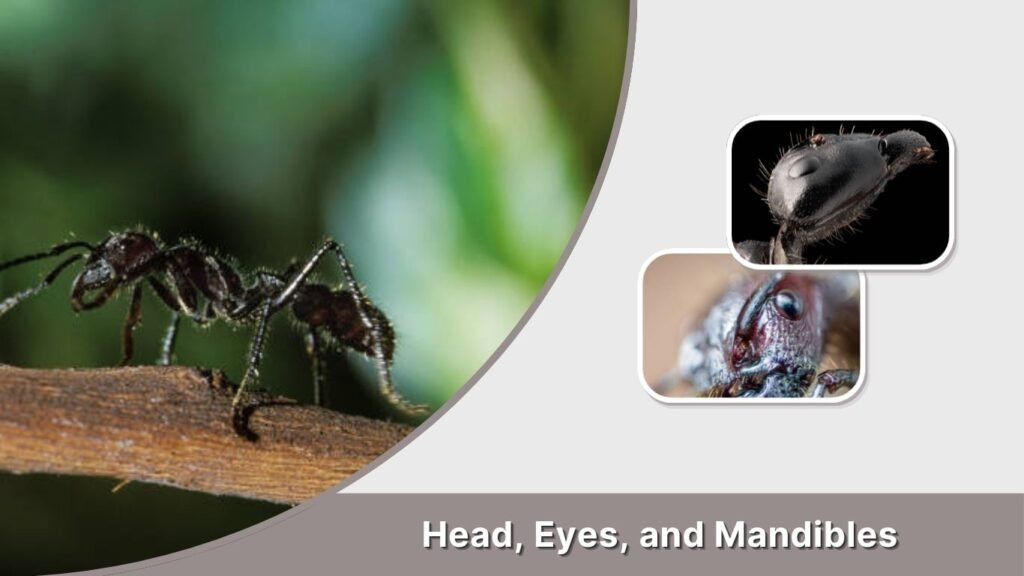
The bullet ant’s head is large and broad, giving it a powerful look from the front. Its head is one of the best identification points because it looks heavier and more wasp-like than the head of many smaller ants.
Head Shape
The head is wide and somewhat rounded, with a strong front section. From above, the head looks large compared with the narrow waist. This broad head helps support its strong mandibles and gives the ant a bold, predatory appearance.
Eyes
Bullet ants have visible compound eyes positioned on the sides of the head. The eyes are not huge like a fly’s, but they are clearly noticeable. In close-up photos, the eyes look dark, oval, and glossy.
Mandibles
The mandibles are strong, curved, and dark. They are used for gripping food, carrying materials, and defense. When viewed from the front, the mandibles make the ant look especially intimidating. The bullet ant can bite, but its sting is the feature that makes it most feared.
Legs, Antennae, and Abdomen
The bullet ant has long legs that lift its body clearly above the surface it walks on. This gives it a tall, alert posture. The antennae are also long and active, often held forward as the ant explores its surroundings.
Long Legs
The legs look strong and slightly spiny because of visible hairs and bristles. They are longer and more robust than the legs of many common ants. On leaves or tree trunks, a bullet ant can appear almost spider-like because of its long-legged stance.
Antennae
Like other ants, bullet ants have elbowed antennae. The antennae are long, dark, and flexible. They help the ant sense chemicals, surfaces, nestmates, and food sources.
Abdomen and Stinger
The rear body section, called the gaster, is rounded and dark. The stinger is at the tip of the abdomen. You may not always see the stinger clearly unless the ant is disturbed or viewed closely, but bullet ants are capable of delivering an extremely painful sting. Their venom includes poneratoxin, a neurotoxic peptide studied in scientific research.
Where You Are Most Likely to See Bullet Ants
Bullet ants are not common house ants. They are rainforest ants found in the wet Neotropical region. Their range includes parts of Central and South America, including countries such as Nicaragua, Costa Rica, Panama, Colombia, Ecuador, Peru, Bolivia, Brazil, and nearby regions.
Rainforest Habitat
Bullet ants are most associated with humid tropical forests. They often nest at the bases of trees and forage upward into vegetation. Workers may climb trunks, move across leaves, and search for nectar or small arthropods. Colonies are often linked with trees because the ants use the forest structure for foraging.
Nest Location
A bullet ant nest is commonly found near the base of a tree rather than in a dry open lawn. Workers may be seen moving around buttress roots, tree trunks, leaf litter, and low vegetation. If you are in a tropical rainforest and see a very large dark ant near tree roots, it deserves careful distance.
Bullet Ant vs Other Large Ants
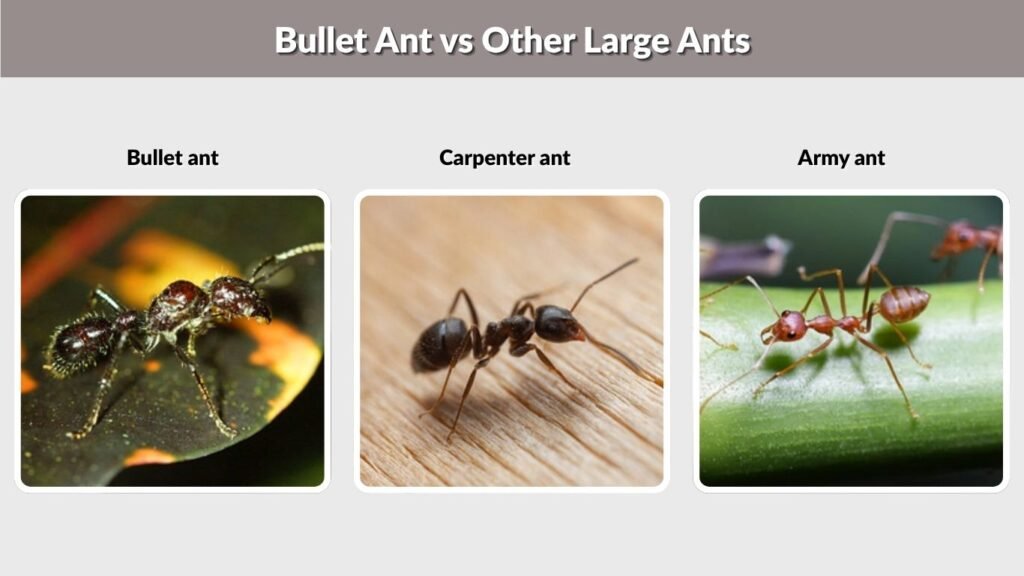
Bullet ants can be confused with other large tropical ants, but a few details help separate them. Their combination of very large size, dark reddish-black color, long legs, wasp-like body, and rainforest habitat is distinctive.
| Ant Type | Main Difference |
| Bullet ant | Very large, dark, long-legged, tropical rainforest species |
| Carpenter ant | Usually smaller, often found in wood or buildings, less wasp-like |
| Army ant | Often seen in moving trails or raids; body shape varies by species |
| Bull ant | Found mainly in Australia, with very large eyes and different range |
| Fire ant | Much smaller, reddish, often in mounds, common in open disturbed areas |
Is a Bullet Ant Easy to Identify?
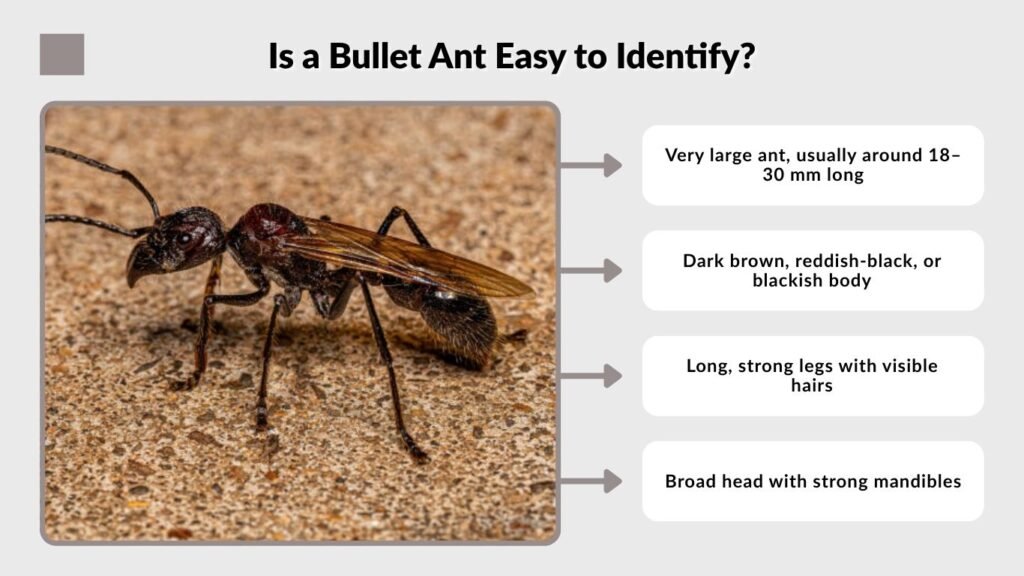
Yes, in its natural range, an adult bullet ant is usually easy to recognize if you know what to check. The most useful clues are size, dark color, long legs, strong head, and rainforest location. However, exact species confirmation can be difficult from a quick photo because many tropical ants are large and dark.
Best Identification Checklist
- Very large ant, usually around 18–30 mm long
- Dark brown, reddish-black, or blackish body
- Long, strong legs with visible hairs
- Broad head with strong mandibles
- Glossy, armored-looking body
- Found in humid tropical forest habitat
- Often seen near tree bases, trunks, or vegetation
- Wasp-like body but no wings on workers
Safety Note When Identifying Bullet Ants
Bullet ants are not usually aggressive without reason, but they defend their nests strongly. When threatened, they may produce warning behavior and sting with force. Their sting is famously ranked among the most painful insect stings and may cause intense pain for many hours.
Never handle a bullet ant for identification. Use a camera zoom, keep distance from nests, and avoid disturbing tree bases where workers are active. If someone is stung and has severe swelling, breathing trouble, dizziness, allergic symptoms, or unusual reactions, they should seek medical help quickly.
FAQs
What does a bullet ant look like?
A bullet ant looks like a very large, dark, wingless wasp-like ant. It has a reddish-black to black body, long legs, a broad head, strong mandibles, elbowed antennae, and a rounded abdomen with a stinger at the end.
How big is a bullet ant?
Worker bullet ants are usually about 18–30 mm long. This makes them much larger than common house ants. Their large size is one of the easiest ways to recognize them in tropical rainforest habitats.
What color is a bullet ant?
Most bullet ants are dark brown, reddish-black, or nearly black. Some individuals show a reddish shine on the head or thorax in bright light. The body usually looks glossy, tough, and slightly hairy.
Where do bullet ants live?
Bullet ants live in humid tropical rainforests of Central and South America. They are often found near tree bases, buttress roots, trunks, and vegetation. Workers may forage upward into the forest canopy.
Can you identify a bullet ant by its sting?
You should not use the sting for identification. A bullet ant is best identified by appearance, size, habitat, and behavior. Its sting is extremely painful, so observing from a safe distance is the best method.